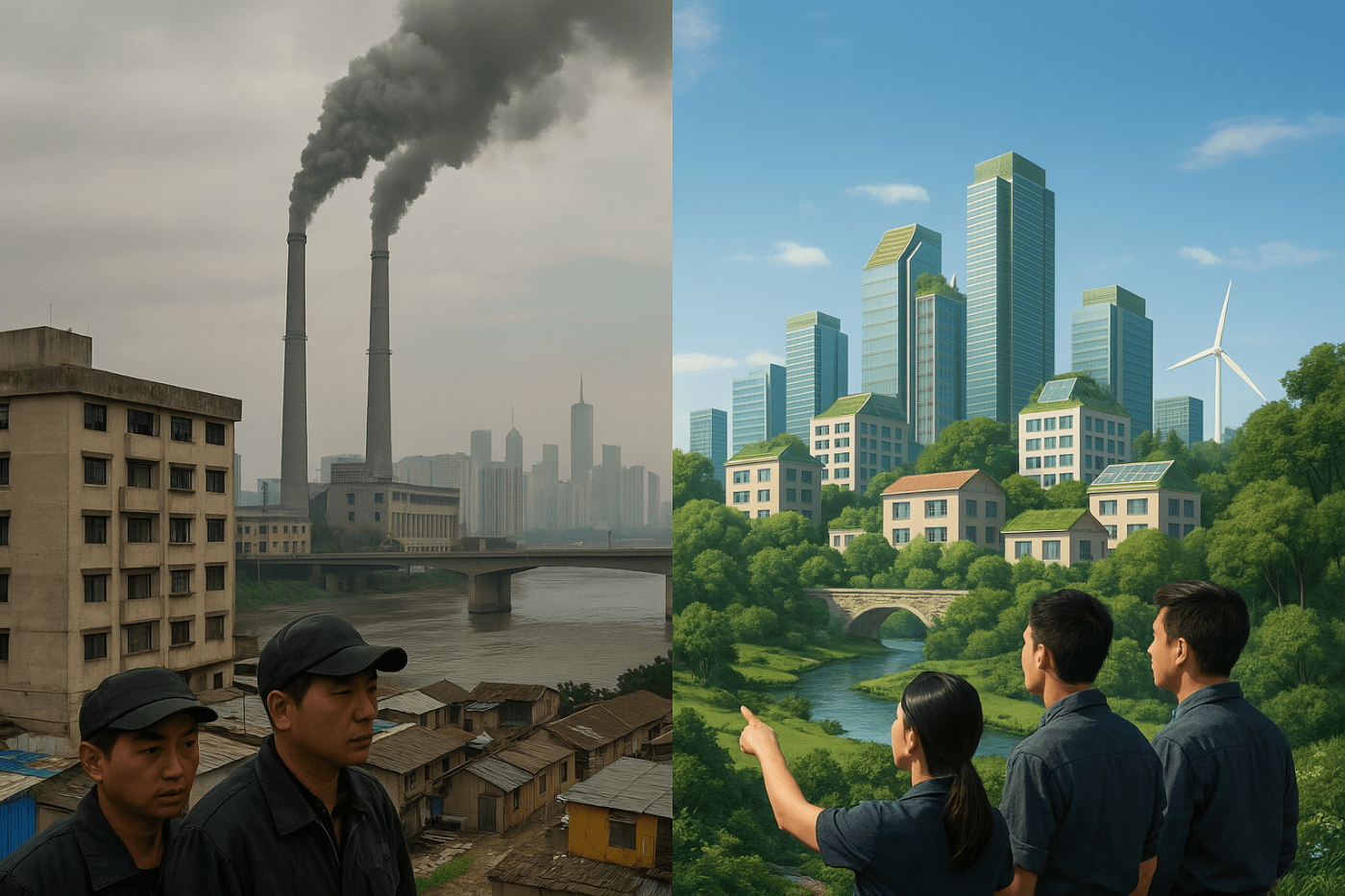
I. Where Capital Paved Over the Commune
In the Pearl River Delta (PRD), China’s revolutionary land meets its reform-era rupture. Once the periphery of Maoist developmentalism, the PRD became the launching pad of Deng Xiaoping’s Opening and Reform—home to Shenzhen, the first Special Economic Zone, and ground zero for China’s integration into global capital.
Today, the PRD is a sprawling industrial zone of hyper-urbanization and green contradictions: it hosts some of China’s most advanced eco-infrastructure projects, yet remains structurally tethered to exploitative labor, urban-rural inequality, and ecological enclosure. This case study explores the historical development of the PRD as a capitalist frontier within socialist China and asks what ecosocialist transformation might look like in two critical sites: Shenzhen and Foshan.
II. From Commune to Capitalist Zone: Historical Rupture and Structural Duality
The rural collectives of Guangdong—built on collective land ownership and mass mobilization—were rapidly displaced in the early 1980s by township and village enterprises (TVEs), export-processing zones, and urban land commodification. Lu Xinyu identifies this process as the emergence of the “market-led dual structure”: urban land under state ownership, rural land under collective ownership—but with vastly unequal access to capital, infrastructure, and rights (Lu, 2023, p. 27–35).
This institutional bifurcation fueled the urban boom while marginalizing the countryside. Migrant workers became the shock absorbers of accumulation: denied hukou, social benefits, and often political representation. As factories and skyscrapers rose, the soil of the commune was paved over—literally and symbolically.
III. Case Study A: Shenzhen — Eco-Technocracy or Socialist Urbanization?
Shenzhen stands as a monument to techno-utopian capitalism in China. Dubbed a “green city,” it boasts the world’s largest fleet of electric buses, LEED-certified skyscrapers, and smart city pilot zones. But its ecological veneer masks deep contradictions:
- Migrant workers—nearly 70% of Shenzhen’s population—live in informal housing, work in precarious industries, and face state surveillance.
- Urban villages, which once offered collective housing and social support, are demolished and replaced by finance-capital megaprojects.
- Collective land rights in surrounding areas are expropriated for urban expansion, often without democratic consent (Lu, p. 51–56).
The question for Shenzhen is not whether it can be green—but whether it can be just. An ecosocialist city would not rely on tech fixes or speculative green finance, but on decommodified land, migrant worker democracy, and reintegration with the ecological needs of surrounding rural zones.
IV. Case Study B: Foshan — Collective Land and the Fight for Rural Autonomy
Foshan represents a countercurrent. Though part of the PRD urban-industrial complex, it has retained strong elements of rural collective land control—especially in places like Nanhai District. Here, village collectives have resisted full land privatization and engaged in hybrid forms of collective urban development: building housing, managing industrial parks, and distributing profits back to residents.
However, these collective economic organizations are now increasingly being transformed into corporate entities—pushed by both local governments and capital interests. Lu Xinyu warns that this “neoliberalization of the collective” threatens to hollow out its socialist potential unless there is a conscious political effort to preserve community control (Lu, p. 63–66).
In Foshan, the terrain of ecosocialist struggle is legal and institutional: reclaiming collective ownership not just as a revenue mechanism, but as a political form—a base for ecological planning, cooperative production, and working-class empowerment.
V. Toward Ecosocialism in the PRD: A Revolutionary Synthesis
Ecosocialism in the PRD must confront not only environmental degradation but the structural violence of capitalist urbanization. That means:
- Abolishing the urban-rural dual structure through full political recognition of migrants and peasant laborers
- Democratizing land use by re-empowering collectives and curbing speculative real estate finance
- Integrating ecological corridors between cities and surrounding farmland through participatory planning
- Reclaiming urban villages as spaces for cooperative housing, culture, and ecological service work
- Building red-green federations that unite workers, farmers, and Party cadres around a vision of sustainable abundance
VI. Conclusion: The City Is a Class Battlefield
The Pearl River Delta is not just a zone of production. It is a terrain of contradiction. It shows that green urbanism without class struggle reproduces the same rifts—just with solar panels. But it also shows that the remnants of the socialist countryside, if protected and politicized, can be the seedbeds of a new urban-rural metabolism.
The struggle in Shenzhen and Foshan is not simply for cleaner air—it is for control over the means of ecological life. And that means bringing the commune back—not as nostalgia, but as the future of the city itself.
Primary source: Lu, Xinyu. Neoliberalism or Neocollective Rural China: A Critique and Prospect. Shanghai Jiaotong University Press, 2023.
 Weaponized Information
Leave a comment