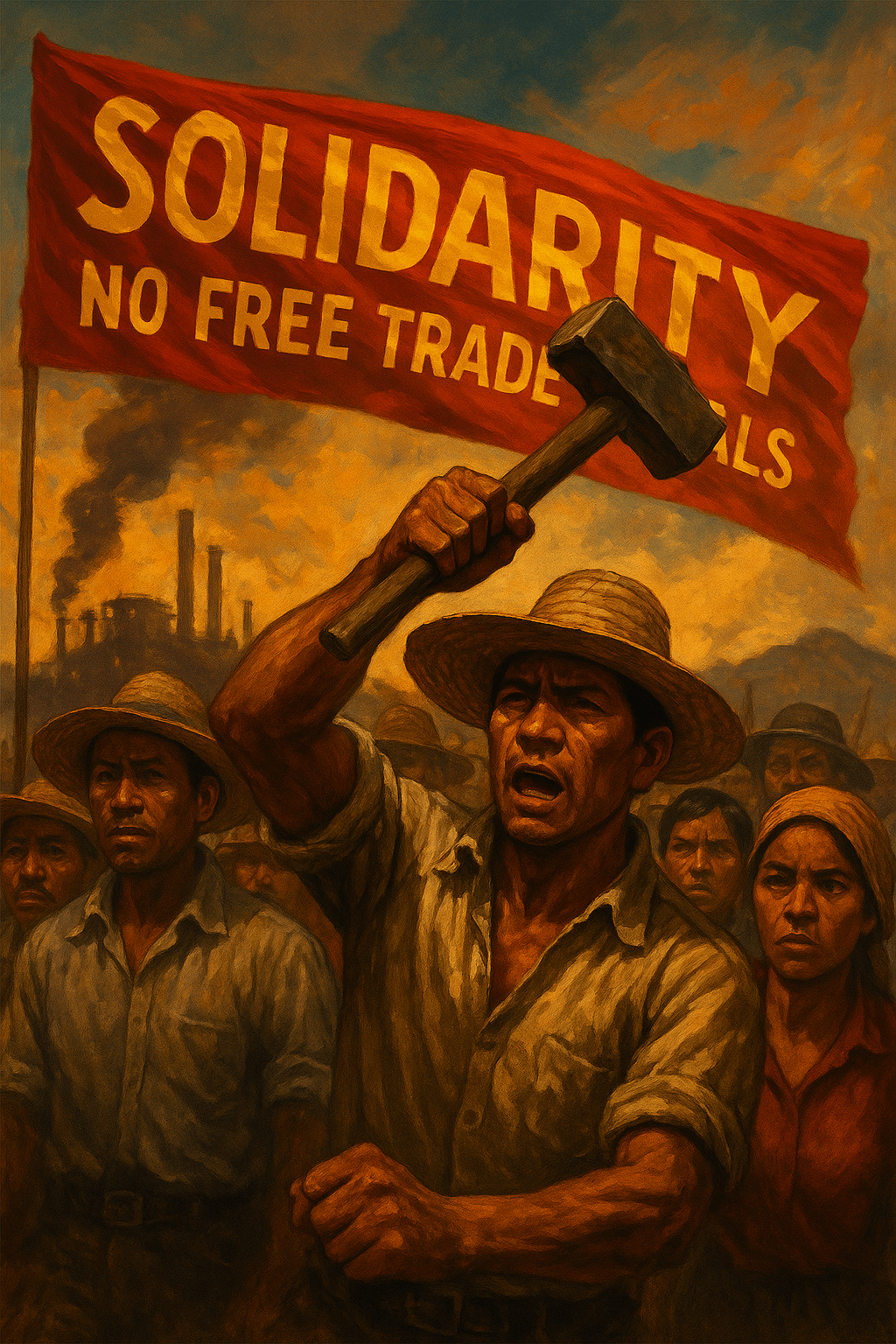
Trade Deals Are the Chains—Solidarity Is the Hammer
By Prince Kapone | Weaponized Information | May 8, 2025
Part I: Propaganda in a Pantsuit—How France 24 Sells Dependency as Diplomacy
You won’t find a byline on France 24’s May 7 dispatch about Mexican President Claudia Sheinbaum defending the USMCA. That’s because when it comes to matters of trade, empire speaks with one voice—anonymous, bureaucratic, and drenched in state propaganda. France 24 is no neutral outlet. It is a wholly owned subsidiary of the French government, a colonial media operation masquerading as international journalism. Like the BBC, it functions as the communications wing of NATO’s economic project: austerity with subtitles.
The article opens by framing Sheinbaum’s defense of the USMCA as pragmatic, even patriotic. “Mexico will defend the USMCA,” she is quoted as saying, calling it “one of the best trade agreements in history”—a line so perfectly recycled from Trump’s first term it could have been written by Stephen Miller’s economic ghostwriter. But there’s no analysis here, no class context, no memory. Just the regurgitation of talking points blessed by Wall Street and sanctified by Davos.
Sheinbaum is presented as a firm but fair negotiator, hoping for peace in Trump’s trade war, while quietly working around his tariffs on steel, aluminum, and autos. The article claims the USMCA has been “beneficial for all three countries,” yet offers no metrics, no data, no mention of the wage theft, union-busting, and forced migration the agreement has enabled. The entire framing depends on a fantasy: that Mexico, a semi-peripheral nation structurally dependent on U.S. capital, has agency in these negotiations. It does not. It has leverage only to the extent that U.S. capital allows it to serve as a cheap labor platform.
The real beneficiaries are hidden in plain sight. U.S. agribusiness, automakers, and supply chain monopolists who rely on maquiladora labor to suppress costs and externalize pollution. Mexican elites and technocrats—Sheinbaum now among them—who maintain the illusion of sovereignty while managing empire’s southern workshop. And, of course, the Trump regime itself, which uses tariffs not as policy but as a weapon of technofascist recalibration: a bludgeon to discipline allies, punish defiance, and reassert the imperial dollar.
France 24 doesn’t interrogate this structure because it is part of it. The outlet’s coverage normalizes economic dependency, recasts imperial treaties as “mutual benefit,” and whitewashes technocratic submission as “leadership.” This is propaganda by omission: not just of the history of NAFTA’s devastation of Mexican agriculture, but of the class war encoded in every clause of the USMCA.
In the imperial imagination, Sheinbaum is doing her duty—protecting market stability and trade continuity. But through a revolutionary lens, she’s acting as an administrator of dependency, reinforcing the very architecture of economic colonialism that Trump’s tariffs merely dramatize. And France 24 is here to clap politely and pretend it’s journalism.
Part II: Free Trade in Chains—The Material Truth Behind Sheinbaum’s USMCA Defense
Let’s start with the official story. According to the France 24 report, Mexican President Claudia Sheinbaum reaffirmed her commitment to the USMCA—the United States-Mexico-Canada Agreement—during a press conference on May 7. She described it as “one of the best trade agreements in history,” praised its role in boosting trilateral commerce, and reiterated its necessity in competing against Asian economies, especially China. She also noted that although Trump had slapped new tariffs on sectors like autos, steel, and aluminum, he had “left Mexico off the list” of general reciprocal tariffs, implying the USMCA is still functional.
On the surface, this sounds like standard trade diplomacy. But dig deeper and a different picture emerges: one of structural dependency, economic coercion, and managed subservience masquerading as sovereignty. Mexico now sends over 80% of its exports to the United States—making it, as of 2023, the U.S.’s largest trading partner. That’s not diversification. That’s hyper-dependence. It’s not a win. It’s a trap.
The USMCA, like NAFTA before it, is a mechanism of imperialist management. It legally binds Mexico into a set of investor-first rules that prevent genuine national development. It prohibits export taxes, limits state-owned enterprises, restricts environmental protections, and offers capital easy recourse to supranational tribunals. It is less a treaty between equals than a carceral framework for regulating Mexico’s subordinate position within the U.S. imperial supply chain.
This is not abstract. Since NAFTA’s passage in 1994, Mexico has seen over 5 million campesinos displaced from the land by subsidized U.S. corn imports. It has lost strategic industries like rail, mining, and electricity to transnational corporations. Labor standards were gutted. Real wages stagnated. And cross-border migration became a necessity—not a choice.
USMCA preserved and updated this framework, with new chapters on digital trade, intellectual property, and data colonialism—ensuring U.S. Big Tech’s domination over Mexico’s information infrastructure. It also strengthened protections for pharmaceutical monopolies and entrenched asymmetries in auto manufacturing by locking in North American content quotas that preserve U.S. control over supply chains.
What Trump’s tariffs really reveal is that these agreements are not protection against coercion—they are tools of coercion themselves. Trump can unilaterally impose duties because the system was designed to legalize economic warfare. These tariffs are not deviations from the “free trade order”—they are its naked face, stripped of euphemism. USMCA is the velvet glove. Trump’s tariffs are the iron fist.
Sheinbaum’s insistence that the deal be preserved shows the limits of Mexico’s political imagination under her administration. While she may represent a progressive shift in rhetoric, the continuity of structural subservience remains untouched. This is not “sovereignty.” It is imperialist equilibrium—calibrated to keep Mexico integrated into U.S. value chains while limiting any real movement toward South-South cooperation, sovereign industrialization, or socialist development.
This moment must be read dialectically. Mexico’s position as top trading partner reflects not success but crisis. China’s partial delinking from the U.S. forced capital to re-anchor itself in “nearshore” labor pools. Mexico became convenient—geographically close, politically pliable, and economically tethered. But this proximity has not empowered Mexico. It has deepened its entrapment.
Part III: Trade as a Trigger—How USMCA Locks Mexico Into Empire’s Supply Chain
Forget the polite fiction that Claudia Sheinbaum is negotiating Mexico’s “place” in a global economy. What’s happening is not negotiation—it’s reproduction. What the France 24 piece cannot admit is that the United States-Mexico-Canada Agreement (USMCA) is not a trade agreement. It is an instrument of imperialist recalibration—engineered to preserve U.S. domination in crisis by hardwiring Mexico’s economy to the needs of American capital.
The praise lavished on the USMCA by Sheinbaum is not accidental—it is ideological alignment. The same agreement that gutted labor rights and enshrined Big Tech’s supremacy is now being cast as a shield against Trump’s “reciprocal tariffs.” But this is strategic misdirection. The USMCA is not a defense against imperial coercion—it’s how that coercion is made legal. It does not protect Mexico—it disciplines it.
From a revolutionary perspective, the deal is a in economic form. It ensures that capital can move freely while labor stays trapped. It militarizes value chains with technocratic jargon. It gives cover to a geopolitical project: the containment of multipolarity through regional dependency. Mexico, in this context, is not a sovereign nation—it is a logistics node in the imperial supply chain, managed by a friendly administrator in a presidential sash.
And Sheinbaum, for all her progressive trappings, plays her role well. By defending the USMCA, she reinforces the false binary between Trump’s tariffs and Biden’s diplomacy—between punishment and partnership. But both sides of that coin are minted by empire. One hand imposes duties; the other hands you a contract. But the outcome is the same: the consolidation of U.S. control over Mexican industry, labor, and land.
We must reframe this entirely. What is being negotiated is not a trade deal—it’s a question of national orientation. Will Mexico continue as an appendage to collapsing U.S. hegemony? Or will it forge new alliances with the rising South: BRICS+, ALBA, CELAC? The USMCA traps Mexico in the former. But the world is shifting—and those who cling to the empire’s hand are already slipping toward the grave.
There is nothing inevitable about Mexico’s position. The contradiction is sharpening. As Trump doubles down on economic nationalism and trade war, Mexico must choose: be a permanent underling in a decaying imperial system, or rise with the multipolar tide. But no choice is possible within the ideological box that Sheinbaum defends. That box is the USMCA. And it is lined with chains.
Part IV: Tear Up the Treaty—Toward a New Internationalism from Below
The U.S. empire doesn’t export freedom—it exports frameworks. NAFTA was one. USMCA is its mutated offspring. And behind every clause, tariff, and “rules-of-origin” metric lies the same colonial logic: extract value, suppress sovereignty, and tighten the noose. But no treaty is unbreakable. The people have always been the counter-signatories—the ones who tear up what their rulers ratify.
There is precedent. In 2019, when the Trump regime tried to hand Venezuela’s Washington embassy to Juan Guaidó’s illegitimate puppet government, activists with CODEPINK, the Embassy Protection Collective, and solidarity organizers from Black Alliance for Peace and ANSWER Coalition physically occupied the embassy for over a month. They faced raids, food blockades, and police repression—but they held the line. That’s what solidarity looks like: not a tweet, but a barricade.
So what does resistance look like now, as Trump 2.0 tightens the USMCA trap and Mexico’s political leadership clings to a dying empire’s coattails?
- Disrupt the supply chain: From Laredo to Long Beach, from Veracruz to Tijuana, the imperial logistics grid relies on uninterrupted flows. Target them. Labor strikes, port slowdowns, trucker blockades, and warehouse occupations can interrupt the very arteries that make USMCA profitable for U.S. capital.
- Expose the infrastructure: Map the physical and legal infrastructure of USMCA dependency. Identify Walmart’s logistics hubs, Tyson’s slaughterhouses, and the data centers controlling trade flows. Make these chokepoints visible—and vulnerable.
- Build binational solidarity: Unite U.S. and Mexican workers under shared struggle. U.S. autoworkers fighting AI layoffs must recognize their fate is tied to Mexican workers forced into underpaid “integration” zones. Coordinate actions across borders. From the UAW to the CNTE, the border is a fiction—solidarity is not.
- Defend Indigenous land and food sovereignty: Stand with movements resisting GMOs, seed patent imperialism, and extractive megaprojects. Protect the stewards of resistance—from Zapatistas in Chiapas to campesino cooperatives in Oaxaca. They are the frontline of anti-imperialist sovereignty.
- Reject technofascist propaganda: Call out the media architecture that launders USMCA as “cooperation.” Break through the euphemisms. Teach the history. Name the system. Radical political education is a weapon.
The USMCA is not a done deal—it is a line in the sand. Sheinbaum may cling to it, but the people are already stepping past it. Every act of resistance—every blockaded rail line, every Indigenous corn field reclaimed, every worker strike—is a referendum on empire. And if we fight with the clarity of history and the fire of internationalism, that treaty can be torn in two.
The chains of free trade were built in silence. But we have the voice to break them. Let that voice rise from Detroit and Durango, from Oaxaca and Oakland. And let it say clearly: we will not feed the empire that devours us. We will sow sovereignty where they planted dependency. And we will reap liberation from the ashes of their agreements.
For deeper context on how U.S. trade policy functions as a weapon of economic dependency and colonial control—particularly through agriculture—read our previous exposé:
Corn, Capital, and Colonization: How U.S. Agribusiness Recolonized Mexico.
 Weaponized Information
Leave a comment