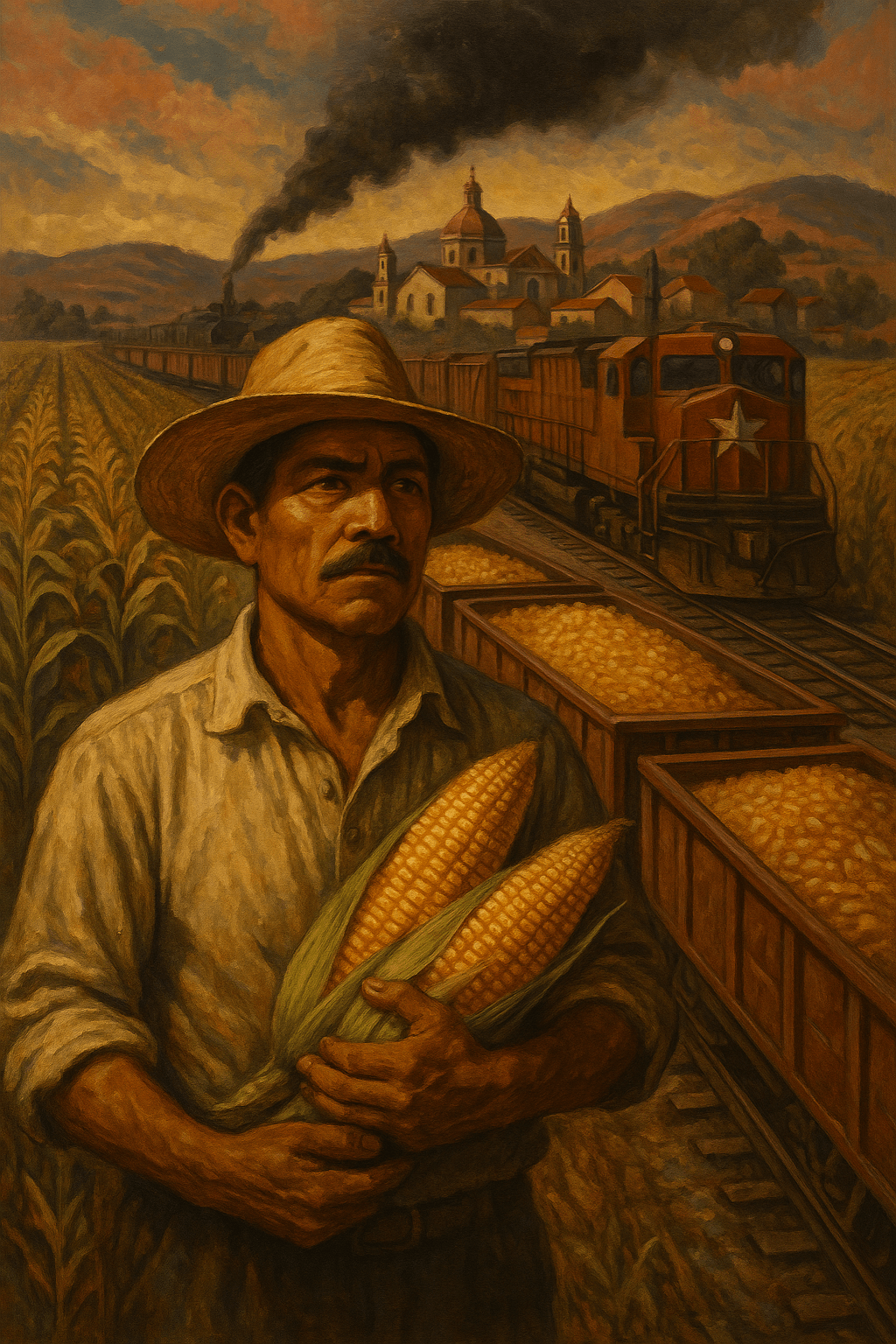
How imperial agriculture, NAFTA 2.0, and technofascist logistics turned Mexico into a captive food market for U.S. grain monopolies
By Prince Kapone | Weaponized Information | May 6, 2025
Part I: The Success Story That Starves
Farm Talk, a Kansas-based agribusiness trade paper, wants you to believe that the United States is generously feeding Mexico. In its May 2025 article, “Mexico poised to become top destination for US agricultural exports,” the paper crows over a 65% increase in U.S. food exports to Mexico, celebrating this as a win-win for “consumers on both sides of the border.” What it doesn’t say—what it cannot say—is that this so-called export boom is the continuation of a colonial relationship that was mechanized by NAFTA, militarized through USMCA, and now framed in the language of “trade growth” to conceal systemic food dependency and economic sabotage.
Quoting corporate economists from CoBank’s Knowledge Exchange and citing data from the USDA and its trade agencies, the article amplifies the voice of monopoly capital while scrubbing out the very people most affected by this trade: Mexican peasants, Indigenous communities, and displaced rural workers. These are the ones whose corn was crushed by cheap U.S. imports, whose sovereignty was buried beneath “consumer choice,” and whose labor is now absorbed into meatpacking plants and maquilas lining the imperial supply chain.
The propaganda framing is almost elegant in its cruelty. Mexico’s rising imports of U.S. corn, pork, and dairy are portrayed not as symptoms of a shattered local economy but as signs of growing “appetite.” Structural food dependency is rebranded as “opportunity.” The collapse of domestic production due to climate crisis and trade liberalization is recast as a simple market mismatch. Mexico’s agricultural sovereignty has been annihilated—and the only question Farm Talk wants answered is whether it will import more cheese in 2025 than Canada.
The central propaganda device here is weaponized optimism: the projection of American economic aggression as mutual prosperity. There’s no mention of how this “demand” was manufactured by dumping subsidized U.S. grain below cost, wiping out local producers, and tethering Mexico’s food system to Cargill, Tyson, and Walmart’s global logistics machine. Instead, the article leans on the aesthetic of inevitability—portraying U.S. agricultural dominance as the natural course of a growing Mexican economy, rather than the calculated outcome of three decades of neoliberal sabotage.
And yet the silences scream. There is no reference to NAFTA. No acknowledgment of the 3 million Mexican farmers driven off their land since the mid-1990s. No recognition that the very structure of U.S.-Mexico food trade was engineered by Washington to extract value from Mexican land, labor, and mouths. There is only a “research brief” and a smiling banker explaining that, while the peso might weaken, consumer demand will hold strong.
This is not journalism. It’s colonial bookkeeping. It is a deliberate attempt to obscure the violence of the present with the language of partnership, to dress up recolonization in trade graphs and economic briefs. Farm Talk is not reporting on trade—it’s laundering the imperial domination of food, repackaging dependency as diplomacy, and rebranding hunger as growth.
This is what propaganda looks like in 2025. It doesn’t bark orders—it smiles with graphs. It doesn’t admit conquest—it calls it a “surge in exports.” But we know better. And our job is to tear the mask off the spreadsheet and expose the hunger that lies behind every line of growth.
Part II: The Colonial Roots of an Export Surge
Behind every statistic in the Farm Talk article lies a long trail of destruction paved by free trade, enforced dependency, and imperial agriculture. The $31.4 billion in U.S. food exports to Mexico in 2024 is not the result of mutual prosperity—it is the outcome of a coordinated economic assault that began with NAFTA in 1994 and continues under the banner of “resilient supply chains” in the post-COVID era.
Before NAFTA, Mexico was largely food self-sufficient. State agencies like CONASUPO supported small farmers, stabilized food prices, and ensured national food reserves. But after the agreement was signed, Mexico was ordered to dismantle its rural protections, open its markets to U.S. grain, and adopt the logic of global capital. The result? U.S. corn—heavily subsidized and sold below the cost of production—flooded Mexican markets, destroying over 3 million rural livelihoods and forcing countless families to migrate north in search of survival.
That pattern never ended—it evolved. What began as the death of peasant agriculture became a structural reordering of Mexico’s entire food system. Today, Mexico’s rising meat and dairy demand is not a spontaneous consumer choice—it is the consequence of an industrial animal protein model fueled by U.S. feed grain exports. American corn feeds Mexican livestock, owned increasingly by transnational corporations, while Mexican fields lie fallow or are converted into export-oriented monocrops. This is not trade. It is logistical extraction.
And while Farm Talk brags about Mexico “almost certainly overtaking China” as the top buyer of U.S. grain and feed, it fails to mention why: China asserts greater control over its food sovereignty, while Mexico was coerced into the role of permanent importer. That’s the logic of food imperialism—it doesn’t just sell you food, it disables your ability to produce it.
The same pattern holds across other sectors. U.S. dairy exports to Mexico surged 76% since 2020, driven largely by cheese—products made cheap by U.S. government subsidies, industrial scale, and a logistical infrastructure that allows corporations like Dairy Farmers of America and Nestlé to offload surplus onto Mexican markets. As with grain, this devastates local producers, fragments traditional food economies, and deepens dependency on the U.S. agro-export machine.
Even processed foods—packaged goods, confectionery, sweeteners—are part of the same recolonization dynamic. U.S. corporations have saturated Mexican grocery shelves with industrial products, displacing regional supply chains, deepening nutritional crises, and embedding Mexican consumption into a web of transnational commodity flows controlled from Bentonville, Kansas City, and Chicago.
Every dollar in “export growth” is a dollar stolen from Mexico’s agricultural future. Every ton of grain shipped south reinforces a logistics empire built on forced dependency and monopolized supply chains. And every cheer from the boardrooms of CoBank and USDA conceals the silent grind of hunger, displacement, and ecological collapse across Mexico’s countryside.
What Farm Talk calls a “surge” is, in fact, a systemic suffocation—a tightening of the imperial grip around Mexico’s food system, labor pool, and national sovereignty. It is the latest chapter in a long war of recolonization. And unless we name that system for what it is—capitalist, imperialist, and extractive—we remain trapped in the hallucination that free trade is freedom.
Part III: Food Imperialism and the Technofascist Grid
From the view of Farm Talk’s editorial board and its corporate handlers, Mexico is not a nation—it’s a market. Its people are not sovereign—they are consumers. And its agriculture is not a cultural and material lifeline—it’s an opportunity for expansion. But when we discard the colonial lens and look from below—from the vantage point of Mexican peasants, displaced farmers, and the exploited working class—another story emerges. A story not of growth, but of extraction. Not of trade, but of domination. Not of partnership, but of recolonization.
This is not a “booming export market.” It is a captive food economy engineered by U.S. capital and enforced by transnational logistics. The myth of mutual benefit collapses when we understand that Mexico’s dependency on U.S. grain, dairy, and processed foods is not accidental—it was manufactured through thirty years of trade aggression, intellectual property enforcement, and monopolistic infrastructure control.
What we are witnessing is a textbook case of weaponized food imperialism: the systematic displacement of national food systems to create new revenue streams for agribusiness monopolies like Cargill, ADM, Bunge, Tyson, and Nestlé. These corporations do not merely trade across borders—they write the trade rules, own the processing plants, control the shipping lanes, and police the intellectual property of seeds and soil. This is not globalization—it is the architecture of technofascism: the fusion of monopoly capital with state enforcement and digital control to suppress food sovereignty and working-class resistance.
NAFTA was the opening salvo in this recolonization process, dismantling the foundations of Mexican food autonomy. USMCA, its 2.0 variant, codified the power of agritech giants to sue governments, override food labeling laws, and enforce corporate dominance through digital trade clauses. The COVID-19 pandemic, far from disrupting this system, was used to justify even deeper integration—rebranded as “supply chain resilience.” But resilience for whom? For the capitalists who hoard profits, or for the peasants pushed into informal economies and borderlands?
The contradiction is not “Mexico vs. the U.S.” It is capitalist agriculture vs. the global peasantry. It is imperial logistics vs. food sovereignty. It is a settler empire exporting its agricultural surplus—and importing its social contradictions. Every U.S. grain shipment to Mexico is tied to a Walmart warehouse, a Tyson slaughterhouse, a Monsanto patent, and a border wall to keep the displaced out.
What Farm Talk calls a trade relationship is in reality a strategic food chokepoint—a method of colonial control whereby the most basic human necessity is subordinated to the dollar and the gun. This is not merely about agriculture. It is about sovereignty, survival, and the right to eat without permission from Wall Street.
To reframe this story is to name the system: imperialist recalibration in a moment of global crisis, where U.S. hegemony clings to life by militarizing food, finance, and logistics. Mexico is not rising—it is being repurposed, its land and labor enclosed within a dying empire’s supply chain. And if we do not rupture this logic, we will all be devoured by it.
Part IV: Seeds of Resistance, Grains of Liberation
The empire’s grip on Mexico’s food system was not achieved overnight—and it will not be broken by policy papers or polite appeals to “fair trade.” It will be broken by the organized power of peasants, workers, and revolutionary movements that refuse to feed the machine that starves them. The time for technocratic reform is over. The task now is to strike at the root: to dismantle the imperial food grid and build a new system grounded in sovereignty, agroecology, and collective survival.
We begin not from scratch, but from memory and momentum. The Zapatistas in Chiapas have long modeled autonomous food production outside state and corporate control. La Via Campesina continues to fight for peasant rights across borders, linking landless workers, small farmers, and Indigenous communities in a shared front against agribusiness and climate collapse. In 2023, Mexican movements again rose up to reject GMO corn and seed patent enclosures, defying U.S. pressure and asserting a basic truth: the land belongs to those who work it, not those who commodify it.
We must expand and radicalize these struggles:
- Expose the grid: Map the physical infrastructure of U.S.-Mexico food dependency—from ports and rail lines to processing plants and Walmart logistics centers. Identify chokepoints. Make them visible. Turn supply chains into political fault lines.
- Block the flows: Organize coordinated actions at trade corridors—slowdowns, occupations, border disruptions. Grain doesn’t move without dockworkers, truckers, and farmhands. The empire’s food economy is vulnerable to the very labor it exploits.
- Build food sovereignty from below: Establish cooperatives, seed libraries, agroecological schools, and community-supported agriculture networks. Reclaim Indigenous farming methods. Break the cycle of dependency with autonomy and ancestral knowledge.
- Strike across borders: Connect U.S. farmworkers with Mexican peasants; dockworkers in Veracruz with longshoremen in Oakland. Coordinate labor disruptions tied to trade agreements. Show that the border is a fiction—capital crosses freely, and so must resistance.
- Disrupt digital domination: Oppose biotech patents, digital trade clauses, and GMO surveillance. Defend seed sharing. Sabotage data-driven control over land, yield, and pricing. Fight technofascism in the field and in the cloud.
Let there be no mistake: food imperialism is not just about calories—it is about control. When the U.S. exports corn, it exports the very logic of empire: monoculture, enclosure, dependency, and surveillance. To reject it is not simply to choose different food—it is to fight for a different future.
So let us organize. Let us resist. Let us plant what they tried to destroy. From Oaxaca to Michoacán, from the Chiapas highlands to migrant fields in California, the resistance has never stopped—it is only waiting to be reignited.
We are not asking to share in the spoils of agribusiness. We are demanding its downfall. No more feeding the empire. No more “win-wins” that leave us hungrier. No more trade that buries our sovereignty beneath another shipment of surplus grain. The soil remembers. The people remember. And when we rise, the land will rise with us.
 Weaponized Information
Leave a comment