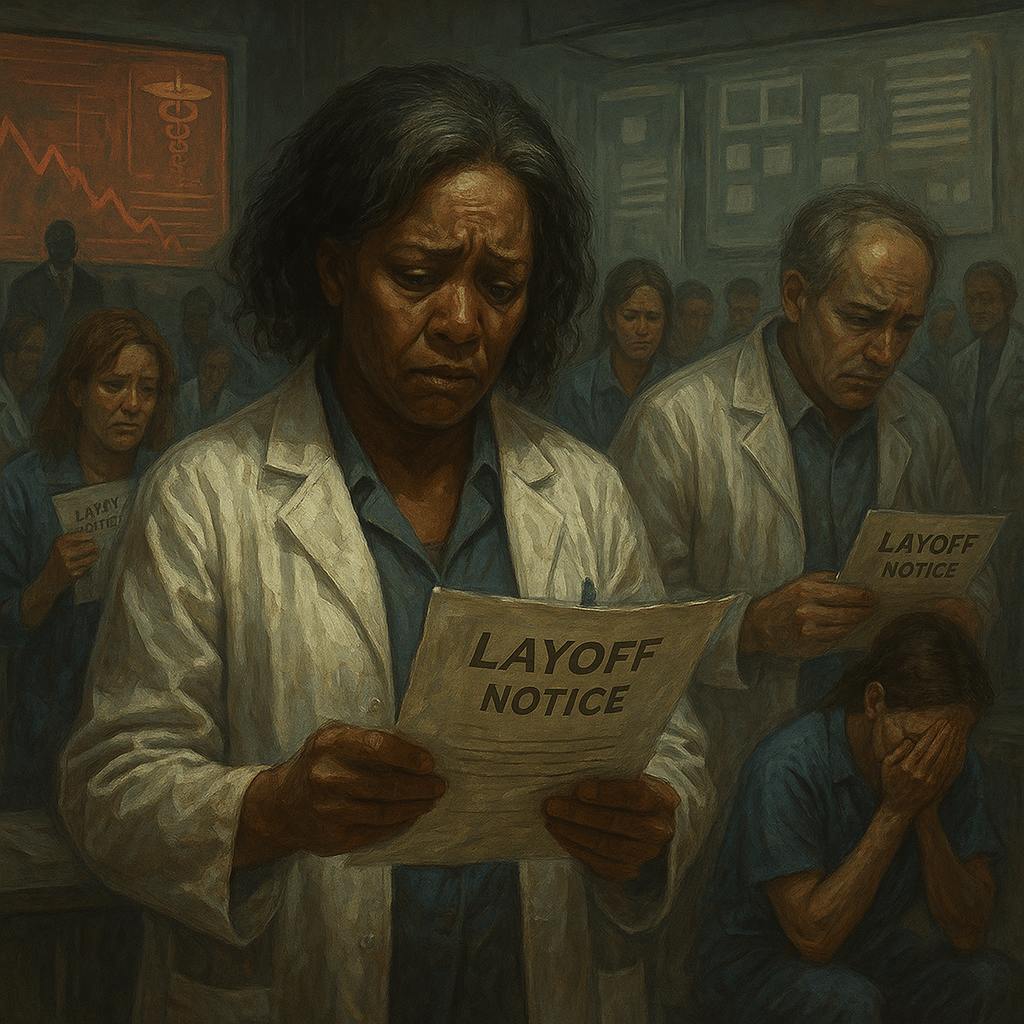
How Trump’s science purge and Bhattacharya’s public health restructuring signal a capitalist counterinsurgency against care itself
By Prince Kapone | Weaponized Information | May 6, 2025
Part I: Austerity Disguised as Efficiency
The article in question—“National Institutes of Health lays off hundreds more staff”—was penned by Alexander Tin, a digital health reporter at CBS News. CBS, the corporate flagship of Paramount Global, has long served as a reliable conduit for state and corporate messaging. Tin’s write-up on the latest NIH layoffs follows that tradition faithfully, framing a mass purge of public sector workers as a matter-of-fact budgetary adjustment. As someone whose partner is a recent survivor of breast cancer, I cannot read about the decimation of public cancer support services without fury. This is not just a policy shift—it’s a calculated blow to the very infrastructure that working-class and oppressed people rely on to survive disease and navigate treatment. The personal is political. And this system is killing us.
Citing anonymous staff and quoting statements from Health and Human Services spokesperson Andrew Nixon, the article presents the layoffs—nearly 250 NIH employees, including dozens from the National Cancer Institute—not as an attack, but as a rebalancing act. It recycles boilerplate rationalizations: “redirect resources,” “maximize impact,” “serve the American people more effectively.” The NIH and HHS, speaking through Tin, are cast as technocratic stewards, responsibly trimming fat to focus on “critical areas.” Nowhere are those areas defined. Nowhere is the ideological function of those cuts interrogated. And nowhere is there any suggestion that these layoffs are part of a coordinated program of domestic structural adjustment driven from the top of the Trump regime.
This is propaganda by filtration. Tin includes quotes from laid-off workers—expressing confusion, frustration, and disbelief—but isolates them from any broader critique of political economy. Their voices become emotional texture, not political indictment. The narrative remains intact: this was unfortunate, maybe even mishandled, but ultimately necessary. CBS’s role here is not to investigate, but to tranquilize. Its readers are meant to feel unease, not outrage; to accept the logic of austerity, not reject it.
More revealing than what’s said is what’s left out. There is no mention of NIH Director Jay Bhattacharya’s ideological pedigree—his central role in pushing the Great Barrington Declaration, his advocacy for herd immunity during COVID, his elevation within the Trump 2.0 regime. No linkage is made between these layoffs and the broader dismantling of public health infrastructure under Trump’s austerity offensive. No examination of what it means for a cancer institute to slash its communications staff—those who help patients, doctors, and the public navigate life-and-death questions. No reflection on how this foreshadows the privatization and political capture of science.
The rhetorical structure of the article is pure technocratic fatalism: numbers first, passive voice throughout, official statements unchallenged. Layoffs don’t happen—they are “received.” Decisions aren’t made—they “follow review.” Agencies don’t pursue ideological objectives—they are simply “restructured.” This language is not accidental—it is a discursive shield. It protects power by erasing agency and masking intent. This is the language of technofascism, where violence is bureaucratized and austerity is delivered like a software update.
What CBS calls a reorganization is, in fact, a targeted demolition of what remains of the public health state. It is not cost-cutting. It is class war waged in lab coats and spreadsheets. And every line Tin writes without context, without interrogation, without resistance—cements the ideological function of his journalism: to make the unacceptable seem inevitable.
Part II: Extract & Contextualize – The Public Health Purge as Imperial Recalibration
The facts, stripped of CBS’s euphemisms, are blunt. Nearly 250 federal employees were laid off from the National Institutes of Health, including around 50 staff from the National Cancer Institute. These weren’t low-priority hires or temporary contractors—they were communications workers, patient liaisons, media relations personnel, and database managers responsible for making cancer research accessible to doctors, patients, and the general public. Many had just met with leadership days before to discuss internal reorganization. Then came the email: your service is no longer required. No explanation. No warning. Just removal.
But this is not a story about mismanagement or internal confusion. It is a strategic assault. The layoffs at NIH are one node in a broader offensive—an austerity campaign disguised as “efficiency,” aimed at dismantling what remains of the New Deal–era social infrastructure and subordinating all public health to capital. This is technofascist labor recalibration: the deliberate shrinking of the federal workforce, consolidation of functions into surveillance-driven “centers of excellence,” and redirection of public funding into private contracts, corporate partnerships, and algorithmically managed service delivery systems.
The architect of this particular purge—NIH Director Jay Bhattacharya—is not acting alone. As co-author of the Great Barrington Declaration, Bhattacharya helped script the capitalist reopening during the COVID-19 pandemic, arguing that vulnerable populations should simply be “protected” while society reopens—i.e., let the working class get sick and die to keep the economy running. His promotion under Trump 2.0 is no coincidence. He represents a new phase in public health governance: one where care is triaged according to profit, science is filtered through ideology, and layoffs are framed as “resource reallocation.”
This is not austerity for austerity’s sake—it’s the method by which empire recalibrates. The crisis of U.S. imperialism is no longer just external; it’s internal. The tools honed abroad—IMF structural adjustment, NGO replacement of the state, workforce “right-sizing,” and technocratic governance—are now being applied at home. The NIH layoffs mirror the logic of every structural adjustment program imposed on the Global South: shrink the public sector, privatize essential functions, and blame the victim for being “inefficient.”
Meanwhile, the same regime that guts cancer communications offices continues to shovel hundreds of billions into defense contractors, border militarization, and AI surveillance. The Pentagon budget remains untouched. DARPA’s biomedical research wing thrives. Biotech firms rake in record profits. What’s being cut isn’t waste—it’s access. What’s being “restructured” isn’t bureaucracy—it’s the idea that health is a public right.
This is how imperialism manages decline. It does not fall gently—it cannibalizes the institutions that once stabilized it. NIH, like the EPA, the CDC, and public education, is being hollowed out—its labor force discarded, its public mission erased, and its shell repurposed as a delivery platform for privatized, politicized, and militarized health data flows. This is not reform. It is liquidation.
Part III: Reframe – Technofascist Medicine and the Infrastructure of Disposability
The official story tells us these NIH layoffs were about optimization, cost-efficiency, and resource “realignment.” But let’s be clear: this is not a rebalancing—it’s a purge. What’s happening at the NIH is the systematic dismantling of public health infrastructure under the logic of technofascism: a merger of executive power, corporate capital, and digital control that treats life not as something to protect, but as something to manage, surveil, and discard.
When cancer patients lose access to public information systems, when researchers are cut off from databases, when communications professionals are fired en masse—it is not an accident. It is a political decision. A decision that says: only those who can pay deserve knowledge, care, and continuity. Everyone else? Disposable.
This is how empire treats its own in decline. The same tools once used to discipline the Global South—budget cuts, privatization, shock therapy—are now being deployed in Bethesda, Baltimore, and beyond. The Trump regime isn’t just slashing jobs. It’s recolonizing the public sector, converting once-public institutions into hollowed-out shells governed by contractors, consultants, and ideological commissars. Where once there were civil servants, now there are performance dashboards. Where once there were patient liaisons, now there are algorithms.
Bhattacharya’s NIH is not a health agency—it is a data-mining operation in a lab coat. A skeletal bureaucracy built to serve corporate medicine, justify budget discipline, and suppress scientific dissent. This is not neoliberalism with a human face—it’s post-consent governance. The era of trying to win hearts and minds is over. Now they just fire you, defund your office, and tell the press you’ve been “streamlined.”
The language of public health has been hijacked by the grammar of capital. “Critical areas” means politically protected programs aligned with regime priorities—biodefense, pandemic modeling, drug development pipelines. “Maximizing taxpayer impact” means gutting care and expanding corporate reach. “Serving the American people” means disciplining them through scarcity, silence, and digital bureaucracy. This isn’t a reform of science—it’s its capture.
And CBS’s role in this process? To narrate it as a policy update. To turn layoffs into logistics. To present a structural attack on public welfare as a benign shuffle of resources. This is how technofascism is normalized—not through grand pronouncements, but through quiet stories that make catastrophe seem routine.
The contradiction is not between Democrats and Republicans. It’s between empire and care. Between a state that feeds war and starves health, and a population that’s told to accept its own erasure in the name of budget discipline. This is not a budget cut. It is a class cut—a surgical strike against the very possibility of public goods. And if we do not name it, it will become the new normal.
Part IV: Mobilize – Reclaiming Health, Resisting the Austerity Machine
The NIH layoffs are not an isolated episode—they are a dress rehearsal. What was once reserved for the periphery is now being rolled out across the imperial core. The layoffs are just one flashpoint in a much larger transformation: the conversion of public health into a privatized, militarized, and algorithmically managed infrastructure of class domination. If we don’t resist now, the cancer information desk becomes the testing ground for eliminating public clinics. The fired NIH worker becomes the template for a future in which science is gated behind corporate paywalls, and care is rationed by spreadsheet.
But the resistance has already begun. NIH workers are speaking out, despite gag orders and job insecurity. Community health coalitions, mutual aid networks, and medical freedom clinics—born during the pandemic—are refusing to let public health be surrendered to profit. And across the broader terrain, teachers, environmental scientists, transit workers, and postal employees are all facing the same enemy: a state that governs not to protect life, but to extract from it.
We must make the connections clear—and act accordingly:
- Map the purge: Track layoffs across federal science and health institutions—NIH, CDC, EPA, HUD—and build a public ledger of the technofascist restructuring. Show that these cuts are systemic, not coincidental.
- Expose the functionaries: Investigate the corporate and ideological ties of figures like Jay Bhattacharya. Trace their affiliations to Silicon Valley think tanks, hedge fund networks, and reactionary science policy groups. Put names to the architects of austerity.
- Unite the workers and the wounded: Forge alliances between laid-off public servants and the communities they once served. From rural cancer patients to inner-city clinics—show that what’s being stolen is everyone’s future.
- Rebuild from below: Expand people’s health councils, free medical programs, community data repositories, and abolitionist health networks. Build a dual power infrastructure to bypass and eventually replace the state’s hollow shell.
- Strike against technofascism: Organize labor actions within the scientific and medical workforce. Leverage collective refusal not just for better conditions—but to defend the very idea of health as a right, not a product.
We are not dealing with mismanagement. We are living through the managed demolition of care. They do not intend to fix the system—they intend to bury it and sell the dirt. And they expect us to say thank you as we are laid off, denied treatment, and fed lies about efficiency.
But we see through them. We know what this is. It is the austerity phase of technofascism—the final frontier of class war, where life itself is collateral. And if we don’t fight, there will be nothing left to defend.
So let’s fight. For the right to care. For the workers they discarded. For the science they’ve politicized. For the lives that austerity treats as margin of error. Let the layoffs be a signal, not a silencing. Let them regret every name they tried to erase.
 Weaponized Information
Leave a comment