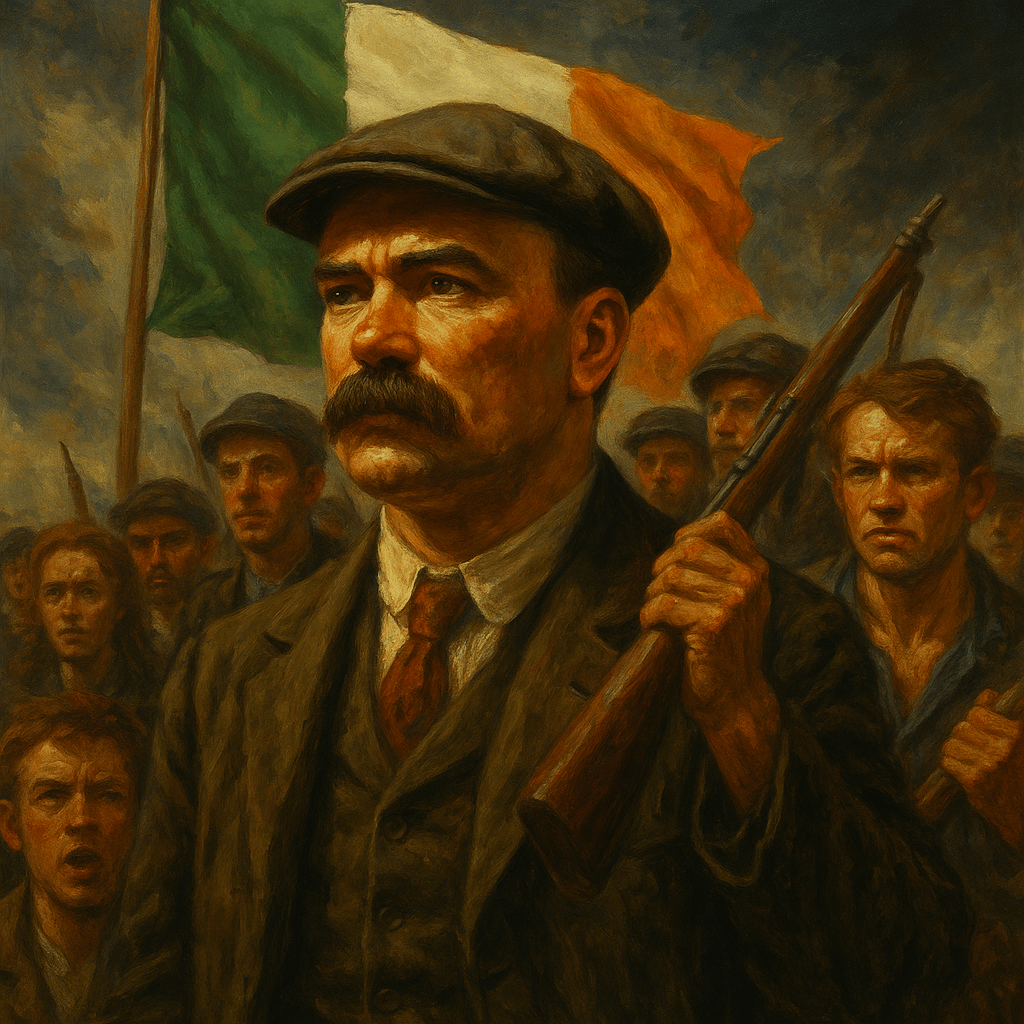
Prologue: The Last Words of a Revolutionary
On May 12, 1916, James Connolly was too wounded to stand. A shattered ankle, torn by British bullets during the Easter Rising, had left him unable to walk. So the British tied him to a chair. Then they shot him.
They thought they were killing a rebellion. What they did was crown a martyr.
Connolly was not just a commander of the uprising. He was its soul. A Marxist who spoke with a Limerick accent. A syndicalist who built unions and barricades. A soldier of the Irish working class who knew that the enemy wasn’t just the English crown—but the system of imperialism that fed it.
“The cause of Ireland is the cause of labor. And the cause of labor is the cause of Ireland.”
— James Connolly
This is the story of the man they feared more than guns. Because Connolly didn’t just dream of an Ireland free from the Union Jack. He dreamed of an Ireland free from landlords, from capitalists, from wage slavery, and from empire.
I. From Edinburgh Slums to Revolutionary Awakening
James Connolly was born on June 5, 1868, in the Cowgate district of Edinburgh, Scotland—a ghetto of Irish immigrants and poverty. He left school at age 11 to work. At 14, he lied about his age and joined the British Army. He was sent to Ireland—the very country his ancestors had fled after the Famine—to help enforce the rule of colonial law.
It was in the barracks and occupied villages that Connolly saw the structure of empire up close. He saw how the British Army wasn’t just oppressing the Irish people. It was weaponizing the poor of one country to brutalize the poor of another.
After several years, he deserted and returned to Scotland. He joined the socialist movement, influenced by Marx, Engels, and the growing labor radicalism of the late 19th century. But Connolly didn’t believe socialism was a thing of theory. It had to be made in the streets, by the working class themselves.
“Revolution is never practical—until the day it becomes inevitable.”
— James Connolly
In 1896, Connolly moved to Dublin and formed the Irish Socialist Republican Party (ISRP)—one of the first organizations in history to unite the struggle for national liberation with that for working-class power.
He denounced both British colonialism and Irish capitalism. He attacked the church hierarchy for siding with landlords. He taught factory girls and dockworkers that socialism wasn’t a foreign idea—it was the birthright of every person born into poverty.
For Connolly, class and colony were one chain—and they had to be broken together.
II. Socialism Made Easy, Struggle Made Hard
James Connolly wasn’t just an organizer—he was a revolutionary educator. He wrote in the language of the working class: plain, direct, and uncompromising. His pamphlet Socialism Made Easy was exactly that—an accessible, fire-breathing introduction to class struggle, national liberation, and the need for working-class power.
In that text, Connolly dismantled the idea that socialism was utopian or foreign to Irish life. He showed how capitalism was a system of organized theft—of labor, of land, and of life. And he didn’t stop at critique. He made the case that working people had to seize power—not just at the ballot, but in the factory, on the dock, and in the streets.
“Government by the rich for the rich—that is the history of the world. But the working class can write a new chapter.”
— James Connolly, Socialism Made Easy
Connolly in the United States
In 1903, driven by poverty and isolation in Ireland, Connolly emigrated to the U.S. He didn’t retreat from politics—he doubled down. He joined the Socialist Labor Party and soon became a key figure in the newly emerging Industrial Workers of the World (IWW).
Connolly helped organize dockworkers, rail workers, and immigrant laborers. He sharpened his anti-capitalist line. He saw how imperialism wasn’t just about nations—it was about class. He saw Black workers, Italian anarchists, and Irish rebels fighting the same system under different flags.
His American experience radicalized him further. He returned to Ireland in 1910 with a deeper understanding of industrial unionism, internationalism, and the need for revolutionary discipline rooted in mass struggle.
Back in Ireland: Labor as the Engine of Liberation
Connolly joined forces with James Larkin and became the key theorist and organizer for the Irish Transport and General Workers Union (ITGWU). He helped organize workers across lines of gender, skill, and religion—building a multi-sector, class-based labor movement in a deeply divided colonial society.
His work laid the groundwork for the 1913 Dublin Lockout—one of the most significant industrial confrontations in Irish history. Over 20,000 workers faced starvation and state violence. When the police attacked workers and their families, Connolly didn’t just protest. He helped found the Irish Citizen Army (ICA)—a workers’ militia trained to defend strikers and prepare for insurrection.
“A great army of workers, trained to use weapons not for conquest, but for justice. That is the hope of our class.”
— Connolly on the ICA
Connolly’s socialism wasn’t electoral. It was revolutionary. It was organized in breadlines and picket lines. It was built with rifles and red flags. And it was preparing for something far bigger than labor rights alone.
Connolly believed that the Irish working class would never be free until it broke both chains: the one held by the British Empire—and the one held by the Irish capitalist class, waiting to take the whip from the colonizer’s hand.
III. The Easter Rising: Connolly’s Gamble, Ireland’s Blood Price
By 1916, James Connolly knew the odds. World War I had thrown the world into chaos. Britain was distracted, bleeding in the trenches of Flanders. Ireland’s nationalist leaders were divided, hesitant. But Connolly was not.
He believed the moment had come. Not for protest, but for revolution.
Connolly allied the Irish Citizen Army with a wing of the Irish Volunteers to launch an armed insurrection against British rule. It was a bold, improbable, and—some said—suicidal move. But Connolly wasn’t looking for easy victories. He was looking to strike a blow so powerful it would awaken a people.
“The chances are a thousand to one against us. But if we win, we win the glory. If we lose, we lose nothing—only life.”
— James Connolly, March 1916
On Easter Monday, April 24, 1916, Connolly led armed workers through the streets of Dublin. They seized the General Post Office (GPO), raised the tricolor, and proclaimed the Irish Republic. For six days, they held the city under siege.
Connolly was everywhere: directing fire, organizing food, treating the wounded. Even after a sniper shattered his leg, he continued giving orders, carried from post to post on a stretcher. His leadership was disciplined, militant, unflinching.
Defeat, Capture, and Execution
The British responded with overwhelming force: artillery, naval bombardment, mass arrests. By week’s end, Dublin lay in ruins. The rebellion was militarily defeated.
Connolly, gravely wounded, was captured. He was tried in secret by court martial. The British feared his words even more than his gun. They executed him at dawn on May 12, 1916—tied to a chair because he could no longer stand.
“Believing that the British Government has no right in Ireland… I am prepared to sacrifice my life for the cause.”
— James Connolly, Final Statement
And he did. But what the empire didn’t understand was that Connolly’s death would ignite a fire. It turned the Easter Rising from a failed rebellion into a political earthquake. Ireland would never again be quiet. And the working class would never again forget the man who had told them they were the soul of the nation.
Connolly had gambled everything—and though the rising fell, the revolution did not die.
IV. Connolly’s Revolutionary Theory and Our Struggle Today
James Connolly wasn’t just a martyr. He was a Marxist, a militant, and a revolutionary theorist whose clarity still cuts through the fog of liberal confusion and settler revisionism.
He argued that you cannot separate the national question from the class question. To demand Irish independence without socialism was to hand the keys from one set of landlords to another. Connolly saw that in a colonized country, national liberation without economic justice was just a new flag over the same prison.
He was among the first to articulate that colonial oppression and capitalist exploitation are not separate systems—they are interlocking chains. The British Empire, he wrote, was “not a foreign accident” but a system that served the class interests of both British elites and Irish collaborators.
“If you remove the English army tomorrow and hoist the green flag over Dublin Castle, unless you set about the organization of a socialist republic, your efforts would be in vain.”
— James Connolly
What Connolly Teaches Us Now
- That class betrayal wears many colors. Even those who wave national flags can serve empire if they uphold capitalism.
- That the working class must lead all national liberation movements—not follow behind bourgeois agendas.
- That armed struggle and political education are not contradictions but complements in revolutionary praxis.
- That internationalism is not charity—it’s strategy. Connolly’s vision included solidarity with struggles in Africa, the Americas, and Asia long before “globalization” was a word.
Connolly Lives in the Global South
You’ll find Connolly today not in Irish parliament speeches, but in the barricades of Palestine, the trade union halls of South Africa, the land occupations of Brazil, and the anti-imperialist trenches of Venezuela and Nicaragua.
You’ll find him in every peasant who resists eviction, every worker who takes a factory, every colonized nation that says “no” to IMF rule and “yes” to people’s power.
James Connolly does not belong to history. He belongs to the unfinished fight for human liberation.
“The great appear great because we are on our knees. Let us rise.”
— Connolly


Leave a comment