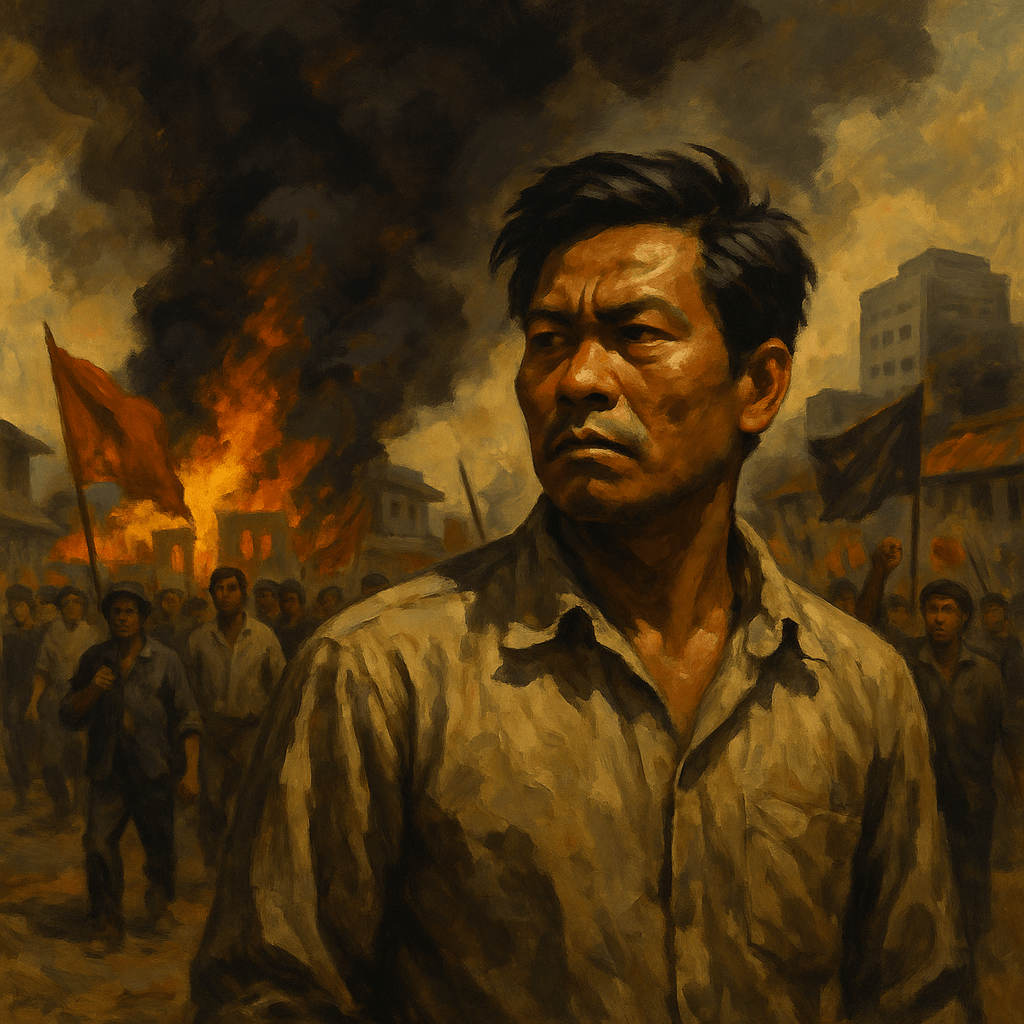
How imperial nostalgia disguises the decline of U.S. power—and why the peoples of Asia aren’t grieving, they’re building
By Prince Kapone | Weaponized Information | May 1, 2025
I. Behind the Byline: The Empire’s Trusted Scribe
Let’s start by pulling back the curtain. This article wasn’t written in a vacuum. It was penned by Hannah Beech, one of the New York Times’ reliable narrators of empire. Beech isn’t just some neutral observer—she’s a career correspondent who’s been covering Asia for the imperial press for over 25 years. That means she’s spent a quarter-century embedded in the ideological trenches of U.S. imperialism, spoon-feeding bourgeois audiences narratives that sanitize America’s crimes and frame the world through Washington’s gaze. Her job, put plainly, is to make empire’s story feel like common sense.
The New York Times itself doesn’t need much introduction. This is the paper that sold the Iraq War to the liberal classes, that ran cover for every U.S. military intervention from Vietnam to Libya, that makes the crimes of empire palatable with big words and careful euphemisms. When the Times sends a journalist to “cover” Asia, it’s not to inform Americans—it’s to discipline the minds of the empire’s citizenry. It’s ideological maintenance.
In this piece, Beech’s assignment is clear: weave a melancholy, wistful narrative about America’s supposed “retreat” from Asia. Fifty years after the fall of Saigon, we’re told, Asia is now learning to live “with a new great power: China.” The frame is simple: Asia was once under America’s wing, and now—oh, tragedy!—it’s being left to the wolves of Beijing. The subtext? U.S. empire was benevolent, stabilizing, even noble. China’s rise is coded as something shady, opportunistic, dangerous.
Notice how she wraps U.S. imperialism in nostalgia, evoking her father’s war reporting as if the Vietnam War was a tragic, noble effort rather than a genocidal invasion. Notice how she slips in fears about Chinese roads, Chinese ships, Chinese investment—never naming the imperialist infrastructure the U.S. spent decades imposing through coups, bombings, puppet regimes, and neoliberal shock therapy.
And notice what’s missing: no mention of Agent Orange, napalm, the 3 million Vietnamese killed, the secret bombings of Laos and Cambodia. No reckoning with the fact that the United States didn’t “leave” Asia—it was kicked out by revolutionary struggle, by the blood and resistance of the Vietnamese, Laotians, Cambodians, Koreans, Indonesians, Filipinos, and so many others.
This isn’t just nostalgia. It’s ideological warfare. Beech’s article isn’t mourning a lost friendship between Asia and America. It’s lamenting the decline of U.S. hegemony, the fraying grip of imperial control. And her task is to frame China’s growing role not as a regional recalibration, not as post-colonial sovereignty asserting itself, but as a dangerous void left by America’s supposed withdrawal.
What Beech won’t tell you—because it’s the unspeakable truth of her class—is that America never stood for “hope and democracy” in Asia. It stood for bombs, dictatorships, military bases, sweatshops, and extractive contracts. Every time U.S. boots touched Asian soil, it wasn’t freedom marching forward—it was capital planting its flag, carving out a market, and setting up a garrison.
And so this article, like so much imperial journalism, isn’t about informing readers. It’s about soft power. It’s about keeping the American liberal class nostalgic for empire, fearful of China, and ideologically aligned with the priorities of the U.S. ruling class as it recalibrates for a new Cold War.
The storyteller here is not a neutral scribe. Hannah Beech is an agent of the narrative apparatus of empire. And The New York Times is its printing press. Their framing isn’t accidental—it’s strategic. And we, reading from the vantage point of the oppressed, must begin by excavating who’s speaking, who they’re speaking for, and what project their words are enlisted to serve.
Because as Walter Rodney taught us, history isn’t just what happened—it’s who’s telling the story, and why.
The Long Shadow of Empire: How Memory Masks the Machinery
When The New York Times mourns the fading of U.S. influence in Asia, it isn’t shedding tears for lost democracy or human rights. It’s mourning the loosening grip of empire, the slow erosion of imperial command. The article’s nostalgic gaze back at Vietnam’s war-torn history isn’t about honoring the Vietnamese people or reckoning with the destruction wrought by American bombs. No — it’s about preserving the narrative of benevolent U.S. power, of a nation that meant well even as it razed villages, propped up dictators, and massacred civilians. This is not an elegy for peace. It’s a lament for diminishing imperial leverage.
Let’s strip away the sentimental veneer and excavate the raw material reality. The United States may have evacuated its embassy in Saigon in 1975, but it never evacuated its ambitions. In the decades since the helicopter lifted off that rooftop, Washington entrenched itself deeper across Asia-Pacific: sprawling military bases in Japan, South Korea, the Philippines; drone surveillance networks; naval choke points from Guam to Diego Garcia; trade deals and IMF-backed austerity measures binding economies to U.S. capital. The New York Times article dares to speak of a retreat — but the footprint remains, heavy as ever. What’s retreating isn’t presence. It’s ideological cover.
Even the framing of Vietnam’s pivot toward China — a “new great power” rising, as the article warns — functions as imperial mystification. What’s deliberately obscured is that Vietnam’s relationship to China is far older, far more complex, and far less reducible to Cold War binaries than U.S. pundits care to admit. Vietnam fought Chinese dynasties for over a thousand years. It defeated Mongol invasions. It resisted Japanese occupation. And yes, it fought China in 1979, even after aligning with the Soviet bloc. To flatten Vietnam’s foreign policy into mere Chinese satellite status is not only historically ignorant — it’s an insult to a revolutionary tradition of anti-imperialist self-determination.
But the Times cannot acknowledge that lineage. To do so would mean recognizing Vietnam as a subject of history, not an object in Washington’s geopolitical chessboard. It would mean admitting that the Vietnamese Revolution wasn’t a mere detour from liberal modernization but a profound rupture with imperial domination — French, Japanese, American, and beyond. And it would force reckoning with the reality that, even today, Vietnam’s economic entanglements coexist with a stubborn political independence that no empire, east or west, has managed to extinguish.
Instead, the Times couches the story in personal anecdotes, elegiac images of a journalist father departing Saigon, laments for a world where U.S. democracy once stood as a beacon. Yet even in these vignettes, the real stakes peek through: a defense minister of Cambodia noting U.S. democracy is in crisis; a Cambodian naval base demolished and rebuilt by China. The reporters can’t help but notice that the empire’s promises have run thin — that what once passed for benevolent hegemony now looks more like decline. But rather than interrogate the imperial structure itself, the article clings to the ghost of America’s moral authority, as if mourning a fallen ideal rather than critiquing a living system of domination.
This is the ideological function of liberal imperial nostalgia: to make empire seem tragic rather than criminal, to cast its decline as global instability rather than global relief. But the facts tell a different story. Washington’s withdrawal from Asian alliances and aid packages isn’t driven by humility or restraint — it’s driven by exhaustion, overstretch, and declining capacity. It’s the predictable crisis of a parasitic system facing multipolar resistance. China’s infrastructural investments, imperfect and contested though they are, expose the hollow core of U.S. commitments: military bases, debt traps, and neoliberal restructuring disguised as development aid.
Consider Myanmar. The article points to U.S. negligence after an earthquake, contrasting it with China’s swift response. Yet it stops short of asking why the U.S., self-proclaimed guarantor of Asian democracy, couldn’t mobilize even a symbolic show of solidarity. The answer lies in material priorities: the U.S. state doesn’t serve human need. It serves capital accumulation and geopolitical leverage. Aid that doesn’t serve those interests won’t be prioritized — a truth long understood by the Global South but rarely acknowledged in Western media.
Vietnam’s pivot to balancing China is framed as a sign of U.S. irrelevance, but in truth it’s a continuation of a centuries-long strategy of resisting domination by any singular external power. That the Times cannot see Vietnam’s independent trajectory — or must reduce it to mere realignment under Beijing’s wing — reveals the poverty of imperial imagination. In the imperialist worldview, nations do not act, they react. They do not build history; they are shaped by it, by the metropoles who grant or withhold favor. But Vietnam — like Cuba, like Venezuela, like Burkina Faso under Thomas Sankara — refuses this script. It builds, it resists, it maneuvers, it survives. And survival, for a people targeted by imperial violence for so long, is a revolutionary act in itself.
The New York Times article misses this. But perhaps the omission is intentional. Because to tell the truth — that Vietnam’s sovereignty stands not because of U.S. tutelage but in spite of it — would unravel the ideological thread stitching together America’s self-image. To admit that the Global South no longer orbits U.S. power by default would be to acknowledge not just a geopolitical shift, but a moral reckoning: that empire is not peace, not order, not stability — but violence, theft, and coercion.
And so the Times clings to ghosts. It mourns a Saigon helicopter ride, while ignoring the millions of Vietnamese who never got airlifted from the napalm and the Agent Orange. It laments a lost era of U.S. primacy, while ignoring that primacy was built atop massacres, coups, and colonial borders. It invokes democracy even as it reports on Cambodia demolishing U.S.-funded military bases to make room for Chinese ones — without asking why U.S. imperialism no longer commands loyalty, only resentment.
But the Vietnamese people know. The Cambodian people know. The peoples of Asia, Africa, and Latin America know. And their memory, their struggle, their survival will outlast every elegy penned by imperial scribes in New York.
III. Rewriting the Story: Asia’s Resistance, Empire’s Decline
Let’s flip the script. Not from the marble offices of the New York Times, but from the rice fields, the factories, the fishing boats, and the streets of Asia. Because this story doesn’t belong to the empire’s narrators. It belongs to the people who bled to push imperialism out—and who are still standing, still fighting, still refusing to bow to the West or the East.
The fall of Saigon wasn’t a tragedy for Asia. It was a triumph. It wasn’t the end of American “benevolence”—it was the end of American occupation. Every U.S. helicopter fleeing that embassy rooftop was a sign that a colonized people had won their liberation, not a signal of some mythical “loss of stability.” What Beech’s article mourns, we celebrate: the retreat of imperial guns, the crumbling of imperial prestige, the fracture of imperial lies.
Today’s shifts in Asia aren’t about nations “falling under China’s sway.” They’re about states navigating a world no longer monopolized by a single imperial core. They’re about sovereignty flexing its muscles, however unevenly, however imperfectly, in the face of centuries of colonial and neocolonial domination. China isn’t a perfect actor, nor free from contradictions. But its rise cracks open possibilities for multipolarity, for new alignments beyond the dictate of Washington’s whip. That’s not a “power vacuum.” That’s the air of empire thinning, making space for other breaths, other dreams.
The New York Times can’t admit that because it was never designed to tell the story of the oppressed. It exists to uphold the ideological scaffolding of imperialism. And Hannah Beech’s pen is one of its tools. But the real narrative—the revolutionary narrative—has always been written by those who resist. By the Vietnamese peasants who tunneled under U.S. bases. By the Cambodian workers rebuilding their ports for their own purposes. By the Asian farmers, students, rebels who’ve faced down tanks, planes, and IMF suits alike.
The memory that matters isn’t the imperial journalist’s memory of a father’s melancholy retreat. It’s the collective memory of struggle: the Tet Offensive, the liberation of Phnom Penh, the toppling of colonial statues, the refusal to forget the smell of burning skin from napalm raids. That memory isn’t trapped in nostalgia—it’s fuel for the next fight. And it’s alive, humming, growing, wherever the bootprint of empire is contested.
We don’t need imperial elegies. We need revolutionary clarity. Asia isn’t mourning America’s retreat. Asia is living, surviving, adapting—and in many corners, it’s still resisting. The question isn’t whether U.S. imperialism is declining. The question is whether we will seize this decline as a chance to deepen sovereignty, to extend solidarity, to dismantle every last base and contract and comprador clique holding the Global South in chains.
IV. Toward Liberation: Lessons and Action for the Global Struggle
So what do we do with this knowledge? We turn it into fire. Into purpose. Into a weapon for our side of the war.
Because make no mistake—this article, like so much of the imperial press, isn’t just analysis. It’s ideological warfare. Its purpose is to demoralize, to sow doubt, to make the decline of U.S. power feel like a tragic loss for humanity rather than a chance for humanity’s rebirth. It’s designed to keep the American public nostalgic for empire, fearful of multipolarity, mistrustful of any alternative beyond the Pax Americana. Our task, then, is to break that spell—not just for ourselves, but for every worker, every student, every colonized soul still shackled by the myths of imperial benevolence.
We start by naming the enemy. By identifying the media mouthpieces of empire not as “journalists” but as ideological operatives. By pulling apart their narratives with the knife of historical materialism, showing that what they call “order” was violence, what they call “democracy” was dictatorship, what they call “stability” was the enforced quiet of hunger and debt.
We build political education spaces—in classrooms, in kitchens, in union halls, in prison yards—where the truth of imperialism’s decline and the promise of a multipolar world can be studied, debated, and shared. We connect the struggles: the Vietnamese worker resisting privatization, the Cambodian farmer defending their land, the U.S. warehouse worker striking against Amazon, the Black radical confronting the carceral state. Their enemies are intertwined. So must their struggles be.
We organize material solidarity. We stand against U.S. military bases abroad. We demand the closure of AFRICOM, PACOM, and every outpost of imperial occupation. We reject the demonization of China, of Russia, of any nation targeted by U.S. hegemony—not by uncritically endorsing their governments, but by standing against the right of empire to dictate any nation’s path.
And we fight to decolonize the mind. Every time a liberal pundit mourns the “loss” of U.S. influence, we remind them: it wasn’t yours to begin with. Every time a newspaper warns of “Chinese expansion,” we ask: compared to whose map, whose bombs, whose bases? Every time they fear a world no longer ruled from Washington, we ask: why should the world obey a power built on genocide, slavery, and theft?
Mao Zedong told us: the masses are not passive spectators of history. They are the makers of history. The Vietnamese Revolution wasn’t handed down from Paris or Moscow or Beijing—it was forged in the jungles, the rice paddies, the cities, by the people themselves. And that’s the lesson we carry forward: that every empire is mortal, that every narrative can be overturned, that every chain can be broken by those who refuse to accept them as permanent.
This isn’t just about Asia. It’s about all of us. About Palestine. About Haiti. About Sudan. About the barrios, the reservations, the ghettos, the favelas, the abandoned factories of the imperial core. We all stand in the shadow of empire. But we also stand in the blaze of its decline. And from that fire, we must forge the tools—not just to analyze, not just to explain—but to overthrow.
The New York Times may cling to its ghosts. But we carry our dead forward—not as specters, but as comrades, as teachers, as reminders that the struggle is not over, that the road is not closed, that the next victory is ours to win.
 Weaponized Information
Leave a comment