By Prince Kapone | Weaponized Information | April 30, 2025
I. When the People Plan: Why Empire Fears the Venezuelan Commune
Google “Venezuela” and what do you get? A cascade of headlines screaming collapse, repression, and chaos. In the Western media imagination, Venezuela isn’t a country — it’s a horror show. The New York Times calls it a “broken nation.” CNN declares it a “failed state.” The Guardian warns of “authoritarianism with a socialist face.” Bloomberg shrieks about “hyperinflation” and “mass exodus.” Politico runs stories with headlines like “Venezuela’s Dictatorship Is Now a Model for Other Autocrats.” Meanwhile, the Washington Post churns out editorials calling for more sanctions to “restore democracy.”
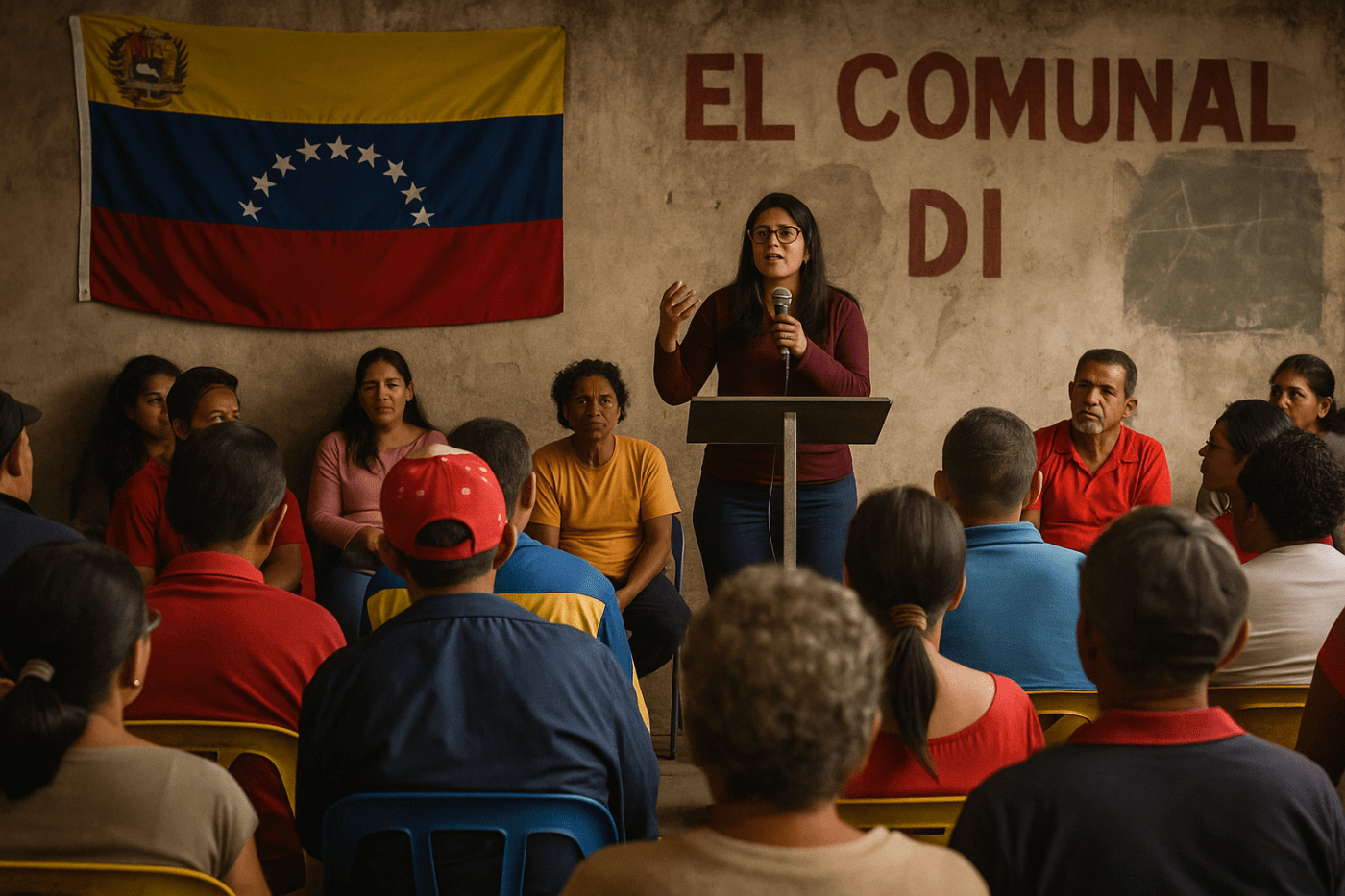
But buried beneath the rubble of imperial narrative warfare is another story — one you won’t find in the pages of the Wall Street Journal or on NPR’s airwaves. This week, Venezuelanalysis published a piece titled “Concrete Results That Benefit Communities: Venezuelans Pick State-Funded Projects.” It documents how, despite sanctions, sabotage, and suffocating propaganda, ordinary Venezuelans across 335 municipalities are directly selecting over 2,500 community infrastructure projects — funded and implemented through participatory governance mechanisms. Roads, clinics, housing, water systems — all chosen, debated, and led by local communal councils.
You won’t hear a whisper of this in Western media. Not because it’s unimportant, but because it is unacceptable. The idea that a socialist government under siege could still be empowering the poor, decentralizing planning, and executing popular projects shatters the imperial narrative. It challenges the lie that Venezuela is nothing but dictatorship and dysfunction. It reveals what empire fears most: an example.
The blackout is not accidental. It is strategic. Because if people in the imperial core knew that, even under sanctions and economic siege, Venezuelans were still participating in grassroots governance and shaping their communities — they might start asking uncomfortable questions. Questions like: what if socialism in the 21st century doesn’t look like the Soviet Union, but like a neighborhood assembly choosing how to rebuild a flood-damaged bridge? What if the “failed state” is actually a laboratory of survival and sovereignty? What if “freedom” doesn’t come from Washington — but from the people themselves?
This is why stories like this are ignored, dismissed, or buried. Not because they lack facts — but because they contain revolutionary truths. They show that another way is not only possible — it’s already happening. And that is the one thing the empire cannot afford for you to believe.
II. Communes Under Siege: The Bolivarian Revolution and the War Against Popular Power
To understand what’s actually happening in Venezuela — and why the corporate press refuses to talk about it — we have to go deeper than the headlines. We have to understand Venezuela not as a “crisis zone,” but as a revolutionary experiment struggling to survive under siege. Since the beginning of the Bolivarian process in 1999, the Venezuelan state — under Hugo Chávez and now Nicolás Maduro — has attempted something unprecedented in the modern capitalist world system: to use state power to dismantle oligarchic privilege and redistribute political, social, and economic power downward into the hands of the poor.
At the heart of this effort lies the commune. Not just a buzzword, but a structural form of dual power — where communities organize through communal councils to deliberate, plan, and control the material development of their own neighborhoods. These councils are made up of elected spokespeople, open assemblies, and sectoral working groups — all rooted in radical democratic practice. In its most advanced form, the commune links multiple councils together under a shared territorial and economic vision. As Venezuelanalysis explains, this structure was not imposed from above — it was demanded from below, forged in the crucible of popular struggle and later institutionalized by the Chávez government as a cornerstone of “21st-century socialism.”
This is the story that corporate media can’t tell — because it violates every ideological pillar of capitalist realism. It shows poor, working-class, Black and Indigenous Venezuelans engaging in planning and decision-making normally reserved for bureaucrats, technocrats, and capitalist developers. It reveals a process in which the state is not suppressing the people, but yielding to their authority. And most importantly, it exposes the fact that socialism — even in a distorted or besieged form — can generate mechanisms of direct, bottom-up democracy within the capitalist world system.
But this process has never been allowed to unfold peacefully. From the 2002 U.S.-backed coup against Chávez, to the economic sabotage by domestic capitalists, to the thousands of unilateral sanctions imposed by Washington and its allies, Venezuela has faced an unrelenting campaign of imperial destabilization. Each attempt to deepen participatory democracy has been met with counter-offensives: shortages, blackouts, inflation, street violence, currency warfare, and diplomatic isolation. The goal has always been the same — to strangle the revolution economically, discredit it politically, and force its retreat ideologically.
Yet despite this war of attrition, the Bolivarian government has continued to defend the commune as both a concept and a practice. And the people — especially those historically excluded from power — have continued to organize, deliberate, and struggle for autonomy. That is the dialectical contradiction of Venezuela today: a state apparatus caught between the pressures of imperial war and the demands of a revolutionary people, attempting to navigate survival while building toward socialism. It is not utopia. It is not hell. It is an unfolding struggle — and it deserves to be studied, not smeared.
What is at stake here is not just Venezuela’s sovereignty. It is the global imagination. If the commune is possible — if the people can plan — then everything neoliberalism tells us is false. If socialism can survive without mass repression, with vibrant debate and participatory democracy, then the entire Western narrative collapses. That is why they must bury the story. And that is why we must excavate it.
III. Socialism by the People: What the Commune Teaches the World
The commune is not a utopian fantasy — it is a practice born of necessity, sharpened in struggle, and grounded in the material lives of Venezuela’s poor. While the Western media bombards the world with images of “socialist failure,” ordinary Venezuelans are building new systems of power that bypass the oligarchy, the bureaucracy, and the corporate marketplace. This isn’t socialism from a textbook — it’s socialism from the barrio. And it looks like this: a community assembly debating where to build a water tank, a group of women forming a bakery cooperative, a campesino council seizing land and planting food for collective survival.
The commune is not separate from the state — nor is it fully absorbed by it. It is a dialectical tension: both a product of the Bolivarian Revolution and a force that pressures it to deepen and radicalize. It is revolutionary governance that does not wait for permission. It is the people — the workers, the poor, the marginalized — becoming subjects of history rather than objects of reform. And it is precisely this that scares the empire: the idea that socialism can be participatory, messy, popular, and still resilient.
This is why Venezuela is under siege. Not because it threatens U.S. security, but because it threatens U.S. ideology. It threatens the lie that there is no alternative. It threatens the myth that people cannot govern themselves. It threatens the assumption that the state must serve capital and not the masses. Venezuela’s communes — even in their unevenness, their contradictions, their vulnerabilities — expose the falsity of these myths.
And they offer something more: instruction. They teach us that socialism is not built in parliaments alone. It is built in assembly halls, in fields, in kitchens, in neighborhoods. It is not handed down — it is constructed from below. It is shaped by conditions, limited by material constraints, attacked by imperial powers — and yet, it grows. Venezuela’s communes show us what it looks like when the people are not just asked to vote every four years, but to plan, decide, and organize every day.
This is the story we are not allowed to hear. This is the democracy the U.S. State Department won’t recognize. This is the revolution that Bloomberg will never profile, and CNN will never broadcast. Because if they did, we might begin to imagine our own power. We might look at our cities, our workplaces, our schools — and ask why we aren’t deciding anything. We might realize that our so-called “freedom” is nothing more than managed consent under capitalist dictatorship.
Venezuela’s communal democracy isn’t perfect. But it is real. And it is a threat — not because it is violent or “authoritarian,” but because it is radically democratic. That is the most dangerous thing a people can be.
IV. The Example Must Not Be Forgotten: What Venezuela Demands From Us
In a world saturated with capitalist despair, Venezuela dares to dream — and more importantly, to organize. That’s why the empire fears it. Not because it’s perfect, or powerful, or even particularly prosperous. But because it’s a mirror we’re not supposed to see. Because in the barrios of Caracas and the rural communes of Lara and Apure, there is proof — living, breathing proof — that even under siege, even with meager resources, even after decades of sabotage and propaganda, the people can govern themselves.
The United States government — and the oligarchs it serves — cannot afford for that truth to spread. That’s why they smear it, sanction it, and silence it. The media doesn’t ignore Venezuela because it’s irrelevant. They ignore it because it’s dangerously relevant. Because its experiment — imperfect, uneven, but revolutionary — offers lessons to every colonized, exploited, and working-class people on this planet.
And what are those lessons? That democracy is not just voting — it is planning. That socialism is not just policy — it is power in the hands of the poor. That sovereignty is not just about borders — it is about production, decision-making, and collective life. That imperialism cannot tolerate alternatives — and that building one is already a kind of war.
So what does Venezuela demand from us — especially from those of us in the heart of empire? First, clarity: the clarity to see through the fog of lies and name the forces at work — Wall Street, the CIA, NATO, the corporate press, the NGO complex. Second, solidarity rooted in history: from the brave defenders of the Venezuelan embassy in Washington D.C. during the 2019 coup attempt — activists from Codepink, the ANSWER Coalition, and beyond — to those who’ve blocked weapons shipments, disrupted IMF meetings, or challenged sanctions from inside the imperial core.
These were not acts of charity. They were acts of resistance. They reminded the world that not everyone inside the U.S. accepts the empire’s crimes in our name. They showed that revolutionary internationalism is not nostalgia — it is a task of today. A task that demands we study the commune not as an exotic relic, but as a living weapon — to be adapted, expanded, defended.
The barricades of the future won’t be built with slogans alone. They’ll be built with food networks, tenant unions, worker assemblies, youth councils, people’s clinics, revolutionary cooperatives. The commune is not just Venezuela’s inheritance — it is ours too, if we are bold enough to claim it. But first, we have to lift the blackout. We have to tear down the veil of lies, and show the world what they were never supposed to see.
Venezuela is not a failed state. It is a besieged revolution. And it is still fighting. So must we.
 Weaponized Information
Leave a comment