Editorial Introduction
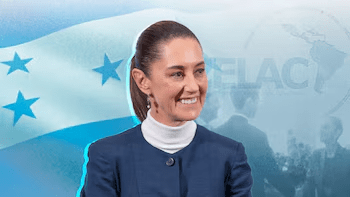
At the 9th Summit of the Community of Latin American and Caribbean States (CELAC) held in Tegucigalpa, Honduras, Mexican President Claudia Sheinbaum delivered a stirring address emphasizing Latin American unity, mutual respect for sovereignty, and a vision of shared prosperity. Representing the political vision known as the “Fourth Transformation,” Sheinbaum advocated a renewed regionalism rooted in dignity, independence, and justice. She called for an end to blockades on Cuba and Venezuela, for a humanist approach to migration, and proposed a CELAC-led summit to advance economic well-being across Latin America and the Caribbean. Her remarks mark a historic intervention from Mexico’s first woman president at a critical geopolitical juncture for the region.
Full Speech by Claudia Sheinbaum at the 9th CELAC Summit
CLAUDIA SHEINBAUM PARDO, President of Mexico:
Thank you very much, dear President of the Republic of Honduras, Xiomara Castro Sarmiento, President pro tempore of the Community of Latin American and Caribbean States.
Congratulations, Xiomara. Thank you for your excellent leadership of CELAC, your courageous leadership of CELAC. And, of course, I greet the people of Honduras, and I thank you for your generous welcome, always.
Greetings to Gustavo Petro, President of the Republic of Colombia, who will receive the Pro Tempore Presidency of CELAC in this symbolic and historic meeting; to President Lula of Brazil; President Luis Alberto Arce of Bolivia; President Díaz Canel of Cuba; President Arévalo of Guatemala; Prime Minister Everard of St. Vincent; Prime Minister Phillips of the Republic of Guyana; President Yamandu of Uruguay; and the President of the Transitional Council of Haiti.
Thank you very much for listening to us and thank you very much for calling this meeting.
I come on behalf of a generous and supportive people, who for more than six years have embarked on a new course. In Mexico we call this the Fourth Transformation of Public Life, and our belief system, Mexican Humanism. Every single day we consolidate rights for the people of Mexico, rights that were taken away from them during the neoliberal period.
Our foundations, two pillars: the magic and wisdom of the indigenous peoples who forged glorious civilizations long before the Spanish invasion; and the other, the fruitful political history of a people with extraordinary heroes and heroines, who built a free, independent, and sovereign country, which is more prosperous by the day.
We have succeeded in separating economic power from political power in Mexico. Disdain for the people is a relic of the past, and today a new era is being built with democracy and equality, based on the maxim of shared prosperity, or as we say in Mexico: “For the good of all, the poor come first,” a phrase that should spread from Mexico to the entire world.
Today, 15 years after the first meeting of this Community, we find ourselves in a very different international scenario. These are times of profound changes in world trade that affect our countries. Each of us, legitimately, seeks the best for our peoples and nations.
However, I believe that today, more than ever, is a good time to recognize that Latin America and the Caribbean require unity and solidarity from their governments and their peoples, in order to strengthen greater regional integration, always within the framework of mutual respect and adherence to the sovereignty and independence of our countries and the trade agreements that each of us may have.
Latin America and the Caribbean are not only a region marked by geographic proximity. We are a community of destiny, united by history, diversity, resistance and, above all, dreams of justice.
From Mexico, we start from a basic premise: a more united region is a stronger region that can articulate solutions and concrete proposals for regional integration and actions based on cooperation in trade, education, science, technological development, clean energy, biodiversity conservation, with the vision of always building more egalitarian societies.
No country in Latin America and the Caribbean should be left behind, no child in Latin America and the Caribbean should be left behind, no man or woman in Latin America and the Caribbean should be left behind.
Our population, still young, numbers 663 million people, with a gross domestic product totaling nearly 6.6 trillion dollars. We are the world’s leading net food exporter.
Our lands are still fertile for agriculture, despite everything that has occurred in our history. We account for more than 30 percent of the planet’s primary forests, 33 percent of fresh water, almost 20 percent of the world’s oil reserves, at least 25 percent of its strategic minerals, and we are capable of strengthening development with justice and environmental protection, and mitigating and adapting to climate change.
There are many examples of regional cooperation and integration that do not weaken but rather complement each other. I will mention a few: food self-sufficiency that promotes trade in complementary agricultural products, energy security, the consolidation of a plan for health self-sufficiency that includes a platform of regulatory agencies that facilitates the production and mutual recognition of pharmaceuticals produced in the region, the supply chains of medical equipment between our countries. Scientific collaboration and technological development, as well.
Therefore, today I have a proposal for you:
I propose that CELAC convene a “Summit for the economic well-being of Latin America and the Caribbean” to make greater regional economic integration a reality on the basis of shared prosperity and respect for our sovereignties.
The history of Latin America and the Caribbean, since the struggle for our independence, has been characterized by solidarity and mutual support. Today should not be the exception; these are times of greater commitment, in order to promote the improvement and wellbeing of our peoples.
I cannot fail to mention the need to cooperate in attending to the phenomenon of migration from a humanist perspective. Our historical position has been that the most humane way to do so and with greater results is to address the structural causes of inequality, unemployment and violence that spur migration.
We reject racism, classism, the violation of human rights and the criminalization of our brothers and sisters from our continent who, for whatever reason, have had the need to migrate north.
For us, Mexican migrants are heroes and heroines, who take care of their families in Mexico, but who also sustain a good part of the economy of the United States.
It is also necessary to loudly and clearly proclaim that we reject, as Mexico has historically done, sanctions and trade blockades that only harm the wellbeing of peoples and do not build regions of peace and prosperity. No to the blockade of Cuba. No to the blockade of Venezuela.
Our foreign policy is characterized by the quest for peace and dialogue as a means to resolve conflicts, as well as always respecting national self-determination. We support the call for a meeting centered on peacebuilding in Haiti.
Heads of State and Government, representatives of Governments and States:
As the first woman President of Mexico, an extraordinary country, with a glorious people, I would like to share with you the lesson that we have learned in Mexico, that, in the face of adversity, there is always hope, and hope today is unity.
Long live Latin America and the Caribbean!
 Weaponized Information
Leave a comment