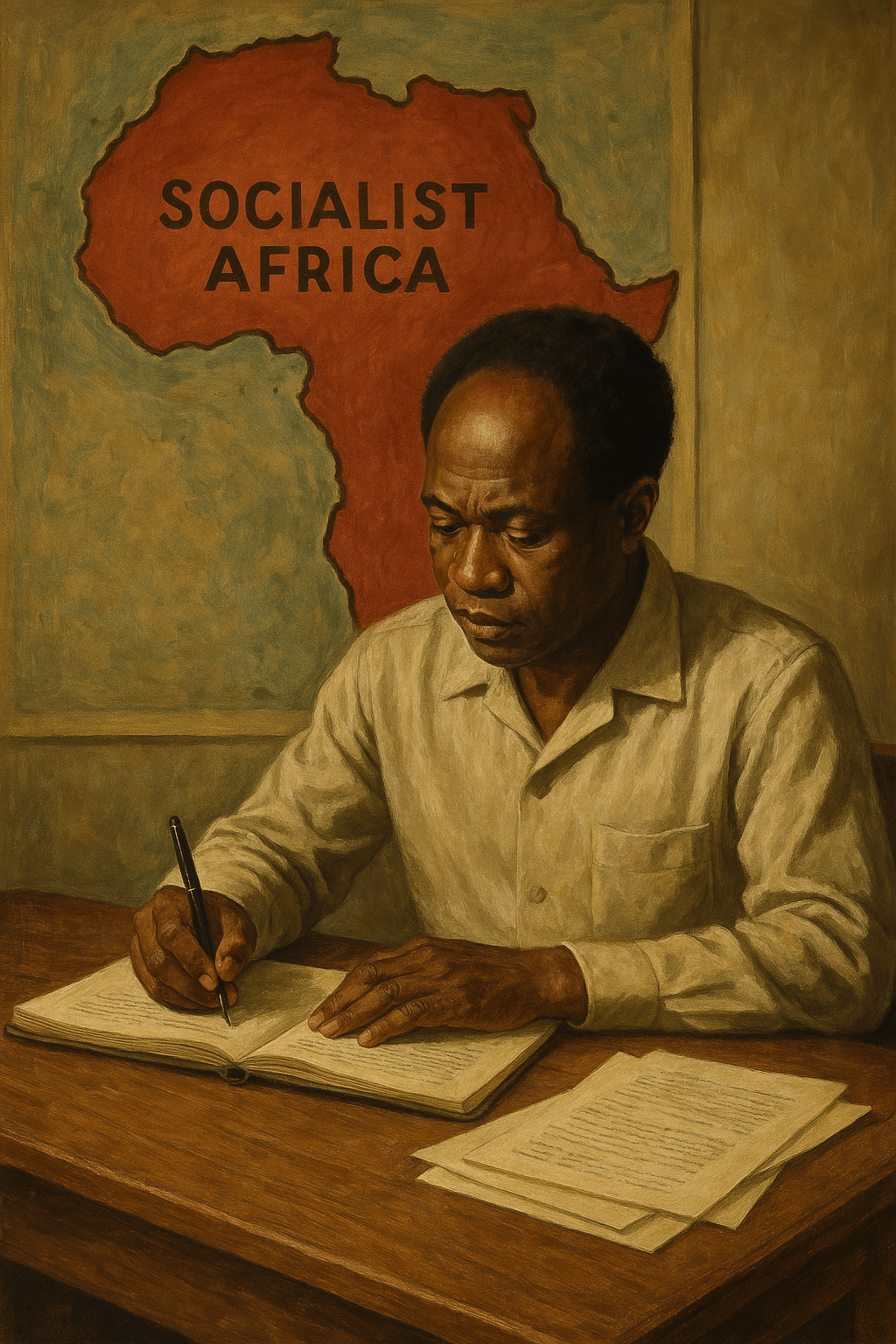
Why They Had to Overthrow Nkrumah
“Revolutions are brought about by men, by men who think as men of action and act as men of thought.” — Kwame Nkrumah
Kwame Nkrumah was more than Ghana’s founding president. He was the embodiment of the African revolution—a Marxist, a Pan-Africanist, and an anti-imperialist who understood that flag independence without economic liberation was a fraud. He rejected the idea that newly independent states should become Western clients. He refused to let Ghana become a puppet of the IMF. And for that, he became a target.
From the moment Ghana gained independence in 1957, Nkrumah sought to go beyond mere symbolism. His vision was not just for Ghana—it was for all of Africa. He pushed for continental unity, socialist transformation, and a coordinated struggle against the global capitalist system. His writings exposed the hidden hands of neo-colonialism long before most of the world dared speak of it. And his policies—state planning, industrialization, education for the masses—threatened to make that vision real.
But the empire was watching. The CIA infiltrated his inner circle. Western banks conspired to sabotage his economy. The media called him a dictator, a megalomaniac, a threat to democracy. And in 1966, while Nkrumah was abroad trying to negotiate peace in Vietnam, they struck.
The coup that overthrew Nkrumah was not spontaneous. It was manufactured. And the story told afterward—that Nkrumah had become authoritarian, that he had lost the people—was the same script used against every revolutionary who dared to wield power in defense of the oppressed.
Nkrumah was not overthrown because he failed. He was overthrown because he was winning.
Part I: The Path to Power and the Meaning of Independence
Kwame Nkrumah did not rise to power through foreign support or elite patronage. He rose through the people. As the secretary of the United Gold Coast Convention and later founder of the Convention People’s Party (CPP), Nkrumah built a mass movement that united workers, farmers, students, and the unemployed. His slogan—Self-Government Now!—electrified the nation.
While others called for gradual reform, Nkrumah called for revolution. And when the British jailed him, the people voted him into office from a prison cell. That was not the act of a tyrant—it was the proof of mass support. In 1957, Ghana became the first sub-Saharan African country to win independence, and Nkrumah became Prime Minister. But he was not content with political theater. He knew that colonialism had simply changed clothes.
Under Nkrumah, Ghana began a radical transformation. He expanded free education, built hundreds of schools, launched massive infrastructure projects, and laid the groundwork for a national industrial base. He promoted women’s rights, unionization, and science. The Volta River Project became a symbol of African-led development—an ambitious effort to power the country through hydroelectric energy.
But these were not just development programs. They were revolutionary in scope and intention. Nkrumah was building a sovereign economy, one that rejected dependency on the West. He nationalized key industries and refused to privatize Ghana’s resources. He saw clearly that capitalism and colonialism were twin forces—and that independence without socialism was a lie.
Part II: The Vision—Pan-Africanism, Socialism, and True Decolonization
Nkrumah knew that political independence was meaningless without economic power. In Africa Must Unite and Neo-Colonialism: The Last Stage of Imperialism, he laid out his vision with surgical clarity: the struggle was not over when the colonizers lowered their flags. It had only changed form.
Neo-colonialism, he argued, was more dangerous than direct colonial rule. It disguised itself in aid packages, development loans, and diplomatic smiles. It used debt instead of whips, consultants instead of soldiers. The old empires, now joined by new ones, would not allow Africa to rise united and self-sufficient. They would divide, destabilize, and drain the continent—unless Africans united to stop them.
Nkrumah’s Pan-Africanism was not a poetic dream. It was a strategic necessity. He called for the immediate formation of a continental union government. A shared military, a common currency, a unified industrial strategy. He understood that Africa’s balkanized borders were colonial scars—and that unless the continent acted as one, it would be picked apart by global capital.
But unity was not enough. Nkrumah demanded socialism. He rejected the capitalist path because he had studied its consequences. He had lived in the United States and seen Black Americans treated as second-class citizens. He had seen poverty in the belly of the beast. And he understood that the only way Africa could be truly free was to break from the global system that had been built on its extraction and suffering.
Under his leadership, Ghana became a laboratory of African socialism. The state played the central role in planning, production, and redistribution. Foreign investment was regulated. Education was retooled to reflect African history and revolutionary consciousness. Science and technology were prioritized not for profit, but for sovereignty.
This was not dogma—it was a revolutionary attempt to carve a new path for the Third World. One based on solidarity, not subjugation. One grounded in Marxism, shaped by African conditions, and aimed at total liberation.
Part III: The Coup—How the CIA, World Bank, and Western Capital Destroyed a Revolution
Nkrumah’s downfall was not the product of internal failure—it was the outcome of international sabotage. By the mid-1960s, he had become a marked man. The CIA had placed agents inside his administration. Western intelligence closely monitored his travel, communications, and diplomatic network.
In 1966, while Nkrumah was abroad on a peace mission to Hanoi, his government was overthrown in a military coup. The Western press immediately cheered. But years later, declassified documents confirmed what revolutionaries already knew: this was a CIA-engineered operation, greenlit to crush a model of independent African socialism before it could spread.
The coup didn’t just remove Nkrumah. It reversed the revolution. Privatization returned. The IMF and World Bank stepped in. Ghana was brought back into the orbit of dependency. The comprador elite reclaimed power.
Nkrumah found exile in Guinea, where Sekou Touré made him honorary co-president. He continued writing, analyzing imperialism, and warning the continent: unity and socialism were not optional—they were survival.
Part IV: The African Left That Abandoned Nkrumah—And the Empire That Rejoiced
When Nkrumah fell, many African liberals and even leftists joined the chorus of condemnation. They called him authoritarian, idealistic, out of touch. They wanted development without rupture. Revolution without risk.
But Nkrumah had seen further. He knew capitalism would not allow a peaceful road to socialism. He knew independence required confrontation with global finance capital. And he understood that to hold power for the people, you had to build a new state—not just inherit a colonial one.
The post-coup African left retreated into respectability, speaking in the language of donors and NGOs. They buried the revolutionary tradition Nkrumah embodied. But the cost was clear: the dream of African liberation was replaced with managed poverty.
Conclusion: Nkrumah and the African Future
Kwame Nkrumah is not a relic. He is a roadmap. A revolutionary who saw the future of Africa with clarity and courage. He understood that unity without ideology is weakness. Independence without socialism is a lie. And revolution without state power is defeat.
His fall was not inevitable—it was engineered. His ideas were not utopian—they were urgent. And his legacy is not over—it is rising again.
If Africa is to be free, it will not be by imitating the West. It will be by returning to Nkrumah—not as nostalgia, but as strategy.
 Weaponized Information
Leave a comment