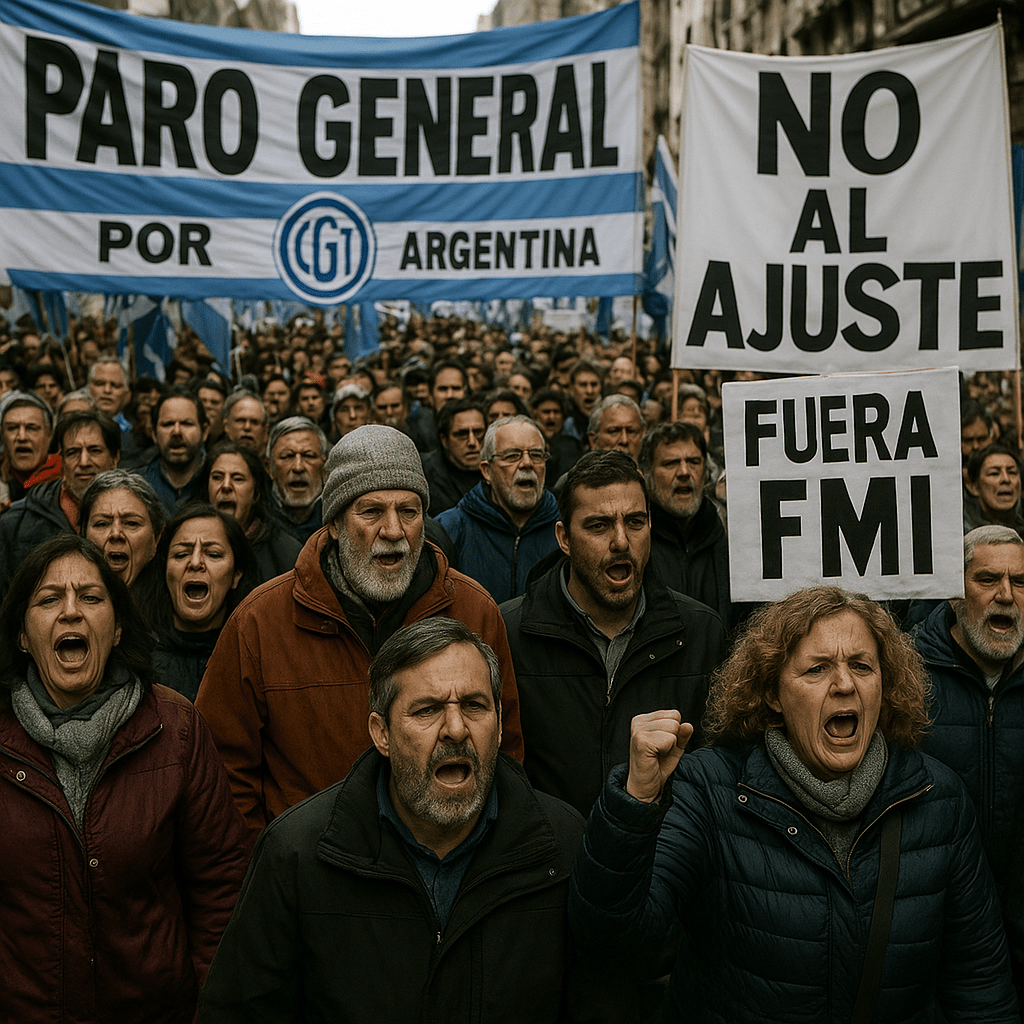
As Milei accelerates neoliberal collapse in service of Wall Street and the IMF, Argentina’s workers bring the country to a halt—reminding the world that the people still have veto power in the streets.
Buenos Aires didn’t fall silent—it shut down with a roar. On April 10, Argentina’s streets became the frontline in a continental war: not of bullets, but of austerity, algorithms, and class annihilation. Trains and buses halted. Ports locked down. Schools emptied. Air travel suspended. It was the second general strike since Javier Milei took office—an unmistakable sign that the working class has seen through the chainsaw rhetoric and knows exactly whose neck is on the chopping block.
This is not just a labor action. It’s a political revolt against imperialism’s newest software update: Milei.
Since assuming office, President Milei has unleashed a ferocious structural adjustment package reminiscent of the IMF’s darkest playbooks. In just three months:
- Inflation surged past 250% year-over-year—the highest in the world.
- The peso was devalued by more than 50% overnight.
- Utility subsidies were slashed, tripling energy and transport costs.
- Real wages dropped by 19% in the first quarter alone.
- Food prices jumped 70%, pushing 60% of the population below the poverty line.
This is technofascism in its raw form: austerity as ideology, data as justification, and social collapse as economic “discipline.” It is the IMF’s logic on fast forward—accelerated not to solve the crisis, but to deepen dependency. In March, IMF officials praised Milei for making “swift progress” on fiscal targets. What they meant was: he’s making the rich richer and the poor hungrier faster than anyone expected.
Make no mistake—this is not policy, it’s counterinsurgency. The strike, led by the CGT and embraced by militant teachers, nurses, transit workers, and the unemployed, is not simply a call for wage increases. It is a defense of life against a government committed to eradicating every remnant of the social contract.
Milei’s “Chainsaw Plan” is not nationalist. It is the dream of BlackRock, JP Morgan, and the IMF brought to life through the mouth of a YouTube libertarian. It proposes full privatization of state oil company YPF, the national airline, public pensions, and even water infrastructure. His dollarization fantasy is not about stability—it’s about surrendering Argentina’s monetary sovereignty to the Federal Reserve.
But Argentina knows this game. The memory of 2001’s rebellion—when millions rose up against IMF-imposed misery—is not a relic. It’s a lesson. In this general strike, that memory takes form. And it is not nostalgic. It is tactical.
The strike was not merely a stoppage. It was a reassertion of collective power. It disrupted $1.2 billion in economic activity in 24 hours. It revealed the fragility of Milei’s so-called “recovery.” It exposed how little governance he has, how much repression he requires, and how little patience remains among the people.
From a broader lens, Milei’s project is not an Argentine aberration. It is the pilot program for a hyper-imperial doctrine: how to convert a country’s debt crisis into a digital enclosure. First, financialize the state. Then gut it. Then sell what’s left to Wall Street while punishing those who resist as enemies of order.
And yet, resistance grows. Across the Global South—from Port-au-Prince to Quito to La Paz—people are saying no to austerity-by-algorithm. They are learning that what’s called “modernization” by the IMF is just recolonization with Excel sheets.
Argentina’s strike is not a demand. It is a warning. And it is also a lesson: that sovereignty begins in the streets, and that when capital wages war from above, the people must shut the country down.
Milei governs for the creditors. The people, this week, governed the streets. And that contradiction—between comprador technocracy and popular insurgency—is now the terrain of struggle in Argentina. And beyond.
Propagate The Revolution:
- Share on X (Opens in new window) X
- Share on Facebook (Opens in new window) Facebook
- Share on Reddit (Opens in new window) Reddit
- Share on Telegram (Opens in new window) Telegram
- Share on Threads (Opens in new window) Threads
- Share on X (Opens in new window) X
- Print (Opens in new window) Print
- Email a link to a friend (Opens in new window) Email
- Share on LinkedIn (Opens in new window) LinkedIn
- Share on Tumblr (Opens in new window) Tumblr
- Share on WhatsApp (Opens in new window) WhatsApp
 Weaponized Information
Leave a comment