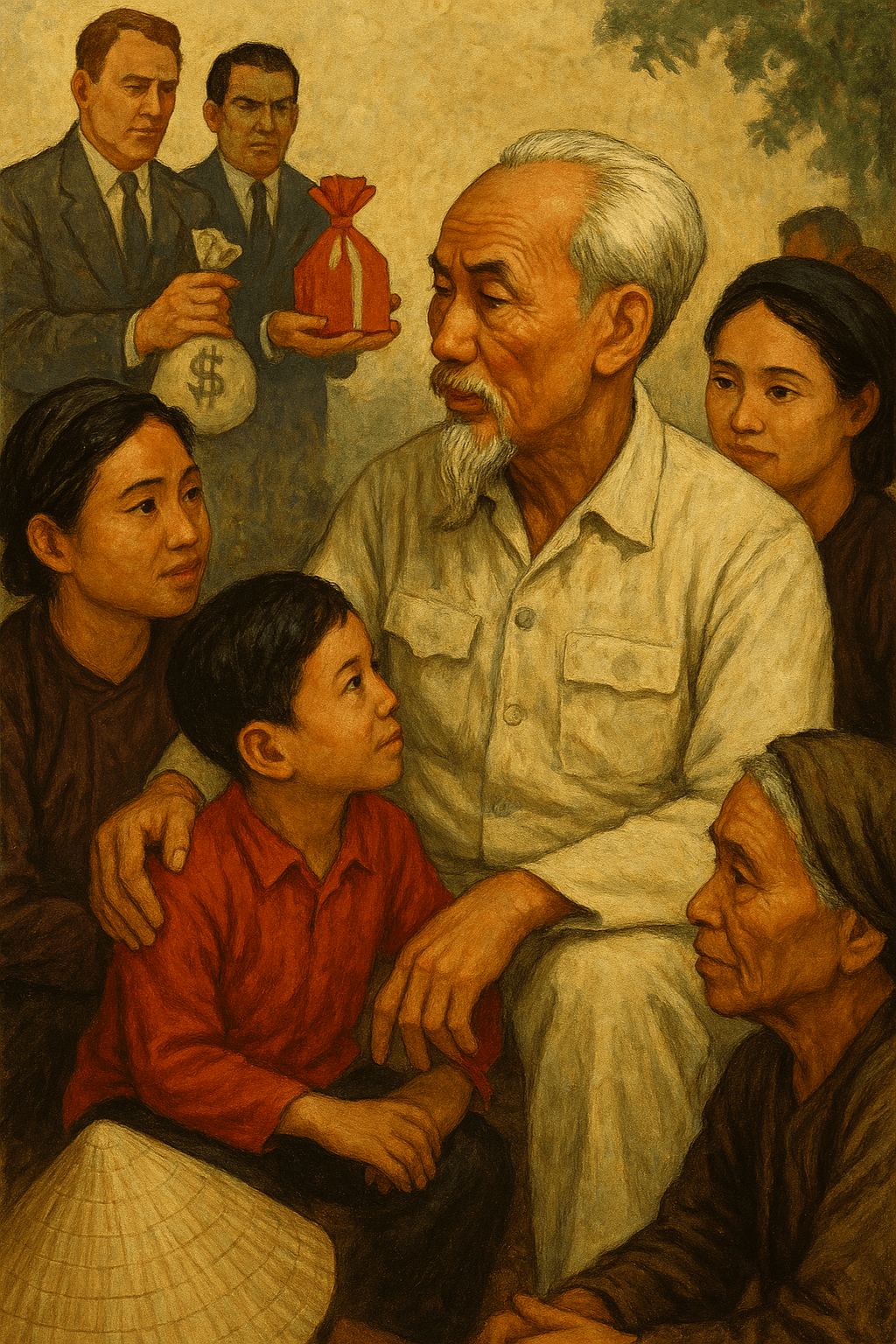
The Man Who Beat the West
“Nothing is more precious than independence and freedom.” — Ho Chi Minh
The West has a habit of rewriting history to make itself feel better. So when a poor peasant revolutionary from Vietnam outsmarted, outlasted, and outfought not one, but two global empires—France and the United States—they had to come up with an explanation. They said he was a puppet. A nationalist. A pragmatist. Anything but what he actually was: a Marxist-Leninist revolutionary of the highest order.
Ho Chi Minh didn’t just liberate Vietnam. He humiliated the myth of Western superiority. He proved that peasants armed with theory, discipline, and political clarity could destroy imperial armies backed by billions. He built a revolutionary movement that combined anti-colonial struggle with socialist transformation. He educated, organized, and mobilized the most dispossessed layers of Vietnamese society into a force that shattered colonialism and laid the foundation for socialism.
The empire had no answer for Ho—so it lied. It erased his theory, mocked his simplicity, and labeled him a moderate. They called him “Uncle Ho” like he was harmless. But Ho was a tactician, a cadre, a communist trained in global class war. He studied in Paris, agitated in Harlem, organized in Moscow, and returned to the rice fields with one goal: to free his people and destroy the system that made them slaves.
This article is not about glorifying Ho Chi Minh. It’s about reclaiming him. Re-inserting him into the revolutionary canon where he belongs—not as a soft-hearted nationalist, but as a hardened revolutionary who fused Marxist science with anti-colonial strategy. He was no puppet. And he damn sure wasn’t a hoe.
He was a soldier of the poor, a servant of the people, and a symbol of what it looks like when revolution is done right—disciplined, ruthless, and rooted in love for the masses.
Part I: From Colonial Subject to Revolutionary Communist
Ho Chi Minh was born in 1890 in a colonized Vietnam carved up by the French and exploited for rice, rubber, and labor. He witnessed firsthand the brutality of colonial rule—the racial hierarchy, the land theft, the famine, the prisons. But Ho didn’t just get angry—he got organized. He left Vietnam not to escape but to study the world, learn its contradictions, and arm himself for war.
He worked as a kitchen hand, a baker, a sailor. He labored in Harlem, marched in Paris, and wrote revolutionary propaganda in multiple languages. While traveling, he saw the global nature of oppression: Black people in the U.S., Africans in the colonies, poor workers in Europe. And he saw clearly that the enemy was not just France, but the entire imperialist system.
In Paris, he joined the French Communist Party and founded the Union Intercoloniale. In 1920, he supported the Communist International and denounced socialists who refused to stand with colonized people. He rejected narrow nationalism and bourgeois politics. Instead, he began building what would become a revolutionary strategy for global decolonization: internationalist, anti-capitalist, and uncompromising.
He studied in the Soviet Union, trained in China, and began forming a political apparatus rooted in Vietnamese peasants and workers. In 1930, he helped found the Indochinese Communist Party—not to win votes, but to win power. His goal was never reform. It was revolution.
What made Ho dangerous was not just his ideology—it was his clarity. He knew the Vietnamese peasantry would be the base of the revolution. He knew that liberation would come through land redistribution, political education, and armed struggle. And he knew that to defeat the empire, you had to outlast it, outthink it, and out-organize it.
By the time WWII broke out, Ho had built a clandestine network of cadres, rooted in the villages and forests, disciplined in theory and committed to class struggle. The Vietnamese revolution was no accident. It was the product of thirty years of planning—and Ho was its principal architect.
Part II: The Vanguard Party and the Long War for Liberation
Ho Chi Minh didn’t just theorize revolution—he built the disciplined, clandestine apparatus needed to carry it out. The Indochinese Communist Party was the nucleus of that effort. But theory without struggle is dead, and Ho understood that revolution in Vietnam would have to be forged in war.
In 1941, he helped form the Viet Minh—a united front under communist leadership to fight both Japanese fascism and French colonialism. It was the first major effort to build dual power in Vietnam: a revolutionary military-political structure rooted in the peasantry, dedicated to armed struggle and mass education.
The Viet Minh didn’t just fight—they governed. In liberated zones, they redistributed land, taught literacy, trained health workers, and built the embryo of a new revolutionary state. Cadres were expected to serve the people completely: to eat less, sleep less, and never use their positions for personal gain. This wasn’t just moralism—it was political strategy. Ho knew that the trust of the people was a weapon stronger than any rifle.
When Japan surrendered in 1945, Ho declared Vietnam’s independence before half a million people in Hanoi. But French imperialism, backed by U.S. logistics, returned to reconquer the country. The First Indochina War began—and it would be a long one.
For eight years, the Viet Minh waged guerrilla war, ambushing supply lines, dissolving into villages, and slowly bleeding the colonial army. They turned every jungle path and rice paddy into a battlefield. And it was the people—not a standing army—who made this possible. Farmers, teachers, children, elders: they all became part of the resistance.
In 1954, at Dien Bien Phu, the French military was decisively defeated. It wasn’t just a military victory—it was a shattering of the illusion of Western invincibility. A peasant army, led by communists, had destroyed a major European power. It sent shockwaves through the colonial world—and panic through Washington.
But victory was incomplete. The Geneva Accords split Vietnam in two: North Vietnam under Ho’s leadership, and the South under U.S.-backed comprador rule. Ho had won the war—but the empire wasn’t done.
And neither was Ho.
Part III: Defeating French Imperialism—And Then U.S. Empire
After the Geneva Accords, Ho Chi Minh governed the North with a clear mandate: build socialism, defend the revolution, and prepare for reunification. While Western media framed it as a “partition,” Ho and the Vietnamese people never accepted a divided nation. For them, it was a temporary arrangement, forced by foreign powers to contain the spread of communism.
In South Vietnam, the U.S. moved quickly to install a neocolonial dictatorship under Ngo Dinh Diem—a Catholic autocrat ruling a majority Buddhist peasantry with brutal police, elite landlords, and CIA advisors. Elections promised in the Geneva Accords were canceled once Washington realized Ho would win by a landslide. So they defaulted to their favorite system: dictatorship in the name of “democracy.”
While Ho led land reform and socialist development in the North—distributing land to peasants, building literacy programs, and training a new generation of party cadres—he quietly supported the southern resistance. By 1960, the National Liberation Front (NLF), known in the West as the Viet Cong, emerged as the vanguard of anti-U.S. struggle in the South.
Ho never separated war from politics. Guerrilla struggle, political education, mass mobilization, and international diplomacy all formed part of a single revolutionary strategy. He knew the U.S. would bring more troops, more bombs, more terror. And he knew they could be defeated—not by outgunning them, but by outlasting and out-organizing them.
The Vietnam War, or the Second Indochina War, was not just a national struggle—it was the front line of the global anti-imperialist revolution. And Ho Chi Minh was its most disciplined commander. He led from behind the scenes in his later years, but his moral authority, political clarity, and revolutionary legacy were foundational.
The U.S. dropped more bombs on Vietnam than on all of Europe during WWII. It used chemical warfare, torture, and scorched earth tactics. But it never broke the will of the Vietnamese people. Why? Because the revolution had been built from below. Because the cadres were trusted. Because the Party delivered land, education, dignity—and demanded discipline.
Ho Chi Minh died in 1969, before final victory. But when the U.S. fled in 1973, and Saigon fell in 1975, it was clear: Ho had won.
He had not just defeated U.S. empire on the battlefield. He had disproven every lie it told about itself.
Part IV: Ho’s Revolutionary Vision—Not Stalin’s Puppet, Not a Nationalist
Western propaganda has always tried to reduce Ho Chi Minh to one of two things: either a Soviet puppet or a soft nationalist. Both are lies. They erase the revolutionary content of his politics, the ideological clarity of his leadership, and the global significance of the Vietnamese revolution.
Ho was a Marxist-Leninist to the core. He believed in class struggle, the vanguard party, and the dictatorship of the proletariat. But he wasn’t dogmatic. He adapted theory to the concrete conditions of Vietnam—rural, colonized, semi-feudal—and forged a uniquely Vietnamese road to socialism. He emphasized land reform, cadre development, and peasant alliances not because he rejected Marx, but because he understood Marxism as a living science, not a European dogma.
His vision was never about national independence alone. It was about national liberation as a stage of proletarian revolution. He knew that kicking out the French or the Americans wasn’t enough. The landlords had to go. Capitalist relations had to be uprooted. A new socialist order had to be built.
In his writings and speeches, Ho made clear that the goal was not simply to free Vietnam—it was to create a classless, democratic society led by workers and peasants. He saw the Party not as a bureaucratic elite but as a revolutionary school, a living link between theory and struggle. He insisted on simplicity, discipline, and humility among cadres. And he constantly emphasized serving the people—not managing them.
Ho also rejected the chauvinism and arrogance of some segments of the international left. He built strong alliances with the Soviet Union and China, but Vietnam’s revolution remained fiercely independent. He called for solidarity between colonized peoples, supported the Cuban Revolution, and denounced U.S. imperialism from the halls of the UN to the rice paddies of the North.
Ho’s vision was global. His method was mass-based. And his ideology was revolutionary. To reduce him to a “patriot” or a “moderate” is to whitewash the truth: Ho Chi Minh was a disciplined, anti-colonial communist who proved that Marxism could be rooted in the Global South and still win.
Ho Lives Wherever People Fight to Be Free
Ho Chi Minh didn’t lead Vietnam to freedom by accident. He did it through theory, discipline, and a revolutionary love so deep it outlived bombs, blockades, and betrayal. He didn’t seek glory. He sought power for the people. He didn’t chase ideology for ideology’s sake—he fused it with the lived experience of the colonized, and forged a weapon the empire couldn’t disarm.
His revolution was not just about Vietnam. It was about the wretched of the earth. It was a model for how the colonized can seize their future. Ho didn’t just fight occupation—he fought capitalism. He didn’t just fight for sovereignty—he fought for socialism. And in doing so, he helped lead a global wave that shook the foundations of imperialism.
They call him “Uncle Ho” to make him soft, to make him safe, to make him palatable to liberal memory. But Ho was not safe. He was sharp, relentless, strategic. He armed the barefoot peasantry with rifles and dialectics. He beat empires without becoming like them.
Today, his name lives in the chants of landless farmers, in the struggles of workers in factories owned by foreign capital, in every village that resists recolonization through debt, sanctions, or coups. Ho lives in Palestine, in Haiti, in the Philippines, in Sudan. He lives wherever revolution means digging in deep, building from below, and fighting until victory.
Ho was no hoe. He was the vanguard of the peasantry. The son of the soil. The hammer of empire.
And the revolution he built is far from over.
 Weaponized Information
Leave a comment