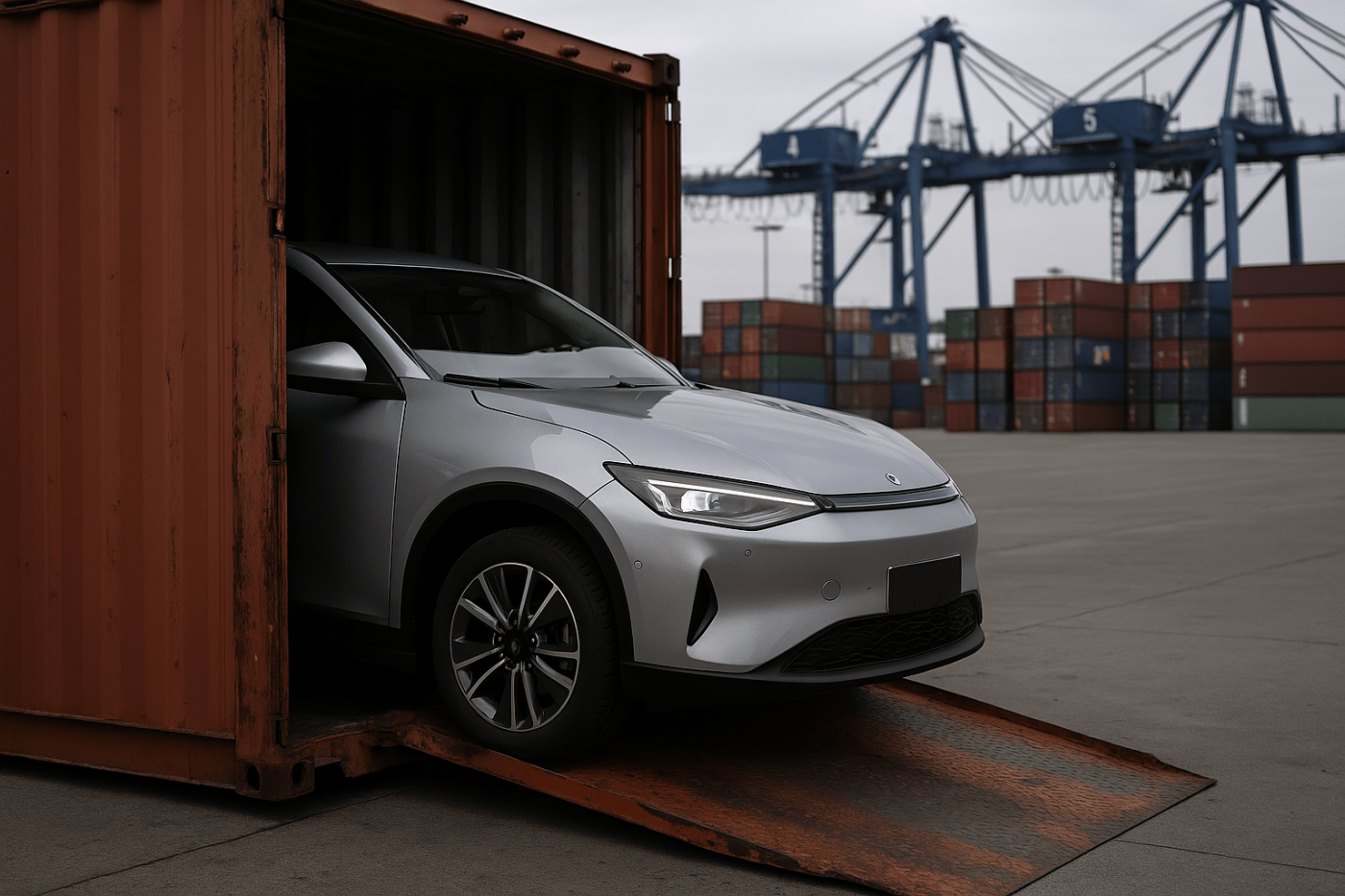
Economic strangulation dressed as trade protection, targeting not Beijing—but the global future.
The U.S. empire has entered its siege stage. No longer capable of seducing the world with the glitz of consumer culture or the promise of prosperity, it now defaults to punishment. The latest: a 104% cumulative tariff on Chinese electric vehicles (EVs), solar panels, steel, batteries, and a growing range of “strategic imports.”
This isn’t about protecting American labor—it’s tariff siege warfare, a method of economic strangulation deployed by monopoly-finance capital to sabotage rising productive powers that threaten imperial command. The Trump regime doesn’t even pretend otherwise. This is not policy—it’s class war in the digital age.
According to The Verge, the new tariff regime includes:
- 100% duties on Chinese EVs
- 50% on solar panels and semiconductors
- 25% on steel and aluminum
- New restrictions on Chinese battery inputs
All told, these tariffs could add billions in hidden costs to U.S. supply chains and consumer markets. But those are not collateral effects—they are the point. Capital is trying to forcibly redirect industrial flows back into the imperial core, not through investment or innovation, but through coercion and threat. That is what technofascism looks like in the economic sphere: a militarized, nationalist, digital command economy driven not by production, but by protectionism and paranoia.
And what triggered this attack? China’s productive efficiency. The very thing the West claimed to cherish in theory has become intolerable in practice. Because China’s manufacturing sector—backed by long-term planning, state coordination, and investment in energy, logistics, and education—has achieved what U.S. capitalism cannot: the ability to produce abundant EVs, batteries, and infrastructure components at scale. This “overcapacity” is now framed by Washington as a threat.
Why? Because in the language of hyper-imperialism, abundance outside the imperial center is insubordination.
What terrifies the U.S. ruling class is not “cheap Chinese goods”—it’s the collapse of unipolar control over who produces what and for whom. China’s emergence as a semi-planned industrial superpower represents a threat not only to the profit margins of U.S. firms, but to the ideological fantasy that only Western capital can lead the world.
This is why Trump—and the bipartisan technocrats who silently agree with him—seek to “decouple” from China. But decoupling is a euphemism. This is recolonization-by-redirection. They don’t just want to stop buying from China. They want to break the alternative developmental pathway China represents—before other Global South nations start to follow suit.
Underneath the patriotic fanfare is the same old settler logic: only white capital has the right to rule the world. Any competing order—especially one that offers infrastructure without strings, production without debt traps, and trade without gunboats—must be labeled authoritarian, dangerous, and “anti-democratic.”
And let’s be clear: this isn’t a reversal of globalization. This is its next stage. The imperialist recalibration of trade, supply chains, and digital infrastructure for a long-term confrontation with multipolarity. What the U.S. ruling class calls “de-risking” is really a project of reasserting digital colonial control—over semiconductors, rare earths, electric grids, ports, and logistics corridors. They are trying to rewire the entire global economy away from sovereignty and back toward servitude.
But there’s a problem. Tariff siege warfare doesn’t create new factories or workers—it just raises costs and tensions. And while Wall Street banks on a rebound, working-class Americans are already facing the blowback: higher prices, outsourced production, and mounting layoffs in export-heavy sectors. Meanwhile, in China, the state retools for domestic circulation, regional integration, and deeper coordination with the Global South.
What we’re witnessing is a test of systemic endurance: a race between U.S. technofascist degeneration and the emergence of a post-imperial order.
One fights with sanctions, seizures, drone strikes, and debt traps.
The other builds railways, ports, satellites, and trade blocs.
And the working class—everywhere—is caught in the middle. But we don’t have to stay there.
This is why Weaponized Information exists: to expose the colonial terms of trade and reveal the imperial architecture beneath bourgeois headlines. The U.S. state doesn’t “protect jobs”—it protects plunder circuits. It doesn’t “secure innovation”—it weaponizes technology against those who try to develop outside its sphere.
There are no neutral tariffs. There is only global class war.
Redlines are being drawn. And with each act of economic aggression, the lines become sharper.
 Weaponized Information
Leave a comment