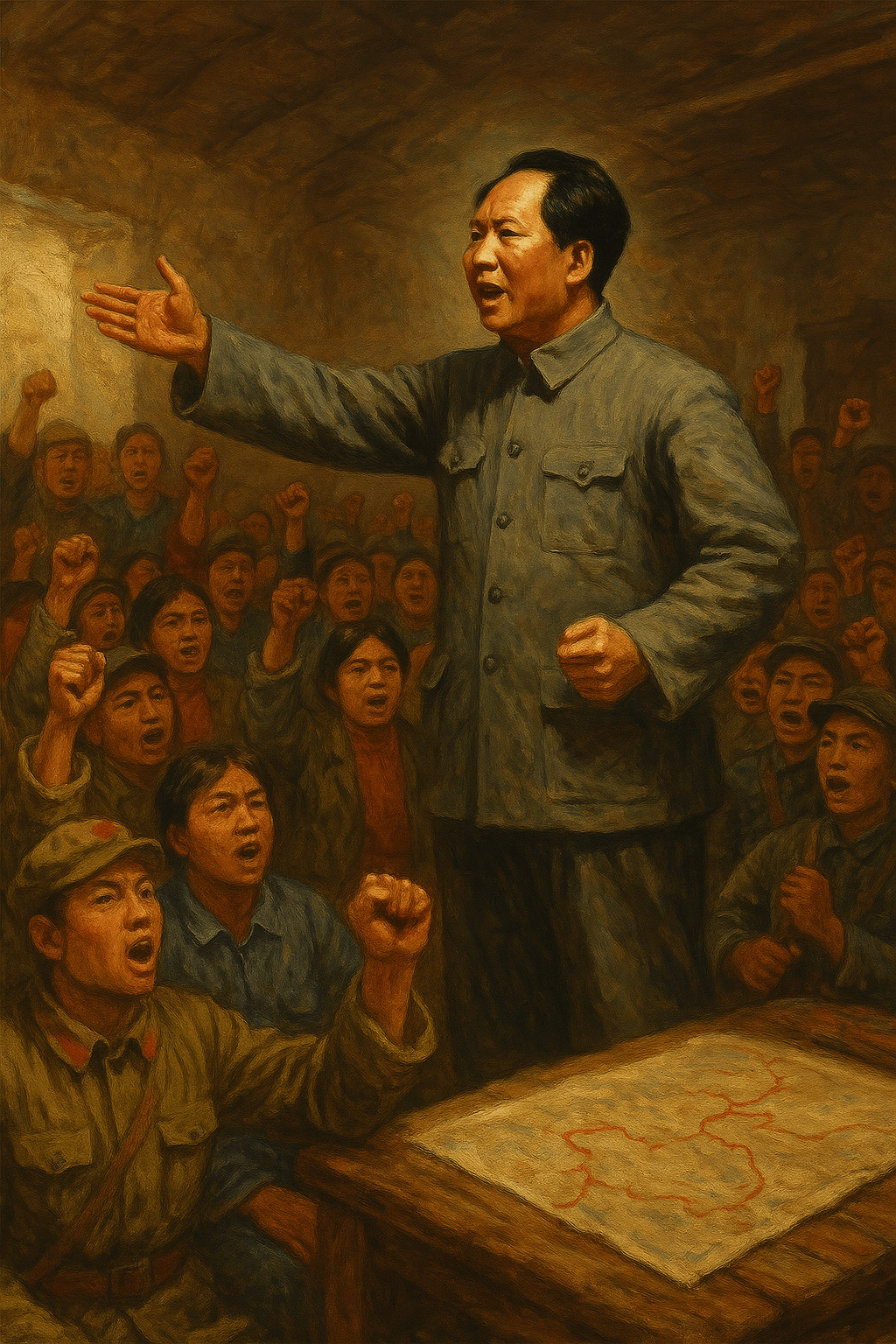
Why Mao Still Haunts the Empire
“The Chinese people have stood up!” — Mao Zedong, 1949
To the ruling class, Mao Zedong is not just a villain—he is an existential threat. More than half a century after his death, his image still triggers fear, loathing, and slander across the capitalist world. From liberal think tanks to pseudo-left academics, Mao is portrayed as a genocidal megalomaniac. But if you scratch beneath the surface, you’ll find something else: terror. Not the terror of Mao’s crimes—but the terror of his success.
Mao led the largest and most successful anti-colonial revolution in human history. He built a unified, independent China from the wreckage of warlordism, Japanese occupation, Western imperialism, and feudalism. He mobilized the poorest people on Earth to destroy an entrenched landlord class and overthrow comprador capitalists. And he didn’t do it with slogans—he did it with political vision, guerrilla warfare, and proletarian power.
This is not an attempt to sanctify Mao. Like all revolutionaries, he made mistakes—some of them catastrophic. But we don’t measure revolutionaries by liberal metrics of civility or stability. We measure them by their commitment to the oppressed, their understanding of power, and their impact on the global class war.
Mao still haunts the empire because he showed that the peasantry could be organized, that the colonized could liberate themselves, and that socialism could be built not just in theory, but in blood and steel.
Part I: The Myth and the Maoist Moment
Mao Zedong is the most hated revolutionary in the Western canon—and that hate is no accident. It didn’t emerge from the people of China, who overwhelmingly revere him. It came from the colonial powers he humiliated, the capitalists he overthrew, and the intellectuals whose libraries he rendered obsolete.
The caricature of Mao as a bloodthirsty tyrant was constructed in tandem with Cold War strategy. U.S. imperialism needed a villain in Asia. It found one in Mao. Western media parroted fabricated death counts—always without sourcing, always without context. These numbers were not produced by neutral historians; they came from right-wing demographers, CIA operatives, and ideologically compromised NGOs. Their purpose was not to explain history but to condemn socialism.
And yet, the Maoist moment terrified the West precisely because it worked. In just a few decades, Mao’s China eradicated mass illiteracy, ended feudal landlordism, achieved full national sovereignty, and built the industrial foundation for what is today the second-largest economy in the world.
This is the Mao they can’t allow you to see: the Mao who armed African liberation movements, trained guerrillas from Southeast Asia to Latin America, and declared war on bureaucratic rot.
Part II: Land, Steel, and the Great Leap Forward
The Great Leap Forward is Exhibit A in the Western indictment of Mao. But famine was not born in 1958. It had plagued China for centuries. Mao’s plan, however flawed, was an attempt to end it forever. It was a gamble to industrialize and collectivize rapidly—without relying on imperialist capital.
Policy errors, local mismanagement, and environmental conditions contributed to the crisis. But this was not genocide. Unlike the British in Bengal, the Chinese state did not hoard grain or profit from the disaster. It responded, adjusted, and learned.
The Great Leap laid critical infrastructure, expanded steel production, and brought industrial capacity to the countryside. It was not a murderous folly—it was a revolutionary miscalculation in the context of siege and survival.
Part III: The Cultural Revolution Was a Class Struggle
No episode is more distorted than the Cultural Revolution. Painted as chaos for chaos’s sake, the truth is more complex. It was Mao’s effort to prevent the emergence of a new ruling class within the Communist Party.
He called on students and workers to rise up—not against socialism, but against bureaucracy. Red Guards didn’t destroy the system—they questioned power and fought to preserve the revolution’s egalitarian spirit.
The Cultural Revolution was imperfect. It unleashed contradictions. But it was the last great experiment in mass political mobilization for socialist democracy. It dared to ask: *Who governs under socialism—the people or the party?*
Part IV: Maoism Is Not Dead—It’s Evolving in Xi Jinping Thought
Xi Jinping is no Maoist in full, but the reemergence of Maoist themes is undeniable. The anti-corruption purge, ideological campaigns, and rural revitalization efforts all draw from Mao’s legacy.
Xi’s “common prosperity” campaign echoes Mao’s egalitarianism. His push for sovereignty, self-reliance, and ideological discipline reflects Maoist sensibilities adapted to a globalized world.
This is not nostalgia—it is a strategic recalibration. The Party knows that Mao cannot be erased. His ghost remains part of China’s political DNA, and a tool to discipline capital when needed.
Part V: The Left That Hates Mao—And the Empire They Serve
The loudest critics of Mao often come from the Western left. They recite imperial propaganda, denounce revolutions they never joined, and sneer at those who take power seriously.
These are not Marxists. They are moralists. They fear the masses. They hate the hard decisions. They want revolution without rupture, socialism without state power.
The hatred of Mao has never come from the oppressed. It has always come from those invested in the comfort of critique—never the cost of struggle.
Maoism and the Road Ahead
Mao was not a monster. He was a revolutionary who transformed the world. He showed that the peasantry could be organized, that imperialism could be beaten, and that socialism was not a European invention—but a global necessity.
He made mistakes. He moved too fast. He trusted the masses more than institutions. But in the final accounting, he stood with the oppressed, and taught them how to stand.
Mao still speaks to us—not as a myth, but as a strategy. And that is why they still lie about him.
 Weaponized Information
Leave a comment