
Written By: Kapone
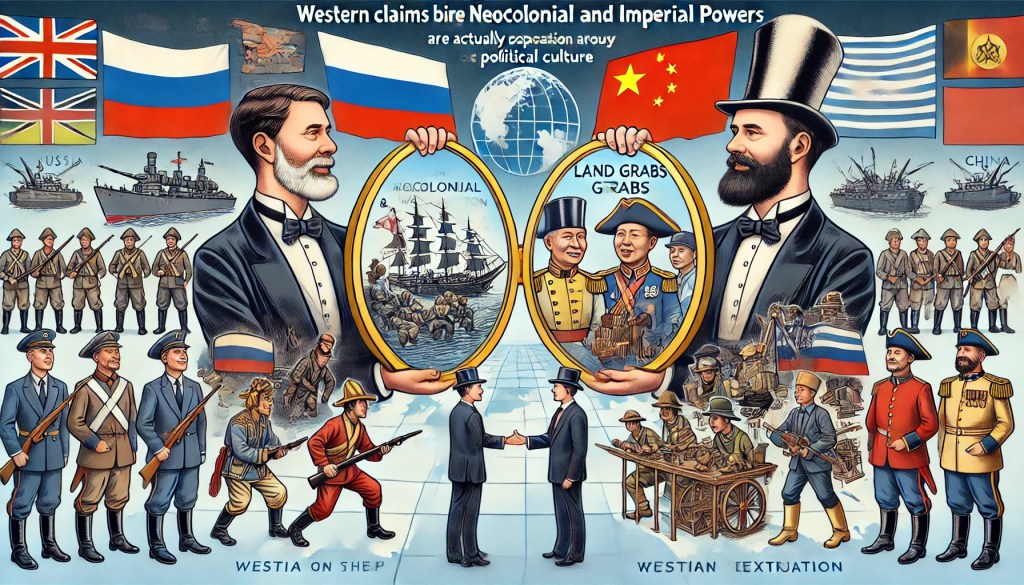
The frequent claims coming out of Western media and government circles that Russia and China are driven by imperialist or expansionist ambitions are not just misguided—they are rooted in a long tradition of Eurocentrism, Orientalism, and even white supremacy. These narratives project the very traits of Western colonial history onto Russia and China without acknowledging the nuances of these nations’ histories or their actual foreign policies. This isn’t just a simple misunderstanding—it’s part of a broader pattern, where the West positions itself as the arbiter of global morality while demonizing non-Western powers based on distorted or outright false premises.
Eurocentrism, Orientalism, and White Supremacy: The West’s Default Lens
Let’s be clear: the Western imagination, especially in Europe and the U.S., has been conditioned to see the rest of the world through a colonial lens. Since the Enlightenment, European thinkers have portrayed themselves as the bearers of civilization and enlightenment, while non-Western nations were cast as backward, despotic, or inherently aggressive. Edward Said’s notion of Orientalism helps explain how this narrative works. The West builds an image of the East, or any non-Western culture, as the “other”—irrational, dangerous, needing to be controlled. When the West looks at Russia or China, it tends to see its own imperialist history reflected back, even when the reality is something altogether different.
And this isn’t just about Russia or China. This is about a much deeper ideology. White supremacy, often cloaked in liberalism or human rights rhetoric, underpins much of the West’s attitude towards the Global South and the non-Western world. It presumes that only Western democracies are capable of responsible, peaceful governance, while non-Western powers, even those as large and complex as Russia and China, are cast as would-be empires in waiting. But this is more a projection of Western fears and anxieties than an accurate reflection of reality.
Russia’s History: Expansion, Yes, But Not Imperialism in the Western Sense
Russia’s history of territorial expansion is often pointed to as evidence of its imperialist tendencies. But the nature of that expansion looks quite different when you compare it to the Western imperialism we’re all familiar with. Western colonial empires—Britain, France, Spain, Portugal—were driven by a relentless pursuit of wealth and power. They crossed oceans, plundered resources, enslaved populations, and exploited entire continents. Russia, by contrast, expanded across contiguous land, integrating territories that had longstanding cultural, religious, or political ties with the Russian state. This isn’t to whitewash Russian history—there was plenty of oppression and violence—but the motives and methods weren’t the same as what we saw with Western colonialism.
Take the example of Russia’s expansion into Central Asia in the 19th century. At that time, British imperial ambitions were looming large, and Russia’s movements in places like Bukhara and Khiva were largely defensive, aimed at countering British influence rather than building an empire for economic gain. While Russia’s rule in these regions was often heavy-handed, it wasn’t driven by the same extractive logic that underpinned Western colonialism in, say, Africa or South America.
Even today, Russia’s actions in its immediate neighborhood—whether in Ukraine, Georgia, or elsewhere—are more about national security than imperial conquest. The Western narrative tends to ignore or downplay the fact that NATO, a military alliance explicitly designed to contain Russia, has been expanding eastward for decades, right up to Russia’s borders. Russia’s response, including its actions in Ukraine, is better understood as a reaction to what it sees as a serious security threat, not as some grand scheme of imperialist expansion.
China’s Foreign Policy: Mutual Benefit Over Imperial Domination
The West’s portrayal of China as an imperialist power is equally flawed. For years now, we’ve heard about China’s supposed “debt-trap diplomacy” in the Belt and Road Initiative (BRI), as if China’s investment in infrastructure in Africa, Asia, and beyond is somehow akin to the colonialism practiced by European powers. But this narrative doesn’t hold up under scrutiny.The Belt and Road Initiative is based on principles of mutual benefit. Countries participating in the BRI are doing so voluntarily, and they often see China’s investment as a welcome alternative to Western financial institutions like the IMF and World Bank, which are infamous for imposing crippling austerity measures on developing nations. China’s approach isn’t about controlling these countries—it’s about building infrastructure that can create the conditions for shared prosperity. The Western obsession with casting China as a neo-colonial power is rooted more in anxiety about its own declining global influence than in any objective analysis of China’s foreign policy.
And historically, China has never been a colonizer in the Western sense. The so-called “tributary system” that China maintained with its neighbors wasn’t about exploiting them—it was a diplomatic system that emphasized peaceful coexistence, trade, and mutual respect. It’s a far cry from the colonial empires of Europe, which sought to dominate and extract resources from their colonies by any means necessary.
Russia and China: Pragmatism, Not Imperialism
Both Russia and China understand that the world has changed since the colonial era. In today’s interconnected, multipolar world, imperialism is a losing strategy. What makes far more sense is fostering relationships based on cooperation, mutual benefit, and respect for national sovereignty. That’s what Russia and China are doing.Russia has cultivated strategic partnerships with countries like India, Turkey, and Iran, not out of some desire to build a new empire, but because these alliances serve the interests of all parties involved. These relationships are based on pragmatic considerations—economic cooperation, shared security concerns—not imperial domination.China’s rise as an economic power has followed a similar logic. The BRI is about creating a global network of trade and infrastructure that benefits China, sure, but it also benefits the countries involved. It’s about building the kind of economic interdependence that can sustain peace and prosperity, not about imposing control over smaller nations.
Western Projection, Not Reality
The Western narrative that Russia and China are imperialist powers is a projection of the West’s own colonial past. It’s rooted in Eurocentrism, Orientalism, and a deep-seated white supremacist worldview that can’t fathom the idea of non-Western powers operating on a different logic. But the reality is that Russia and China are playing a different game. They’re not interested in colonial conquest—they’re interested in protecting their borders, building cooperative relationships with their neighbors, and creating a multipolar world where the West no longer calls all the shots.
This isn’t to say that Russia or China are perfect actors, free from any wrongdoing. But to frame their foreign policies as imperialist or expansionist is to miss the point entirely. What we’re seeing is not a resurgence of imperialism but a pragmatic response to a world that’s becoming more interconnected and multipolar. The West would do well to recognize that, instead of clinging to outdated, self-serving narratives.
 Weaponized Information
Leave a comment