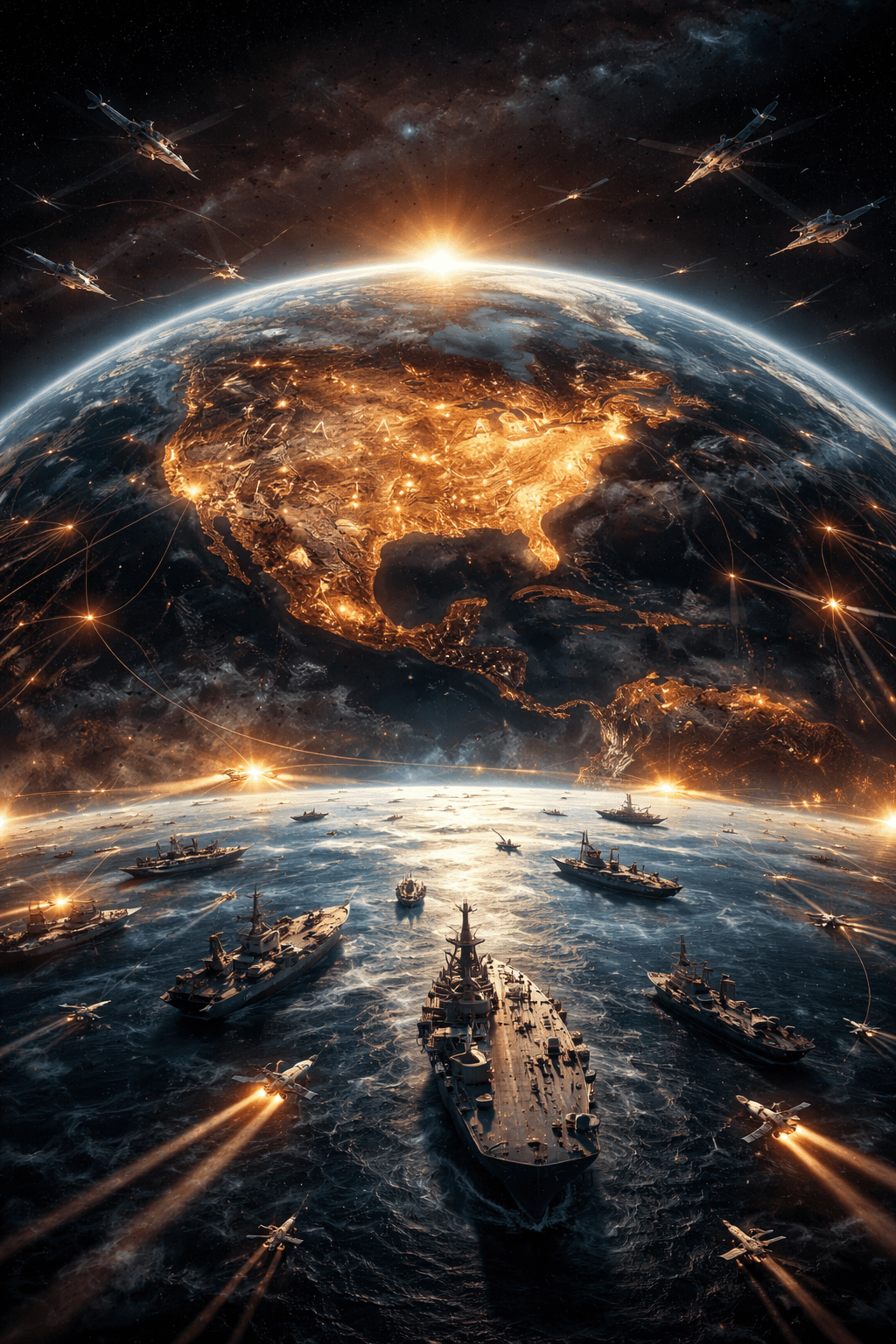
From settler conquest on the North American continent to a planetary lattice of bases, fleets, satellites, and command zones, the United States has constructed the most extensive military infrastructure in human history. Beneath the language of alliances, deterrence, and security lies a global machine designed to police the colonial world economy. But the very scale of that machine now exposes the contradiction at its core: the more the empire expands to supervise the planet, the more clearly the limits of imperial power come into view.
By Prince Kapone | Weaponized Information | March 13, 2026
The Empire That Runs on Concrete
They teach ordinary people to speak about American power in the soft, upholstered language of imperial manners. They call it leadership. They call it deterrence. They call it alliance management, as if the most heavily armed state in human history were some weary but honorable custodian walking the halls of the international order with a wrench in one hand and a rulebook in the other. But empire is not made of phrases. It is not built from press briefings, policy seminars, or the holy incantations of think-tank priests. It is made of poured concrete, dredged harbors, hardened runways, satellite relays, fuel depots, radar arrays, command centers, and fenced compounds carved into other people’s land. The missiles that dominate the headlines do not rise from the earth by divine instruction. The bombers do not fly on patriotism. The fleets do not drift across the seas on the moral vocabulary of Washington. They move because a gigantic material system keeps them moving. What stands behind the spectacle of military power is a built environment of organized violence.
That is where this essay begins. Not with the bedtime story that the United States simply happens to be strong, nor with the fairy tale that its military reach is an accidental byproduct of responsibility, but with the harder and more useful truth that American supremacy has been built into the physical geography of the modern world. In our time, empire does not appear mainly in the old costume of governors, viceroys, and colonial flags fluttering over conquered capitals. It appears as infrastructure. It appears in the runway, the naval port, the supply depot, the communications relay, the missile battery, and the command node. It appears in the vast logistical skeleton that allows force to be projected across oceans and continents with bureaucratic regularity and industrial scale.
This is why the language of “defense” so often conceals more than it reveals. These installations are not merely protective walls around a threatened homeland. They are outward-facing mechanisms of movement, reach, and control. They allow aircraft to refuel far from home, fleets to anchor near strategic waterways, surveillance systems to watch whole regions, and expeditionary forces to arrive with terrifying speed wherever Washington decides history has become inconvenient. The empire’s true genius, if we may grant a machine its grim intelligence, lies not only in its capacity to destroy but in its capacity to remain permanently positioned for destruction. It has embedded military power into the ordinary architecture of the world.
And like every mature structure of class rule, this one does not merely occupy space. It helps organize the conditions under which global power operates. It anchors a wider order favorable to Washington and to the ruling interests fused to it—finance, industry, logistics, extraction, and the armed bureaucracy that secures them all. The built environment of empire is therefore not a backdrop to power but one of its primary forms. Steel and concrete do political work. Runways and ports are arguments written into the earth. They say that some states may move anywhere, at any time, with weapons in hand, while others must live beneath the shadow of that mobility.
So the task here is simple, though not small. We have to strip away the mythology and look directly at the machine. We have to trace the historical doctrine that produced it, examine the accounting tricks that conceal its real scale, show how war construction hardened into permanent real estate, and explain the legal and logistical architecture that allows foreign land to function as an extension of imperial command. We have to map the military partitioning of the planet, follow the circuits of capital that reproduce the whole apparatus, confront the ecological wreckage it leaves behind, and finally grasp the contradiction built into any empire that tries to supervise the earth itself.
Because what stands before us is not a defensive shield, not a neutral security arrangement, and certainly not the charitable armature of a benevolent republic. It is a world-spanning machine built to secure chokepoints, protect accumulation, discipline labor, intimidate rivals, and preserve a hierarchy still carrying the old fingerprints of conquest. The old empires painted maps. This one pours concrete, lays fiber, dredges harbors, and calls the result stability. If we want to understand how American power actually works, we have to begin there: not with the slogan, but with the runway; not with the sermon, but with the base.
Doctrine Grows From Conquest
The global military machine that now circles the earth did not appear suddenly in the twentieth century, nor was it born from the abstract imagination of strategists sitting in Washington offices. Its deeper origins lie in the social order that produced the United States itself. European settlers did not arrive on the North American continent as neutral migrants seeking peaceful opportunity. They arrived as agents—willing or otherwise—of a wider Western European settler colonial project. That project was materially grounded in land seizure, Indigenous dispossession, racial hierarchy, and the violent restructuring of entire societies. The colonial economy required territory. Territory required conquest. The political doctrines that later justified expansion were therefore not the cause of empire but the ideological expression of an already existing material system.
Within that structure the early leadership of the republic began to articulate a language that translated conquest into political philosophy. One of the clearest expressions came from Thomas Jefferson, who described the young republic as an “Empire for Liberty”. The phrase has long circulated in American mythology as a noble declaration of democratic ambition. But read in its historical context, it reveals a harsher reality. Liberty referred primarily to the political freedom and economic opportunity promised to European settlers. Empire referred to the territorial expansion necessary to sustain that freedom. The two ideas were inseparable because the settler economy depended upon access to land, and that land could only be obtained through the displacement of the people already living upon it.
The consequences were written directly into the geography of the continent. Indigenous nations were treated not as sovereign societies but as obstacles standing in the path of what American leaders called progress. The violence that followed was not an accidental byproduct of frontier life. It was deliberate policy. The Indian Removal Act of 1830 authorized the forced displacement of entire Indigenous communities from their homelands, driving tens of thousands of people westward under military supervision in one of the most brutal episodes of settler expansion in modern history. The frontier celebrated in American folklore was therefore not a natural boundary advancing across empty land. It was a moving line of conquest.
By the middle of the nineteenth century this expansion acquired a theological vocabulary. The doctrine of Manifest Destiny claimed that the United States possessed a providential mission to spread across the continent. The phrase itself entered the political lexicon when journalist John L. O’Sullivan proclaimed in 1845 that it was America’s destiny to overspread the continent. The language wrapped territorial aggression in the garments of historical inevitability. Conquest could now be described as destiny. Expansion could be framed as the unfolding of divine history. Beneath the rhetoric, however, the underlying mechanics remained brutally material: land was taken, populations were displaced, and new territories were absorbed into the growing political economy of the settler state.
The culmination of this continental phase arrived at the end of the Mexican–American War. After defeating Mexico militarily, the United States imposed the Treaty of Guadalupe Hidalgo, through which enormous territories stretching from California to New Mexico passed into American control. With a single treaty the political map of North America was permanently redrawn. The expansion confirmed a structural truth about the American project: territorial growth was not treated as an extraordinary measure adopted during moments of crisis. It was understood as the normal trajectory of a republic whose economy and social order had been built upon expansion from the beginning.
Yet the logic of expansion did not stop at the Pacific shoreline. By the late nineteenth century the continental frontier had effectively closed, and the United States had become an industrial power integrated into global trade networks. Strategic thinkers began to ask how a rising commercial empire might protect its interests across the oceans. It was during this moment that naval strategist Alfred Thayer Mahan argued that global power depended on control of maritime trade routes supported by chains of naval bases. His argument was brutally straightforward. Warships operating far from home required coaling stations, repair docks, and fortified ports scattered along the world’s sea lanes. A nation that hoped to dominate international commerce would therefore need an overseas network of strategic installations.
The United States soon tested this theory in practice. In 1898 the country defeated Spain and emerged from the conflict with its first formal overseas empire. The settlement was codified in the Treaty of Paris of 1898, which transferred Puerto Rico, Guam, and the Philippines to American control. For the first time the republic governed territories thousands of miles beyond the continental mainland. The frontier had crossed an ocean.
The twentieth century would transform that overseas presence into a planetary military infrastructure. During the Second World War the United States undertook one of the largest military construction efforts in history. Engineering units erected airfields, naval anchorages, supply depots, and communications stations across Europe, North Africa, and the Pacific theater. According to the historical archive of the U.S. Navy’s Seabee construction battalions, hundreds of advanced bases were built during the war to support fleets and bomber wings operating far from American shores. At the time these installations were conceived as temporary logistical platforms necessary for victory. When the war ended, however, the infrastructure remained.
The Cold War converted this wartime geography into a permanent system. As tensions with the Soviet Union hardened, Washington consolidated and expanded its overseas installations across Europe, East Asia, and the Middle East. Strategic doctrine, articulated through policies such as the Truman Doctrine and institutionalized through the National Security Act of 1947, established a national security architecture designed for continuous global military presence. Air bases appeared in Germany and Japan. Naval facilities anchored fleets in the Mediterranean and the Pacific. Communications networks linked installations into an integrated command structure capable of coordinating military operations across continents.
When the Soviet Union collapsed in 1991, many observers expected this enormous military architecture to contract. Instead it adapted. Strategic planners concluded that the United States must prevent the emergence of any rival capable of challenging its supremacy. That objective was spelled out bluntly in the 1992 Defense Planning Guidance, which argued that American policy should ensure that no peer competitor would rise to contest U.S. dominance. Rather than dismantling the base network, Washington reorganized it—supplementing large Cold War garrisons with smaller installations, rotational deployments, and access agreements that allowed forces to operate from hundreds of locations across the globe.
In the years that followed, the Project for a New American Century helped drag that ambition out of bureaucratic prose and into open ideological agitation. The Library of Congress archive of the Project for the New American Century preserves the political milieu that argued, in plain imperial language, for preserving and extending American military preeminence after the Cold War. After 9/11, that strategic hunger found state form. The 2002 National Security Strategy openly organized U.S. doctrine around the imperatives to “Strengthen Alliances to Defeat Global Terrorism and Work to Prevent Attacks Against Us and Our Friends,” “Prevent Our Enemies from Threatening Us, Our Allies, and Our Friends with Weapons of Mass Destruction,” “Ignite a New Era of Global Economic Growth through Free Markets and Free Trade,” and “Transform America’s National Security Institutions to Meet the Challenges and Opportunities of the Twenty-First Century.” The post-Cold War doctrine of supremacy had now been rearmed as a doctrine of preventive war, open-ended intervention, and planetary institutional retooling.
Obama did not dismantle that architecture. He recalibrated it. The Pentagon’s 2012 strategic guidance, Sustaining U.S. Global Leadership: Priorities for 21st Century Defense, declared that “The United States has played a leading role in transforming the international system” and described a strategy that would transition the defense enterprise “from an emphasis on today’s wars to preparing for future challenges,” while serving as a “blueprint for the Joint Force in 2020.” Trump’s first term then stripped away the humanitarian perfume and named the thing more bluntly. The 2017 National Security Strategy announced an “America First” orientation, and the 2018 National Defense Strategy summary made the decisive doctrinal turn by stating that “Inter-state strategic competition, not terrorism, is now the primary concern in U.S. national security.” The empire had not abandoned the War on Terror so much as folded it into a broader age of great-power rivalry.
Biden, for all the liberal incense burned around his project, largely consolidated that shift. The 2022 National Security Strategy cast the period ahead as a “decisive decade” and pledged to advance a “free, open, prosperous, and secure international order.” Its companion, the 2022 National Defense Strategy, identified China as the Pentagon’s “pacing challenge,” Russia as an acute threat, and organized doctrine around “integrated deterrence” across domains, theaters, and allied networks. Trump 2.0 has now pushed that same trajectory into a harsher register. The 2025 National Security Strategy demands that allies “assume primary responsibility for their regions” and meet a new 5 percent defense-spending benchmark, while the administration’s 2026 arms-transfer strategy openly ties foreign military sales to domestic reindustrialization and the need to “revitalize the defense industrial base” so allied states can shoulder more of the burdens of regional enforcement. From PNAC to Bush, from Obama to Trump I, through Biden and now Trump 2.0, the language changes, the packaging changes, the enemies are renamed, but the governing impulse remains the same: preserve American supremacy over the international system, whatever new doctrine the age requires.
Seen in this historical light, the modern network of military bases appears not as a sudden invention of the Cold War or the War on Terror but as the latest institutional form taken by a much older expansionary system. The same colonial order that once drove the seizure of Indigenous land across North America gradually expanded outward across oceans and continents. The frontier moved from forests and plains to archipelagos and sea lanes, and eventually to the entire planet. The concrete installations that now anchor American military power are therefore not accidental outgrowths of recent conflicts. They are the hardened infrastructure of a long historical trajectory whose origins lie in conquest.
How the Empire Counts Itself
Every empire keeps two maps of its power. One is the real map—the one drawn in airstrips cut through jungle, naval piers driven into coral reefs, warehouses stacked with ammunition, and command bunkers humming with satellites and encrypted signals. The other is the public map, the one presented to citizens, journalists, and occasionally even legislators. That second map is carefully simplified, trimmed, and rearranged so that the machinery of domination appears smaller, tidier, and more defensive than it actually is. The modern American empire is no exception. Before we can understand the geography of the base network, we first have to examine how the empire counts itself.
The number most frequently cited in public discussions of U.S. military presence abroad comes from a familiar bureaucratic source. According to a report prepared for Congress, the Congressional Research Service identifies at least 128 U.S. military bases across 51 countries. The figure circulates through policy debates and media coverage as if it were a neutral fact—a tidy numerical portrait of American military reach. But numbers in imperial bookkeeping rarely function as innocent measurements. They are categories, and categories are political. The CRS figure tells us something important, but it does not tell us everything.
Even the report itself hints at the limitations of this official accounting. The definition of what constitutes an “overseas base” is narrower than the global reality of military operations. Installations that fall outside formal base designations can disappear from the count entirely. Temporary operating locations, contingency facilities, and expeditionary airstrips may host American personnel and equipment for months or years without ever appearing in permanent basing inventories. Rotational deployments allow troops to move through host countries in cycles that maintain a continuous presence while technically avoiding the classification of a permanent base. The statistical picture that emerges is therefore less a photograph than a carefully cropped portrait.
Colonial geography introduces another distortion into the official map. American military infrastructure located in territories under U.S. sovereignty often disappears from overseas basing statistics altogether. The island of Guam, where the United States is constructing an expanded missile defense architecture and strengthening its Pacific military installations, sits thousands of miles from the continental United States in the western Pacific. In practical military terms it functions as a forward fortress anchoring operations across the Indo-Pacific region. Yet because Guam is legally classified as American territory, installations there often vanish from the statistical category of “overseas bases.” The empire redraws geography through accounting.
Independent researchers have attempted to reconstruct a broader picture of the system. Their findings suggest that the official base count captures only part of the infrastructure that enables global military operations. A comprehensive survey conducted by the International Peace Bureau and World BEYOND War argues that once smaller facilities, access agreements, and dispersed operating sites are included, the global network expands dramatically. Many of these installations are deliberately designed to remain lightweight and flexible. They may consist of little more than an airstrip, a fuel depot, or a warehouse for equipment pre-positioned in case of crisis. Yet in aggregate they form the connective tissue of a planetary operating system.
Military planners sometimes refer to these installations as “lily pads”—small staging points scattered across regions that allow aircraft, drones, and special operations forces to move rapidly across vast distances. Individually they appear modest. Collectively they create mobility. A transport plane can refuel on one island, land for maintenance on another, and reach a conflict zone thousands of miles from the continental United States within hours. Logistics, not spectacle, is the real currency of global military power.
Financial accounting follows a similar pattern of fragmentation. The infrastructure that sustains American military presence abroad is enormously expensive, yet the costs rarely appear in a single, easily identifiable ledger. Budget documents from the Pentagon’s own overseas cost summaries reveal tens of billions of dollars devoted annually to maintaining forces outside the United States. These figures include personnel expenses, operations, and the upkeep of facilities scattered across dozens of countries. But they represent only a portion of the total financial burden. Construction projects appear under separate appropriations. Equipment procurement is tracked elsewhere. Emergency deployments and exercises often fall outside permanent basing accounts altogether. The empire’s financial architecture is distributed across the federal budget much like its military infrastructure is distributed across the planet.
When these pieces are assembled together, the official portrait of the base network begins to look less like a definitive map and more like a selective sketch. Permanent installations form the visible spine of the system. Rotational deployments extend its reach without increasing the official base count. Colonial territories alter the geography of what qualifies as “overseas.” Small expeditionary sites multiply the number of operational locations. And dispersed financial categories blur the full cost of maintaining the apparatus.
The result is not merely bureaucratic confusion. It is a form of political management. By controlling how the base network is counted, categorized, and described, the empire manages how its scale appears to the public. A sprawling global infrastructure can be presented as a modest network of defensive installations. A worldwide logistics architecture can be framed as routine military presence. Numbers become part of the machinery of empire itself.
Understanding that machinery is essential because the statistics are only the surface of a much larger structure. Beneath them lies a landscape of airfields, ports, radar installations, supply depots, and communications hubs that allow American forces to move across continents with industrial efficiency. To see how that infrastructure came into existence—and why it remains embedded across the planet—we must now turn to the historical moment when war construction first transformed geography into permanent military real estate.
When War Became Real Estate
The planetary base network did not fall from the sky fully formed. It was hammered into existence by war. In the twentieth century, global conflict forced the United States to build a logistical architecture capable of moving men, machines, fuel, and ammunition across oceans at industrial scale. What began as emergency construction in wartime slowly hardened into permanent geopolitical real estate. The infrastructure that today appears routine—the airfields, naval anchorages, supply depots, and communications hubs scattered across continents—was originally poured under the pressure of world war.
During the Second World War the United States undertook one of the largest military construction efforts in human history. Engineering units, most famously the Navy’s construction battalions known as the Seabees, carved airstrips into coral islands, dredged harbors from jungle coastlines, and assembled vast logistical installations across the Pacific and Atlantic theaters. According to the official history of the Navy’s wartime construction program, these units built hundreds of advanced bases designed to support fleets and bomber wings operating far from American shores. The purpose was simple: modern warfare required logistics, and logistics required territory.
At the time these installations were conceived as temporary. They were wartime tools meant to defeat the Axis powers and then fade back into obscurity once peace returned. But history rarely follows the tidy schedule imagined by planners. When the war ended in 1945, the United States emerged as the dominant industrial and military power of the Western bloc. Instead of dismantling the enormous infrastructure built during the conflict, Washington began integrating these installations into a new global security architecture. Bases that had once supported wartime operations became the foundation of a permanent military presence.
The Cold War accelerated this transformation. As tensions with the Soviet Union hardened, the United States consolidated its wartime installations across Europe and East Asia while constructing new facilities in regions deemed strategically vital. The expanding system was no longer simply a collection of leftover wartime airfields. It became a coordinated network designed to maintain continuous global reach. Historical research summarized by the Congressional Research Service study on overseas basing shows how Cold War planning embedded American forces in dozens of countries, from Germany and Japan to South Korea, Italy, and Turkey. The logic of containment demanded permanent readiness, and permanent readiness required permanent infrastructure.
Over time the architecture of these installations evolved. Massive Cold War garrisons hosting tens of thousands of troops were supplemented by a more flexible web of smaller facilities capable of supporting rapid deployments. Military planners began to treat bases less as static fortresses and more as nodes in a mobile logistics network. This approach was eventually codified in strategic guidance such as the Department of Defense doctrine governing global defense posture, which frames basing, troop presence, logistics, and access agreements as integrated elements of a worldwide operational system.
In the decades that followed, new operational concepts refined this distributed model of military infrastructure. Modern planning frameworks emphasize dispersal, mobility, and the ability to operate from numerous smaller sites rather than relying solely on a few massive installations. The U.S. Air Force’s concept of Agile Combat Employment envisions aircraft moving between multiple temporary airfields in order to complicate enemy targeting and maintain operational tempo. The Marine Corps has developed a similar framework known as Expeditionary Advanced Base Operations, which focuses on rapidly establishing small forward installations capable of supporting missiles, drones, and surveillance systems across contested regions.
Naval doctrine has followed the same trajectory. The concept of Distributed Maritime Operations emphasizes the dispersal of naval forces across multiple operating areas supported by an extensive network of logistical infrastructure. Instead of concentrating power in a few large fleets anchored at major bases, the system spreads ships, aircraft, and sensors across a wide geographic field, making the network itself the primary instrument of military reach.
What emerges from these doctrinal shifts is a clear pattern. The base network built during the Second World War did not disappear when the conflict ended. It evolved. Wartime construction became the skeleton of a permanent global presence. Cold War strategy expanded and institutionalized that presence. Post–Cold War doctrine transformed it into a dispersed logistical web capable of sustaining operations across nearly every region of the planet.
In this sense the modern geography of American military infrastructure is not simply a byproduct of contemporary strategy. It is the cumulative result of decades of war, planning, and adaptation. Airfields carved from jungle during emergency wartime construction have become permanent fixtures of international politics. Naval ports once built to supply fleets in battle now anchor strategic chokepoints. Logistics depots constructed for temporary campaigns have matured into enduring nodes of global command.
War, in other words, did not merely reshape borders. It reshaped the physical landscape of the planet. The runways remained. The harbors remained. The supply depots remained. And over time the temporary scaffolding of wartime logistics hardened into a permanent architecture of global power.
Empire as a System of Land, Law, and Logistics
By this point in the story the physical outline of the machine is already visible. War built the first installations. Cold War strategy stabilized them. Post–Cold War doctrine dispersed them across the globe. But concrete alone does not sustain an empire. Runways and harbors are only the visible surface of a deeper architecture that allows the system to function across sovereign borders. Bases endure not merely because they are constructed, but because they are embedded within a legal and logistical framework that allows one state to operate military power inside the territory of another.
The most important instruments in this framework are the legal agreements that regulate the presence of foreign troops. These arrangements, commonly known as Status of Forces Agreements, define the jurisdictional rules governing American military personnel stationed abroad. A detailed overview of these arrangements compiled by the Congressional Research Service explains how Status of Forces Agreements determine legal authority over U.S. forces operating in host nations. In practice these agreements often establish complex jurisdictional boundaries that allow American troops, contractors, and equipment to operate under conditions partially insulated from the legal systems of the countries in which they are stationed.
This legal architecture produces a peculiar geography. A base may sit physically inside a sovereign country, but the authority exercised within its perimeter often belongs to another state entirely. Installations function as enclaves—territorial pockets where the military command structure of the United States governs land that technically lies within the jurisdiction of another nation. Research summarized by the EBSCO overview of U.S. overseas military bases describes how these arrangements allow the United States to maintain installations across dozens of countries through negotiated agreements that structure the legal and operational environment around them.
One of the most prominent examples of this arrangement operates across the Atlantic alliance. Under the framework of the NATO Status of Forces Agreement, American forces stationed in European member states operate within a standardized legal regime governing jurisdiction, taxation, and logistical coordination. These agreements enable the United States to maintain extensive military infrastructure across Europe while embedding that presence within the political architecture of the alliance. Bases that appear as bilateral installations are therefore also nodes in a wider military system spanning the Atlantic world.
Logistics forms the second pillar of this architecture. The global base network is not simply a chain of isolated installations. Each facility functions as a node within a much larger logistical system that coordinates transportation, supply, maintenance, and communications across continents. Aircraft must be refueled, ships repaired, equipment stored, intelligence transmitted, and personnel rotated between theaters. The base network therefore operates less like a series of fortresses and more like a circulatory system through which the material resources of war continuously flow.
Financial structures reinforce this logistical framework. Maintaining installations across dozens of countries requires an immense flow of public expenditure, construction contracts, and operational funding. Yet the costs of this system are rarely visible in a single location within the federal budget. Analysis summarized in the Congressional Research Service report on overseas basing shows how expenses associated with foreign installations are distributed across multiple appropriations accounts, including personnel, operations, infrastructure maintenance, and contingency deployments. The economic footprint of the base network therefore spreads across the entire defense budget rather than appearing as a single easily identifiable category.
Once these legal, logistical, and financial layers are viewed together, the true character of the system begins to emerge. A base is not merely a piece of land with aircraft parked on it. It is the product of treaty arrangements, jurisdictional negotiations, supply chains, procurement contracts, and command structures that extend far beyond the perimeter fence. Each installation functions as a hinge connecting multiple dimensions of imperial power: territory, law, industry, and military force.
This architecture also reveals something deeper about how modern empire operates. Earlier colonial systems often ruled directly through administrative governors placed over conquered populations. The contemporary system relies far less on direct political administration and far more on infrastructure embedded within cooperative or dependent states. The empire does not need to formally govern every territory in which it operates. It only needs the legal and logistical arrangements that allow its military apparatus to function there.
Through these arrangements the United States has assembled a global lattice of installations capable of projecting force across the planet with remarkable speed. Runways, ports, supply depots, and command nodes link distant regions into a single operational environment. The legal frameworks surrounding these installations allow them to function continuously across political borders. Logistics keeps them supplied. Budgetary flows keep them maintained. Taken together, they form the operating system of a military power whose reach extends across continents.
Yet even this architecture does not fully explain the geography of the system. Bases are not scattered randomly across the globe. They are organized according to a larger administrative logic that divides the world into military theaters of responsibility. To understand how the machine actually governs space, we must now examine how the Pentagon has partitioned the planet itself.
The Pentagon’s Partition of the Planet
By now the structure of the machine is clear. Doctrine gave it direction. War gave it infrastructure. Law and logistics gave it permanence. But one more transformation was necessary before this sprawling network of bases, ports, airfields, and depots could function as a single coordinated system. The empire had to organize the earth itself. Military power cannot operate efficiently across a globe of nearly two hundred sovereign states unless that globe is administratively simplified. And so the Pentagon did what all large bureaucracies eventually do: it divided the planet into manageable jurisdictions.
Today the United States military organizes the world through a set of unified combatant commands, each responsible for a defined geographic theater. These commands do not merely coordinate troops. They oversee entire regional architectures of bases, alliances, logistics routes, and intelligence networks. Through this system the earth is quietly reorganized into operational zones—territories assigned to specific command authorities within the American military hierarchy. The planet becomes, in effect, a managed battlespace.
One of the most revealing examples is the command responsible for Africa. The expansion of U.S. military activity across the continent has been documented extensively by investigative journalists and researchers. Reporting by Nick Turse for Black Agenda Report describes how American military installations, training missions, and surveillance outposts have spread across Africa under the banner of counterterror operations. Additional research published by the Tricontinental Institute examines the growth of American military infrastructure across the continent, while activists within the Black Alliance for Peace have documented the political consequences of the AFRICOM command structure. What emerges from these studies is a portrait of a dispersed but expanding military footprint—one composed of training facilities, drone bases, intelligence hubs, and temporary operating sites scattered across dozens of countries.
In the Middle East and Central Asia a different command structure manages the most heavily militarized energy corridor on earth. The region overseen by U.S. Central Command contains some of the most strategically important maritime routes in the global economy, including the Persian Gulf and the Strait of Hormuz. American naval forces anchored in Bahrain form a central pillar of this architecture, supported by airfields, logistics depots, and regional headquarters across the Gulf. Financial summaries contained within the Pentagon’s overseas cost reporting illustrate how large portions of American military expenditure abroad are tied to sustaining this regional infrastructure.
Europe, meanwhile, functions as the logistical backbone of the entire system. Installations spread across Germany, Italy, the United Kingdom, Poland, and other NATO member states anchor the transatlantic military alliance while also serving as staging grounds for deployments to other regions. Historical surveys compiled by the Congressional Research Service document how the American military presence across Europe evolved from Cold War garrisons into a complex network of logistics hubs, air bases, and command facilities supporting operations across multiple theaters. Independent global basing studies such as the International Peace Bureau survey of U.S. military installations show how this network has expanded further into Northern and Eastern Europe in recent years.
Across the vast Pacific and Indian Ocean region the Indo-Pacific command oversees the largest geographic theater in the American military system. Here the infrastructure of empire stretches from Japan and South Korea to Australia and the island chains of the western Pacific. One of the most heavily fortified nodes in this network is the island of Guam, where the United States is expanding missile defense systems and reinforcing its forward military infrastructure. The militarization of the island has also generated legal disputes and environmental controversies, including cases such as the hazardous waste litigation reported by Reuters, which highlight the ecological and political tensions surrounding the base network.
In Latin America and the Caribbean the United States Southern Command manages a smaller but still significant web of installations, training programs, and cooperative security arrangements. While the scale of permanent bases is smaller than in Europe or East Asia, the region remains integrated into the wider military architecture through logistics hubs, surveillance operations, and joint exercises with allied governments.
Even the territory of the United States itself forms part of this planetary command structure. Northern Command coordinates military operations related to homeland defense while integrating domestic infrastructure into the broader global planning system. The distinction between domestic and overseas theaters therefore becomes porous, as command networks link installations across continents into a single operational grid.
Some of the most revealing bases within this system lie in places where colonial history still lingers. One of the most controversial examples is the island of Diego Garcia in the Indian Ocean. Legal research by the UK Parliament, along with rulings from the International Court of Justice and resolutions of the United Nations General Assembly, have challenged the legality of Britain’s continued control of the Chagos Archipelago—territory from which local inhabitants were expelled in order to establish a joint U.S.–UK military base. Despite these rulings, official statements such as the U.S. State Department position on the Chagos Archipelago show how the installation remains embedded within the American military network.
Taken together, these command structures reveal the deeper administrative logic behind the base network. Installations scattered across continents are not isolated outposts. They are components of a coordinated system that divides the earth into military jurisdictions. Each command supervises its regional infrastructure while connecting to a larger global hierarchy headquartered in Washington.
The result is a planetary architecture in which geography itself is reorganized through military administration. Continents become theaters. Oceans become corridors of movement. Islands become fortresses. Airfields become launchpads for operations thousands of miles away. The empire does not merely occupy territory—it organizes the world according to its strategic requirements.
Yet maintaining this immense architecture requires more than doctrine, law, and administrative planning. It demands an enormous and continuous flow of capital. Beneath the runways and radar stations lies a financial engine that sustains the entire system.
The Financial Engine Beneath the Runways
By the time the empire has divided the planet into commands, laced foreign territory with legal arrangements, and hardened wartime construction into permanent military real estate, one question begins to press with special force: who pays for all of this? Concrete does not pour itself. Satellites do not launch themselves. Radar arrays do not rise from the ground out of patriotic mist. Beneath every runway, command bunker, naval pier, and missile battery lies a financial architecture as vast and disciplined as the physical one above it. If the base network is the skeleton of American power, capital is the blood that keeps the skeleton alive.
The scale of this expenditure is staggering even by the standards of a world long accustomed to American military excess. For fiscal year 2026, the Trump administration requested a base national defense budget of roughly $892.6 billion. Even in an empire where numbers are routinely inflated beyond ordinary human comprehension, that figure still demands a pause. It represents not merely spending on soldiers and weapons, but the continuous reproduction of a global apparatus of war: installations, supply chains, command systems, maintenance contracts, transport corridors, fuel flows, and research pipelines. This is not a “defense budget” in any modest sense of the term. It is the annual operating cost of planetary military primacy.
Seen in world context, the imbalance becomes even more severe. According to the Stockholm International Peace Research Institute’s fact sheet on global military spending, world military expenditure reached extraordinary heights in 2024, with the United States accounting for the largest national share by far. In other words, the machine we are describing here is not merely one military among many. It sits at the apex of the global war economy, consuming public wealth on a scale that dwarfs most of the rest of the planet.
But the state does not simply spend this money and lock it in a vault beneath the Pentagon. The funds move outward, through contracts, subcontracts, procurement systems, research grants, maintenance agreements, logistics arrangements, and construction programs. Public money becomes private revenue. The empire is therefore not just a military formation. It is also a vast market structure, one in which organized violence and capital accumulation have been fused into a single institutional metabolism.
This is not a metaphor. Research published by the Quincy Institute found that military contractors received more than half of Pentagon discretionary spending between 2020 and 2024. A war budget of this magnitude does not remain inside the state for long. It is transmitted outward into a dense ecosystem of firms that build aircraft, design software, service naval fleets, provide intelligence infrastructure, manage logistics, and manufacture every lethal device the empire may someday need to lecture humanity about peace.
The concentration of this wealth is just as revealing as its scale. According to the Costs of War project’s analysis of Pentagon spending from 2020 to 2024, the five largest military contractors—Lockheed Martin, RTX, Boeing, General Dynamics, and Northrop Grumman—received roughly $771 billion in Pentagon contracts over that period. One does not need mystical theory to grasp what this means. It means the war machine is not some unfortunate externality of capitalism. It is one of the most disciplined and profitable forms of capitalist organization in the contemporary United States.
This is why military infrastructure cannot be understood apart from class power. The base network is not sustained only because strategists desire it. It is also sustained because enormous sectors of capital materially depend upon it. Every new missile defense system requires subcontractors. Every overseas facility generates construction work, maintenance contracts, fuel purchases, and technology upgrades. Every strategic “challenge” announced in Washington becomes a fresh investment horizon for the firms positioned to service it. The empire therefore reproduces itself not only through doctrine and force, but through the ordinary mechanisms of profit.
The system reaches still deeper into the domestic political economy. Military spending supports shipyards, aerospace plants, research parks, electronics manufacturers, engineering firms, and local labor markets spread across the United States. Whole congressional districts become materially entangled with Pentagon budgets, making “national security” a local payroll issue. This is one of the old tricks of empire: it teaches workers to depend for survival upon the same machine that devours the wealth of the public and the lives of the poor abroad. It turns war preparation into regional development policy and calls the arrangement patriotic common sense.
And yet for all its scale, the financial structure remains remarkably opaque. The Department of Defense oversees one of the largest institutional budgets on earth, but its internal accounting has been notoriously dysfunctional. Reuters reported that the Pentagon failed its eighth consecutive full financial audit, a detail so astonishing that it would provoke national scandal in any genuinely democratic society. But in the imperial core such failures are treated almost like weather: regrettable, recurring, and somehow never disqualifying. The machine can account for villages, coastlines, and airspace across the globe, but when asked to fully account for its own money, it suddenly develops the innocent confusion of a pickpocket caught in church.
This financial architecture is not confined to the United States alone. It sits inside a wider international war economy. According to the Stockholm International Peace Research Institute’s report on the world’s top one hundred arms-producing and military services companies, global arms revenues reached immense levels in 2024, confirming that military production is not a national anomaly but an international field of accumulation. The American system dominates that field, but it also coordinates with allied industries, overseas procurement chains, and transnational technology networks.
New fractions of capital are now pushing even deeper into this military ecosystem. The old military-industrial complex of steel, jets, and shipyards has not disappeared, but it is being joined and in some cases transformed by a newer bloc centered on data, artificial intelligence, satellite systems, cloud infrastructure, and predictive analytics. Reporting by Geopolitical Economy Report documents the growing integration of Silicon Valley firms into U.S. military planning and procurement. This matters because it shows that the financial engine beneath the runways is evolving. The empire is no longer powered only by conventional arms manufacturers. It is increasingly fed by platform capital, venture-backed surveillance technology, and digital infrastructure firms eager to turn war into software and software into recurring revenue.
This transformation also links military spending ever more tightly to resource extraction on a global scale. Weapons systems, batteries, data centers, satellites, and communications hardware require vast inputs of strategic minerals, industrial metals, and energy. Investigative reporting by The Grayzone has examined the overlap between U.S. military presence, corporate interests, and struggles over strategic mineral regions such as the Congo. The significance of this overlap is profound. The war machine is not merely financed by capital; it is tethered to extraction, supply chains, and resource frontiers across the Global South. The same system that polices the world economy is materially dependent upon the uneven and often violent organization of that economy.
Once all these layers are brought together, the financial logic of the base network becomes unmistakable. Tax revenue flows into the Pentagon. Pentagon appropriations flow into corporations. Corporate profits strengthen lobbying power, research networks, media influence, and political dependency. Those forces then press for larger budgets, new threats, expanded missions, and fresh rounds of procurement. The machinery of war thus becomes self-reinforcing. It is not maintained despite its cost. In many quarters it is maintained because its cost is somebody else’s income.
This is the deeper meaning of the financial engine beneath the runways. The global military infrastructure of the United States is not simply expensive. It is a structured circuit through which public wealth is converted into private gain while simultaneously reproducing the material conditions of imperial domination. The ports, bases, fuel depots, and command systems examined throughout this essay are held up by an ocean of money. And that ocean does not merely sustain the machine. It gives powerful interests reason to keep expanding it.
Yet capital does not move through this system without consequences for the earth itself. The same machine that consumes public wealth on a planetary scale also consumes fuel, land, water, coral, soil, and entire ecologies. To follow the logic of this apparatus further, we have to descend from budgets and contracts into the damaged landscapes that militarism leaves behind.
The Ecological Cost of Empire
If the previous section followed the money beneath the runways, this one follows something even more material: the earth itself. Empires have always consumed landscapes. Forests were cut to build fleets. Mountains were gutted for metals. Rivers were redirected to irrigate plantations and feed factories. The modern American military machine is no exception. It does not hover above the planet like some abstract strategic concept. It sits on land, burns fuel, dredges coastlines, detonates explosives, and saturates soil and water with the chemical residue of war preparation. Beneath the rhetoric of national security lies a much simpler ecological truth: maintaining a global war machine is one of the most resource-intensive activities any state can undertake.
The scale of that consumption is staggering. Research from Brown University’s Costs of War project demonstrates that the U.S. military is one of the largest institutional consumers of fossil fuels in the world. Aircraft fleets, naval task forces, armored divisions, cargo transport, and the sprawling infrastructure required to sustain them burn enormous quantities of petroleum every year. The empire’s logistics network—stretching from desert airfields to island naval stations—operates like an industrial organism fueled by hydrocarbons.
Yet the environmental consequences of this consumption rarely appear in international climate accounting. Military emissions have long enjoyed exceptional treatment within global environmental reporting frameworks. Investigative reporting highlighted by The Guardian has examined how geopolitical tensions and military activity complicate global efforts to confront climate breakdown. The problem is not merely that armies burn fuel; it is that the institutions responsible for burning it often operate beyond the regulatory frameworks applied to civilian industries.
The ecological footprint of the base network extends far beyond fuel consumption. Military installations routinely introduce toxic chemicals into surrounding environments through training exercises, weapons testing, and industrial maintenance operations. One of the most widely studied examples involves per- and polyfluoroalkyl substances—commonly known as PFAS—used in firefighting foams and other military applications. Scientific research such as recent studies published in the biomedical literature has documented how PFAS contamination associated with military facilities can persist in soil and water for decades.
In Japan and Okinawa, where large concentrations of U.S. bases remain from the Cold War era, researchers and activists have raised sustained concerns about environmental contamination linked to military infrastructure. Scholarly analysis published in The Asia-Pacific Journal and investigative reporting such as journalist Jon Mitchell’s extensive work on U.S. military pollution in Okinawa describe how PFAS and other toxic substances have entered local ecosystems through activities connected to American bases. The resulting contamination has generated intense political conflict between local communities, national governments, and the military institutions operating in the region.
Other landscapes tell similar stories. On the island of Vieques in Puerto Rico, decades of U.S. Navy bombing exercises left behind unexploded ordnance, heavy metals, and widespread ecological damage. Reporting by The Guardian has documented the long struggle of residents to address the environmental consequences of the former naval training range. What once appeared on military maps as a convenient location for weapons testing now appears in public health research as a site of contamination and chronic illness.
In the Pacific, the ecological legacy of empire reaches still deeper. During the Cold War the United States conducted dozens of nuclear weapons tests across the Marshall Islands, transforming entire atolls into laboratories of atomic warfare. Communities were displaced, ecosystems were irradiated, and radioactive contamination lingered across land and sea. Documentation submitted to the United Nations, including analysis such as research addressing the ongoing justice claims of Marshallese communities, demonstrates how the consequences of those tests continue to shape life in the region generations later.
These examples illustrate a broader pattern. Military infrastructure rarely appears in environmental narratives about industrial pollution, yet its ecological footprint is immense. Air bases require enormous tracts of land and produce constant aviation emissions. Naval ports reshape coastlines through dredging and construction. Training exercises scar landscapes with explosions and chemical residues. Fuel storage depots risk contamination of groundwater. And weapons testing grounds transform remote environments into sacrificial zones where the long-term health of ecosystems becomes secondary to strategic experimentation.
The result is a geography of environmental sacrifice zones distributed across the global base network. Islands, deserts, forests, and coastal plains become laboratories for the technologies of war. Communities living near installations bear the long-term consequences of contamination, noise pollution, land seizure, and ecological degradation. Meanwhile the strategic value of these locations ensures that military institutions remain reluctant to abandon them even when environmental damage becomes undeniable.
In this sense the ecological cost of empire mirrors the financial one examined earlier. Just as public wealth is drawn into the circuits of militarization, so too are landscapes drawn into its metabolism. The war machine consumes both money and matter. It burns fuel, contaminates soil, and converts entire ecosystems into instruments of strategic planning.
Yet the environmental damage surrounding military infrastructure is not simply an unfortunate side effect. It reveals something deeper about the priorities embedded in the imperial system. The base network exists to secure geopolitical dominance, protect trade routes, and preserve strategic advantage. When those goals collide with ecological stability or community health, the hierarchy of priorities becomes painfully clear.
The empire therefore leaves two parallel maps in its wake. One is the strategic map of bases, commands, and logistics corridors described in earlier sections. The other is an ecological map of contaminated aquifers, bomb-scarred landscapes, radioactive islands, and polluted coastal waters. Together they form the environmental underside of global military power.
And yet even this ecological destruction does not fully capture the purpose of the machine. Bases, fleets, and logistics corridors are not maintained simply for their own sake. They exist to stabilize a much larger structure: the global economic order that places Washington and its allies at the apex of the world system. To understand why such an immense apparatus continues to expand, we must now examine the political work it performs.
Empire’s Real Job: Policing the Colonial World Order
By this point the machine should stand before the reader in full view. We have traced its historical origins in conquest, watched war harden into permanent real estate, followed its legal and logistical wiring, mapped its command zones, and exposed the torrents of capital and fuel that keep it alive. But a machine of this size is not built for ornament. No ruling class assembles a planetary infrastructure of bases, fleets, satellites, intelligence systems, and logistical corridors merely to admire its own reflection in polished brass. Such a machine exists to do work. Its real job is to police a world order.
And that world order is not neutral. It is not a level field of sovereign equals meeting in some peaceful market of nations. It is a hierarchy, built historically through colonial conquest and sustained in altered form through finance, trade, sanctions, military pressure, and unequal development. As the Tricontinental Institute’s dossier on the churning of the global order argues, the contemporary world economy remains structured by deep asymmetries between the wealthy imperial core and the laboring, resource-producing regions of the Global South. Formal colonial administrations may have receded, but the underlying pattern has not disappeared. Wealth still moves upward. Raw materials still move outward. Labor is still disciplined into supply chains whose command centers sit overwhelmingly elsewhere.
The global military architecture of the United States exists to stabilize that arrangement. It is the armed skeleton of an international order in which extraction must continue, shipping must continue, debt repayment must continue, and investment must remain secure. The machine does not simply wait for war. It stands guard over the conditions under which global accumulation takes place. This is why American bases cluster not according to some abstract love of geography but around the vital organs of the world economy: shipping chokepoints, energy corridors, strategic islands, industrial transit routes, and politically unstable regions rich in labor or resources.
The monetary side of this order is just as important. International Monetary Fund reserve data show that the U.S. dollar continues to occupy the dominant position in official foreign-exchange reserves. That fact is not merely financial trivia. Dollar dominance gives Washington extraordinary leverage over trade settlement, debt servicing, sanctions, and access to the channels through which global capital moves. In plain language, the empire sits not only on military high ground but on monetary high ground as well.
This monetary dominance becomes a weapon when coupled with political coercion. Analysis of contemporary sanctions policy published through Brookings makes clear that the United States can weaponize access to payment systems, banking networks, and dollar-clearing infrastructure to discipline states that fall out of line with its strategic priorities. Sanctions, then, are not a civilized alternative to force. They are one of the administrative instruments through which imperial power is exercised. And behind them, always, stands the harder machinery of military credibility.
But finance does not float above the world like a saintly ghost. It rides on ships, pipelines, fiber-optic cables, ports, industrial zones, and mineral corridors. The United Nations Conference on Trade and Development’s maritime transport overview identifies chokepoints such as Hormuz, Suez, Panama, and Malacca as vital arteries of global shipping and energy circulation. These are not incidental waterways. They are the narrow passages through which the world economy breathes. And it is no accident that the imperial military footprint thickens around them like plaque around the arteries of a dying aristocrat.
The same logic applies to foreign investment. UNCTAD’s work on international investment risk makes clear that global capital remains deeply concerned with political instability, nationalization, expropriation, and disruptions to corporate control. That concern is not theoretical. It reflects a hard historical pattern: when countries in the Global South attempt to reclaim control over strategic resources, land, or infrastructure, they often find themselves in the crosshairs of imperial retaliation.
The twentieth century offers more than enough examples. The U.S. documentary record on Iran in the early 1950s shows how the nationalization of oil under Mohammad Mossadegh collided directly with imperial interests. Declassified material on Guatemala reveals how agrarian reform and a challenge to the power of United Fruit triggered intervention. Historical documentation on Chile shows how the assertion of control over copper and a sovereign development path was treated as intolerable by Washington. These were not random episodes of Cold War excess. They were enforcement actions in defense of a global economic structure.
Labor sits at the center of this system as well. The International Labour Organization’s analysis of supply chains shows how modern production is distributed across far-flung regions in which workers in poorer countries are integrated into circuits of accumulation controlled by multinational firms and finance headquartered elsewhere. The sneakers, chips, machine parts, batteries, garments, and processed commodities moving through the global economy do not emerge from nowhere. They are produced by labor disciplined through wage differentials, precarious legal regimes, and the ever-present threat of disposability.
This is why the phrase “free market” has always sounded so holy in imperial discourse. It hides the fact that the market is neither free nor self-sustaining. It must be organized. Labor must be cheap enough. Governments must be cooperative enough. Resource frontiers must remain open enough. Shipping lanes must remain secure enough. Investment climates must remain welcoming enough. When these conditions fail to reproduce themselves spontaneously, they are reproduced through pressure—financial, diplomatic, covert, and when necessary military.
Debt tightens the screws even further. UNCTAD’s work on debt pressures in the developing world shows how large portions of the Global South remain burdened by repayment structures that drain public resources away from health, housing, food systems, and national development. Debt is often presented as a technical problem of economics. In reality it is a political instrument. It narrows sovereignty. It limits policy choices. It forces states to structure domestic life around the expectations of foreign creditors and rating agencies. It converts whole societies into repayment machines.
The military system stands behind all of this not always as the first instrument, but as the final guarantor. The fleets near the Gulf, the installations around the Pacific, the logistics spine through Europe, the surveillance web in Africa, the command structures that divide the earth into theaters—these are not neutral defensive arrangements. They are the hard steel underneath the velvet glove. They ensure that shipping continues, that investments remain protected, that adversarial governments are disciplined, and that any serious break with imperial order carries risks far beyond the economic realm.
So when Washington speaks of “stability,” we should hear the term correctly. Stability means the continued reproduction of an international hierarchy favorable to imperial capital. Stability means the sea lanes stay open for the movement of commodities and military power alike. Stability means the dollar remains central. Stability means debt gets paid. Stability means resources continue to leave the periphery. Stability means labor remains governable. Stability means sovereignty, where tolerated at all, remains carefully fenced within limits acceptable to the empire.
The colonial contradiction therefore lies at the heart of the entire machine. Political independence has spread across the world, but economic power remains grotesquely uneven, and military force continues to underwrite that unevenness. Vast regions formally freed from colonial rule are still inserted into a global order whose basic movement is upward extraction. The empire’s real job is to manage that contradiction—to make domination look like order, dependence look like development, and coercion look like peace.
Once this is understood, the base network takes on its proper meaning. It is not a defensive shell around the United States. It is the material enforcement arm of a colonial world economy still very much alive beneath the flags of formal sovereignty. The runways, ports, radar systems, legal treaties, and command centers examined throughout this essay are the infrastructure through which that order is kept in motion.
But here the contradiction sharpens. To police a world economy of this scale, the empire must remain militarily operative across the entire planet at once. It cannot simply defend one frontier or dominate one sea. It must attempt continuous supervision of multiple theaters simultaneously. And that necessity turns imperial scale into imperial strain. The machine built to secure the colonial world order increasingly reveals the limits of its own reach. That is the contradiction we turn to next.
The Contradiction of Imperial Overextension
Section VIII revealed the real job of the imperial machine: policing the colonial world economy. The bases, fleets, logistics corridors, legal regimes, and financial circuits described earlier exist to stabilize a hierarchy in which resources, labor, and wealth flow upward toward the commanding heights of the global system. But once that purpose is understood, another contradiction immediately emerges. To defend such a system the empire cannot operate regionally. It must attempt to supervise the entire planet simultaneously.
The scale of that ambition is difficult to grasp until one looks directly at the historical record. The United States has deployed military forces to 101 countries between 1798 and 2023. Historians count at least 392 military interventions carried out by Washington between 1776 and 2019. Even more revealing is the tempo of recent activity: in 2022 alone the United States conducted 454 imperial military deployments abroad, including 317 in countries of the Global South. This is not the behavior of a regional power guarding a border. It is the operational pattern of a state attempting to administer a planetary system.
The result is a strategic environment with no safe rear. Earlier empires could often distinguish clearly between core territories and distant frontiers. The modern imperial system cannot. The world economy that the United States attempts to manage is integrated through shipping, finance, energy, and industrial production. A disruption in one region ripples through the entire structure. The Red Sea matters because it channels maritime trade. The Persian Gulf matters because it anchors global energy markets. East Asia matters because it concentrates industrial manufacturing. Eastern Europe matters because it sits inside the Atlantic security architecture. None of these theaters can be treated as secondary without risking instability elsewhere.
This condition creates permanent overstretch. The United States remains the dominant military power but must expend growing resources to maintain that dominance across multiple regions at once. The empire is not collapsing in a dramatic moment of defeat; it is grinding forward under the weight of the system it built.
When crises erupt inside such a structure, they rarely remain local. Because the imperial order links theaters together, conflict in one region quickly generates shockwaves elsewhere. Emergency fuel-saving measures across parts of Asia have appeared as governments scramble to adapt to energy disruptions triggered by the conflict. The war has therefore become more than a military confrontation; it has become a disturbance inside the circulation system of the global economy.
The political consequences spread just as quickly. Anti-war mobilizations have erupted across multiple continents as populations reject another imperial war. Protests against the U.S.–Israeli war on Iran across Europe illustrate how a regional war reverberates through global public opinion. Overextension, in other words, is not only logistical. It is social and political as well.
Inside the United States itself the political costs are becoming increasingly visible. The war on Iran has become the most unpopular war in U.S. history among the American public. Imperial power ultimately depends on domestic consent, whether manufactured through propaganda or maintained through fear. When wars become politically toxic at home, the strategic room for maneuver begins to narrow.
On the battlefield itself the war has exposed further structural tensions. Tehran insists that the long-standing shadow of war imposed by external powers must be permanently removed rather than periodically managed through temporary truces. The Iranians learned through bitter experience that the empire does not negotiate in good faith or engage in genuince diplomacy.
The logistical side of the war reveals similar strains. The pace of operations has consumed several years worth of munitions stockpiles . The conflict has also exposed vulnerabilities in expensive missile-defense systems that form a central component of the American military architecture.
Independent geopolitical analysis interprets the war as part of a wider struggle over the limits of imperial power. Disruptions to energy markets, shipping routes, and supply chains spread the consequences of war far beyond the battlefield. When the imperial system is so deeply embedded in the functioning of the world economy, every major conflict threatens to destabilize multiple sectors simultaneously.
The war has also revealed the widening coalition aligned against Iran. European governments are materially aiding the military campaign. Yet the hoped-for fragmentation of Iranian society has not occurred, undercutting assumptions that external pressure would quickly produce regime collapse.
Meanwhile resistance continues to widen across the Global South. Solidarity mobilizations opposing the war have appeared in Venezuela and elsewhere. These developments reinforce a broader trend: the imperial center faces not only rival states but increasingly organized political opposition across multiple societies.
All of these developments illustrate a deeper structural problem. The imperial system must maintain military readiness across the entire planet in order to secure the colonial world economy described earlier. Yet every additional theater increases the logistical burden, the financial cost, the political risk, and the vulnerability of the system itself. Strategic bandwidth—attention, munitions, alliance management, supply lines—has limits even for the most powerful military state in history.
The empire therefore confronts a strategic dilemma with no easy resolution. If it attempts to maintain global supremacy through permanent military expansion, the costs of sustaining that expansion continue to rise. Budgets increase, wars multiply, alliances become harder to manage, and domestic opposition intensifies. But if the imperial state attempts to retrench—reducing deployments or relinquishing control over strategic regions—it risks weakening the very dominance the system was built to protect.
This is the trap of imperial overextension. The more the empire expands in order to defend the global order, the more strain the system must absorb. Yet the more strain it absorbs, the more difficult it becomes to maintain the architecture of control that expansion created in the first place. The machine therefore becomes self-reinforcing. Crisis produces intervention. Intervention produces further crisis.
Earlier empires encountered similar contradictions, but rarely at this scale. The modern imperial infrastructure is tied into global finance, energy markets, digital communications, and industrial supply chains. When the system strains, the consequences reverberate across the entire world economy.
This is the dialectical turn at the heart of the imperial project. The machine built to guarantee permanent supremacy increasingly reveals the limits of that supremacy. Every new front that opens must be supplied, defended, and politically justified. Every expansion of the imperial footprint multiplies the pressures acting upon it.
What appears on the surface as overwhelming power therefore contains the seeds of instability. The more the empire attempts to secure the whole world, the more fronts it creates. The more it expands to defend the colonial world economy, the more clearly the limits of that expansion come into view.
When the Machine Becomes the Contradiction
We began this essay with concrete. Not the language of diplomacy, not the slogans of national security, but the material substance of empire itself: runways carved into islands, radar stations bolted into mountain ridges, ports dredged deep enough to cradle nuclear fleets, satellite relays humming above the atmosphere, and an administrative system that divides the earth into military theaters. What appeared at first as a scattered archipelago of installations revealed itself as something far more deliberate—a planetary machine designed to organize the movement of power.
The journey through the sections of this investigation exposed that machine layer by layer. The doctrine of expansion gave it ideological birth. War turned construction projects into permanent geopolitical real estate. Law and logistics embedded military enclaves inside other nations’ territory. The Pentagon partitioned the globe into command zones. Capital financed the system through a vast circuit of contracts and profits. Landscapes across the world absorbed the ecological residue of permanent militarization.
But the most important revelation came later. Beneath the machinery of empire lies the colonial contradiction that sustains it. The base network does not exist simply to defend American territory. It exists to police a world economy structured by unequal exchange, resource extraction, debt hierarchies, and labor regimes that continue to funnel wealth toward a narrow bloc of imperial centers. The fleets and garrisons enforce the conditions under which that hierarchy survives.
Yet the same system that grants the empire its reach also generates its crisis. To supervise the colonial world economy, the imperial state must remain active across the entire planet at once. Every shipping corridor, every energy route, every industrial region, every strategic island becomes a potential frontier requiring attention. Expansion therefore produces overextension. The infrastructure that once guaranteed supremacy begins to strain under the burden of maintaining it.
This is the dialectical turning point of the imperial machine. The architecture designed to stabilize the system increasingly reveals its instability. Each war generates economic shockwaves. Each deployment multiplies logistical demands. Each intervention provokes new resistance. The empire must constantly expand its apparatus of control merely to hold together the order that expansion created.
At the same time the world beneath that order is changing. Across the Global South, governments and movements increasingly challenge the political and economic arrangements that have governed international life for generations. In many countries populations are questioning the debt regimes, trade structures, and security alliances that bind them to imperial centers. Even within the imperial core itself, millions of people are beginning to confront the contradiction between a society starved of public resources and a military machine that devours them.
These developments reveal something fundamental about the moment we inhabit. The imperial machine is enormous, but it is not invincible. It depends on resources, legitimacy, and cooperation that cannot be extracted indefinitely without generating resistance. Empires rarely collapse in a single dramatic event. More often they erode through the accumulation of contradictions—economic strain, geopolitical rivalry, social unrest, and political disillusionment.
What we are witnessing today is the maturation of those contradictions on a planetary scale. The machine still operates. Its fleets still patrol the seas and its aircraft still darken the sky. But beneath the spectacle of power the structural pressures are multiplying. The more the empire attempts to enforce its supremacy, the more clearly the limits of that supremacy become visible.
For the social forces that seek liberation from this system, the lesson is not despair but clarity. The infrastructure of empire appears permanent only so long as the political imagination of the oppressed remains confined within its shadow. Once people recognize that the machine exists to defend a particular economic order rather than some universal security, the terrain of struggle changes. The bases, the treaties, the sanctions, and the debt structures cease to appear as natural features of the world. They reveal themselves as institutions that can be challenged, dismantled, and replaced.
Every empire eventually reaches the moment when the system it constructed begins to outgrow the power that built it. The American empire is approaching such a moment. The planetary infrastructure described throughout this essay stands not only as a monument to imperial ambition but also as a map of the contradictions that threaten it.
The task facing the forces of liberation is therefore historical in scope. Workers, peasants, colonized nations, and movements across the world share a common interest in dismantling the structures that enforce exploitation and dependency. The same networks of trade, communication, and political awareness that once allowed empire to organize the world are now allowing resistance to organize as well.
In the end the question confronting humanity is not whether the imperial machine will continue to function indefinitely. History offers no such guarantees. The question is whether the social forces capable of transforming the world will recognize the contradictions before them and act with the courage required to resolve them.
The old empires painted maps. This one poured concrete across the planet. But concrete cracks. And when the cracks widen enough, the foundations of the system built upon it begin to tremble.
 Weaponized Information
Leave a comment