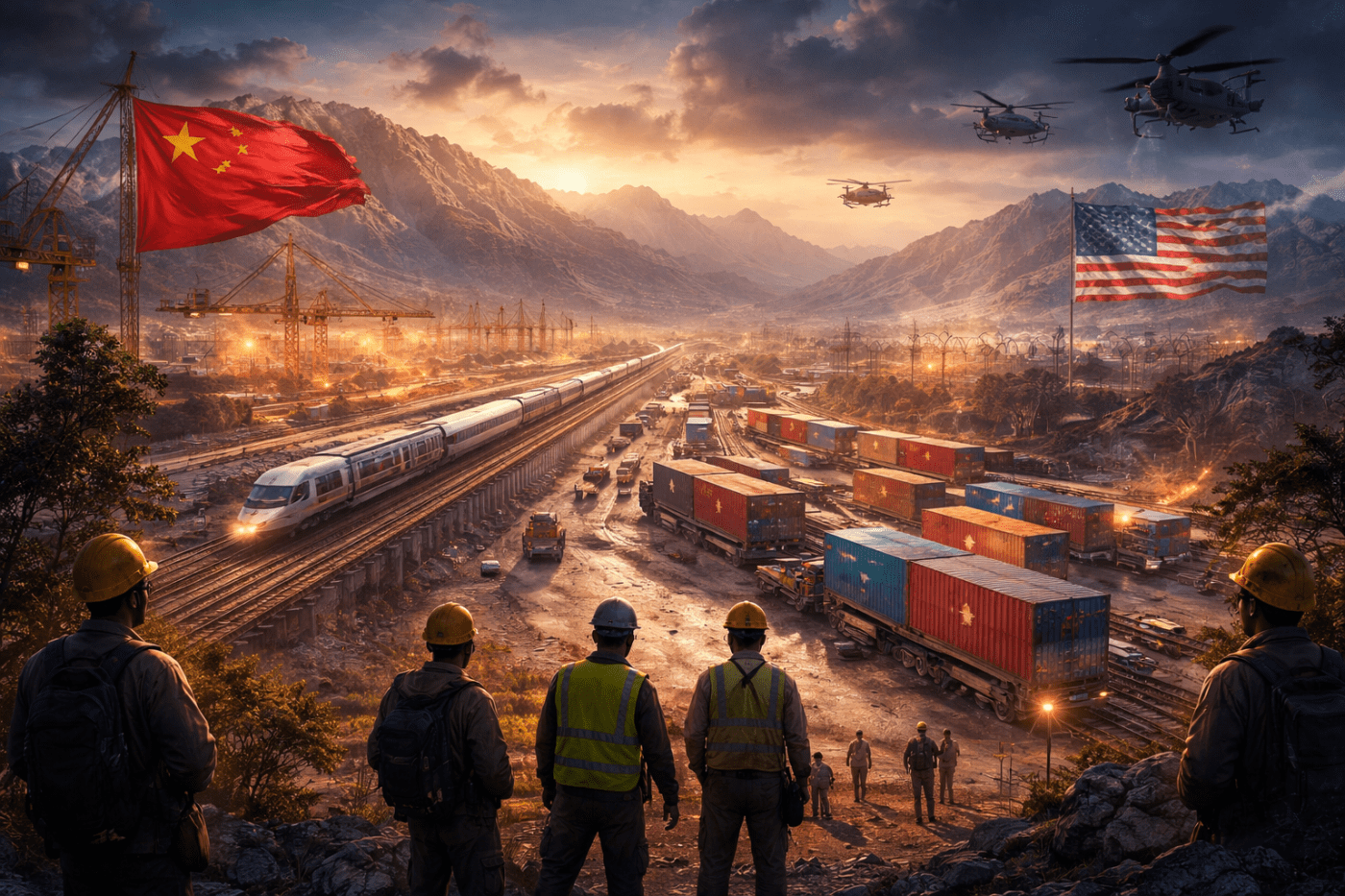
A wire story turns development into suspicion by replacing politics with the language of “influence.”
The facts reveal a region actively recalibrating after decades of imposed dependency and underdevelopment.
Beneath the headlines lies a global shift where infrastructure collides with imperial decline and class struggle.
The task ahead is to organize solidarity so this opening leads to sovereignty, not recycled dependence.
How a Balance Sheet Becomes a Threat: Turning Development into “Influence”
This excavation takes as its object the syndicated wire piece “China Accelerates Investment, Trade, and Influence in Central Asia”, credited to Eurasianet and republished by Oilprice.com on January 21, 2026. Framed as straight geopolitical and economic reporting, the article surveys a series of Chinese investments, joint ventures, infrastructure projects, and institutional initiatives across Kazakhstan, Uzbekistan, Kyrgyzstan, Tajikistan, and Turkmenistan. It catalogs mining acquisitions, logistics corridors, rail expansion, educational and agricultural training programs, and new cooperation platforms, presenting them as evidence of China’s rapidly expanding regional presence. The cumulative effect of this reporting is to portray Central Asia as a space being steadily absorbed into Beijing’s orbit, with “influence” serving as the unifying concept that links otherwise disparate economic, cultural, and technical developments.
The wire story arrives wearing the costume of neutrality. It speaks in the calm voice of markets, the tidy grammar of consultants, the tone of people who never get their hands dirty. But don’t be fooled by the smooth surface. From its first paragraph to its final implication, the article performs a familiar imperial trick: it takes concrete acts of development and quietly recodes them as something suspicious called “influence.” No tanks, no threats, no ultimatums—just a raised eyebrow disguised as reporting.
The story advances the way an accountant flips through ledgers. Kazakhstan, Uzbekistan, Kyrgyzstan, Tajikistan—one after another—each reduced to a list of projects, deals, trainings, visits. Mining here. Rail there. A seminar in one capital, a cultural exchange in another. The pace is fast and breathless, as if speed itself were evidence. There is no pause to ask why these projects exist, who negotiated them, or what pressures shaped them. Momentum replaces explanation. Accumulation stands in for argument.
Language does the quiet work of ideology. The article leans heavily on verbs like “accelerates,” “deepens,” and “expands,” creating the sense of a force that cannot be slowed or redirected. And almost every one of these verbs is tethered to a single, loaded noun: “influence.” Investment becomes influence. Trade becomes influence. Training farmers becomes influence. Steel rails and flight routes are no longer infrastructure; they are insinuations. The word floats free of definition, which is exactly the point. Influence can mean partnership or pressure, cooperation or control. The article never chooses, letting suspicion do the work that evidence does not.
Watch closely how agency is assigned. Chinese firms and institutions are always in motion. They acquire, launch, expand, train, invest. They act. Central Asian states, by contrast, mostly receive. They host, ratify, approve, welcome. They become settings rather than subjects. And the people who actually live and work in these places—the miners, rail workers, farmers, drivers, students—are nowhere to be found. A world without workers is a world without class struggle, and that absence is not a mistake. It is the condition that allows “influence” to appear as a moral problem rather than a material relationship.
The technocratic tone finishes the job. Education programs, agricultural trainings, qualification recognition, and cultural exchanges are presented as dry procedures, stripped of politics and conflict. Everything appears administrative, as if power now flows through paperwork instead of struggle. By treating these initiatives as neutral upgrades, the article empties them of social meaning while still stacking them up as proof of reach. Politics is replaced with process. Domination, if it exists at all, is said to emerge not from exploitation or coercion, but from efficiency.
Then come the silences—the loudest part of the story. There is nothing about wages, working conditions, land use, environmental damage, or who ultimately controls the value produced. Conflict only enters the narrative when construction is disrupted, framed as an external security problem rather than a social consequence. There is no mention of popular response—no consent, no resistance, no debate. Development is portrayed as a smooth machine that only malfunctions when something from outside interferes.
Geography, too, is chopped into pieces. Each country is treated like a sealed box, its relationship with China described in isolation from its neighbors. Regional coordination disappears. Cross-border integration is flattened into a series of bilateral encounters. The reader is never allowed to see the larger picture: a reorganization of Eurasian space driven by material needs and political choices. Fragmentation keeps power opaque and history offstage.
Put it all together and the operation becomes clear. Development is quietly reframed as encroachment. Cooperation is recast as consolidation. And “influence”—undefined, unmeasured, and endlessly repeated—steps in to replace analysis. The article never makes an accusation outright. It doesn’t have to. By the time the inventory is complete, the reader has already been guided to the intended conclusion: that undercapitalized local firms, expanding Chinese capital, and new regional platforms amount not to sovereign strategy or negotiated development, but to a creeping dependency whose legitimacy is never examined.
This is how empire prefers to speak when it can no longer command. It does not argue; it insinuates. It does not explain; it catalogs. Politics disappears, class disappears, history disappears—and in their place stands a single shadowy figure called “influence,” doing all the work that real analysis refuses to do.
What the Wire Tells You — and What It Carefully Leaves Out
Stripped of its insinuations, the article does contain a core of verifiable facts. Chinese firms are expanding their economic presence across Central Asia through mining acquisitions, logistics projects, manufacturing investments, and joint ventures. In Kazakhstan, Chinese companies have moved to purchase stakes in silver, lead, tungsten, and uranium assets, often assuming the debt burdens of undercapitalized local firms. In Uzbekistan, the number of Chinese companies and joint ventures has more than doubled since 2023, making China one of the largest foreign commercial presences in the country. Across the region, rail traffic, cargo volumes, and transit routes connecting Central Asia to China have grown sharply, while new air routes, logistics centers, and industrial zones have been announced or launched. China has also expanded cooperation in education, agriculture, and technical training, hosting Central Asian specialists in China while sending delegations and instructors into the region. These are the article’s concrete claims, presented as isolated data points rather than as parts of a political economy.
What the article omits is just as important as what it lists. It never explains that China is Uzbekistan’s largest trade partner, nor that Kazakhstan’s trade with China has surged to record levels, with Chinese customs data showing China has become Central Asia’s biggest overall trading partner. It does not mention that Chinese–Central Asian engagement has been formalized through high-level summits and political frameworks that explicitly speak in the language of sovereignty and “win-win” development—such as the official PRC development-agency framing of South–South cooperation around non-interference and mutual respect and the recent China–Central Asia summit track that produced a “permanent” good-neighborliness treaty.
It leaves out the fact that many of the “low valuation” acquisitions it highlights are explicitly tied to debt and undercapitalization inside the target firms themselves—something the piece notes in passing (for example, that the Alaigyr seller carries significant debt that the buyer would assume) but never develops into a serious explanation of why “cheap” does not automatically mean “theft.” It ignores the role of regional transit corridors—especially expanding rail and overland links connecting Central Asia to China and onward toward the Caspian and Europe—as deliberate strategies to reduce vulnerability to maritime chokepoints and sanction-sensitive routes, a logic spelled out in transport research on the Trans-Caspian / Middle Corridor as an alternative Eurasian trade pathway. And it avoids any discussion of how education, training, and standards-recognition agreements are part of broader regional efforts to diversify skills and labor markets in societies still shaped by remittance dependence—an issue illustrated by Kyrgyzstan’s remittances as a share of GDP and the wider push for cross-border qualification recognition under UNESCO’s Asia-Pacific qualifications recognition framework.
Most strikingly, the article refuses to situate these developments in historical context. Central Asia did not enter the twenty-first century as a blank slate waiting for China to arrive. The region emerged from the collapse of the Soviet Union economically fractured, heavily privatized, and structurally dependent on external capital, export corridors, and remittances. For three decades, Western financial institutions prescribed austerity, privatization, and “market reforms” that hollowed out state capacity while enriching local elites. Russia retained influence through energy and labor migration and security ties, but offered little in the way of new industrial development. By the time Chinese capital began arriving at scale, Central Asia was already undercapitalized, infrastructure-poor, and searching for alternatives that did not come with IMF conditionality or NATO alignment.
The article also avoids the broader geopolitical shift underway. China’s engagement with Central Asia has accelerated alongside the breakdown of the unipolar order, the weaponization of sanctions, and the increasing unreliability of Western trade and finance for much of the Global South. Overland corridors linking China to Central Asia, the Middle East, and Europe are not accidental commercial side effects; they are responses to a world in which payment systems, insurance markets, and sea lanes are routinely turned into instruments of coercion. Central Asian states are not passive recipients in this process. They have actively sought to position themselves as transit hubs, industrial partners, and logistical bridges in a changing Eurasian economy, leveraging competition among external powers to regain room to maneuver.
Finally, the article erases the social terrain on which all of this unfolds. Infrastructure expansion under the Belt and Road Initiative (BRI) is explicitly tied to improved connectivity and economic activity, and research shows that such investments can affect trade, GDP, employment, and welfare across participating regions. BRI transport corridors, railways, and road links are not just trade lines; they reshape labor markets, wages, and migration patterns by lowering transport costs and opening new corridors of circulation that alter where and how people work. Empirical work on rail investments, for example, has documented effects on employment distribution and wage dynamics in Central Asian cities and regions, illustrating that connectivity can shift population and economic activity toward hubs like Almaty and Astana.
Education and training programs, too, are part of this terrain. While we lack region-specific quantitative data in this search set, development research highlights that infrastructure and integration initiatives often coincide with efforts to build human capital and adapt skills for new economic circuits. They alter skill hierarchies, class composition, and patterns of labor mobility under conditions where workers must navigate new demands and opportunities. These processes carry contradictions—between capital and labor, between public interest and elite capture, between development and environmental strain—and are central to how social and economic structures transform in response to continental connectivity initiatives. Yet by refusing to acknowledge this terrain, the article presents China’s role as an external force acting upon a passive region, rather than as one factor in an ongoing struggle over sovereignty, development, and class power in Central Asia.
From “Influence” to Infrastructure: Reframing the Struggle over Central Asia
Once the fog of insinuation is cleared, a different picture comes into view. What the wire story calls “influence” is better understood as a collision between two historical trajectories: a region shaped by decades of imposed dependency, and a global shift in which that dependency is no longer guaranteed. Central Asia sits at this fault line. The question is not whether China has arrived—capital always arrives where there is need—but what kind of world system is being contested through rails, mines, classrooms, and ports.
For much of the post–Cold War period, Central Asia was disciplined by absence rather than presence. Western institutions arrived with advice, audits, and austerity, not with factories or freight corridors. Markets were opened, assets privatized, and social protections stripped away in the name of “transition,” leaving states undercapitalized and workers exported as remittances. When the article marvels at low purchase prices and debt-heavy firms, it is describing the residue of that earlier order—one that socialized risk upward and privatized loss downward. Chinese capital enters not into a healthy marketplace, but into an economy already deformed by decades of extraction without development.
The expansion of overland trade routes and industrial projects must be read against this backdrop. Infrastructure is not neutral, but neither is stagnation. Railways, logistics hubs, and energy facilities reorganize space and time; they shorten distances, lower transport costs, and redraw the map of who can trade with whom. In a world where financial systems and sea lanes are routinely weaponized, the construction of continental corridors is a material act of self-defense for states that have learned—often the hard way—that dependency is enforced not only by guns, but by insurance markets, payment systems, and choke points.
From the standpoint of the global working class and peasantry, this matters because development changes the terrain of struggle. New factories and rail lines create jobs, but also new forms of exploitation. Training programs raise skills, but can just as easily discipline labor. State revenues grow, but elites remain eager to capture them. None of these contradictions are resolved by declaring China a savior or a villain. What matters is that the material basis of society is shifting, opening space for contestation that did not exist when Central Asia was locked into a single axis of dependency.
The imperial narrative insists on reading this shift as a morality tale: one power replacing another, one form of domination swapping flags. But this flattens history and denies agency to those who live in the region. Central Asian states have not stumbled blindly into these arrangements. They have pursued them as part of a broader recalibration, seeking room to maneuver in a system where Western promises arrive chained to conditionality and military alignment. The rise of multipolar economic relations does not abolish class struggle; it relocates it onto new ground.
For revolutionary forces, the task is to hold two truths at once. China’s role as a counterweight to imperial coercion creates real breathing room for countries long suffocated by sanctions, debt regimes, and geopolitical blackmail. At the same time, capitalist contradictions persist within and through these projects—contradictions that can only be resolved through organization from below. Infrastructure can serve emancipation or elite accumulation; training can empower workers or discipline them; trade can redistribute wealth or deepen inequality. Which path prevails is not decided by balance sheets or wire stories, but by struggle.
When viewed from this angle, the wire’s fixation on “influence” collapses. Influence is not a force that floats above society; it is produced through material relations. What is unfolding in Central Asia is not a stealthy takeover, but a contested reordering of the world economy in which old imperial levers no longer function as they once did. The real question, carefully avoided by the article, is not whether China’s presence is growing, but whether the peoples of Central Asia can turn this moment of transition into genuine sovereignty rather than another round of managed dependence.
Turning the Opening into a Movement: Tasks for Solidarity and Struggle
The contradictions exposed in Central Asia are not distant abstractions; they are signals of a world in motion, and they demand response. As new infrastructure is laid and new economic routes take shape, the space for popular intervention widens. But openings do not organize themselves. For the global working class, the task is not to cheer from afar or to substitute slogans for analysis, but to connect materially with the struggles already unfolding along these corridors of change.
Across Central Asia, workers and communities are already negotiating the terms of this transformation. Transport workers confront new schedules, safety regimes, and wage structures as rail and logistics expand. Farmers and agricultural laborers weigh the benefits of training and market access against land pressure and ecological strain. Students and technical workers move through new education and certification systems that promise mobility while reshaping class hierarchies. These are not theoretical debates; they are lived conflicts over who controls development and who pays its costs.
Revolutionary and multipolar forces in the Global North have a responsibility to meet these struggles with practical solidarity. That begins by breaking the information monopoly that turns development into suspicion and cooperation into threat. Independent media projects, labor publications, and movement-based research collectives must amplify worker-centered accounts of infrastructure and trade, refusing the language of “influence” and replacing it with analysis rooted in class relations. Translation, syndication, and popular education are not auxiliary tasks; they are weapons in an information war.
Solidarity must also move through existing organizations. Transport and logistics unions, particularly those with international federations, are positioned to share safety standards, bargaining strategies, and cross-border communication with workers along Eurasian corridors. Agricultural cooperatives and peasant movements can exchange knowledge on land defense, water use, and food sovereignty in the face of industrial expansion. Student and technical-worker networks can contest the use of training programs as instruments of discipline rather than empowerment. These connections already exist in fragments; the task is to knit them together.
At the same time, forces in the imperial core must confront their own states. Sanctions regimes, financial blockades, and “security” frameworks are the very pressures driving the reorganization now unfolding in Central Asia. Campaigns to expose, resist, and ultimately dismantle these coercive tools are not acts of charity toward the Global South; they are acts of self-defense by workers whose wages, prices, and futures are bound to the same system of imperial management. Every successful challenge to sanctions and militarized trade policy expands the room for genuine development elsewhere.
The moment demands discipline rather than dogma. China’s role in this process should neither be idealized nor demonized. It should be defended where it obstructs imperial coercion and challenged where capitalist accumulation threatens to reproduce inequality. Multipolarity is not socialism, but it is a condition in which socialist struggle becomes possible again. The task before us is to help turn this opening into durable power—from rail yards to classrooms, from fields to factories—by organizing across borders, grounding solidarity in material struggle, and refusing to let the future be decided by elites, whether old or new.
 Weaponized Information
Leave a comment