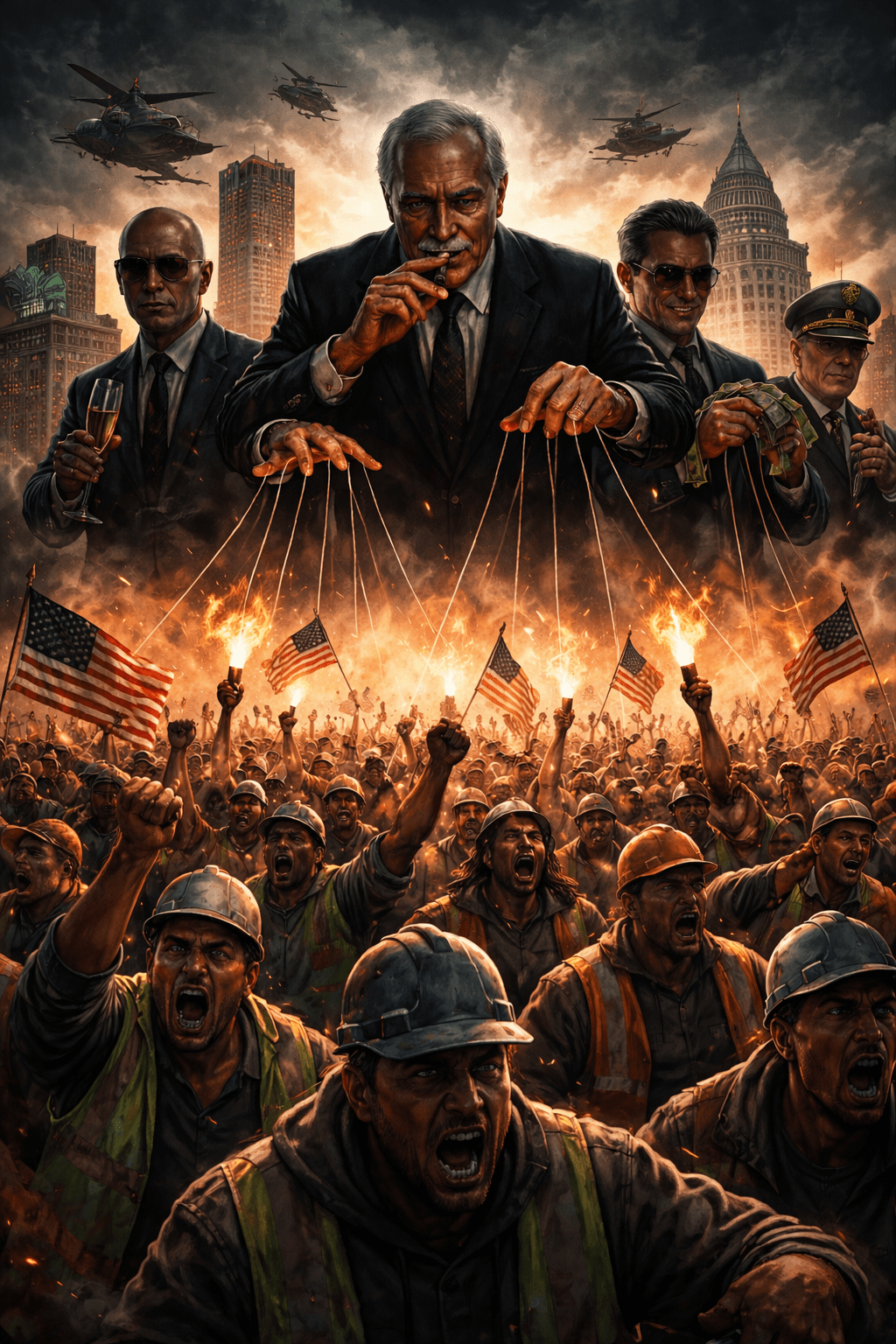
This essay is a direct political intervention into the crisis of working-class consciousness inside a settler-colonial empire in decline. It argues that the anger animating the MAGA movement is real—rooted in decades of deindustrialization, wage stagnation, debt, farm foreclosure, and the slow collapse of social life—but that this anger has been deliberately misdirected by monopoly capital into a fake rebellion that protects the very system responsible for these conditions. By exposing how Wall Street, Big Tech, agribusiness, the military-industrial complex, and the political class fuse into a single apparatus of class rule, the essay shows how Trumpism functions not as resistance to empire, but as elite counterinsurgency: a managed revolt designed to turn workers against each other, tighten the colonial leash on the internal colonies, and preserve corporate power at home while escalating hyper-imperial extraction, sanctions, and resource war abroad. In short: what looks like populism is the ruling class reorganizing itself for the age of technofascism—when capitalism can no longer buy consent, so it builds surveillance, militarized borders, and propaganda factories to enforce obedience.
By Prince Kapone | Weaponized Information | January 14, 2026
Your Anger Makes Sense — But Somebody Handed You the Wrong Map
Let us begin with honesty, because working people can smell propaganda the way a farmer smells rain. A lot of you are furious, and you have every reason to be. You watched the factory gates close and the “for lease” signs multiply like weeds. You watched small towns get hollowed out while corporate chains moved in to sell the same cheap junk everywhere, like a carpet laid over a grave. You watched wages stay flat while the price of everything—rent, groceries, gas, medicine—climbed like it was trying to reach heaven. You watched debt become a permanent roommate. You watched your kids get offered either a uniform, a prison number, or a lifetime subscription to student loans. And you watched politicians smile through all of it, shaking hands, cutting ribbons, making speeches about “opportunity” as if opportunity is something you can buy at Walmart.
So when you say the system is rigged, you are not being paranoid. When you say the elites are corrupt, you are not imagining things. When you say the country feels like it has been sold off, piece by piece, you are naming something real. The only problem is that the same system that robbed you also trained you to misunderstand the robbery. It gave you a vocabulary that sounds rebellious, but functions like a leash. It gave you “culture war” instead of class war. It gave you scapegoats instead of owners. It gave you a shouting match so you would never have a serious conversation about power.
Here is what most people are not told in plain language: the people who run the economy run the government. There is no clean wall between politics and money. That wall exists only in textbooks and campaign ads. In real life, politics is how the owners manage what they own. The state does not float above society like a neutral referee; it is stitched into the society of property, profit, and power. That is why the political class so often behaves like a cartel—because it is financed like one, recruited like one, and disciplined like one. If you want to understand why Congress can’t find the money for healthcare but always finds the money for bombs, you don’t need a conspiracy theory. You need a balance sheet.
This is also why the “outsider” story works so well. When Trump walked onto the stage, he did not sound like a politician. He sounded like a rich man who had learned how the machine works from the inside—because he had. Many people took that as proof that he was against the ruling class. But that conclusion rests on a mistake that liberal culture has drilled into the population for generations: it teaches you to think the ruling class is “the politicians,” as if the problem is manners, not ownership. Trump was outside the political establishment, yes. But he was never outside the economic ruling class. He did not come from the world of wage labor; he came from the world of property. He did not rise through unions, shop floors, farms, or tenant struggles; he rose through deals, branding, finance, and the soft violence of contracts. And when asked how he knew the political world was bought, he answered in the simplest language possible: because he was one of the people buying it. That is not the voice of a rebel. That is the owner class speaking without makeup.
If your enemy is only “corrupt politicians,” then any billionaire who insults politicians can dress up as your champion. That is how the trick is done. The political class becomes the villain, and the economic class that owns them becomes invisible. You are encouraged to hate the waiter while ignoring the person who owns the restaurant. But the waiter doesn’t set the prices. The waiter doesn’t decide who gets hired and fired. The waiter doesn’t decide whether the business moves overseas. The waiter doesn’t own the building. The owner does. The owner always does. And when workers are angry enough to demand a different world, the owner class does not simply say no—it hires storytellers, builds media machines, funds movements, and manufactures a politics that feels like resistance while keeping ownership intact.
There is another truth we have to face, and we have to face it carefully, without cheap moral theater. The United States was not built as a home for working people in the first place. It was built through conquest, land theft, slavery, and expansion—a machine that created wealth for some by turning others into fuel. That history is not a side issue; it is the foundation. But the point here is not to drown you in guilt or to lecture you like a liberal priest. The point is to understand that there is no pure “America” that was stolen from ordinary people, no innocent paradise waiting to be restored if only the right strongman comes along. What working people have experienced—Black, Brown, Indigenous, immigrant, white—is a system that protects property first, profits second, and people last. Sometimes it throws a few crumbs to keep the peace. Sometimes it tightens the belt and calls it patriotism. But the structure remains: a small class owns, and the rest are managed.
This is why your anger must be defended from being hijacked. Because anger can become consciousness, and consciousness can become organization. But anger can also be redirected into hatred for other poor people, into fantasies about national purity, into worship of police power, into the belief that repression is “freedom” as long as it targets somebody else. When that happens, the owners win twice: they keep their wealth, and they recruit the exploited to police the exploited—tightening the colonial leash on some today so they can tighten it on everyone tomorrow. They turn your frustration into their weapon. They teach you to punch sideways and downward while they continue to pick your pocket from above.
So Part I begins with a simple promise: we are going to take your grievances seriously, because they are serious. We are not going to flatter you, because flattery is how con men operate. And we are not going to sell you an easy enemy, because the truth is not easy, but it is liberating. The question is not whether you have been betrayed. You have. The question is whether you will keep fighting the wrong war on behalf of the people who betrayed you—or whether you are ready to learn how power actually works, so that your anger can finally find the right target.
What They Call “Globalism” Is What Marxists Have Always Called Imperialism
One of the first tricks played on working people is linguistic. The ruling class knows that if they control the words, they can bend the meaning. So they gave us a debate between “globalism” and “nationalism,” between “open borders” and “America First,” between “free trade” and “protectionism,” as if these were the real lines of battle. But long before cable news invented these slogans, Marxists had already named the system and mapped its logic. What liberals now dress up as “globalization,” and what the right rages against as “globalism,” has a much older name: imperialism. It is the outward expansion of capital in search of cheap labor, raw materials, new markets, and higher profits. It is capitalism on the move, doing what it has always done.
This is not a twenty-first-century invention. It is not the product of some secret cabal meeting in a Swiss hotel. It is the normal behavior of a system built on accumulation. Marx described its early forms when he wrote about primitive accumulation and the violent birth of capitalism. Lenin later explained how capitalism matured into monopoly power and finance capital, exporting not only goods but domination itself. Kwame Nkrumah showed how formal empire gave way to neo-colonial rule, where flags changed but ownership did not. Samir Amin exposed how the wealth of the imperial centers rests on the systematic underdevelopment of the periphery. Different generations, same machine.
Imperialism is not about culture. It is not about national identity. It is not about whether people speak English or Spanish or Mandarin. It is about who owns the mines, the oil fields, the factories, the ports, the cables, the data, the land, and the banks. It is about who writes the trade rules, who controls the credit, who sets the prices, and who enforces the contracts. It is about a world economy organized so that wealth flows upward and outward, from workers to owners, from colonies to empires, from the many to the few. When people say “our jobs went overseas,” what they are really saying is that capital went where labor was cheaper and unions were weaker. When they say “foreign countries are stealing from us,” what they are really describing is American corporations extracting profit abroad while abandoning communities at home. The thief is not the worker on the other side of the ocean. The thief is the corporation that plays one workforce against another.
This is why the right-wing story about globalism is both seductive and false. It speaks to real pain: factories closed, farms wiped out, towns turned into ruins with a dollar store on every corner. But instead of explaining how monopoly capital reorganized the world economy for its own benefit, it tells you that the problem is “foreigners,” “open borders,” or “international institutions.” It gives you a nationalist mirror image of liberal mythology. Where liberals say globalization is progress, the right says it is betrayal. But both leave untouched the real structure: a world run by corporations and banks, enforced by states and armies, and paid for with working-class lives everywhere.
The bitter irony is that the same system that destroyed industrial jobs in the United States also destroyed peasant agriculture in Mexico, flooded African markets with subsidized Western grain, privatized water in Latin America, and turned entire regions into export zones for the benefit of Western consumers and shareholders. Imperialism does not have a favorite color or passport. It chews through communities wherever profit demands it. The difference is that in the Global South, the violence is more naked—coups, sanctions, blockades, bombs, and now a harsher form of hyper-imperial extraction as U.S. power recalibrates in a multipolar world. In the imperial center, it is more polite—plant closures, foreclosures, layoffs, austerity, debt. Different methods, same class rule.
So when you hear politicians and pundits talk about “bringing jobs back” without ever talking about who owns the factories, or when you hear billionaires complain about “globalism” while sitting on global investment portfolios, understand what game is being played. They are not opposing imperialism. They are negotiating how it should be managed. They are fighting over which faction of capital gets the bigger slice. And they are recruiting working people into that fight by pretending that empire can be made humane if only the right managers are in charge.
Imperialism is not a policy error. It is not a bad idea that can be voted away. It is the world system of capitalism itself, stretched across continents and enforced with law, money, and violence. You can paint it red, white, and blue, or wrap it in the language of human rights, or sell it as “economic freedom,” but underneath the costume it remains what it has always been: a machinery for turning labor into profit and profit into power. If you want to understand the forces that hollowed out your town and chained whole nations to poverty at the same time, you don’t need slogans. You need political economy.
And once you see imperialism for what it is, the picture changes. The worker in Ohio and the worker in Shenzhen are not enemies. The farmer in Iowa and the farmer in Honduras are not rivals. The miner in Appalachia and the miner in the Congo are not competing for scraps. They are all caught in the same web, spun by the same class, for the same purpose. That is the truth hidden behind the fog of “globalism.” And it is the truth that terrifies the owners most: that their power depends on keeping the exploited divided, and that the moment workers recognize the system for what it is, imperialism loses its greatest weapon—ignorance.
Why the Political Class Is Corrupt — And Why That Is Not an Accident
By now most working people do not need to be convinced that the political class is corrupt. They see it in the revolving door between Congress and corporate boardrooms. They see it in the lobbyists who write the laws and the regulators who go to work for the industries they were supposed to regulate. They see it in the campaign donations that look like legal bribes and the speaking fees that look like retirement plans. They see it in the way both parties suddenly agree when Wall Street needs a bailout or when the Pentagon wants another war. This is not cynicism. This is pattern recognition.
But the reason the political class is corrupt is not because individual politicians are uniquely immoral. It is because the system is designed to be owned. The modern state is not some neutral referee floating above society, calmly balancing the interests of all. It is a machine that grew alongside capitalism and learned to serve it. Laws are written in the language of property. Courts defend contracts before they defend human beings. Police protect wealth long before they protect communities. And elections, under monopoly capitalism, function less like popular control and more like a marketing campaign funded by billionaires who expect a return on their investment.
This is why it is so easy for the rich to buy influence. They are not corrupting a healthy system; they are operating it as intended. When a corporation spends millions lobbying for tax breaks, deregulation, or subsidies, it is not cheating. It is doing business. When a bank writes the fine print of financial legislation, it is not sneaking into the process. It is exercising ownership. And when politicians move from public office into corporate consulting firms, defense contractors, or Wall Street banks, they are not betraying democracy. They are returning to the class that put them there in the first place.
Liberal culture tells us that corruption is a deviation from democracy, a kind of sickness that occasionally infects an otherwise healthy body. But capitalism is not a body that sometimes gets sick. It is a system that runs on extraction. Politics is not a realm of public service floating above the economy; it is the managerial wing of the ownership class. That is why reforms come slowly, if at all. That is why even popular demands—healthcare, housing, education, decent wages—get buried under committees, watered down in negotiations, and strangled in budget fights. The question is never whether society can afford dignity for working people. The question is always whether dignity interferes with profit.
This is also why outrage at “career politicians” misses the point. A new face does not change an old structure. You can rotate the staff, but the building remains the same. You can replace one manager with another, but the owners do not change. And if someone arrives from outside the political world but from inside the world of capital, they do not challenge the system—they bring it with them. That is the sleight of hand: turning anger at political corruption into loyalty to economic power.
When people say they want to “drain the swamp,” what they are really saying is that they want an end to a political order that no longer serves them. But swamps are not drained by electing landlords. They are drained by dismantling the system that created them. Corruption is not a bug in capitalism. It is one of its core features. The state exists to manage society in the interests of those who own it. And until that ownership is challenged, no amount of new slogans, new personalities, or new parties will change the basic reality: a government that answers to money will always treat working people as expendable.
Understanding this is not about despair. It is about clarity. If the political class is corrupt because it is owned, then the fight is not simply against bad politicians. It is against the class that owns them. It is against the banks that write the rules, the corporations that dictate policy, the monopolies that dominate markets, and the billionaires who believe society is their private estate. Once you see the system for what it is, the fog lifts. You stop looking for saviors in tailored suits and start asking the only question that matters in a class society: who owns, and who works?
That is the line they never want you to cross. Because the moment working people understand that corruption is structural, not accidental, the entire political theater begins to look different. The speeches sound hollow. The scandals look staged. The culture wars feel like distractions. And the real conflict comes into focus: not left versus right, not red versus blue, but top versus bottom. Owners versus workers. Empire versus humanity.
How a Real Crisis Was Turned into a Fake Rebellion
Every system in decline generates two things at the same time: anger from below and fear from above. The anger comes from people whose lives are getting harder, whose work is worth less, whose futures are shrinking. The fear comes from elites who know that when enough people realize they have nothing left to lose, history starts moving fast. That is the moment when the ruling class does not merely defend its wealth. It reorganizes its politics. It looks for new managers, new slogans, new uniforms. It looks for a way to ride the wave instead of being drowned by it.
Trump did not invent the crisis. He arrived after decades of deindustrialization, union busting, financialization, debt expansion, and imperial overreach. The American economy had already been hollowed out. The social contract had already been shredded. The promise of stability had already been broken. People were angry long before he descended an escalator and declared war on the political establishment. What he did was recognize that anger, validate it, and then redirect it. He took a real rebellion that was waiting to happen and replaced it with a counterfeit one.
The genius of the operation was simple. He said what millions of people already believed: that Washington is corrupt, that politicians lie, that the media manipulates, that trade deals were written for corporations, not workers. On this much, he was telling the truth. But instead of tracing those realities back to their source in monopoly capital, colonial class rule, and imperial power, he offered a story that stopped halfway. He named the swamp but refused to name who owns the land it sits on. He attacked the political managers but left untouched the economic system they manage. In doing so, he turned class anger into loyalty to a different faction of the same ruling class.
This is how fake rebellion works. It dresses up domination as resistance. It takes the language of revolt and empties it of content. It borrows the posture of defiance while enforcing obedience. It tells working people that their enemy is not the corporations that closed their factories, but the migrants who followed the jobs those corporations created. It tells them that their enemy is not the banks that foreclosed on their homes, but the poor families trying to survive in the same economy. It tells them that their enemy is not the system that turned healthcare into a commodity, but the nurses, teachers, and students who demand a different world.
The right-wing populist narrative is built on this inversion. It presents the state as a victim of “globalist plots” rather than as the main instrument of imperial power. It presents the police and the military as defenders of freedom rather than as enforcers of class rule. It presents repression as security and obedience as patriotism. It wraps authoritarian power in the flag and sells it as independence. In this story, freedom means submission to capital, and rebellion means loyalty to empire.
What makes this so dangerous is that it feeds on legitimate suffering. People who have been thrown away by the economy are told that their pain is proof of their virtue. People who feel ignored are told that they are the “real nation.” People who are drowning in debt are told that their misery is caused by outsiders. The anger is real, but it is being carefully aimed away from the structures that created it. This is not an accident. It is a political strategy with a long history, perfected in moments when ruling classes feel threatened by the possibility of mass revolt.
In the end, fake rebellion always serves the same purpose: to preserve ownership. It allows the ruling class to reshuffle its political leadership without changing its economic power. It gives the appearance of rupture while maintaining continuity. It convinces working people that they are storming the fortress, when in reality they are guarding the gates for a different set of generals. And when the dust settles, when the slogans fade and the rallies disperse, the same corporations still own the land, the same banks still own the debt, and the same empire still claims the right to rule the world.
The tragedy is not that people believed the story. The tragedy is that the story was written for them, in their language, with their anger, using their lives as proof. But history does not end with deception. Every lie carries within it the seed of its own exposure. And every fake rebellion eventually collides with reality. When it does, the question will not be whether working people were angry. They already are. The question will be whether they are finally ready to aim that anger where it belongs.
The Class That Actually Rules This System
If you want to understand why nothing ever really changes no matter who wins elections, you have to stop looking at the stage and start looking at the owners of the theater. Politics is the performance. Power is backstage. The speeches, debates, scandals, and slogans are the noise that fills the room while the real decisions are made quietly, in boardrooms and banks, in hedge funds and defense contractors, in energy conglomerates and tech monopolies. This is not where democracy lives. This is where ownership lives.
The ruling class is not defined by party affiliation or by which news channel they appear on. It is defined by control over production, finance, land, energy, data, weapons, and infrastructure. Wall Street decides which industries live and which die. Big Tech controls the platforms where speech circulates and markets form. Energy giants dictate the terms of extraction that shape entire regions. Agribusiness monopolies dominate food systems from seed to supermarket. Defense contractors write the wars and then sell the weapons to fight them. Pharmaceutical corporations patent life itself and charge rent on survival. Media conglomerates manufacture reality and sell it back to the population as entertainment.
This class does not simply influence the state. It owns it. Campaigns are financed by corporate money. Think tanks are funded by billionaires. Universities are sponsored by defense firms and banks. Regulatory agencies are staffed by former executives and future consultants. Courts are packed with judges who treat property rights as sacred scripture. And when crises hit—financial crashes, pandemics, wars—it is always the same pattern: social losses are collectivized, while private profits are protected. Bailouts for the rich, austerity for the poor. That is not mismanagement. That is class policy.
The genius of modern capitalism is that it hides its rulers in plain sight. The billionaire is presented as an entrepreneur, a genius, a visionary. The corporation is presented as a job creator, a benefactor, a pillar of the community. The bank is presented as a service provider. The empire is presented as a peacekeeper. And when people suffer under this system, they are told that the problem is their own failure, their own lack of hustle, their own poor choices. Meanwhile, a handful of families accumulate more wealth than entire nations, and are praised for their “success.”
This is not a conspiracy. It is a class structure. It operates through laws, contracts, markets, and institutions. It reproduces itself through inheritance, elite schools, private networks, and political access. It enforces itself through police, courts, prisons, and armies. And it defends itself ideologically through media, education, and culture. The ruling class does not need to meet in secret. Its interests are written into the architecture of society.
When working people are told that their enemy is “the left,” “the right,” “the government,” or “foreigners,” what is really being protected is this class. As long as anger is scattered, fragmented, and misdirected, ownership remains secure. As long as workers fight each other over scraps, the banquet continues upstairs. The most dangerous idea in a class society is not any particular ideology. It is the simple realization that those who do the work should control the wealth they create.
This is the line that is never crossed on television. You can argue about taxes, borders, schools, and culture until you are blue in the face, and the system will tolerate it. But the moment you ask why a tiny minority owns everything while the majority lives on the edge, the mood changes. The tone hardens. The language becomes hostile. You are called unrealistic, radical, un-American. Not because the idea is wrong, but because it threatens the only thing the ruling class truly cares about: its property.
To name the ruling class is not to indulge in resentment. It is to tell the truth about how power is organized. It is to refuse the fairy tale that we live in a society governed by equal opportunity and fair competition. It is to recognize that democracy without economic power is theater, and that freedom without control over your own labor is a slogan. Once you see who really rules, the political fog lifts. You stop chasing villains on the screen and start studying the structure behind it. And that is the first step toward building a world where ownership no longer sits above humanity like a god.
How Working People Are Turned Against Each Other
Every empire learns the same lesson sooner or later: it is easier to rule a divided people than a united one. You do not need to convince workers that the system is good. You only need to convince them that their suffering is caused by someone else who is suffering just like them. Divide the exploited into camps, and they will police each other for you. That is the oldest trick in the book, and it has been rewritten for every generation.
In a society built on conquest and slavery, division was not an accident. It was a strategy. Race was turned into a political weapon to keep labor fractured. Citizenship was turned into a gate to separate insiders from outsiders. Borders were drawn not just around land, but around rights. And over time, these divisions were naturalized, treated as common sense, passed down like folklore. Meanwhile, the owners of the economy learned to move freely across every border that workers were told to respect.
When jobs disappeared, people were told to blame immigrants instead of the corporations that moved production abroad. When wages fell, people were told to blame affirmative action instead of union busting. When healthcare became unaffordable, people were told to blame the poor instead of the insurance industry. When housing turned into a casino, people were told to blame renters instead of landlords and private equity firms. The formula never changes: point downward, never upward.
This is how working-class anger is domesticated. It is taken off the terrain of ownership and redirected onto the terrain of identity. Instead of asking who controls the factories, people argue about who deserves to work in them. Instead of asking who owns the land, people argue about who belongs on it. Instead of asking who profits from war, people argue about which flag to salute. And while the debate rages on television and online, the real business of empire continues uninterrupted.
The ruling class understands something that many politicians pretend not to: solidarity is dangerous. A united working class, across race, nationality, gender, and culture, is the only force that has ever seriously challenged capitalist power. That is why every movement for economic justice has been met with surveillance, infiltration, repression, and propaganda. It is not enough to break unions and crush strikes. You have to break the idea that workers share a common enemy.
So the culture war is not a sideshow. It is a battlefield. It is where class struggle is disguised as moral panic. It is where economic violence is hidden behind symbolic outrage. It is where the language of freedom is used to defend exploitation. When workers are encouraged to fear each other more than they fear the corporations that exploit them, the system is working exactly as designed.
This does not mean that people’s identities and experiences are not real. It means they are being manipulated. Real grievances are being folded into fake narratives. Real pain is being weaponized in service of real power. And the result is a working class that is exhausted, suspicious, and isolated—while the ruling class remains organized, coordinated, and global.
The greatest threat to empire is not any foreign power. It is not any ideology. It is not any single movement. It is the possibility that the people who grow the food, build the roads, drive the trucks, teach the children, care for the sick, mine the minerals, write the code, and clean the buildings might one day recognize themselves as one class with one enemy. In the United States, that recognition has always had a colonial edge: the system trains sections of white labor to see the internal colonies as threats, so they will accept repression that begins there and then expands outward to everyone. That recognition is what every propaganda machine is designed to prevent. And it is exactly the recognition that history keeps trying to force back into the open.
The Police State Is Not Being Built for Criminals
One of the strangest features of life in a declining empire is that repression is sold as protection. Cameras on every corner are called safety. Databases on every citizen are called security. Armored vehicles rolling through neighborhoods are called peace. Borders bristling with walls, drones, and soldiers are called sovereignty. And when people ask why all of this is necessary, they are told the same story again and again: crime, terrorism, chaos. The threat is always external. The danger is always somewhere else. The solution is always more force.
But look at the direction of the force. It does not point at the banks that crashed the economy. It does not point at the corporations that poisoned the water, polluted the air, or sold addictive drugs for profit. It does not point at the landlords who turned housing into a speculative bubble or the hedge funds that turned grocery stores into price-gouging machines. It points downward and outward. It points at the poor, the migrant, the dissident, the protester, the surplus population created by the very system that now claims to fear them.
The modern police state did not grow out of a sudden crime wave. It grew out of a long crisis of legitimacy. As wages stagnated and inequality exploded, as trust in institutions collapsed and faith in the future eroded, the ruling class began to prepare for what comes next. They know history. They know that when people lose hope in reform, they turn to resistance. And they know that when empires can no longer buy consent, they try to enforce obedience. This is technofascism: monopoly capital fused with digital control and armed force to manage a population it can no longer provide for.
This is why surveillance has become total. Phones track your movements. Apps harvest your data. Platforms monitor your speech. Algorithms map your networks. Credit scores determine your access to life. Facial recognition watches your face. License plate readers follow your car. Drones scan your streets. And all of it is justified in the language of efficiency and safety, as if a society that needs to watch everyone at all times is somehow free.
This is why policing has become militarized. The equipment of foreign wars is brought home. The tactics of counterinsurgency are tested on city streets. Protest is treated as a security threat. Dissent is framed as extremism. Organization is labeled subversion. And the same intelligence agencies that once ran coups abroad now run influence operations at home. Empire always comes back to its center.
This is also why borders have become theaters of punishment. Migrants fleeing the wreckage of imperial policy are caged, deported, and hunted like criminals. Their suffering is turned into spectacle, their desperation into warning. The border becomes a stage where the state performs its power, not to stop exploitation, but to discipline labor. Fear is a useful tool when wages are low and unions are weak.
None of this is about protecting working people. If it were, the greatest threats would be treated as emergencies: unaffordable housing, predatory healthcare, mass debt, poisoned environments, collapsing infrastructure. Instead, these are managed as normal. The real emergency, from the point of view of the ruling class, is the possibility that people might connect their suffering to the system that produces it.
The police state is not being built because society is becoming more dangerous. It is being built because society is becoming more unequal. It is the architecture of class rule in an age when consent is wearing thin. It is the iron fist inside the velvet glove of democracy. And it exists for one reason above all others: to make sure that when working people finally demand a different world, they will be met not with justice, but with force.
What Real Resistance Actually Looks Like
The ruling class has spent generations teaching working people to confuse obedience with virtue and submission with patriotism. They wrap exploitation in the flag, dress repression in the language of order, and sell resignation as realism. In this upside-down world, the worker who demands control over their labor is called a radical, while the billionaire who owns entire industries is treated as a national treasure. But history tells a different story. Every gain that working people have ever made—shorter workdays, safer conditions, pensions, public schools, labor rights, civil rights—was won not by polite requests, but by organized struggle.
Real resistance does not begin with slogans or strongmen. It begins with people recognizing that their problems are not personal failures but political conditions. It begins when workers stop competing with each other for scraps and start asking why there are scraps in a society of abundance. It begins when farmers realize that agribusiness monopolies are not their partners but their landlords. It begins when tenants understand that housing is not a commodity to be flipped but a human necessity. And it begins when communities understand that the police state is not their shield but their chain.
Real resistance is not about returning to some mythical past. It is about building a future that has never existed under capitalism: a society where the wealth produced by many is controlled by many, where land is not a casino chip, where food is not a speculative asset, where healthcare is not a profit stream, and where education is not a debt trap. It is about replacing an economy organized for profit with one organized for human need—and it is about building the kinds of organizations that make that possible: workplace committees that can shut down production, tenant unions that can block evictions, strike support networks that can hold the line, community formations that can defend people from raids and repression, and international solidarity that refuses to treat the suffering of the Global South as the price of life in the North.
This kind of resistance is dangerous to empire precisely because it does not fit into the approved channels. It cannot be bought with campaign donations. It cannot be neutralized with culture wars. It cannot be pacified with tax credits and slogans. It is built in workplaces, neighborhoods, schools, farms, and prisons. It is forged in strikes, boycotts, mutual aid that tells the truth about power, tenant defense, community protection, and solidarity with colonized nations fighting to breathe under blockade, sanction, and war. It is slow, patient, disciplined work—the kind that does not make headlines until it makes history.
The ruling class would like you to believe that resistance means choosing which billionaire you want to rule over you. They would like you to believe that rebellion is a brand, a hat, a chant, a rally. But real rebellion is quieter and more powerful. It looks like workers walking off the job together. It looks like farmers refusing predatory contracts. It looks like communities blocking evictions. It looks like neighbors protecting each other from raids. It looks like soldiers refusing imperial wars. It looks like people deciding that they will no longer live on their knees.
Empire fears nothing more than organized working people who understand their own power. That is why unions were crushed, movements infiltrated, leaders assassinated, organizations destroyed. Not because they were perfect, but because they proved something the system never wants proven: that ordinary people, when united, can govern themselves. That they can plan production, distribute resources, defend their communities, and care for each other better than any boardroom ever could.
Real resistance is not chaos. It is democracy without landlords. It is order without bosses. It is security without surveillance. It is freedom without exploitation. It is the long, hard work of building a society where no one lives off the labor of another, and no one is disposable. That is the future the ruling class is trying to make unthinkable. And that is why every lie, every distraction, and every crackdown exists: to stop working people from realizing that the world they deserve is not only possible, but necessary.
You Are Being Forced to Choose Sides — Whether You Like It or Not
Every period of history eventually reaches a point where neutrality becomes impossible. You can pretend that politics is just noise, that power is someone else’s problem, that the future will somehow sort itself out. But the system does not grant that luxury for long. As inequality deepens and crises multiply, society is pushed toward a reckoning. Lines are drawn. Camps form. And working people are told, once again, that they must pick a side.
The ruling class would like that choice to look simple: order or chaos, security or danger, nation or enemy, obedience or collapse. They want you to believe that the only alternative to their rule is disorder. That without their banks, their corporations, their police, their surveillance, their wars, society would fall apart. It is a powerful myth. It has been used by every empire in decline, from Rome to Britain to every colonial power that ever mistook domination for civilization.
But history shows the opposite. What destroys societies is not too much democracy. It is too much inequality. What breeds instability is not freedom. It is exploitation. What produces violence is not resistance. It is dispossession. When people are locked out of decent work, decent housing, decent healthcare, and a decent future, they do not become loyal subjects. They become surplus. And surplus populations are never stable. They are governed either through justice or through force.
The ruling class has already made its choice. It has chosen monopoly over competition, rent over wages, surveillance over trust, repression over reform. It has chosen to manage crisis through police power rather than social investment. It has chosen to defend profit at the expense of life. And it has chosen to prepare for a future of permanent insecurity, where billions are controlled by a handful of owners who believe the planet itself is their estate. Abroad, that same choice shows up as hyper-imperialism: a harder, more desperate extraction regime of sanctions, blockades, coups, and resource war to keep the imperial center fed.
Working people are now being pushed toward a decision of their own. You can accept a future where life is reduced to a transaction, where debt is permanent, where housing is a privilege, where healthcare is rationed by insurance algorithms, where speech is monitored, where protest is criminalized, and where war is endless. Or you can refuse it. You can decide that a society built on permanent insecurity is not a society worth defending.
This is not a choice between left and right. It is a choice between rule by property and rule by people. It is a choice between empire and humanity. It is a choice between a world organized around accumulation and a world organized around life. You can stand with the class that owns everything and fears the future, or with the class that produces everything and deserves one.
The system will try to convince you that this is unrealistic. That nothing can change. That power is eternal. But no empire has ever survived its own contradictions. No ruling class has ever ruled forever. And no people have ever remained silent once they understood the source of their suffering. The future is not written by the powerful alone. It is written by those who refuse to accept their chains as destiny.
The question is not whether history is moving. It is. The question is whether you will be moved by it as a subject, or whether you will help shape it as a force. That is the choice being placed before you. Not by politicians. Not by pundits. But by the reality of a system that can no longer hide its nature.
You Were Lied To — But You Can Still Choose the Side of Humanity
There is a difference between being wrong and being deceived. Being wrong is a mistake. Being deceived is an injury. For decades now, working people in this country have been subjected to a propaganda machine built on an imperial scale. You were told that capitalism is freedom. You were told that billionaires are innovators. You were told that poverty is a personal failure. You were told that empire is democracy with a passport. And when your life did not match the story, you were told the problem was you.
You were told that the system rewards hard work, even as corporations replaced workers with machines and shipped jobs across oceans. You were told that the market is fair, even as monopolies swallowed entire industries and turned competition into a joke. You were told that the government represents the people, even as it was auctioned off to the highest bidder. You were told that America stands for freedom, even as it bombed, sanctioned, and blockaded half the world into poverty. And when you began to feel that something was deeply wrong, they handed you a narrative that sounded like rebellion but functioned like obedience.
None of this makes you foolish. It makes you human. People look for explanations that fit their experience, and when the truth is buried under layers of lies, the lies are often all that is visible. The ruling class understands this. That is why it invests more in media than in medicine, more in surveillance than in schools, more in advertising than in housing. It knows that controlling the story is as important as controlling the factory. And for a long time, it succeeded.
But deception has a shelf life. Reality keeps intruding. Bills keep coming. Rents keep rising. Jobs keep disappearing. Wars keep expanding. And the distance between what you were promised and what you live grows wider every year. At a certain point, the story collapses under its own weight. People begin to ask questions that no amount of spin can answer. Why is everything for sale? Why is life so expensive? Why is work so insecure? Why is the future so uncertain? These are not moral questions. They are political ones.
The most dangerous thing for the ruling class is not your anger. It is your understanding. Anger can be redirected. Understanding cannot. Once you see how power actually works, the old myths lose their grip. The culture wars start to look staged. The election dramas start to feel hollow. The billionaire saviors start to resemble what they really are: landlords of society. And the system that once felt natural begins to look like what it is—a historical arrangement built by human beings, maintained by institutions, and therefore capable of being dismantled by human beings.
You were lied to about who your enemies are. You were lied to about what freedom means. You were lied to about what is possible. But history is not a courtroom where you are forever bound by past testimony. It is a battlefield where people change sides every day. The question is not whether you were misled. Millions were. The question is whether you will continue to defend a system that treats you as disposable, or whether you will stand with those who believe that no one should live on the edge of survival in a world of abundance.
The ruling class wants you to believe that humanity is too divided to govern itself. That greed is natural. That exploitation is inevitable. That hierarchy is destiny. But every struggle for liberation, from the plantations to the factories, from the colonies to the ghettos, from the mines to the fields, proves the opposite. People do not fight for justice because they are perfect. They fight because life demands it.
You stand at the same crossroads that every generation in crisis has faced. On one side is a dying order that offers only deeper insecurity, harsher repression, and endless war. On the other is a future that has not yet been built, but which millions are already struggling to bring into existence—a world without landlords of labor, without empires of profit, without police states guarding inequality. A world where the wealth of society belongs to those who create it.
You were lied to. But you are not powerless. You can choose solidarity over division. You can choose truth over propaganda. You can choose humanity over empire. And when working people make that choice together—across race, across borders, and across the colonial lines this system was built to enforce—history moves. That is not a promise. It is a fact written into every revolution the world has ever known.
 Weaponized Information
Leave a comment