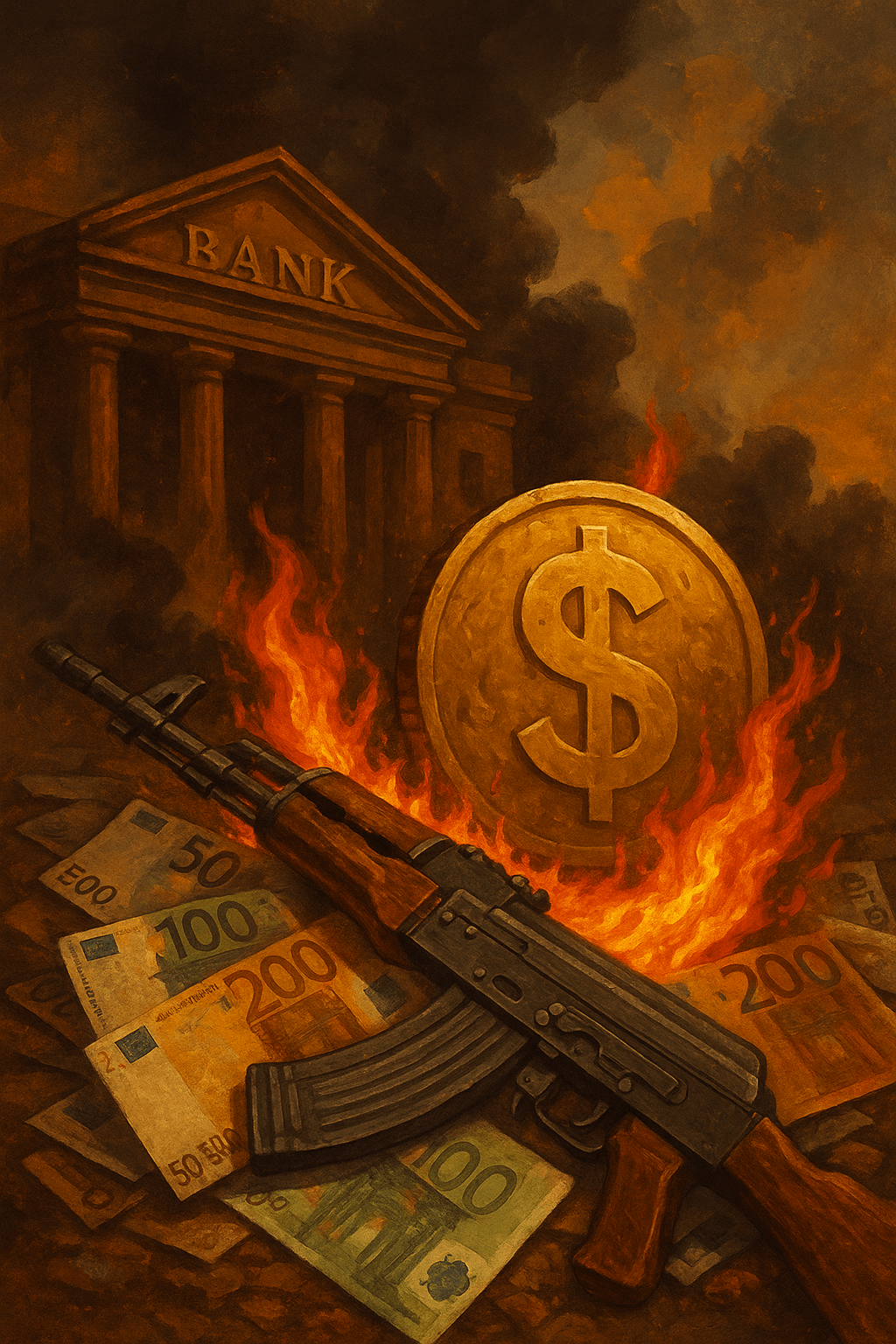
Euroclear, frozen reserves, and the quiet normalization of financial warfare in a collapsing imperial order
When Power Speaks in the Calm Voice of Administration
The article under excavation —
“EU dismisses Russia’s lawsuit against Euroclear as ‘speculative’ and groundless”
,
published by Euronews on December 12, 2025 — presents itself as a routine piece of institutional reporting. Its tone is measured, procedural, almost bored. There are no raised voices here, no moral panic, no lurid metaphors. And that calm is precisely the point. What the reader encounters is not argument but assurance: a steady stream of official declarations designed to close questions before they can even form.
From the opening lines, the narrative is structured around a simple asymmetry. On one side stands the European Union, speaking through commissioners, spokespersons, and legal abstractions. On the other side stands Russia, appearing only as an irritant — a state that “launches” lawsuits, “threatens” retaliation, and engages in vaguely defined obstruction. The lawsuit itself is never treated as a legal claim with substance or argument; it is framed immediately as “speculative,” a word that does heavy ideological lifting. The reader is trained, from the first paragraph, to understand that nothing serious is happening here — only noise from a disgruntled actor.
Authority in the text does not emerge through explanation or demonstration. It is asserted. Phrases such as “legally robust,” “fully in line with EU and international law,” and “court-proof” appear not as conclusions reached after reasoning, but as axioms. The article offers no glimpse into how these determinations are made, no sense of debate or uncertainty. Law appears not as a contested field but as a settled possession, held comfortably by EU institutions and deployed through confident quotation. The effect is to collapse legality into institutional voice: if the Commission says it, it is so.
Risk, which might otherwise introduce tension or doubt, is carefully managed through a language of technical containment. Retaliation is acknowledged only to be neutralized. Potential losses are not described as conflicts or confrontations but as accounting problems already solved by “offsetting” mechanisms. Even the possibility of escalation is rendered procedural, something to be absorbed by systems and safeguards rather than lived by societies. Conflict is translated into management, and management is presented as mastery.
Time itself is handled with similar care. Measures described as indefinite are softened through conditional phrasing, as if permanence were merely provisional patience. The future is always open in theory, even as the present is locked in practice. By anchoring release to abstract conditions rather than concrete timelines, the article transforms an open-ended situation into something that feels temporary, reasonable, and reversible — without ever saying how or when that reversal might occur.
Moral responsibility is quietly inverted through this framing. Actions taken by EU institutions are described as responses to obligation, while reactions from Russia are framed as attempts to evade accountability. The reader is never invited to consider the measures themselves as exercises of power; they are presented instead as the natural enforcement of order. In this way, coercion is linguistically laundered into compliance, and domination is recast as duty.
What emerges, taken as a whole, is a familiar script of contemporary imperial communication. Power does not shout. It reassures. It speaks in the language of process, legality, and protection, while ensuring that only one side of the story ever speaks in full sentences. The article does not argue for the legitimacy of what is being done; it performs legitimacy by surrounding the reader with institutional certainty and administrative calm. And in that performance, the most political act of all — the exercise of material power — is made to appear as nothing more than good governance.
What “Immobilised” Really Means When Power Holds the Keys
To understand what is actually happening in the fight over Russian assets held by Euroclear, we have to strip away the polite language and look at the machinery underneath. Since February 2022, the European Union and its allies have frozen roughly €210 billion in Russian central bank reserves, with the bulk of that money sitting inside Euroclear’s vaults and databases. These are not spare coins forgotten in a drawer. They are sovereign reserves, built up over decades to protect a state in moments of shock — war, sanctions, market panic. Neutralising them is not a technical footnote. It is a direct strike against a country’s financial lifeline.
EU officials insist that nothing has been “seized.” Ownership, they say, remains with Russia; only access has been denied. This distinction matters a great deal to lawyers, and it rests on the long-standing principle of sovereign immunity, which has traditionally shielded central bank reserves from foreign confiscation. Institutions like the IMF, the World Bank, and the Bank for International Settlements have long emphasized that reserve management is grounded in safety and liquidity—not out of kindness, but because reserves exist to be rapidly usable in emergencies and because legal exposure to attachment or seizure can undermine that function. If states cannot trust that their reserves are safe abroad, the entire system of global finance begins to wobble. Reserves only work if everyone believes they will still be there tomorrow.
But history tells us that this “sanctity” has always been selective. Long before Russia entered the picture, Western powers routinely froze or appropriated the assets of states in the Global South when political winds shifted. Iranian funds were locked down after the 1979 revolution. Venezuelan gold was stranded abroad as sanctions tightened. Afghan reserves were frozen overnight after the Taliban returned to power. Each time, lofty legal explanations followed close behind. And each time, ordinary people paid the price through inflation, shortages, and collapsing public services. What is new today is not the method, but the target: a major power whose reserves were deeply woven into Western financial systems.
This is where Euroclear comes in. Publicly, it appears as a neutral clerk — a quiet bookkeeper of global finance. In reality, it sits at a crucial choke point. As one of the world’s largest central securities depositories, Euroclear helps move trillions of euros in bonds and securities every day and functions as a custodian and settlement infrastructure at the heart of European and international markets. When governments decide to punish a state financially, it is institutions like this that turn political orders into material reality. No soldiers are needed. A switch is flipped, an instruction is blocked, and money that once moved freely becomes frozen in place. The article portrays Euroclear as a bystander, but its position shows how financial intermediaries have become the frontline troops of modern coercion.
The EU’s plan to use these frozen assets to finance a so-called reparations loan to Ukraine pushes this logic even further. Formally, Brussels claims the reserves will remain Russian property. Practically, their value will be used to fund another state without Russia’s consent. Supporters argue this respects international law; critics argue it empties that law of meaning. From the standpoint of any country watching from the outside, the message is hard to miss: assets held in Western systems can be locked up indefinitely and put to work for someone else, all while legal ownership is politely preserved on paper.
All of this is happening as the old financial order begins to crack. In the post–Cold War years, sanctions were sold as rare and exceptional tools, usually aimed at isolated states. Today they are routine, escalating from trade restrictions to the direct immobilisation of central bank reserves. The European Union, once content to present itself as a neutral regulator of markets, now operates openly as a coercive financial power. This shift coincides with the rise of alternative monetary arrangements outside the Western core, as more states begin to ask whether parking their reserves in Europe or the United States is still a form of security — or a gamble.
The economic consequences reach far beyond diplomats and courtrooms. By turning clearing systems and depositories into instruments of punishment, risk is pushed down the chain. Financial intermediaries are exposed to retaliation and legal battles, markets absorb new uncertainty, and working people feel the impact through rising prices, weaker currencies, and shrinking public budgets. For non-aligned and reserve-holding nations, the precedent now being set is unmistakable: what was once a shield can become a trap.
This is the deeper story missing from the Euronews article. The dispute over Euroclear is not a narrow legal spat, nor a technical disagreement between institutions. It is a sign of a world in transition, where control over financial infrastructure has become a central weapon of power, and where the language of law is increasingly used to disguise acts of economic force. Behind the calm talk of “immobilisation” lies a hard question that more and more countries — and peoples — are beginning to ask: who really owns the money, and who decides when it can be used?
When Law Becomes a Weapon and Money Becomes a Battlefield
Once the technical fog is cleared, the meaning of the Euroclear dispute comes into sharper focus. What is being presented as a narrow legal disagreement is in fact a political struggle over who controls the arteries of the world economy. The immobilisation of Russian reserves is not an accident of law, nor a temporary administrative fix; it is an expression of power exercised through financial infrastructure. In earlier periods of empire, this power was enforced through gunboats and blockades. Today it is enforced through clearing systems, custodial accounts, and emergency clauses written in careful legal prose.
From a historical standpoint, this shift is not mysterious. Capitalism has always relied on control over circulation as much as control over production. What has changed is the degree of centralisation. As global finance became more integrated, key choke points emerged — places where enormous volumes of value pass through a small number of institutions. In the post–Cold War moment, these choke points were sold to the world as neutral conveniences, the plumbing of a globalised economy. But neutrality was always conditional. When geopolitical conflict returned with force, these same infrastructures revealed their other function: discipline.
The language deployed by European officials — “rules-based order,” “international law,” “sovereign immunity respected” — masks this transformation. Law here does not stand above power; it travels with it. Legal distinctions between freezing and seizure, between ownership and access, matter less in practice than the material outcome. A reserve that cannot be used is a reserve in name only. For the working classes and peasantries who ultimately bear the cost of sanctions and counter-sanctions, such distinctions offer little comfort. Currency instability, rising prices, and austerity do not care whether deprivation arrived by court ruling or executive order.
This episode also exposes a deeper contradiction in the contemporary imperial order. For decades, states in the Global South were told that integration into Western financial systems would bring stability and protection. Hold your reserves in our currencies, settle your trades through our institutions, and you will be safe. Now the same systems are being openly repurposed as tools of punishment. What is being enforced is not a universal rule, but a hierarchy: those who sit at the center of the system retain discretion, while those on the periphery are subject to conditional access.
The European Union’s evolving role is instructive. Once eager to distinguish itself from the raw unilateralism of Washington, the EU now functions as a key pillar of financial coercion. By shifting from renewable sanctions to indefinite immobilisation, and from passive freezing to active monetisation of another state’s reserves, Brussels has crossed an important threshold. Regulation has given way to enforcement; market governance has given way to financial warfare. This is not an aberration, but an adjustment to a world in which economic dominance can no longer be taken for granted.
For revolutionary and multipolar forces, the implications are clear. The crisis is not simply about Russia or Ukraine. It is about the future of sovereign finance in a world where imperial power is increasingly exercised through economic mechanisms rather than open conquest. The same tools now used against a geopolitical rival have long been tested on weaker states, especially in Africa, Latin America, and parts of Asia. What we are witnessing is the generalisation of a method once reserved for the margins.
From the standpoint of the global working class and peasantry, this development deepens an already brutal contradiction. Financial coercion rarely harms elites alone. It seeps downward, hollowing out public budgets, eroding social protections, and intensifying exploitation. When reserves are frozen, it is not bankers who lose access to medicine, fuel, or food. It is ordinary people. Yet these costs are rendered invisible by the technical language of law and finance, which abstracts suffering into balance sheets and legal briefs.
The struggle unfolding around Euroclear therefore belongs to a broader historical moment: the slow unraveling of an imperial financial order and the uneven emergence of alternatives. As trust in Western custodial systems erodes, states seek new arrangements, new currencies, and new institutions. These moves are not ideological gestures; they are survival strategies. They reflect a growing recognition that money held under someone else’s control is not security, but exposure.
What the Euronews narrative cannot admit is that this process is driven by fear as much as confidence. The aggressive use of financial infrastructure signals not strength alone, but anxiety — the anxiety of an order that senses its leverage slipping and responds by tightening its grip. In this sense, the calm administrative tone of the article is misleading. Beneath it lies a world where money has become a battlefield, law has become a weapon, and the struggle over who commands the circuits of value is rapidly becoming one of the central conflicts of our time.
From Exposure to Organization: Turning Financial Warfare into Collective Struggle
Once the veil is lifted, the question is no longer whether financial power is being used as a weapon, but what is to be done about it. The immobilisation of sovereign reserves, the quiet repurposing of financial infrastructure for coercion, and the steady normalisation of economic punishment are not abstract policy choices. They are material assaults that ultimately land on the backs of workers, peasants, and the dispossessed, both in the Global South and increasingly within the imperial core itself. Recognising this is the first step; organisation must follow.
Across the world, labor unions are confronting IMF/World Bank-linked austerity and structural reforms, even if they are rarely named in the language of “sovereign assets” or “clearing systems.” Popular movements have resisted IMF-imposed restructuring with protests and demonstrations, and communities fighting austerity and privatization have organized strikes and general actions tied to cuts in public services. In the Global South, campaigns against debt and IMF/World Bank conditionalities link economic survival to political sovereignty, insisting that control over money is inseparable from the right to self-determination and calling for debt cancellation, reparations, and an overhaul of the global financial system.
At the same time, new forms of resistance are taking shape at the state and regional level. Efforts to conduct trade outside dominant Western currencies, to establish alternative payment systems, and to pool reserves through new institutions reflect a shared understanding: dependence on imperial financial infrastructure is a vulnerability. These initiatives are uneven, contested, and still fragile, but they signal a collective refusal to accept a system in which access to one’s own resources can be switched off by distant authorities.
For revolutionary and socialist forces in the Global North, this moment demands a break with passivity and abstraction. Labor unions are organizing against austerity and economic reforms tied to international financial institutions, showing that economic policy is already experienced as a class issue, not an abstract debate. Grassroots movements like the Blockupy protests have united unions and community groups against austerity and cuts in public services, demonstrating how social movements connect financial policy with lived economic pain. Political education within unions, tenants’ associations, and community organisations can expose how sanctions, austerity, and asset freezes translate into higher prices, job insecurity, and cuts to public spending — effects documented in countries where sanctions and economic restrictions have led to inflation, reduced incomes, and increased poverty for ordinary people by raising costs and reducing household incomes. Naming these links helps dismantle the illusion that economic pain is accidental or unavoidable, and instead reveals how economic policy and financial coercion are lived class issues.
Concrete forms of solidarity can grow from this clarity. Independent media projects and research collectives document the human cost of sanctions on everyday lives, showing how healthcare shortages, food price inflation, and disrupted livelihoods emerge from economic restrictions. Campaigns challenging the role of banks, clearing houses, and financial institutions in enforcing economic punishment have been raised even at the United Nations when civil society emphasises how sanctions hinder humanitarian funding and access. Workers and communities in Russia’s GAZ Group protested against sanctions, linking them directly to job losses and economic pressure, showing how cross-border ties between workers in sanctioned countries and those facing austerity in the core can transform isolated struggles into shared ones, grounded in mutual recognition rather than charity.
This is not a call for symbolic protest, but for sustained engagement with the structures that govern everyday life. As financial power becomes more central to imperial strategy, resistance must follow it into those spaces — demystifying its operations, contesting its legitimacy, and building alternatives wherever possible. The struggle over Euroclear is only one front in a wider battle over who controls the conditions of survival in the twenty-first century.
History offers a simple lesson. Empires rarely announce their decline; they manage it, technocratically and quietly, until management turns into repression. When money becomes a weapon, organisation becomes a necessity. The task before us is to connect the scattered fights against austerity, sanctions, and financial domination into a conscious movement, one capable of defending sovereignty, dignity, and life itself against an order that increasingly treats all three as expendable.
 Weaponized Information
Leave a comment