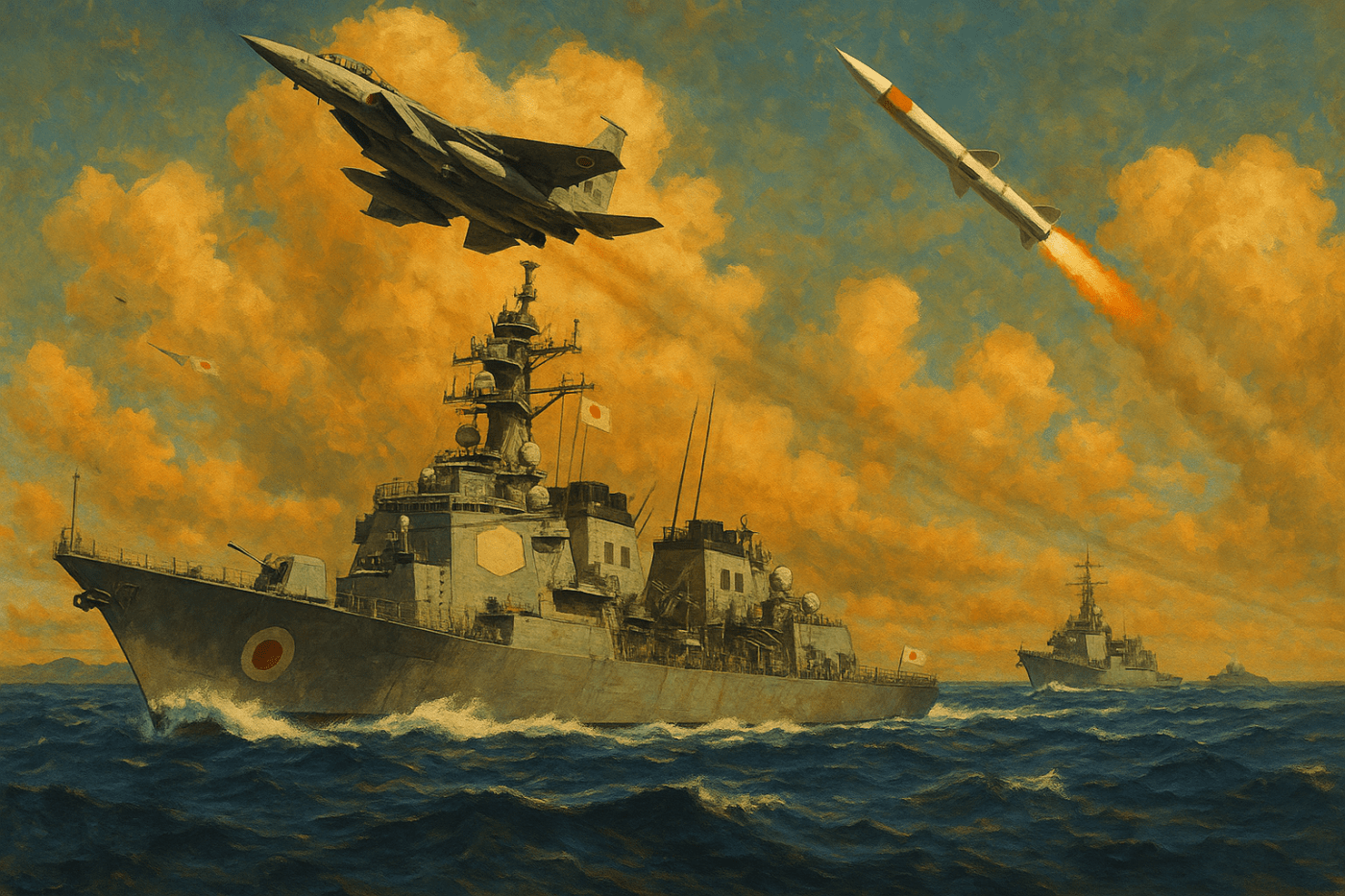
How a $70 Billion Defense Budget, Missile-Riddled Islands, and a Manufactured “Security Crisis” Are Rewriting the Map of Asia
By Prince Kapone | Weaponized Information | December 4, 2025
Budgets, Islands and the Quiet Manufacture of Consent
If you just skim the surface of this USNI News piece, it looks like any other routine defense story: numbers, acronyms, quotes from officials in suits. “Japan Poised to Increase Defense Spending to $70 Billion, 2% of its GDP” announces the headline, and Dzirhan Mahadzir walks us through the spreadsheet. Eleven trillion yen here, 1.1 trillion yen there, a supplementary budget on top of an initial budget, all laid out like a grocery list for war. The whole thing is written to feel boring, safe, inevitable: not a political decision about life and death in East Asia, just responsible fiscal housekeeping by grown-ups.
This is the first trick. The article talks to you in the language of budgets and logistics so you forget you’re reading about missiles and islands being turned into launchpads. Money becomes the main character. Koizumi, the Japanese defense minister, is quoted like a bookkeeper, calmly explaining that with the supplementary funds Japan has already reached the fabled “2 percent of GDP” benchmark. No one asks who set that benchmark, for what purpose, or in whose interest. It is treated as a neutral law of nature, like gravity or the seasons. When imperial planners can get you to think of their targets as “thresholds” instead of strategies, they’ve already won half the battle.
Wrapped around this budget talk is a thick shell of “defensive” language. Every meaningful escalation in the piece is wrapped in cotton: surface-to-air missiles are there to “counter attacks,” radar is simply “enhancing surveillance,” construction for U.S. Forces realignment is just about building “facilities.” Koizumi is allowed to repeat, unchallenged, that the systems on Yonaguni are “equipment for defensive purposes, not for attacking other countries.” The journalist never once breaks the spell to ask what it means, in practice, when you harden an island with missiles, radar and U.S. Marine Corps exercises 67 miles from Taiwan. The word “defense” is not an analysis here; it is a magic word that suspends analysis.
China is used as punctuation, not as an object of serious description. A suspected UAV passes between Yonaguni and Taiwan. A carrier strike group sails through the same waters. A spokesperson in Beijing condemns Japanese deployments. Each of these moments appears precisely where the narrative needs an unspoken “you see?” to justify the previous paragraphs of spending and deployment. The article does not pause to ask whether these flights or passages are legal, routine, or expected; it simply drops them into the text like jump scares in a horror movie. The emotional logic is simple: Japan moves because China lurks. That is enough.
There is another erasure at work. Yonaguni, Kita Daito, Okinawa, Mageshima: in this story they are not communities, they are real estate. The only time residents appear is as a vague obstacle slowing “progress,” a mass to be “brought on board” so Tokyo can get on with the important business of building bases. You learn in loving detail how Marines flew in, set up a forward arming and refueling point, fueled their helicopters and packed up again. You learn nothing about the people who live on those islands, how they feel about being rehearsed into someone else’s war. The land is animated; the people are not.
Mahadzir’s own biography, tacked on to the bottom of the page, tells you what world this narrative comes from. He is a freelance defense journalist, filing for Jane’s Defence Weekly, Navy International, International Defence Review and a small constellation of similar outlets. USNI News itself is the house organ of the U.S. Naval Institute. None of this is hidden; it simply goes uninterrogated. The point is not that these people are secretly evil masterminds. The point is that their whole social universe is ships, bases, budgets and “security environments,” and they write as if that universe is the same as yours.
Read this way, the article is not just “informing” you that Japan is spending 11 trillion yen on defense. It is training you to treat that fact as normal, reasonable, and even overdue. It is smoothing over the jagged edges of militarization with the soft language of readiness and deterrence. It is teaching you to see islands as platforms, Marines as problem-solvers, and Chinese movements as ominous shadows in the background. Before a single missile is launched, the story has already done its job: it has made the rearrangement of other people’s lives into a technical adjustment in someone else’s spreadsheet.
What the Story Refuses to Say: History, Geography, and the Machinery Behind the Numbers
To understand what this USNI News article is doing, we have to begin by laying out the facts it actually presents, and then set beside them the facts it carefully avoids. Only then can we see the full silhouette of the narrative. The verifiable details are straightforward enough: Japan’s FY2025 defense budget now reaches roughly 11 trillion yen—about $70 billion—breaking the 2 percent of GDP threshold years earlier than planned. The money goes to munitions, personnel pay, aviation and naval readiness, missile development, and major infrastructure for the realignment of U.S. forces at Mageshima and Henoko. New surface-to-air missile units will be deployed to Yonaguni and mobile radar installed on Kita Daito. U.S. Marines have staged their first forward arming and refueling point on Yonaguni, demonstrating the ability to move, set up, and withdraw in a single day. China’s UAV overflights and naval passages are offered as the atmospheric justification for these moves. And throughout it all Japan’s Ministry of Defense repeats that these are “defensive” steps, designed to protect facilities and islands against threats in the region.
But this is only half a story—and by itself, it is almost meaningless. What the article does not include, or includes only in passing, is the context that gives these numbers and deployments their political weight. For example, Japan’s own constitution—Article 9, drafted after the Second World War—explicitly renounces war as a sovereign right and forbids maintaining “war potential.” This was not a symbolic flourish. The Japanese state and its military had just spent half a century dragging Asia through an archipelago of horrors: the colonization of Korea and Taiwan, the invasion of China, the Nanjing Massacre, the forced labor of millions, the medical tortures of Unit 731, the military sexual slavery system euphemized as “comfort women.” The countries that suffered under Japan’s boot insisted on its disarmament. The world agreed. And for decades afterward, the Japanese public itself—especially in Okinawa—fiercely protected this demilitarized stance.
That history is not ancient. It is living memory across East and Southeast Asia, kept alive in official narratives, museums, and the unresolved wounds of those who lived through occupation and war. It shapes every regional reaction to Japanese military expansion. Yet in this article, there is no mention of Japanese imperialism, no recognition of why Japan was disarmed in the first place, no acknowledgment that a remilitarizing Japan carries a very different meaning for Korea, China, the Philippines, or Indonesia than it does for the U.S. Navy or Tokyo’s defense establishment. A story about Japanese missile deployments 67 miles from Taiwan that does not mention Japan’s 20th-century role in the region is not a neutral account. It is a curated one.
The omissions continue. The people who live on the islands being fortified—Yonaguni, Miyako, Ishigaki, Okinawa—are some of the most consistent and vocal opponents of military expansion anywhere in Japan. In 2019, Okinawans voted overwhelmingly against the Henoko base relocation: 72 % opposed the move. Local assemblies on other islands have opposed missile batteries and radar stations for years — for example, a recent protest on Miyakojima disrupted a Self-Defense Force drill in opposition to base expansion. These communities carry the scars of Japanese colonialism and U.S. military occupation alike; they know what it means to live as a buffer zone in someone else’s conflict. Yet in the article, they appear only as “municipal authorities” whose cooperation Tokyo must secure. Their political agency is reduced to bureaucratic noise.
U.S. involvement is also pruned down to logistics. The RAND Corporation, CSIS, and Pentagon-linked strategic assessments openly describe Japan’s southwestern islands as critical chokepoints for U.S. operations in the event of a conflict with China. But in the USNI narrative, the FARP on Yonaguni is a technical demonstration of interoperability, not part of a much larger American design to position Japan as a forward-operating military partner. The fact that Japanese taxpayers are being asked to subsidize the realignment of U.S. forces is mentioned, but never contextualized as a symptom of strategic dependence.
Event China’s presence in the story is carefully curated. The UAV flight described was legal under international law. The PLA Navy’s passage through the strait was permitted under maritime norms. These are not tests of Japanese sovereignty; they are the routine movements of a major regional state in international waters. But once ripped from their legal context, they can be dropped like little flares into the narrative—suggestive enough to justify militarization, vague enough to avoid scrutiny.
When we put these extracted and omitted facts side by side, the contradictions come into sharp relief. Militarization presented as “defensive” clearly enhances forward operational reach. Public resistance is erased to produce the illusion of national unity. Japan’s political autonomy is overstated even as its strategic direction is aligned with U.S. imperatives. China’s normal activity is reframed as lurking menace. Infrastructure described as simple “readiness” is plainly escalatory. And beneath it all, the single most important truth of the region is entirely missing: the Japanese military was once the terror of Asia, disarmed for a reason, and its revival is not some neutral technocratic adjustment but a seismic geopolitical shift that will be felt most sharply by the peoples once subjected to Japanese rule.
Rearming the Past to Police the Future: How the Empire Rewrites the Map of Asia
Once we restore the missing history and the submerged political facts, the story in front of us changes shape entirely. The USNI article works overtime to present Japan’s militarization as a technical adjustment to a changing security environment, but the deeper movement here is unmistakable: an imperial power in decline is resurrecting an old colonial sword and sharpening it for a new confrontation. Japan’s accelerated rearmament is not an isolated policy choice. It is a strategic hinge in the United States’ effort to fuse Asia’s geography, history and domestic politics into a bulwark against a rising China—and it is the people of the region, especially those on the colonized and peripheral islands, who will be asked to bleed for this arrangement.
Every verifiable fact in the previous section points to the same structural transformation. Japan is pouring unprecedented sums into its military budget. It is constructing or expanding bases across islands whose residents have resisted militarization for decades. It is deploying missiles and radar systems on territories that lie within a stone’s throw of Taiwan. It is integrating its operational tempo with U.S. Marines who practice landing, refueling, withdrawing and reappearing with fluidity. All of this is occurring under legal and rhetorical cover, with the word “defense” absorbing the shock of the obvious: Japan is being rewoven into the warfighting architecture of a declining superpower that cannot maintain unipolar dominance on its own.
This is why the history matters—why the article works so hard to bury it. Japan is not Belgium. Japan is not Canada. Japan is a former imperial state whose armies once burned, raped and enslaved their way across the Asian continent. Millions were killed; tens of millions were subjugated. The demilitarization that followed Japan’s defeat was not punitive for its own sake—it was demanded by the colonized nations that had survived Japanese occupation. For countries such as China and Korea, Japanese rearmament is not an abstract concern; it is a return of memory, a reopening of wounds kept barely closed for eighty years. When the United States pushes Japan to break Article 9, expand missile systems, rehearse forward deployments and serve as a frontline bastion, it is not simply empowering a partner; it is destabilizing a region by reviving the very apparatus that previously terrorized it.
The dialectical contradiction at the core of this moment is stark. Japan’s people, especially the working and Indigenous communities on Okinawa, Yonaguni, and the chain of islands stretching toward Taiwan, have no interest in becoming the world’s next battlefield. They have lived as the periphery of empire twice over—first as subjects of the Japanese empire, then as hostages to American force posture. Their resistance is not symbolic; it is an assertion of survival. The U.S. Navy and Japan’s Ministry of Defense, however, treat these islands as stepping stones in a strategic contest whose beneficiaries live oceans away. The island residents’ opposition is erased because their presence complicates the imperial map.
For the global working class and peasantry, the logic is familiar. An empire in decline seeks to preserve its supremacy not by improving the lives of its own people but by tightening its grip on faraway territories and conscripting allies into its designs. The United States cannot challenge China’s industrial base, diplomatic influence, or internal stability on its own terms. So it constructs an encirclement apparatus, rebuilding Japan’s military capacity, expanding bases in the Philippines, militarizing Pacific Island nations, and linking Australia and South Korea into a lattice of naval and air power. Japan’s militarization is therefore not a Japanese project—it is an American one executed through Japanese institutions. The budget numbers tell the tale: Japan is paying for American strategic needs.
And yet the other pole of this contradiction is also visible, though the USNI story cannot name it: the quiet ascent of a multipolar world order driven by the formerly colonized nations of Asia, Africa and Latin America. China’s role here is not the caricature drawn in U.S. military reporting. It represents the gravitational center of a global shift in which the South is asserting sovereignty after centuries of subordination. The anxiety produced in Washington appears in the article in coded form—through the insinuation that ordinary Chinese naval passages or UAV flights are proof of imminent escalation. But the truth is simpler: the United States is using Japanese rearmament to slow a process it cannot reverse, to hold onto a regional dominance it can no longer justify through economic or political legitimacy.
If we read the facts dialectically, we see that this tension—between the dying reach of imperial hegemony and the emerging sovereignty of the Global South—is being mapped onto the bodies and lands of people who never asked for this role. The budget lines, radars, missiles and refueling drills are the material expression of an empire outsourcing risk. The revived Japanese military serves as both shield and spear: a shield for U.S. interests, a spear aimed at the heart of multipolar Asia. For the region’s workers, peasants, Indigenous communities and oppressed nations, this is a direct threat to their safety and self-determination. For the Global North’s working class, it is a warning that their rulers are willing to ignite a regional war to maintain their fading authority.
The narrative presented by USNI News tries to hide this contradiction behind neutral terminology. But once we reassemble the pieces—budget data, constitutional history, island resistance, U.S. strategic planning, and the long shadow of Japan’s imperial atrocities—the larger truth becomes impossible to ignore: Japan’s rearmament is not the restoration of balance. It is the return of a dangerous weapon into the hands of an empire desperate to police the emergence of another world. Whether that world is born peacefully or in flames depends, in no small part, on whether the peoples of Asia and the global working class can expose and resist the project laid out in such antiseptic prose.
From the Islands to the World: Building a Front Against the Return of Empire
By the time we reach this point in the analysis, the contradictions illuminated in the facts are no longer academic. They are alive on the ground, shaping the lives of people who wake up every morning on the islands being transformed into military platforms. Yonaguni, Kita Daito, Ishigaki, Miyako, Okinawa—these are not chess pieces in a Pentagon strategy document; they are communities where workers fish, farm, teach, raise children, bury elders, and fight to hold on to a peaceful future. Japan’s rearmament, as it is unfolding, threatens to turn their home into the first flashpoint of a war they did not choose. And this struggle is not simply a Japanese one. It is a node in the larger global confrontation between declining imperial domination and the rising sovereignty of the world’s colonized and working peoples.
Across Japan’s southwestern islands, movements have already taken shape. The All-Okinawa Council rallies tens of thousands against the Henoko base project. Grassroots groups on Yonaguni have organized petitions, assemblies, and marches rejecting missile deployments. Elders, fisherfolk, teachers, students, and farmers have joined hands to defend their land against a militarization that threatens to drag them into the blast radius of a U.S.–China confrontation. They name something that Tokyo and Washington both refuse to acknowledge: that whichever great power commands the bases, it is the people of these islands who will suffer. In their struggle, we see the first line of resistance to the reactivation of the old colonial machine.
Their struggle resonates far beyond Japan. In Guam, activists campaign against U.S. missile defense sites being planted next to ancestral lands. On Palau, residents organize to resist the installation of U.S. radar systems that threaten to reshape their island without their consent. In the Philippines, communities near EDCA sites warn that they are once again becoming staging grounds for a war that serves neither Filipino workers nor peasants. These movements are not isolated; they arise from the same material conditions—the same imperial logic—that is now binding the Japanese archipelago into America’s forward line.
For the global working class, especially those of us in the imperial core, the question becomes urgent: What does solidarity look like in this moment? It begins with recognizing that militarization abroad always prepares repression at home. The same budgets that build missile sites on Yonaguni underfund schools in Detroit, hospitals in Los Angeles, and public housing in Chicago. The same militarist narratives that erase Okinawan voices are used to silence dissent in our own cities. When our rulers push Japan toward confrontation, they are laying the ideological groundwork to discipline workers here—to demand sacrifices, justify austerity, and rally us behind an empire in decline.
But solidarity is not merely recognition—it must take on organized form. In the Global North, labor unions, anti-war networks, diasporic communities and student movements can begin linking their struggles with those on the frontlines in Asia-Pacific. When educators in New York stand with teachers in Okinawa resisting base expansion; when dockworkers in Busan, Yokohama, Oakland, and Manila coordinate actions around the movement of war materiel; when Japanese diaspora and Asian-American communities amplify the voices of Yonaguni and Henoko organizers—we begin to weave the threads of a truly internationalist resistance.
In the Global South, where multipolar institutions are consolidating, grassroots diplomacy can strengthen the hand of local movements fighting militarization. Pacific Islanders resisting U.S. and Japanese bases can find allies in Indigenous movements in Aotearoa and Australia, in anti-NATO networks across Africa, and in Latin American organizations defending sovereignty against foreign military installations. These forces are already rejecting the world the empire is trying to rebuild; our task is to help them find each other.
And for the colonized nations of Asia—Korea, China, the Philippines, Indonesia, Malaysia—the return of a militarized Japan is not an abstract strategic problem. It is a historical echo. The workers and peasants of these countries have buried ancestors whose lives were taken by Japanese occupation. They have every reason to insist that Article 9 remain intact, that Japanese remilitarization be halted, and that Asia’s future not be determined by the fears and fantasies of Washington. Their resistance—diplomatic, popular, and historical—is an essential pillar in the fight to prevent a new imperial order from tightening its grip.
None of this will be easy. But the movements already rising—on Okinawa, on Yonaguni, in Guam, in Palau, across the Philippines—show that people understand what is at stake. They know that belonging to the frontline of an empire’s strategy means accepting the risk of annihilation for the sake of someone else’s profits and someone else’s power. They refuse. And their refusal gives the rest of us a political compass.
So we end with this: a call for the workers of the imperial core to reject the lies of safety and inevitability; for the peoples of Asia to trust the lessons carved into the bones of their ancestors; for the Global South to deepen its path toward multipolar sovereignty; for every frontline community to know they do not stand alone. The empire is rearming the past to police the future. Our task—collectively, internationally, uncompromisingly—is to ensure that the future belongs not to empire, but to the peoples who have suffered under it and who now struggle to build a world beyond its reach.
 Weaponized Information
Leave a comment