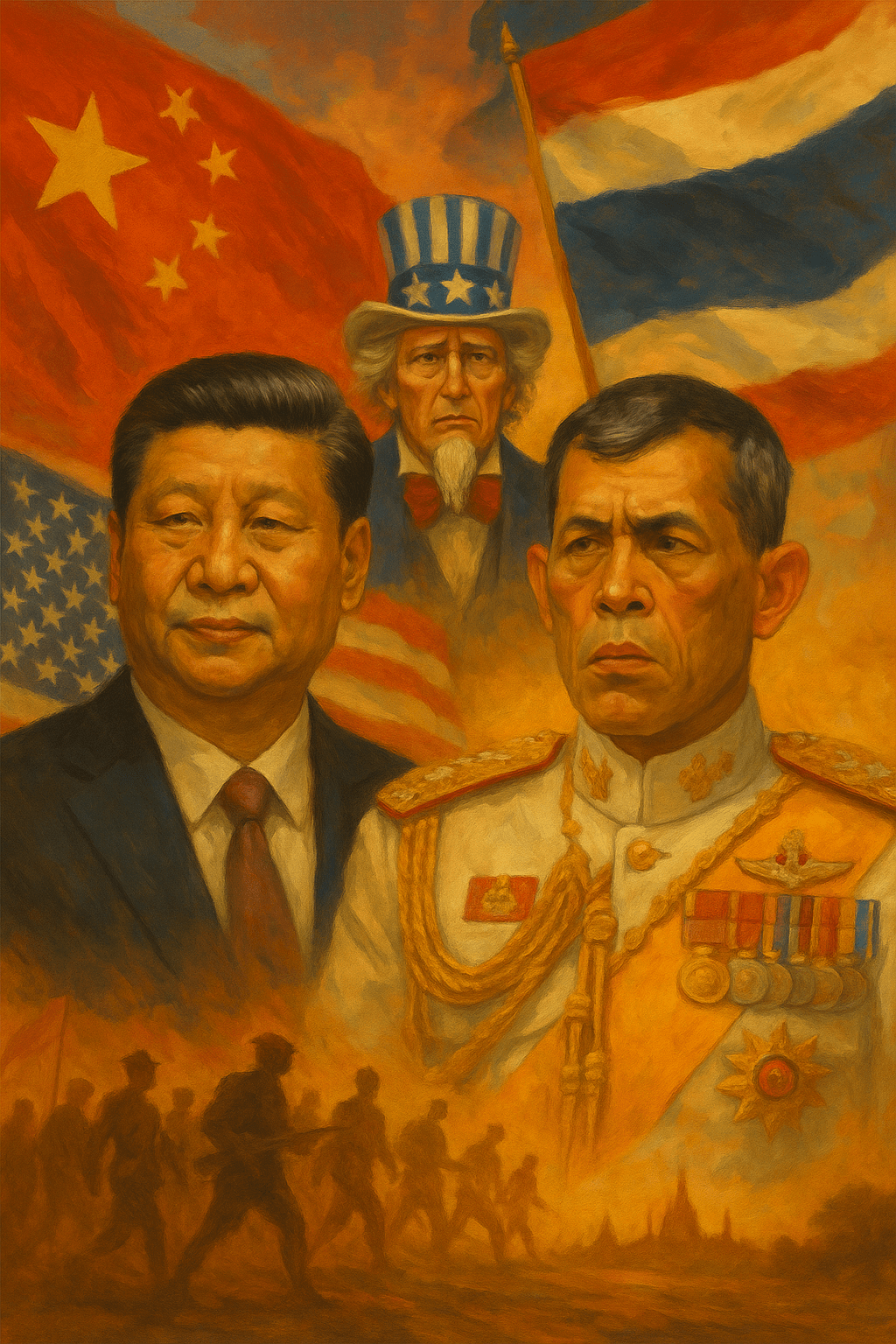
The Economist dresses up imperial anxiety as neutral reporting, hiding a Cold War script beneath polite prose. The facts it selects—and the history it omits—reveal a region reshaped by U.S. decline and Asian integration. Thailand’s maneuvers only make sense when read through the crisis of imperialism and the recalibration of a multipolar world. Global movements are already rising in these cracks, and it’s time to link their struggles across borders.
By Prince Kapone | Weaponized Information | November 28, 2025
When Empire Hears a Client Thinking for Itself
Read The Economist’s piece, “America’s oldest ally in Asia is drawing closer to China”, and you can hear the subtext louder than the headline: this is not a report, it’s a nervous phone call from the landlord wondering why the tenant is suddenly talking to the neighbor. Thailand is described as “America’s oldest ally in Asia” that is “leaning ever closer” to China, as if a sovereign country were a misbehaving child wandering away from its proper guardian. The storyline is simple: a wayward ally is drifting out of orbit, seduced by Beijing’s gravity, and the reader is invited to share the anxiety of the American pole as if it were common sense.
The Economist’s voice here is not neutral; it’s the house organ of the investor class speaking through a courteous whisper. The narrator never says “we, the West,” but every line assumes that standpoint. America is “ally,” “partner,” “long-standing friend.” China is “bigger neighbour,” source of “pressure,” “demands,” “retaliation.” Thailand is never a subject with its own historical will; it’s a swing state, a prize, a hinge to be worried over. The class position is clear: this is written from the balcony of transnational capital and foreign policy elites, not from the streets of Bangkok or the rice fields of Isan. The question they are really asking is not “What is Thailand doing?” but “How is this going to affect our architecture of power?”
The propaganda doesn’t arrive with foam at the mouth. It arrives in the tone. The article is framed as a reasonable concern about “balance,” “dependence,” and “risks.” You get the feeling of a doctor calmly explaining that a long-time patient is making unhealthy choices by spending too much time with the wrong crowd. This is the first trick: the voice of empire is dressed up as responsible adulthood. The United States is allowed to have “allies,” as if that relationship were naturally benign. China can only have “closeness” that smells of leverage, coercion, and moral ambiguity. The same act—building ties—is coded as friendship when Washington does it and as danger when Beijing does it.
Pay attention to how the story handles agency. Thailand “leans,” “depends,” “fears retaliation.” China “demands,” “complains,” “long wanted him back.” America simply “notes its dismay,” as if uttering a disappointed sigh from across the Pacific. Thais are not shown deciding anything for their own reasons; they are reacting—mostly to China’s shadow, occasionally to America’s displeasure. The population itself, the working class that lives through tourism booms and busts, arms deals, migrant flows, and crackdowns, is almost entirely absent. This is foreign policy written as elite theatre, where only kings, presidents and generals move; the rest of society is scenery.
Another device: the article quietly teaches you who is allowed to be the victim. We are told about a Chinese celebrity kidnapped and trafficked to a scam compound in Myanmar, and how this event spooked Chinese tourists. It’s a real horror, but here it is used as a narrative hinge: uncertainty about Thailand is expressed through Chinese middle-class anxiety. No mention of workers trapped in the same compounds, or migrants exploited in cross-border economies. The human face of the story is carefully selected: a celebrity with a fan base, not a Burmese cleaner or a Thai security guard. Suffering is allowed to appear only when it reinforces the article’s angle about risk and instability in Thailand’s vicinity.
The piece also relies heavily on numbers to project authority—trade figures, tourism counts, arms purchases, military aid totals. The figures are not the problem by themselves; the problem is how they are arranged. They are never framed as part of a longer history of dependency or struggle. They are used instead like stage props to support one emotion: unease about Thailand’s drift. The reader is never invited to ask who benefited from those arms deals, which class in Thailand profited from tourism, which sectors of Thai society have always been locked out of this “ally” relationship with America. The numbers are there to give the imperial worry a veneer of empirical necessity, not to illuminate the lives under those digits.
Silence is doing as much work as speech. The article does not have to say that America has long treated Thailand as a frontline outpost; it just has to call the country “America’s oldest ally” and move on. It doesn’t have to admit that Washington cut military funding after a coup to discipline a client and then moved on to other priorities; it simply observes that China filled the “void.” The void, conveniently, appears as a natural phenomenon, not as the consequence of U.S. choices. This is another core technique: omissions are treated as neutral gaps in the story, when in reality they are deliberate absences that keep the reader from seeing the full set of hands in the game.
Notice, too, how the article toys with the idea of “retaliation.” When Thailand deports Uyghur detainees, the piece notes that Thailand “feared retaliation” if it resettled them elsewhere, implying an atmosphere of Chinese menace. But there is no corresponding language for American power: no “retaliation” when the U.S. cuts military assistance, no fear when Washington rearranges tariffs, blacklists companies, or weaponizes financial rules. One actor’s pressure is presented as structural, quasi-natural. The other’s is personalized and ominous. That asymmetry is ideological; it tells you who is allowed to be a system and who must be a bully.
Even the ending is crafted as moral guidance. When Thailand’s finance minister announces duties on low-cost imports from China, The Economist calls it a “rare pushback,” as if the country had finally found the courage to stand up straight. The reader is nudged to feel relieved: yes, Thailand is drifting, but perhaps it can still be nudged back into a healthier alignment. The closing line—“Closeness to China brings its own risks”—is the sermon: the problem is not dependence on empire, but dependence on the wrong one. Nowhere is the possibility raised that maybe the real risk is dependence itself, and that the Thai people might want something beyond choosing between two different overseers.
This is how propaganda works when it wears a tie instead of a uniform. The Economist doesn’t have to yell. It only has to assume that America’s interests are the natural horizon of the story, and that anything which threatens those interests is a problem for humanity at large. Thailand’s attempt to maneuver in a changing world is converted into a tale of betrayal and risk. The reader is invited to sit in the cockpit of empire and worry about a client’s wandering loyalty, instead of sitting in a Bangkok bus and asking what any of these “allies” have ever really delivered for the people who live there. And underneath that calm tone, another function quietly hums: to prepare Western audiences to see any future U.S. “course correction”—from pressure campaigns to covert meddling—as a reasonable attempt to rescue a confused friend, rather than the latest chapter in a long counterinsurgency project.
What the Story Refuses to See: History, Power, and the Material Map Beneath Thailand’s “Drift”
To understand the weight of The Economist’s narrative, we have to strip away the colonial fog and look directly at the terrain it glides over. The article throws numbers around like loose change—trade volumes, tourism counts, arms purchases—but none of these figures mean anything unless we situate them inside the long arc of Thailand’s entanglement with global power. Extraction begins by pulling the factual fragments from the article and laying them bare: the extradition of She Zhijiang; the deportation of forty Uyghur detainees; Chinese investment in high-speed rail, industrial parks, and infrastructure; bilateral trade reaching $122 billion in the first ten months of 2025; a tourism collapse among Chinese nationals; Thailand’s expanding purchases of Chinese weaponry; and the stunning freefall of American military assistance from $106 million in 2023 to just $8 million by 2025. These are the article’s anchors, offered as neutral statements. But facts without context are the favorite tools of an imperial storyteller—they decorate the stage rather than build an explanation.
When we look beyond The Economist’s curated selection, a different picture emerges. Thailand’s balancing act is not new; it is the historical pattern of a country caught between empires, improvising survival. Scholars like Pavin Chachavalpongpun and Thongchai Winichakul have long argued that Thai elites—especially the palace, the military, and the Bangkok business class—have historically leveraged great-power rivalry to preserve their own domestic order. Thailand aligned with Britain in the colonial period, with Japan during the Second World War, with the United States during the Cold War and Vietnam War, and increasingly with China during the era of Asian economic integration. What appears as “drift” from Washington’s perspective is, to the region, the logic of a state that has avoided colonization precisely by refusing to belong wholly to anyone.
But “never colonized” does not mean “never subordinated.” Thailand’s survival strategy came at a price: instead of a revolutionary break with imperial power, the country bargained under imperial shadows through concessions and unequal treaties, and later anchored its political order in a military–monarchy axis tied to the dominant Cold War empire. There was no national liberation war that dismantled the old ruling bloc. The monarchy and senior officer corps, together with entrenched business families closely intertwined with state power, that managed those compromises in the colonial and Cold War eras were never overthrown; they were retooled inside a façade democracy dominated by the same institutions. That is the essence of Thailand’s neocolonial configuration: formal sovereignty resting on a domestic class structure that has long been willing to trade real independence for regime security and elite continuity.
The Economist’s silence about U.S. involvement in Thailand’s political life is particularly loud. For decades, American intelligence and military agencies cultivated close relations with the Thai armed forces, especially during the Cold War when the country served as a major logistical base for the war in Vietnam. Declassified documents show direct U.S. support for Thailand’s military regimes, police apparatus, and counterinsurgency operations. Washington’s relationship with Thailand has never been a friendship—it has been a security architecture in which Thailand played the role of forward operating platform. U.S. planners helped shape Thailand’s internal security doctrine, police forces, border militias, and intelligence services with oneloo overriding goal: prevent leftist or revolutionary forces from ever threatening the monarchy-military-business nexus.
That is the other story The Economist will not tell: Thailand as a long-running counterinsurgency project, where core security institutions were built around civilian counterinsurgency and royalist nationalism rather than popular sovereignty. In this configuration, the modern state was hardened not by a democratic struggle from below, but through tutelage in “nation-building” aimed at containing communism and disciplining the countryside. The Thai Border Patrol Police and its elite PARU unit, which became central to this project, were formed as a United States CIA paramilitary intelligence force in the early 1950s and later transformed into a civic-action agency backed by USAID and the monarchy, while PARU itself was largely CIA-funded in the 1950s and 1960s for clandestine missions. Through this royalist–military–U.S. security nexus, the Thai ruling bloc presided over a political order in which counterinsurgency, not emancipation, was the organizing principle—an order that, as scholars of the period note, continued to dominate Thai politics well into the post–Cold War era via royalist networks, right-wing groups, and security forces, and in which the apparatus fighting the communist insurgency included the Border Patrol Police, Village Scouts, and foreign patrons such as the CIA and the U.S. Air Force as part of a broader counterinsurgency coalition. Once you see this—palace, generals, and U.S. operatives co-authoring the modern Thai state—the idea that Thailand is now suddenly “going rogue” against its supposed benefactor starts to look less like analysis and more like imperial class anxiety.
The shift toward China also has economic roots far deeper than the article admits. The ASEAN–China Free Trade Area (ACFTA), launched in the early 2000s, reshaped regional economic flows. Thai agribusiness, fisheries, manufacturing, and electronics all tied themselves heavily to Chinese demand. Chinese banks became lenders for infrastructure. Chinese tourists became the backbone of Thailand’s service economy, especially from 2013 onward. These weren’t sudden preferences that appeared because “America pulled back” or because “China demanded obedience.” They reflected a regional economic integration process that Thailand could not have avoided even if it wanted to. Southeast Asia’s production networks are now woven intimately with China’s industrial base—something ASEAN research institutes have documented for years.
The article’s isolated mention of Chinese tourists fleeing in fear after a high-profile kidnapping collapses a complicated economic and human reality into a tabloid moment. While tourism volatility is real, the structural roots of the crisis run deeper — across Southeast Asia, organized crime syndicates have transformed border zones and marginalised regions into criminalized economies sustaining “scam compounds.” According to a recent investigation by a United Nations body, hundreds of thousands of people have been trafficked into online scam operations, forced to commit fraud, illegal gambling or crypto-scams under coercion. Independent rescues — such as the 260 workers freed from a compound in Myanmar and repatriated through Thailand — confirm that victims are drawn in by false job advertisements and then trapped in virtual slavery. Investigative human-rights NGO report that victims are often held against their will, subjected to long hours of forced labor, debt bondage, and threat of violence. Investigative journalism backed by victim testimony reveals compounds across border zones where hundreds or thousands are detained in inhumane conditions, used as forced fraud labor. Journalistic investigations document how scam centres have expanded rapidly, exploiting migrants, coercing them into criminality, and operating with impunity in zones where state oversight is weak or complicit. The so-called “tourism downturn” cited by the article masks a deeper structural crisis: a regional economy simultaneously booming in illicit profits and rotting from exploitation — built on the backs of trafficked migrants, forced laborers, and criminal networks entrenched across Southeast Asia.
Likewise, Thailand’s growing military purchases from China are presented as a novelty or as a response to U.S. stinginess. But the regional context tells us more: American military sales come wrapped in lectures, conditions, and political strings. Chinese weapons come cheaper, faster, and without moralizing. When Washington cut military financing after Thailand’s 2014 coup, Beijing stepped into the vacuum not because Thailand was drifting, but because the United States was retreating. Southeast Asia’s militaries have increasingly diversified procurement to avoid dependence on any single great power. Thailand’s shift mirrors patterns in Indonesia, Malaysia, and the Philippines—not acts of subservience but acts of hedging.
Another contradiction absent from The Economist’s account is the growing turbulence caused by U.S. tariff regimes and trade-policy unpredictability, which recent analyses show have begun reshaping regional trade routing. Recent U.S. tariff hikes on autos, auto parts, electronics, and other manufactured exports have placed pressure on Thailand’s export sectors—which rely heavily on stable access to key markets. Auto-parts export segments in Thailand are now flagged as significantly vulnerable under U.S. import restrictions. Major Thai banks warn that escalating tariff pressures could threaten exports, labour, and foreign investment across multiple sectors. As global supply-chain and trade-war dynamics make reliance on a single export-market riskier, Thailand—and other ASEAN economies—are being forced to consider alternative trade and production linkages to reduce exposure to U.S. instability. Recent economic analysis confirms that shifting global demand and tariff differentials are already inducing some export substitution and diversification away from traditional markets. The Economist implies Thailand is abandoning America out of political sympathy with China; the more grounded interpretation is that Thailand and similar states are adapting to a shrinking and volatile space offered by Washington’s trade architecture.
Even when the article mentions Thailand’s decision to impose a 10% duty on low-cost Chinese imports, it frames it as “rare pushback,” as if the entire Thai economy were normally docile and compliant toward Beijing. In reality, contradictions have grown within Thailand’s domestic economy: Chinese low-end imports have undercut local manufacturing, leading to layoffs and factory closures. Thai SMEs and business leaders have raised alarms about cheap Chinese products flooding the market and squeezing local firms, while analysts warn that factory closures and sectoral shake-outs are increasingly linked to Chinese competition and investment patterns, and that Chinese overcapacity is driving a surge of low-cost exports into foreign markets. The duty is not geopolitical muscle-flexing; it is a defensive response aimed at protecting local manufacturers and retailers from sectors of Thai capital that fear being crushed inside China’s industrial footprint.
The real context is this: Thailand is caught between a contracting empire (the United States), an expanding industrial leviathan (China), and its own domestic contradictions—military rule, palace politics, class inequality, and a fractured working class navigating global currents beyond its control. The Economist’s story cherry-picks facts to protect the illusion that Thailand’s natural place is under U.S. guidance. The facts—when placed inside the broader historical, economic, and regional reality—tell us something far more human and far more structural: Thailand is moving because the world around it is moving, because no empire can offer the stability it once promised, and because the people living under these forces are trying to survive inside a storm created far above their heads. And because the Thai state never underwent a revolutionary recomposition, that storm is mediated through a ruling bloc whose first instinct is not independence, but finding the next overseer least likely to threaten its own survival.
Through the Cracks of a Dying Order: Reframing Thailand’s Maneuvers in a World No Longer Unipolar
Once the smoke of The Economist’s imperial storytelling disperses, what comes into view is not a wayward ally or a confused nation, but a society navigating the tremors of a collapsing world-system. The movements that the article caricatures as “leaning” or “drifting” are in fact the visible expressions of deeper structural forces—forces unleashed not by Thailand, but by the disintegration of the imperial scaffolding that has organized global power for decades. The Economist wants the reader to believe something has gone wrong with Thailand. The truth is that something has gone wrong with the world that once surrounded it.
This is why the concept of the Crisis of Imperialism is essential here—not as metaphor but as diagnosis. When an empire enters terminal decomposition, the symptoms appear at its edges first: alliances lose coherence, commitments lose credibility, and the old promises of stability dissolve into uncertainty. What The Economist frames as Thailand’s “change of heart” is, through the lens of the Crisis of Imperialism, a predictable adjustment to the shrinking horizons of U.S. power. It is not that Thailand is rejecting Washington out of preference; it is that Washington can no longer anchor the region as it once did. The imperial center is weakening, and the periphery is responding to the gravitational slack.
But a weakening empire does not produce clarity—it produces contradiction. This is where Uneven Development reveals the inner logic of Thailand’s apparent zigzags. Different factions within the Thai ruling bloc experience the global shift from radically different vantage points: the palace seeks insulation, the military seeks autonomy within hierarchy, capital seeks profit regardless of flag, and the working poor seek survival in a world where every “partnership” arrives with a cost. Thailand’s contradictory maneuvers—welcoming one power in the morning and hedging against it in the evening—are not signs of confusion. They reflect the fragmented structure of a society pulled in incompatible directions by the uneven pressures of global capitalism. Uneven Development explains why there is no single Thai position—there are only class positions navigating a global storm.
The absence of a revolutionary rupture is key. In countries where anti-colonial struggle smashed the old ruling class, new institutions—however fragile—were at least born from mass mobilization. Thailand never had that break. The same monarchy-military-business complex that once bargained with Western empires now manages the transition into a multipolar world. Its instinct is not to side with the people, but to preserve its own continuity by surfing between great powers. The Thai state’s “flexibility” is not the flexibility of a sovereign people; it is the flexibility of a comprador bloc trying to avoid being discarded as the architecture around it shifts.
At the same time, Thailand is recalibrating inside a world no longer organized around a single hegemon. This is not the celebratory rhetoric of a rising multipolar order; it is the sobering reality of multipolar recalibration: the strategic repositioning that states undertake as old hierarchies fracture and new centers of power emerge. Multipolar recalibration captures something deeper than hedging or balancing. It reflects the messy improvisation of states caught between declining imperial guarantees and expanding alternative corridors—not as ideological converts, but as actors trying to survive a planetary transition that none of them control. Thailand’s oscillations—cooperate here, resist there, diversify everywhere—are the lived texture of multipolar recalibration.
Within that process, China appears in The Economist’s narrative as an ominous replacement empire. But what is actually operating in Thailand is less a project of conquest than the gravitational pull of an industrial and financial giant offering trade, investment, and infrastructure in a region it is materially interwoven with. China does not ring Thailand with bases, overthrow its governments, or subject it to sanctions architecture. Its role in this story is structural and economic: a counterweight to Western financial-military power that opens some space for states like Thailand to maneuver—even as Thai capital and the Thai ruling class use that space primarily for their own reproduction, not for popular emancipation.
Yet even as Thailand navigates this shifting landscape, it remains entangled in inherited structures of subordination. Nowhere is that more visible than in its relationship to U.S. security doctrine, which follows the script of Sovereignty Theater. For decades, Thailand has performed independence while operating inside a military and intelligence framework designed in Washington. Training pipelines, doctrinal alignment, intelligence-sharing networks, and elite-to-elite patronage systems form the backstage machinery. What appears as sovereign decision-making is often a choreography of constraints, ghost-written by the afterlife of U.S. hegemony. The Economist mistakes this choreography for loyalty; Sovereignty Theater reveals it as the residue of an older command structure still embedded in Thai institutions.
When these concepts are brought together—Crisis of Imperialism, Uneven Development, multipolar recalibration, Sovereignty Theater—the Economist’s narrative collapses. Thailand is not swinging between two poles; it is navigating the ruins of one and the rise of another. It is not abandoning the United States; it is adjusting to an imperial structure that can no longer command obedience by default. And it is not being absorbed by China; it is experimenting with the fragments of autonomy available in a world where hegemonic certainty has eroded. Inside that experiment, the Thai ruling bloc is trying to update its old role—local manager of foreign power—to new conditions.
And this is where the function of The Economist’s piece becomes clearest. It is not just an anxious dispatch; it is part of the ideological infrastructure that keeps Sovereignty Theater intact. By framing Thailand’s moves as dangerous “closeness” to China, it prepares Western elites and publics to see any future U.S. pressure campaign—whether through lawfare, sanctions, covert funding, or classic regime-disciplining tactics—as the restoration of order rather than interference. The real story is not that Thailand is drifting. The real story is that the world is drifting away from the order that once claimed ownership over it—and the imperial media apparatus is scrambling to script this loss of control as a moral emergency.
The Economist senses this but cannot name it. It feels the tremors but cannot admit the earthquake. But the people of the Global South feel it directly: the ground beneath the old empire is breaking, and through the cracks, new paths are appearing—messy, contradictory, dangerous, but unclaimed. Thailand is walking those paths. And whether the empire approves or not, millions across the world are preparing to follow—if they can pry those paths out of the hands of their own comprador classes and turn them toward real sovereignty from below.
From Bangkok to the Barricades of the World: A Call to Mobilize Across the New Fault Lines
If the first three sections peeled away the layers of imperial narration and exposed the deeper contradictions shaping Thailand’s political movement, this final section must turn outward—toward the people whose lives bear the weight of these global shifts. Because what is happening in Thailand is not just a geopolitical recalibration; it is a reminder that no nation caught between imperial forces can navigate this moment alone. The global working class, the colonized nations, and the revolutionary forces of the multipolar world are already moving within these cracks. The task now is to name them, uplift them, and join them, so that the struggles unfolding in Southeast Asia become part of a broader front against the imperial decay reshaping the world.
Across Thailand itself, contradictions are already fueling popular resistance. Labor federations—long suppressed by decades of military tutelage and Cold War counterinsurgency—have begun challenging austerity regimes, workplace exploitation, and the quiet entrenchment of foreign capital. Student and youth organizations, born out of years of fighting for democratic reforms, continue pressing for demilitarization and real political transformation, even as elites tighten the leash. Peasant and rural networks organize against land grabs, agribusiness monopolies, and the cross-border trafficking economies that feed on regional inequality. Migrant solidarity groups, particularly those tied to Burmese, Lao, and Cambodian workers, challenge the brutal hierarchies that sustain the region’s supply chains. And independent journalists, community media outlets, and digital collectives are resisting both state repression and foreign narrative manipulation, insisting on the right to speak in their own voice. These are not isolated formations—they are the living engine of Thailand’s struggle for genuine sovereignty.
Beyond Thailand’s borders, these struggles resonate in wider regional formations already confronting the same pressures. ASEAN grassroots networks fight authoritarian drift, environmental devastation, and the militarization of the Pacific. Anti-base movements in Okinawa, Jeju, the Philippines, and South Korea resist the permanent imprint of foreign militaries in their homelands. Pan-Asian digital rights coalitions combat surveillance regimes and coordinated repression across borders. South and Southeast Asian peasant movements challenge agrarian dispossession, trade dependency, and the dominance of global supply chains that treat the region as a warehouse for extraction. And across the multipolar world, unions, socialist currents, and popular forces—from India to Indonesia, from Malaysia to Myanmar—are asserting their presence against both Western domination and domestic comprador elites. These are the natural allies of the Thai people, bound by shared conditions rather than abstract principles.
For those of us in the imperial core, solidarity cannot be symbolic. It must be rooted in the material contours exposed by these contradictions. First, movements in the Global North must pressure the United States to reveal and dismantle the military and intelligence arrangements that continue to shape Thailand’s internal politics from behind the curtain. The infrastructures of foreign basing, elite training, doctrinal integration, and security liaison work only survive because they operate in obscurity. Second, we must materially support independent media, labor unions, migrant groups, and rural networks in Thailand and Southeast Asia—using translation, funding, platforming, and infrastructural assistance to counter the suffocating reach of corporate and state-aligned propaganda. The Economist’s piece should be treated not just as biased commentary, but as one more brick in the ideological wall that shields those arrangements from scrutiny.
Third, we must build worker-to-worker networks that connect Thai migrants, regional labor struggles, and rank-and-file U.S. workers whose exploitation is tethered to the same supply-chain violence. The factories closing in Thailand, the warehouses grinding workers down in America, and the trafficked laborers trapped in scam compounds are part of one system of profit. Making that visible is itself an act of class war. Finally, we must build joint political education spaces with Southeast Asian movements—not to lecture, but to learn collectively—so that the map of imperial decay becomes the blueprint for internationalist reconstruction. The goal is not to “save” Thailand from China or America, but to help create conditions where Thai people can break from both and chart a path rooted in their own popular power.
These are not abstract proposals; they are the organic tactical outgrowths of the contradictions revealed in the analysis: the insecurity produced by competing empires, the fragmenting of domestic class forces, the tightening of imperial shadow structures, and the improvisational agency emerging from below. Thailand’s struggle is part of a global movement of people who are refusing to be folded back into the gravity of a dying empire or absorbed blindly into new centers of power. The global working class and the colonized nations are already in motion. Our task—wherever we stand—is to link those motions, strengthen them, and make them converge. Because if empire is cracking, then humanity must organize in the spaces where the light comes through.
 Weaponized Information
Leave a comment