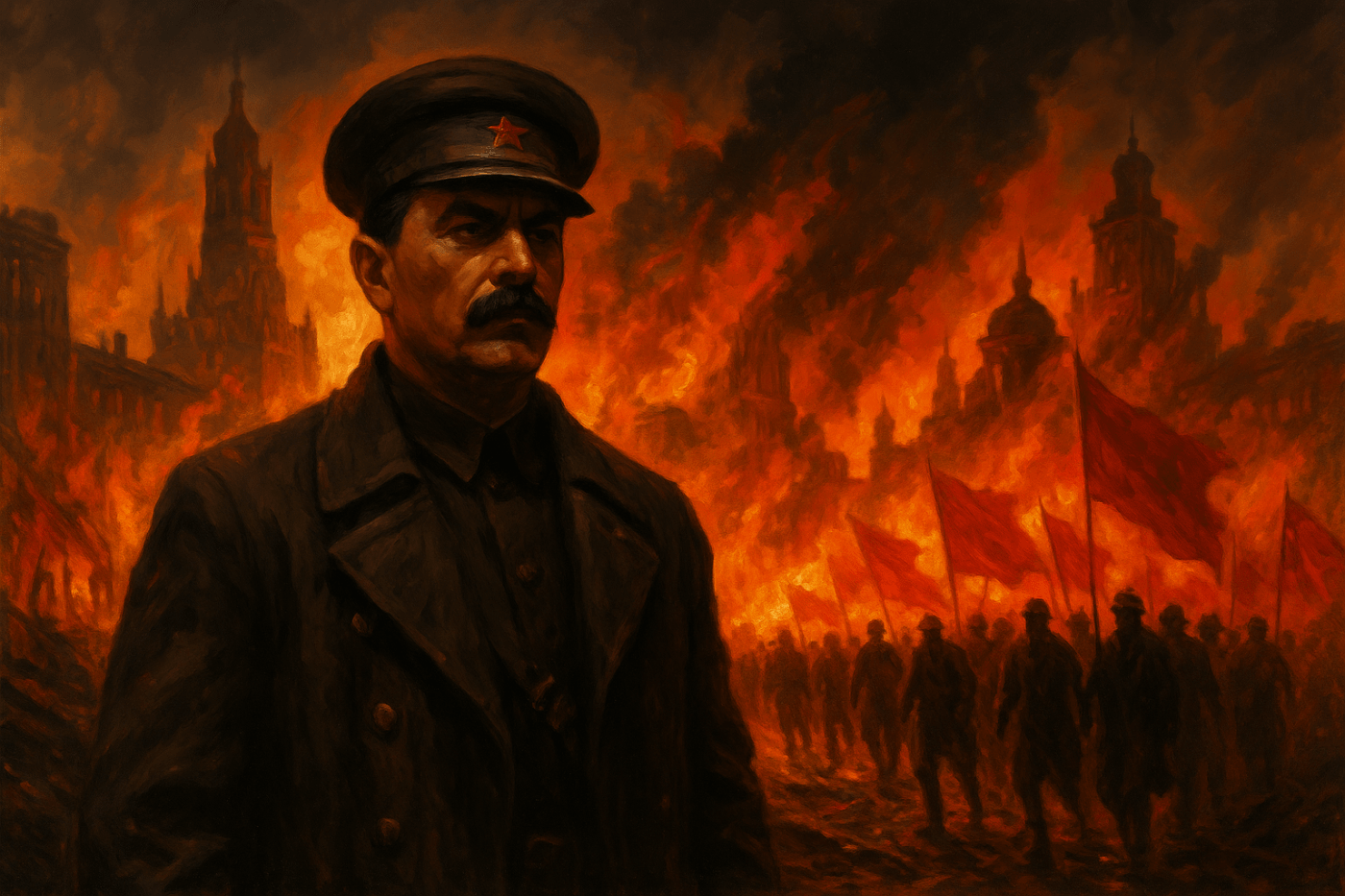
A Weaponized Intellects review of The Road to Terror: Stalin and the Self-Destruction of the Bolsheviks, 1932–1939by J. Arch Getty and Oleg V. Naumov — a forensic excavation of how a besieged socialist project fought its enemies abroad, its contradictions within, and the limits of human endurance.
By Prince Kapone | Weaponized Intellects — October Revolution Series | November 16,2025
Through the Fire: Reading Getty & Naumov as a Map of Class War Under Siege
This book isn’t another Cold War morality play about a mustache and a gulag. The Road to Terror opens the archives and drags us into the furnace where a besieged revolution tried to harden itself into a state while the old world pressed on every border and slipped through every crack inside. Getty and Naumov reconstruct a Bolshevik leadership forged in civil war—its language disciplined by scarcity and sabotage, its reflexes shaped by the habit of survival. That’s not an apology; it’s a material fact of the period, and it frames the contradictions we need to confront if we’re serious about socialist construction in the real world rather than in graduate-seminar utopias. The civil war’s legacy—emergency rule, one-party press control, and a permanent vigilance against restoration—was not a quirk of personalities but the sediment of history itself, carried forward into the 1930s like shrapnel under the skin.
Getty’s archive shows a party that had become the state and, therefore, the primary battlefield. The Bolsheviks monopolized political organization, the press, the courts, the army, and the police—because the counterrevolution, foreign and domestic, would monopolize them the second the party let go. That concentration of authority is exactly where the contradictions erupted: the same apparatus that defended October also incubated a strata of officials with their own interests, their own survival instincts, their own little fiefdoms. When the center demanded vigilance, local machines turned screenings into score-settling; when Moscow tried to rein them in, the ground shifted again. The party, “priesthood” and “police” at once, undertook policies that disorganized itself, which is to say the revolution attempted self-surgery while under fire.
By 1932 the stakes had sharpened. Industrialization raced, the countryside convulsed, and the leadership moved in zigzags—tightening discipline, screening the membership, overhauling the judiciary, redefining “the enemy,” and, step by step, sliding toward mass repression. Getty’s point is devastating precisely because it is not melodramatic: this was a group consensus, a wagon circle, born of famine, sabotage, and the fear—some imagined, much of it not—that the party could split and the state could crack. Read this not as a psychological diagnosis but as a political x-ray of socialism in one country, isolated and yet forced to build.
The flashpoints—Kirov’s assassination, the show trials, the aborted experiment with genuinely contested elections—were not staged props on a fixed script; they were accelerants poured onto already smoldering contradictions. Even Getty’s cautious reconstruction of the aftermath of Kirov shows a regime jolted into reprisals through emergency tribunals, a standard Bolshevik response to political murder since the civil war days. By mid-1937, with secret-ballot plans on the table and “class enemies” suddenly eyeing legal openings, the center lurched to mass executions: a brutal retreat from a dangerous aperture. This is how a ruling class in embryo behaves under siege—testing openings, then slamming them shut when the cost looks existential.
If you want a tidy parable about monsters, look elsewhere. The record Getty and Naumov assemble is more disturbing: the terror was not only done to the party by a single hand; it was also carried out by the party as it tore itself apart to keep the project alive. That’s the dialectic we have to sit with. A leadership convinced—Leninist to the bone—that class struggle sharpens under socialism, met real conspiracies, real wrecking, and a real world tilting toward fascism with methods that alternated between necessary defense and catastrophic overreach. By January 1938, even the center tried to brake “excessive vigilance,” a sign not of innocence but of a political organism groping for a way to survive without devouring itself whole—just months before the storm of world war made the question tragically concrete.
We open this series, then, with no flinching and no liberal incense. The Road to Terror is a dossier of a revolution trying to hold the line with imperfect tools and imperfect people in an impossible position. Our task is not to launder errors or echo prosecutors; it is to learn the hard lessons: how a vanguard makes itself both sword and shield without becoming a noose, how to build institutions that can fight enemies without reproducing them, how to keep the class character of the state proletarian when the state itself offers careers, comforts, and a thousand petty temptations. That’s not antiquarianism; that’s our present tense.
The Siege Within: Fear, Faith, and the Foundations of Revolutionary Vigilance
Every revolution that survives long enough to build institutions must one day face its own reflection: what happens when the organs of liberation begin to resemble the enemy’s? Getty and Naumov show that by the early 1930s, this question was no longer theoretical in the Soviet Union—it was the heartbeat of political life. The revolution had entered what Lenin foresaw as its most dangerous phase: construction under siege. The imperialist armies had withdrawn, but the siege never ended; it simply changed form. Spies replaced soldiers. Trade blockades replaced bullets. Economic isolation and technological embargoes replaced artillery. Inside the borders, the line between vigilance and paranoia blurred until it vanished. The ruling class abroad could not destroy the workers’ state from without, so it waited for the contradictions within to ripen.
The Bolsheviks were not naïve. They had lived through intervention, sabotage, famine, and conspiracy. They had seen the wrecking operations of technicians and specialists still loyal to the old order. They understood that counterrevolution could wear a party badge as easily as a priest’s collar. Stalin’s famous declaration—that class struggle intensifies as socialism advances—was not a prophecy of terror, but a restatement of historical materialism under new conditions. In a society still scarred by peasant semi-feudalism and bureaucratic residues, socialism was a struggle, not a state of grace. Every advance—the collectivization of agriculture, the electrification of industry, the education of millions—produced new contradictions, new strata, and new interests. The bourgeoisie, expropriated as property-owners, began to reconstitute itself as managers, clerks, and local bosses. The class war had simply changed clothes.
Getty’s analysis, restrained and empirical, still captures the claustrophobia of this moment. Letters to the Central Committee multiplied; denunciations flooded local offices; men and women who had built the Revolution began to suspect one another. This was not only fear of Stalin; it was fear of defeat—fear that the entire project could collapse under its own weight if vigilance wavered. Western liberal historians have always treated this as psychosis. But to people who had watched fourteen foreign armies invade the newborn republic, paranoia was realism. You do not survive such an ordeal by trusting the benevolence of class enemies. The Revolution had to learn how to breathe in an atmosphere of permanent hostility. The tragedy is that the air itself became toxic.
Here the contradictions sharpen. To defend the Revolution, the Party demanded discipline; to maintain discipline, it centralized power; and by centralizing power, it produced the very bureaucratic caste that now required purging. This is the dialectic of siege socialism—where necessity breeds deformity, and deformity demands more necessity. Getty and Naumov’s archival excavations reveal a state apparatus both terrified and triumphant, capable of building the largest industrial machine in the world while drowning in memos about “wreckers” and “Trotskyite diversion.” They do not romanticize it, nor should we. But what they inadvertently reveal is a political order still guided by revolutionary logic, however distorted: that the greatest danger was not error, but surrender.
There is a line from Marx that haunts every revolutionary epoch: “The tradition of all dead generations weighs like a nightmare on the brains of the living.” In the USSR, that nightmare wore the uniforms of tsarist bureaucrats repurposed as Soviet functionaries, the habits of deference and careerism smuggled into the Party by those seeking stability after the storm. The Bolsheviks were trying to make new men and women while relying on old materials. Every failure of consciousness looked like treason; every deviation looked like sabotage. Stalin’s “vigilance” was the political expression of a deeper crisis: how to build socialism with the social material inherited from capitalism.
Getty and Naumov, careful not to moralize, show how the Party’s internal life turned into an endless sequence of investigations, expulsions, and readmissions—an organism devouring its own cells to survive infection. What they call “self-destruction” was in truth a grim form of political self-defense, distorted by the pressures of isolation and by the absence of a world revolution that might have relieved it. The Soviet Union was both fortress and laboratory, its experiments conducted in the crossfire of imperial hatred. That is why this “terror” cannot be understood as pathology—it was the behavior of a revolution forced to live in a permanent state of emergency. To call that madness is to forget that the enemy was real.
The lesson is not that socialism inevitably corrodes into suspicion, but that without international revolution, vigilance turns inward. When a proletarian state stands alone in a capitalist world, every decision becomes a wager for survival. The Bolsheviks won that wager—at a cost measured in lives and in trust. And while Getty and Naumov do not celebrate that survival, their evidence testifies to it. Against famine, sabotage, and encirclement, the Revolution endured. It did not fall. And that endurance, however bloody, remains one of the most staggering acts of human will in the modern age.
Steel and Grain: The Class War Beneath Socialist Construction
By 1930, the Revolution had outlived its infancy but not its hunger. The Soviets were no longer the insurgent councils of 1917—they were the scaffolding of a new state attempting to industrialize a peasant empire at breakneck speed. Getty and Naumov’s reconstruction of these years—grain requisitions, sabotage trials, factory breakdowns, and bureaucratic panic—lays bare the violent birth of socialist modernity. Collectivization wasn’t a “policy error” dreamed up by sadists; it was the desperate maneuver of a government caught between famine, foreign blockade, and the iron law of industrial competition imposed by imperialism. The USSR had to build steel or be strangled. The contradiction was brutal: to abolish exploitation, it first had to accumulate capital faster than the capitalists. s show no master plan unfolding with bureaucratic precision. Instead, they reveal chaos—grain shipments rotting, Party secretaries falsifying quotas, peasants slaughtering livestock rather than surrendering it to collective farms. The rhetoric of “kulaks” and “wreckers” came not from sadism but from real social fractures. The kulak was not just a mythic scapegoat; he was the concentrated expression of a rural bourgeoisie that hoarded, speculated, and burned its own harvest rather than see the workers’ state fed. Getty’s neutral language—“dislocation,” “excess,” “mass repression”—barely contains the scale of the struggle. This was class war waged across fields and furnaces, fought with wheat as much as with rifles.
Stalin’s argument that class struggle would sharpen under socialism was not the paranoia of a tyrant but the hard logic of historical development. A society trying to leap from feudal semi-slavery to modern industry in a decade was bound to breed contradictions sharper than those of any bourgeois democracy. In every collective farm and factory committee, the past clung like soot: habits of private gain, corruption, patriarchal domination, and regional chauvinism—all relics of the old order reappearing inside the new. To suppress them, the Revolution turned to mobilization campaigns, political education, and yes, coercion. History is not a clean surgery; it is amputation without anesthesia.
Getty and Naumov do not moralize. They note that, far from being omnipotent, the central leadership often reacted blindly—issuing contradictory decrees, calling for restraint one day and punishment the next. The state machine, only half built, behaved like a nervous system in shock, its reflexes firing in every direction. But beneath the administrative chaos lies a coherent social logic: the drive to subordinate petty commodity production to collective control. The famine of 1932–33—one of the darkest chapters in Soviet history—was not a divine curse or genocidal design; it was the catastrophic byproduct of revolutionary transformation under siege. To speak honestly is not to excuse it, but to recognize that starvation was the price of breaking the landlords’ grip and ending a thousand years of rural bondage.
The Western narrative reduces this epoch to cruelty; the Marxist lens sees the contradiction. The Revolution was trying to create abundance while trapped in scarcity, to democratize production while centralizing power, to uplift the peasantry while forcing it into a new mode of life. The Party was not blind to these contradictions—it drowned in them. Getty’s sources describe endless plenums, letters, self-criticisms: men and women groping for a socialist ethic of labor amid the wreckage of the old world. They failed often. They lied. They repressed. But they also built the foundations of a society where literacy, electrification, and collective ownership would become the norm rather than the exception. The paradox is that the same revolution that built schools and dams also built prisons to guard them.
Marx wrote that the revolution “creates not only new institutions but new men.” What Getty and Naumov’s archives reveal is how painfully that creation proceeded. Peasants who had never owned more than a shovel now operated tractors; workers who could barely read became foremen; women entered public life in unprecedented numbers. The material base was transforming faster than consciousness could keep up. In that gap—between a socialist economy in formation and a population still molded by centuries of class and patriarchal hierarchy—the seeds of the later purges were already germinating. Bureaucracy, fear, opportunism, heroism: all were expressions of one great unresolved contradiction—how to build socialism without socialist men and women yet formed.
To read Getty and Naumov dialectically is to see not a morality play but a process: a revolution climbing out of mud and blood toward industrial modernity, surrounded by enemies, sustained by the faith that history itself could be bent toward justice. The steel plants of Magnitogorsk, the collective farms on the steppe, the new alphabet textbooks in the villages—all of these were born in struggle. To condemn the pain without understanding its necessity is to side, knowingly or not, with those who wanted socialism to fail. The Soviet people did not choose the road to terror; they chose the road to survival—and found that, in their epoch, the two were one and the same.
The Party at War With Itself: Bureaucracy, Betrayal, and the Battle for Revolutionary Purity
If the 1930s were a crucible, then the Communist Party itself was the molten core. What Getty and Naumov reveal—often despite their own cautious language—is that the Party became the primary terrain of class struggle once the external bourgeoisie had been crushed. The Revolution had built its own state, but that state was staffed by men and women forged under the old order. Peasants turned functionaries; factory militants turned bureaucrats; careerists learned to mouth Marxism while hoarding privilege. The Bolshevik Party was no longer a clandestine vanguard but a sprawling organism—millions strong, administratively indispensable, and ideologically divided. It was at once the instrument of proletarian dictatorship and the seedbed of a new class.
Getty’s archival lens captures the microscopic texture of this transformation: a Central Committee overwhelmed by petitions, denunciations, and self-criticisms; provincial officials waging factional war through paperwork; comradeship decaying into mutual suspicion. Yet beneath this chaos ran a deeper current. The Party was not simply disintegrating—it was trying to defend its revolutionary character in the only language it knew: the purge. From the earliest Bolshevik codes, purification was both moral and political, an act of self-defense. Lenin’s generation had practiced it sparingly; Stalin’s generation made it system. Every audit, every questionnaire, every “verification of Party documents” was an attempt to prove that the Revolution still belonged to the workers and peasants, not to the bureaucrats. In the heat of the class struggle, however, vigilance turned inward and consumed itself.
Getty and Naumov dismantle the myth of an omnipotent dictator orchestrating the terror from above. Their evidence shows instead a complex web of initiatives from below: local leaders, regional NKVD officers, and Party committees competing to demonstrate zeal, each accusing the next of softness or sabotage. The purges became a form of political currency. To denounce was to survive; to hesitate was to risk being labeled an accomplice. Revolutionary faith, once a bond of trust, mutated into proof of loyalty. It is here that the dialectic of siege socialism reaches its most tragic expression: a proletarian party defending itself from enemies real and imagined, turning its methods of revolutionary discipline into instruments of self-destruction.
To call this merely “madness,” as liberal historians do, is to strip it of causality. The world beyond the USSR was arming itself for fascist conquest. The capitalist powers—each soaked in colonial blood—were preparing for war, while foreign spies operated inside Soviet borders with impunity. Hitler and Mussolini rose as avatars of counterrevolution, financed by the same bankers who once funded the White armies. Against this backdrop, Stalin’s vigilance had a grim logic: a wounded revolution surrounded by predators could afford neither mercy nor internal collapse. The Party’s tragedy was that its defensive reflexes, honed during years of invasion and sabotage, could not distinguish between counterrevolution and criticism. In the fever of survival, dissent itself appeared as treason.
The contradiction deepened as the Party’s role expanded. To industrialize, it had to delegate power; to maintain discipline, it had to centralize it. Every new commissariat, every local executive committee became both an extension and a distortion of proletarian rule. By 1936, when the USSR promulgated its new constitution—declaring universal suffrage and civil equality—the Party faced its greatest ideological test. Could a dictatorship of the proletariat also democratize itself? The subsequent terror answered with blood: the Revolution recoiled from its own promise, fearing that the opening of political life might invite the return of the class enemy. Getty’s documents make clear that this retreat was not merely a command from above; it was an eruption from below, from thousands of cadres who saw liberalization as suicide.
Marx warned that revolutions “storm heaven with bayonets,” but cannot sustain themselves by faith alone. In the USSR, the dream of equality collided with the logic of emergency. Every institution—trade unions, soviets, even the press—was subordinated to the Party, and the Party was subordinated to survival. Getty and Naumov’s reluctant conclusion is that the Bolsheviks destroyed their own leadership in order to preserve the Revolution. From a dialectical standpoint, this is less paradox than law: under conditions of siege, the class struggle concentrates at the summit. The purge of the Party was the continuation of the civil war by other means.
And yet, beneath the terror, the machinery of progress ground on. Factories rose, literacy spread, science advanced. The contradictions did not paralyze history; they propelled it. The very cadres who carried out arrests also built the Red Army that would defeat fascism. The bureaucrats who feared foreign agents would, a few years later, organize the evacuation of entire industries eastward under Nazi fire. The Revolution’s wounds became its armor. Getty and Naumov’s book, stripped of its moralism, tells this story in the language of archives: a party that bled to cleanse itself, a movement that mistook purification for permanence, and a state that, for all its deformities, refused to die. It is a study in how a revolution survives not by virtue but by endurance.
The Purges as Thermidor: Revolution, Counterrevolution, and the Tragedy of Survival
To the liberal historian, the Great Purge is proof that the Revolution devoured its children; to the Marxist, it is proof that revolutions, when encircled, must devour their contradictions or perish. Getty and Naumov’s archives read like dispatches from a political earthquake—the Party’s own ground liquefying under its feet. They reveal no single puppeteer pulling strings but a vast organism consuming itself in feverish motion: resolutions chasing denunciations, plenums issuing confessions, commissars collapsing under the weight of their own decrees. The logic was merciless yet not irrational. A revolution born in civil war and fenced in by imperial hostility could not afford ambiguity. The Bolsheviks, facing the specter of fascism in Europe and sabotage at home, mistook social contradiction for conspiracy because history had left them no room for nuance.
The purges were not random violence—they were the continuation of class struggle under conditions of isolation. Every revolution carries two souls: one creative, one destructive. The creative builds schools, power plants, collectives; the destructive clears the rubble of the old order. When the revolution stands alone, these souls fuse. What Getty and Naumov call “self-destruction” was the collision of these twin imperatives within the same state. The leadership struck at its own ranks because it no longer trusted the class composition beneath them. In that sense, the purge was not the betrayal of Leninism but its grim afterimage: the dictatorship of the proletariat turned inward, attempting to preserve proletarian power by annihilating its own bureaucracy.
The famous trials—Zinoviev, Kamenev, Bukharin—were theater, yes, but they were also confessionals of an exhausted generation. Men who had made the Revolution stood before microphones and begged forgiveness for crimes half-fabricated, half-believed. They spoke in the dialect of the defeated, not because Stalin’s police were magicians of torture, but because history itself had rendered their contradictions unsustainable. To stand against the line of socialist construction in 1937 was to stand for a future that no longer existed. Some embraced their own liquidation as final service to the Revolution; others simply broke. Getty’s documents record both with chilling precision. The Western press saw only cruelty; the Marxist eye sees tragedy—tragedy not as sentiment, but as the cost of a revolution forced to rule without reprieve.
Here lies the dialectic of Thermidor and permanence. In bourgeois revolutions, reaction returns openly—the Robespierres fall and the Napoleons rise. In the socialist revolution, reaction wears red stars and speaks in the language of vigilance. The purges were the Soviet Thermidor in form but not in essence: the counterrevolution failed to capture the state, yet the fear of its return drove the Revolution to purge itself more ruthlessly than any external foe could have managed. Getty’s evidence shows this duality: the NKVD slaughtering Communists by night while factories by day continued to exceed production quotas; Party congresses denouncing “enemies” while approving plans for universal education. Reaction and progress walked hand in hand through the corridors of the Kremlin.
The Western imagination loves a moral fable, but Getty and Naumov’s research offers something more disturbing: complicity. The purges were mass participation, not mass hypnosis. Ordinary citizens wrote denunciations; workers demanded the firing of engineers; comrades condemned comrades to prove devotion. This was not totalitarian control—it was revolutionary consciousness distorted by siege. When the horizon narrows to survival, moral categories collapse. To remain loyal was to act; to hesitate was to risk the label of traitor. The very faith that built the Revolution became its weapon of self-discipline. That is why the purges, however grotesque, were also political: they reaffirmed the legitimacy of the project through ritualized sacrifice. The Soviet Union re-forged unity through terror because it lacked the material stability to forge it through trust.
And yet, history’s verdict refuses to conform to bourgeois morality. After 1938, when the storm subsided and the state began to repair the damage, the Revolution did not collapse—it hardened. The same apparatus that bled itself rebuilt its leadership, its army, its industry, and confronted fascism head-on. The Great Terror, for all its horror, annihilated neither the socialist ideal nor the proletarian state. When Hitler invaded in 1941, the Soviet people did not welcome the Wehrmacht as liberators; they fought to the death to defend the Revolution that had once imprisoned and starved them. That fact alone refutes the moralists. A population that had turned against socialism would not have sacrificed twenty-seven million lives to preserve it.
To read Getty and Naumov through the lens of dialectical materialism is to see the purges not as moral collapse but as historical contradiction in motion. The Revolution faced annihilation from abroad and decomposition from within. Its leadership, trapped between necessity and virtue, chose necessity. It was not right. It was not just. But it was the decision of a class fighting for its continued existence in a world that had already decided it must die. In that sense, the purges mark not the end of the Bolshevik Revolution but its most tortured survival—its Thermidor without capitulation, its self-destruction without surrender.
The lesson for revolutionaries is as sobering as it is clear: socialism cannot survive indefinitely as an island. Encirclement breeds fear, and fear breeds repression. The Soviet Union’s tragedy was to bear the entire weight of the world’s reaction on a single set of shoulders. In that sense, the purges were not simply a Soviet event—they were a world event, a symptom of the global class war that capitalism waged on the twentieth century’s only living revolution. History’s indictment must fall not only on Stalin’s hammer but on the anvil that struck back—the empires that left the Revolution no other way to live than through terror.
The Ghosts of Kirov: Conspiracy, Fear, and the Limits of Revolutionary Justice
In December 1934, Sergei Kirov was shot dead in the Smolny Institute in Leningrad. The bullet that ended his life tore through the heart of the Revolution. Getty and Naumov treat the murder not as mystery noir but as the pivot around which the Soviet state’s paranoia crystallized into policy. Kirov’s assassination marked the crossing of a threshold: from suspicion to certainty, from vigilance to vengeance. Whether or not there was a grand conspiracy—as the regime claimed—the effect was total. Every tremor in the political body now registered as mortal danger. Stalin saw in Kirov’s death not merely an act of violence but a signal from history that enemies still stalked within the walls. The result was a spiral of repression that no one, not even its architects, could fully control.
Getty’s documents—minutes, directives, private letters—show how swiftly the machinery of justice was converted into a machinery of prevention. Trials were streamlined, appeals curtailed, and executions accelerated in the name of “proletarian legality.” The Revolution, born in defiance of bourgeois law, found itself wielding law as a weapon sharper than any czar’s decree. There was logic in the madness: a class war government cannot afford the luxury of liberal jurisprudence when the very categories of guilt and innocence are defined by history’s direction. To Western readers this is barbarism; to a people whose state had nearly been drowned in blood only fifteen years earlier, it was survival through control.
The Kirov affair unleashed what Getty calls the “psychology of conspiracy.” Officials feared exposure, subordinates preemptively denounced superiors, and Stalin’s inner circle began to read politics as battlefield. It is here that the Revolution’s moral contradiction becomes unbearable: how does one preserve revolutionary justice when justice itself becomes an arm of politics? Lenin had warned that a workers’ state must repress the exploiters but never surrender to bureaucratic formalism. By 1935, that warning was an epitaph. Justice, stripped of its class content and driven by fear, became theater—a spectacle of loyalty where confession replaced evidence and faith stood in for proof.
Yet to reduce these trials to cynicism is to miss their ideological substance. Bukharin’s final letters, preserved in the archives, tremble with conviction: he saw himself as a tragic defender of a purer Marxism betrayed by historical necessity. To the world, his confession was capitulation; to him, it was sacrifice—one last service to the Revolution that had outgrown him. The logic is monstrous yet profoundly human: better to die a loyal heretic than to hand the class enemy the pleasure of your defiance. Getty and Naumov’s dry transcripts cannot contain the pathos of that moment—the sense that the Bolsheviks, having turned the world upside down, were now offering themselves up to appease its fury.
What followed was less a purge than a storm. The Kirov murder became the founding myth of an entire era of vigilance, a justification for every midnight knock on the door. But beneath the terror there remained an echo of principle: the refusal to let the Revolution decay into complacency. This is not to romanticize repression, but to recognize that its engine was not sadism but fear—fear that socialism, if left undefended, would rot from within before capitalism could destroy it from without. In this, Stalin’s Russia was not unique. Every empire in crisis—British, French, American—has justified its cruelties in the name of security. The difference is that the Soviet state’s security apparatus was animated by an idea of liberation, however mangled in practice.
By 1938, after millions of arrests and executions, the Party itself sensed the abyss. The Central Committee’s resolution condemning “excessive vigilance” was a political confession—a recognition that the Revolution had turned its sword upon its own body. Getty and Naumov interpret this as bureaucratic self-preservation. From a dialectical standpoint, it was something deeper: the revolutionary organism, after hemorrhaging for years, was attempting to clot. The leadership that emerged from the terror was leaner, more disciplined, and utterly loyal. It would go on to rebuild the army, oversee wartime mobilization, and guide the Soviet people through the crucible of the Great Patriotic War.
Kirov’s ghost never left the Soviet imagination. His death became shorthand for the dangers of complacency and the price of division. In every revolution since—from Havana to Hanoi—the lesson echoes: a single act of betrayal, or even the perception of it, can trigger a convulsion that reshapes the state. The Soviet response to that trauma was catastrophic, but it was not senseless. Getty and Naumov’s chronicle, stripped of Cold War hysteria, forces us to see Kirov’s bullet not as the beginning of Stalin’s madness but as the sound of a Revolution realizing that it could still bleed. The tragedy of the 1930s was not that socialism was defended too fiercely, but that it had been left so isolated it could only defend itself by tearing its own heart out.
The Great Cleansing: Necessity, Excess, and the Anatomy of Revolutionary Exhaustion
By 1937, the Revolution had reached its psychological breaking point. What Getty and Naumov uncover in the archives is not a simple chronicle of tyranny, but a collective implosion—the exhaustion of a society that had lived twenty years in emergency mode. The “Great Terror,” far from a monolith of command, was a patchwork of overlapping fears, ambitions, and self-justifications, a decentralized storm. Orders from Moscow arrived half-formed; provincial officials filled the gaps with enthusiasm or opportunism. Targets were set, exceeded, and revised as if the revolution could be saved through arithmetic. It was politics by body count. Yet even amid this grotesque overproduction of fear, something distinctly political persisted: the belief that vigilance was the only guarantee of survival.
Getty’s fragments—reports from regional committees, NKVD directives, confessions scribbled at midnight—reveal a world in which reality and rumor fused. The category of “enemy” no longer marked a social class but an epistemological one: whoever doubted, hesitated, or demanded proof was suspect. Bureaucrats denounced engineers, engineers denounced poets, and poets denounced themselves. This was not the insanity of one man; it was the collective neurosis of a revolution forced to maintain absolute purity in a world where purity had become impossible. The Soviet Union in 1937 was both the most egalitarian and the most fearful society on earth—a paradox born of its isolation and the scale of its achievement. The farther it advanced, the more it feared collapse.
Marxist analysis demands that we read this moment not as moral failure but as historical contradiction in overdrive. The dictatorship of the proletariat, tasked with eliminating exploitation, had become an employer of millions. The state built to abolish hierarchy now required hierarchy to function. Every promotion, every ration, every apartment key created new gradations of privilege; every gradation generated new resentment; every resentment invited suspicion. Getty’s reluctant conclusion—that the Terror was as much bottom-up as top-down—confirms what dialectical materialism predicts: under conditions of scarcity and encirclement, contradictions erupt first within the revolutionary class itself.
And yet, even as prisons filled and comrades vanished, the Soviet project refused to disintegrate. New cadres stepped into vacated posts. Production continued to rise. The purged factories produced the tanks that would one day encircle Berlin. It is this continuity that unsettles liberal historians: how could a state so consumed by internal violence still function, let alone triumph? The answer lies in the material foundation of belief. The Revolution still promised a future beyond hunger and humiliation; its crimes were committed in the name of that promise, not despite it. Terror became the distorted expression of faith—the faith that socialism, if defended long enough, could finally outgrow the conditions that demanded terror in the first place.
By 1938, Stalin himself appeared weary of the monster he had unleashed. The order to halt mass operations and the release of thousands of detainees were not acts of mercy but of recalibration. The Revolution had purged so many of its servants that it risked disabling the very apparatus of state. Getty and Naumov cite Politburo minutes where the language shifts from “cleansing” to “restoration,” from “vigilance” to “correction.” The Party was trying to wake from its nightmare without disowning it, to claim that the terror had been necessary but was now complete. History offered no such closure. The scars remained: a generation of Communists buried without trial, families shattered, faith replaced by silence. Yet the machine resumed its march, stripped of sentiment but not of purpose.
To the West, this denouement confirmed its prejudice: the Revolution had devoured its soul. But to those who endured, survival itself became vindication. The Soviet Union had outlasted intervention, famine, civil war, and now its own excess. The purge, however monstrous, had not extinguished the socialist impulse—it had burned away its illusions. Out of that furnace emerged a state that could face fascism not as an idea but as an army. When the Wehrmacht crossed the frontier in 1941, it encountered not a disillusioned populace but a hardened one. The children of the terror became the soldiers of Stalingrad. History’s irony is cruel: the same vigilance that devoured the Revolution’s heart also forged the steel that would save it.
Getty and Naumov close their study with the image of a society staggering out of a storm it did not understand. To the dialectical mind, this is not an ending but a transformation. The Great Cleansing was both culmination and prelude—the final convulsion of the revolutionary epoch before it reconstituted itself as wartime socialism. The terror was not a break in the Revolution’s logic but its terminal stage under isolation. When the guns of fascism replaced the whispers of denunciation, the Revolution found clarity in external war that it had lost in internal peace. The tragedy of 1937–38 is that socialism, denied the solidarity of world revolution, was forced to rediscover unity through suffering. It was, as Du Bois wrote of Reconstruction, “a magnificent failure whose foundations made future victories possible.”
Revolution Reforged: From the Ashes of Terror to the Dawn of Victory
When the smoke cleared in 1939, the Soviet Union stood bloodied but unbroken. The Revolution had survived not only its external enemies but its own convulsions. What Getty and Naumov’s archives ultimately reveal—often unintentionally—is that socialism, even in its darkest hour, proved more resilient than the capitalist world ever imagined. The cadres who replaced the purged officials were young, untested, and ideologically raw, yet they carried within them the stubborn conviction that the Revolution must endure. They were not the heirs of privilege but of necessity—the first generation raised entirely within the socialist order. Their education, their industrial labor, their patriotism were all products of the very system the West declared had collapsed. This new leadership would be the one to face fascism and win.
The irony is unbearable and instructive. The same purges that decapitated the old Bolshevik elite also cleared the ground for a new kind of state—centralized, militarized, and disciplined to a fault. In liberal hands, this becomes the ultimate indictment: proof that Stalinism triumphed by annihilating Leninism. But dialectical materialism compels a harsher truth. The Revolution did not perish—it adapted. The Soviet Union’s transformation from a revolutionary republic into an industrial superpower was not a betrayal of Marxism but a deformation born of survival. The terror was the crucible through which the USSR reconstituted itself as a global force capable of confronting imperialism on its own terrain. What the bourgeois historian calls degeneration was, from a historical standpoint, the consolidation of power in a world determined to exterminate socialism.
Getty and Naumov end their narrative before the war, but the trajectory is clear. The purges exhausted the Party yet streamlined the state. When the fascist invasion came, the USSR possessed an industrial base that could be relocated eastward, a unified command structure, and a population hardened by decades of sacrifice. This was not accidental—it was the material consequence of revolutionary construction under siege. The very paranoia that had fueled repression now became vigilance on the battlefield; the same centralized command that stifled debate now allowed rapid mobilization; the same culture of suspicion toward foreign influence became a fortress mentality capable of withstanding Hitler’s onslaught. History, in its ruthless logic, converted terror into endurance.
The Western mind recoils from this synthesis because it collapses its cherished moral binaries. To say that terror and triumph were dialectically linked is not to celebrate suffering, but to recognize causality. Every socialist experiment must pass through its own Calvary—the point where survival demands a choice between the ideal and the possible. For the Soviet Union, that choice was made in the 1930s, and the result was neither utopia nor hell, but a world-historical deterrent to fascism and imperialism. The tanks that rolled into Berlin in 1945 carried within them the ghosts of the purges; the red flag over the Reichstag was raised by the sons of those the Revolution had once feared. History does not deal in absolution. It deals in transformation.
Getty’s restraint leaves space for interpretation, and here the Marxist must speak plainly: the purges were both crime and necessity, horror and discipline, betrayal and preservation. They expose the contradiction of socialism in one country—a proletarian dictatorship forced to behave like a besieged empire to keep capitalism at bay. The tragedy is not that the Bolsheviks failed to achieve perfection, but that they were forced to build socialism under conditions designed for its destruction. The fault lies not in the dream but in the encirclement. And if we are to inherit anything from this epoch, it is the understanding that socialism cannot exist indefinitely in isolation. Without international revolution, the walls of the fortress will always turn inward.
What endures, then, is not the bureaucracy, nor even the state, but the idea—the scientific conviction that humanity can govern itself without masters. The Soviet experiment, for all its deformities, remains the single greatest demonstration of that truth. Getty and Naumov’s The Road to Terror unintentionally testifies to it. Every memo, every confession, every decree documents the agony of a people refusing to surrender. They did not break. They rebuilt, fought, and changed the course of world history. When we read these archives today, we are not reading the obituary of socialism; we are reading the record of its crucifixion—and its resurrection.
The Revolution did not die in the terror. It walked through it, scarred but breathing, carrying the lessons of its own contradictions. It taught us that power, once seized, must be disciplined by ideology; that vigilance without vision becomes tyranny; and that the price of isolation is the corrosion of trust. Yet it also proved that human beings can remake the world even in the furnace of despair. The Soviet Union emerged from the terror not pure, but possible—and possibility, in a world chained to capital, was the most radical achievement of all.
The bourgeois historians will keep writing epitaphs; the revolutionaries will keep reading blueprints. The archives of terror are also the archives of survival. To study them is not to mourn, but to prepare—to learn how a revolution can be surrounded, betrayed, slandered, and still, somehow, prevail. That is the final lesson of Getty and Naumov’s book: socialism endures not because it is perfect, but because the world that opposes it is infinitely worse.
The Dialectic of Memory: Lessons from a Revolution That Refused to Die
History does not weep; it warns. To read The Road to Terror today is to stand before the mirror of revolutionary experience and see both the light and the flame. Getty and Naumov offer no moral comfort, no easy villains. Their archives speak instead of contradiction—the very element that defines all revolutions worth the name. The Soviet Union, in their pages, is neither a dystopia nor a miracle but a living organism: one part bureaucracy, one part prophecy, held together by the iron will of a class that had nothing left to lose but its history. The Great Terror was not the opposite of October; it was its distorted reflection, the proof that socialism, isolated and encircled, could survive only by wrestling with its own shadow.
The Marxist approach does not sanitize these facts. It insists on their logic. The purges, the trials, the confessions—these were not accidents of personality or madness but the culmination of contradictions that had been accumulating since 1917. When a proletarian state inherits the institutions of empire, it inherits also their ghosts. The Bolsheviks built socialism with the tools of their oppressors, and those tools, sharpened by fear, cut both ways. The state that had abolished private property still bore the imprint of the property form; the Party that had abolished class distinctions still functioned as a hierarchy; the people who had overthrown tsarism still looked upward for command. The Revolution’s greatest victory—the creation of a workers’ state—became its greatest weakness when that state had to reproduce itself faster than class consciousness could mature.
Getty and Naumov’s contribution lies not in the discovery of new horrors but in the documentation of process. Their files record meetings where comrades debated quotas for repression, then adjourned to plan literacy drives. They show us men who could sign death sentences at noon and write paeans to socialist realism by dusk. To bourgeois eyes, this is hypocrisy; to the dialectician, it is the simultaneity of progress and regression inherent to every transition between modes of production. The same contradiction that birthed the Paris Commune and drowned it in blood ran through the Soviet project—only magnified across a sixth of the planet. Where capital resolves crisis through exploitation, socialism in isolation must resolve it through political repression. That is the horror of the siege, and the reason we fight to end it everywhere it exists.
The Western world has spent a century turning the Soviet tragedy into its favorite morality play: Stalin as Satan, the gulag as original sin. This narrative functions not as history but as absolution—a way for imperialism to wash its own hands while lecturing the dead. Yet as Getty and Naumov’s evidence makes clear, the terror did not spring from ideology but from geography: a workers’ state surrounded by wolves. It was the logical consequence of world capitalism’s refusal to allow any rival form of civilization to exist. The Revolution’s isolation was the condition of its excess. The same nations that now cry crocodile tears for its victims were the ones that armed its enemies, sabotaged its trade, and plotted its destruction. They did not fear tyranny—they feared liberation.
The lesson for our time is therefore not to romanticize or to repent, but to remember strategically. A revolution is not a museum piece; it is an experiment under fire. Its mistakes are not evidence against it but data for those who come after. The Soviet Union demonstrated both the power and the peril of centralized planning, the necessity of ideological education, the danger of bureaucratic ossification, and the catastrophic price of global isolation. To extract those lessons without succumbing to anti-communist mythology is the duty of every revolutionary intellectual today. Getty and Naumov’s book, when read against the grain, becomes a manual on how a proletarian state can endure even its own collapse.
In the end, the terror could not erase what the Revolution had already achieved: the abolition of landlordism, the industrialization of a backward empire, the defeat of fascism, and the global awakening of the colonized. Even in its darkest years, the Soviet project shifted the horizon of possibility for all humanity. It inspired independence movements from Beijing to Havana, educated generations of workers and peasants, and proved that the world could function without private owners. That legacy did not die with Stalin, nor with the USSR’s disintegration in 1991—it lives on in every struggle that refuses to bow to empire.
We, too, inherit those contradictions. Our century is defined by surveillance, technocratic control, and corporate dictatorship—the heirs of the very forces that besieged the Revolution. The task before us is not to mourn Stalin’s errors but to understand their roots and to build a socialism immune to their recurrence: international in scope, democratic in form, disciplined in execution, and clear in its enemy. To wield power without becoming it. To purge without terror, to govern without hierarchy, to defend without paranoia. Such a socialism will not emerge from nostalgia but from study, struggle, and renewal.
When Walter Rodney wrote that “revolutions are not made by saints but by people who are themselves products of oppression,” he could have been writing the epitaph of the Soviet century. Getty and Naumov’s The Road to Terror reminds us that even saints would have failed under such siege. The Bolsheviks did not fall because they were too cruel or too ambitious; they fell because they stood alone. The next revolution must ensure that no socialist state ever stands alone again. That is the true meaning of proletarian internationalism—the antidote to terror and the guarantee of human freedom.
History’s verdict on the Soviet experiment is still being written. But this much is certain: the world it fought to build remains unfinished, and its enemies remain the same. To study the road to terror is not to recoil from revolution but to prepare for its return—wiser, broader, and unstoppable. The ghosts of 1937 do not demand pity; they demand continuation.
 Weaponized Information
Leave a comment