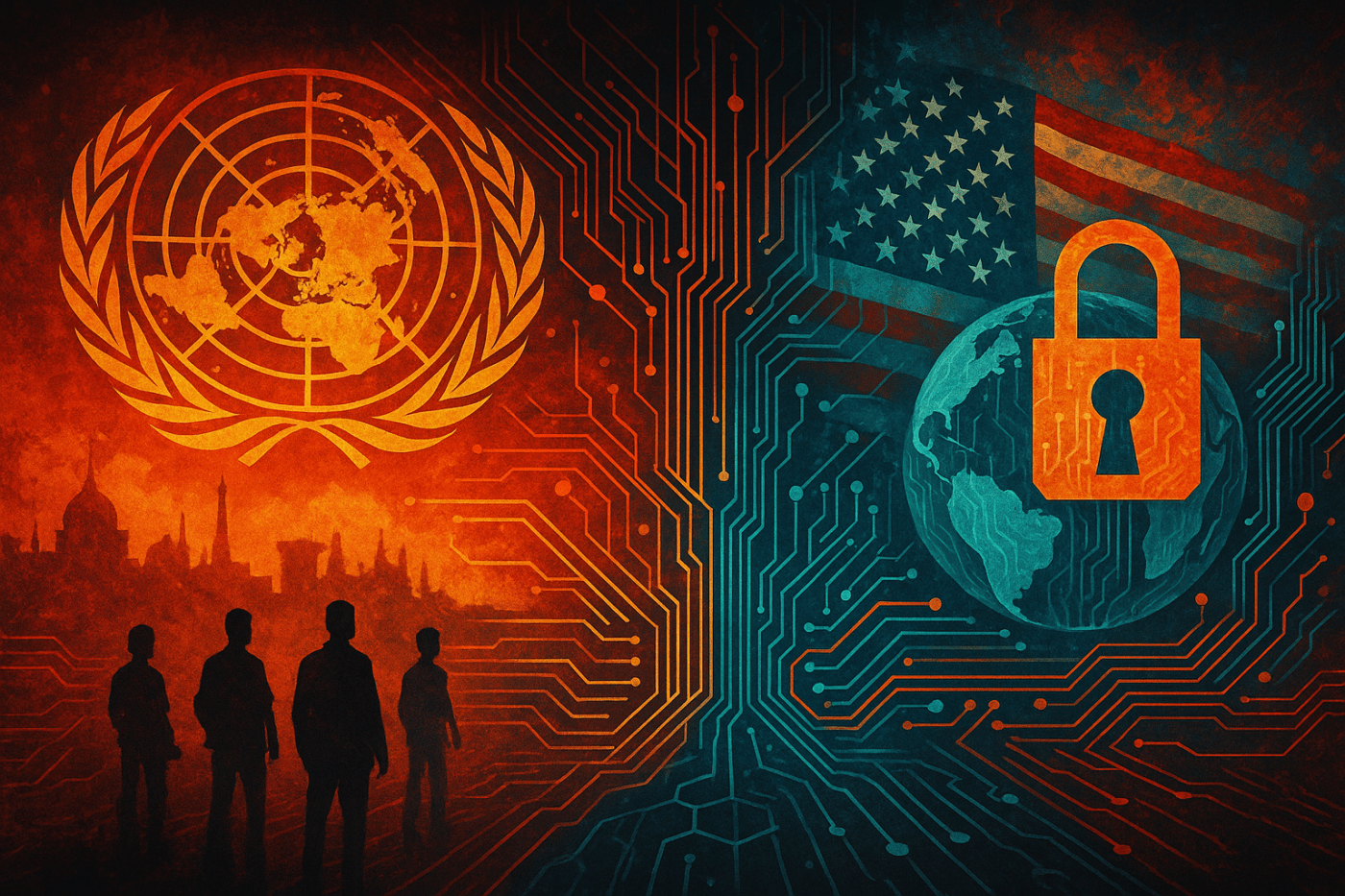
A global struggle over who controls the internet, the flow of information, and the meaning of security in the 21st century.
By Prince Kapone | Weaponized Information | November 7, 2025
The Internet Was Never Neutral
The story that Silicon Valley likes to tell is that the internet emerged from garages and college dorm rooms, built by free-spirited innovators guided by genius and caffeine. It is a beautiful myth — and like all effective myths, it hides the truth behind a soft glow of sentimental nostalgia. In reality, the internet was born in the belly of the American war machine. ARPANET was a Pentagon experiment. DARPA funded the research. The architecture of the web was shaped by Cold War anxieties, military strategy, and the permanent desire of an empire to know, monitor, anticipate, and if necessary, neutralize.
Before Google was a verb, surveillance was a doctrine. Before Facebook taught us to confess our lives to a screen, intelligence agencies were developing frameworks to make entire populations legible. What later became “the cloud” began as a defense infrastructure — a network designed to survive nuclear exchange by decentralizing communication and dispersing command. The digital world did not set us free; it extended the reach of empire.
When the Cold War faded and the neoliberal era began its long march across the earth, the military backbone of the internet did not disappear — it simply shifted its outward appearance. The uniforms changed to hoodies, the war rooms to open-concept tech campuses, the Pentagon to Menlo Park and Redmond. But the pipeline remained: federal funding, military research labs, elite universities, venture capital, and then corporate platforms that operated at planetary scale. Under the banner of “innovation,” monopoly capital inherited the surveillance infrastructure of the U.S. state and refined it into something more intimate, more invisible, and more total.
By the time the world realized what had happened, it was already inside the machine. The internet had become an imperial highway: data crossing borders without passports, corporations operating above the law, and intelligence agencies riding shotgun. The U.S. did not merely build the digital world — it built itself into the operating system. Every message, every search query, every purchase, every location ping, every image uploaded into the planetary archives of private servers.
So when we speak of “cyber governance,” we are not speaking about technical standards or criminal procedure. We are talking about power. About who has the authority to see, to record, to analyze, to intervene. The lines of code are political borders. The fiber optic cables are trade routes. The platforms are fortified ports. This is not the “information age” as a triumph of human progress — this is the continuation of empire by digital means.
Now, for the first time in thirty years, the imperial circuitry is being contested. A multipolar world is emerging — hesitant in places, uneven in shape, but unmistakable in direction. States of the Global South — the same nations once colonized, looted, sanctioned, destabilized, and disciplined by Western power — are now asserting their right to control the data that flows across their territory and through their societies. And this is where our story begins: in the struggle between a decaying order that built the internet to serve its dominion, and a rising world that demands sovereignty over its own digital future.
The UN Process as a Struggle for Digital Self-Determination
When the United Nations began negotiating a new cybercrime convention, it was not simply drafting another treaty. It was reopening a battlefield that had been closed for three decades. For most of the internet’s political lifetime, digital governance was shaped outside of the Global South, in rooms where the voices of colonized nations were politely acknowledged and materially ignored. But this time, the balance of forces is different. Over 150 countries entered the negotiations — and the majority of them carry the memory of colonization not as a chapter in a history book, but as a wound still warm beneath the skin.
The UN draft convention, on its surface, presents itself in calm legal language: “criminalization,” “procedure,” “international cooperation,” “human rights.” But beneath the polite vocabulary is a far more consequential thesis — that every nation has the right to govern the digital space within its borders, regulate the flow of data, and decide how evidence is gathered and exchanged. This is not merely technical; it is political. It is the articulation of a principle that the United States and Europe have resisted for generations: sovereignty is not forfeited just because the world has gone online.
What distinguishes the UN framework is not simply that it seeks cooperation, but that it grounds cooperation in state-to-state relations. To request evidence, to pursue investigations, to conduct joint operations — nations must speak to one another as equals, through recognized legal channels. No corporate gatekeepers sitting above the law. No intelligence agencies operating behind it. No automatic privilege granted to those who built the initial architecture of the global network. In a world where Amazon and Google operate more like empires than companies, this position is neither symbolic nor trivial. It is a demand to place the digital world back under political control, rather than leaving it to the invisible hand of markets that are not markets at all, but monopolies.
The convention also emphasizes the protection of human rights — not as an ornamental clause, but as a necessary safeguard against the misuse of cybercrime law for repression. Critics in the West claim that this is a backdoor for authoritarianism. But the irony is too thick to ignore. The nations making this accusation are the same ones running mass surveillance dragnets, storing the world’s communications in military data centers, and prosecuting journalists for exposing war crimes. The Global South is not demanding new powers of control. It is demanding the right to not be controlled by an imperial surveillance regime that pretends to be the guardian of freedom.
The UN cybercrime effort is therefore not a technical reform. It is a declaration that the era of unilateral digital rule is ending. And like all such declarations, it is met with fear, derision, and hostility from those who built their power on the assumption that the world would never dare to say no. The draft convention is still being negotiated, contested, revised — but the political meaning is clear: the Global South is no longer willing to be a data colony.
Budapest and the Imperial Inheritance of the Digital Age
Long before the UN process gathered momentum, the rules of cyberspace had already been written — or rather, imposed. In 2001, at the height of unchallenged U.S. global dominance, the Council of Europe drafted the Budapest Convention, the first international treaty on cybercrime. It was quickly embraced by the United States and its allies, and presented to the world as the natural and rational framework for digital law enforcement. The timing was not accidental. The “War on Terror” had just begun. Intelligence agencies were expanding their powers. The internet was becoming central to surveillance, propaganda, and financial monitoring. To control the network, one needed a legal instrument that transcended borders. Budapest was that instrument.
Budapest’s language is clean, procedural, and seemingly neutral: “expedited preservation,” “production orders,” “interception of data,” “international cooperation.” But neutrality in law is often the most effective disguise for domination. The convention’s power lies in the investigative channels it opens — and in who has the capacity to use them. Under Budapest, law enforcement agencies can request data across borders, demand access to servers hosted abroad, and obtain subscriber information directly from private companies. On paper, any signatory can do this. In practice, only those with geopolitical leverage, intelligence partnerships, and corporate alignment can act with speed and impunity. And we know who those are.
Consider how data actually moves across the world. The vast majority of global internet traffic is routed through infrastructure owned or controlled by U.S. and European corporations. The dominant social platforms, cloud services, and search engines are headquartered in the imperial core. Their databases live on servers subject to U.S. law enforcement requests, intelligence-sharing agreements, and secret court orders. When Budapest allows “direct cooperation with service providers,” it is not facilitating equality — it is reinforcing a hierarchy in which Western agencies have home-field advantage in a game they designed.
The 2nd Protocol makes the architecture even clearer. It accelerates cross-border data access, expands real-time cooperation, and allows emergency disclosure without prior judicial approval in urgent cases. Again, the language is framed around efficiency, speed, modernity. But the real effect is to streamline the pathways through which Western states can reach into the jurisdictions of others — while shielding their own digital borders behind corporate opacity and national security exemptions.
This is not collaboration. It is a legal mechanism for preserving the imperial distribution of power in the digital domain. Budapest emerged not from dialogue among equals, but from a world where one bloc had the authority to dictate global norms, set standards, and enforce compliance. It is the digital equivalent of the post–World War II monetary system — a structure built when the balance of forces favored the United States, and maintained long after the balance had shifted.
Therefore, the conflict between the UN convention and the Budapest regime is not a matter of legal technicalities. It is a clash between two world orders — one fading, one being born. Budapest represents the unipolar moment: the belief that the internet belonged to the West, and that the rest of the world would adapt, submit, or be disciplined. The UN process represents the return of history: the insistence that sovereignty does not disappear at the edge of a fiber-optic cable.
Shared Language, Divergent Worlds
To a casual reader, the UN draft convention and the Budapest Convention appear to be cousins of the same legal family. Both speak of criminalization, mutual legal assistance, procedural safeguards, human rights, and international cooperation. Both insist that cybercrime must be confronted collectively, that evidence must move across borders, that no state can secure its digital space in isolation. In the abstract, the texts harmonize. They seem to describe a shared global problem requiring shared global solutions. And it is precisely here, in this melody of agreement, that the ear must become sharp.
For what looks like similarity at the surface masks a profound political divide underneath. The UN convention is built on the premise that states are sovereign — that cooperation must be negotiated between them as equals, through explicit channels, with transparent accountability. Its architecture insists that law cannot be dictated by the power of those who already dominate the network. It assumes that the digital world is not exempt from the basic principle of national self-determination.
Budapest assumes the opposite. It was written during a moment when Western dominance of digital infrastructure was so complete that sovereignty appeared optional, even outdated. In that world, the West did not merely hold power — it confused its power with universal reason. The language of Budapest, therefore, does not announce itself as imperial. It does not need to. It lets the existing distribution of force do the talking. Its mechanisms operate smoothly, efficiently, and predictably only when Western states make the request and Western companies respond. It is a universal map drawn using the geography of empire.
This is why both frameworks can reference “human rights” while standing on opposite sides of global history. The UN’s invocation of human rights emerges from the experience of nations that have been spied on, destabilized, sanctioned, and invaded in the name of “democracy.” For them, “rights” mean protection against domination. Under Budapest, “human rights” enter as a diplomatic flourish, a moral gloss on a system that already assumes the West has the authority to decide whose speech is dangerous, whose communication is criminal, whose access to information must be curtailed.
So the issue is not whether cooperation should exist — it is whose terms cooperation is built upon. The UN process asks: how do sovereign nations work together without surrendering their autonomy? Budapest presumes the answer: by aligning with a legal framework that reflects the interests of the powers that built the digital world in their own image.
In other words, the two conventions speak the same legal grammar, but they do not speak the same political language. One is written in the accent of a multipolar world rediscovering its voice. The other is written in the confident tongue of an order that believed history had ended. The words converge. The worlds do not.
Data Is the New Territory
It is often said that “data is the new oil,” but this comparison is too gentle, too apologetic, too afraid to speak plainly. Oil can be traded. Oil can be shared. Oil can be nationalized. Data is something else entirely. Data is the memory of a people, the movement of their bodies, the map of their desires, the archive of their behaviors, the infrastructure of their communication, the fingerprints of their social life. Data is the new territory. And like all territory, it becomes the site of conquest when empire begins to lose control.
Under Western capitalist imperialism, the digital world has been organized as a domain of extraction. The platforms we use are not free. They are instruments of capture. The algorithms that feed us information are not neutral. They are behavioral factories. The “cloud” is not a metaphor — it is a global network of server-fortresses, owned by giant corporations aligned with Western intelligence agencies. Every keystroke, every click, every biometric scan routes through commercial infrastructures that answer to monopoly finance capital. And when the United States speaks about “securing cyberspace,” it means securing its privileged access to this territory.
The struggle over the UN cybercrime convention is, at its core, a struggle over who controls the flows of data and who has the right to regulate it. It is a struggle over whether nations in Africa, Asia, the Middle East, and Latin America will continue to hand their social, economic, and political lives to server farms in Northern Virginia and Frankfurt — or whether they will build their own digital institutions capable of defending their autonomy. The call for sovereignty in the UN process is not isolationist. It is not reactionary. It is not an attempt to close the world. It is the demand for a world in which communication does not require surrender.
For the West, this is an existential threat. Because without privileged access to global data flows, the imperial center loses the ability to predict, shape, and discipline the political behavior of the world. Its sanctions become weaker. Its information warfare becomes clumsy. Its economic leverage erodes. Its security doctrine begins to falter. Control over data is the neural system of modern empire — and empire does not surrender its nervous system willingly.
This is why the U.S. and its allies defend the Budapest framework with such desperation. It is why they frame the UN process as dangerous, destabilizing, authoritarian, and irresponsible. It is not because the UN threatens “freedom.” It is because the UN threatens the freedom of the West to spy, monitor, intimidate, and intervene without accountability.
To understand this conflict, we do not need to be technical experts. We only need to remember the oldest lesson of imperialism: when the colonized develop the means to speak in their own voice, to store their own knowledge, to guard their own communications, the colonizer calls it a threat to civilization. The digital world is simply the newest terrain on which this ancient drama is being played.
Cybercrime as Counterinsurgency
If we listen closely to the language used by Western officials when they speak about “cybersecurity,” a pattern emerges. The threat is always framed as something external, criminal, unpredictable — hackers, terrorists, foreign agents, rogue states. But when we examine who is actually targeted, who is surveilled, who is censored, who is imprisoned, and who is silenced, a very different picture comes into view. Cybercrime law is not simply a tool to fight theft or fraud. It is a mechanism for managing dissent, suppressing opposition, and maintaining the political and ideological supremacy of an imperial order that fears it is losing control.
This is why whistleblowers are treated as criminals while war criminals write memoirs. Why journalists who expose state violence are hunted while officials who authorize torture retire into corporate boards. Why workers who organize online are monitored, blacklisted, and algorithmically contained. Why revolutionary movements and anti-colonial struggles are smeared as “extremism.” If the internet is the new territory, then narrative is the new battlefield — and cyber law becomes the police force of empire.
The Western intelligence agencies that built the architecture of digital surveillance — the NSA, GCHQ, CIA — did not design these systems to protect democracy. They designed them to detect insurgency. They designed them to prevent the rise of movements that could challenge capitalist property relations, imperial military strategy, or Western geopolitical dominance. What the Cold War could not accomplish with coups and counter-revolutions, the digital age attempts to accomplish with metadata, blacklists, predictive policing, and the weaponization of online platforms.
Under this system, communication itself becomes suspect. The simple act of speaking across borders, forming networks, building solidarity, or coordinating struggle becomes framed as a security threat. The point is not to eliminate communication — it is to make communication transparent to those who hold power. To make speech visible to the state. To make dissent predictable and therefore containable. In this way, cyber governance becomes the continuation of colonial governance by new means — not through the occupation of land, but through the occupation of communication.
This is why the debate over international cyber law is not about legal technicalities. It is about whether oppressed people have the right to organize without being watched, infiltrated, disrupted, or silenced. Whether journalists have the right to publish evidence of state crimes without being treated as enemies of the state. Whether movements for liberation can speak in their own voice, using their own tools, without their words being weaponized against them by an empire that has always feared the sound of the colonized speaking back.
The West calls this control “security.” But security for whom? Whose lives are protected and whose lives are targeted? Whose voices are amplified and whose are erased? If we measure security not by the safety of imperial institutions but by the dignity of human beings, then the current system is not a security regime. It is a counterinsurgency regime — a system designed to suppress the global struggle for freedom using the internet as its most sophisticated instrument.
Toward a Multipolar Digital Future
We are living through the slow collapse of a world that believed itself permanent. For three decades, Western capitalist imperialism imagined that the digital universe it constructed would remain forever under its stewardship — that the cables, the servers, the platforms, the protocols, the laws, and the languages of the internet would all continue to reflect and reinforce the worldview of the imperial core. But history has never bowed to permanence. And today, the world is moving. The monopoly the West once held over meaning, memory, and communication is cracking.
What emerges in its place is not yet fully coherent. It is uneven, contradictory, and still forming. But it carries the unmistakable shape of a world in which nations refuse to be data colonies — where sovereignty extends into the digital and political imagination becomes a force capable of altering the structure of global power. The UN cybercrime negotiations are only one front in this shift. They do not guarantee liberation. They do not break monopoly capital on their own. But they mark a critical turning point: the recognition that the digital world is not above politics — the digital world is politics.
The path forward is not to replace Western domination with another empire. Nor is it to romanticize state power as inherently just. The demand for sovereignty is not a demand for isolation, censorship, or repression. It is the insistence that the rules governing digital life must be made by the people who live under them — not by corporate executives in California, military strategists in Virginia, or bureaucrats in Brussels. It is the recognition that data, communication, and memory are too essential to human dignity to be left in the hands of those who treat them as instruments of profit or geopolitical leverage.
A multipolar digital order will require institutions capable of protecting privacy, regulating monopoly capital, securing communication infrastructures, and supporting the free circulation of knowledge without surrendering control of that knowledge to imperial centers. It will require technological development that is not dependent on Western supply chains or Western platforms. It will require the formation of alliances that recognize that digital sovereignty is a condition for cultural, political, and economic sovereignty.
And it will require movements — genuine movements — rooted in the struggles of working class and colonized peoples, capable of articulating a different vision of the digital world. A world where technology is not an instrument of surveillance but a resource of liberation. Where communication is not mediated by algorithms that reproduce racial, colonial, and class hierarchies, but where communication becomes a field of shared learning, creativity, and collective power. A world where the internet ceases to be the nervous system of empire and becomes instead a tool for emancipation.
This future is not guaranteed. It will be fought for, contested, and resisted by those whose power depends on preventing it. But the cracks are already visible. The old order is no longer unquestioned. The new is no longer unimaginable. And in that space — between the world that is dying and the one struggling to be born — we find our task: to build the political, technological, and intellectual capacities for freedom in a digital age still haunted by empire.
 Weaponized Information
Leave a comment