Weaponized Intellects Book Review: October Revolution Series | By: Prince Kapone | Weaponized Information | November 1, 2025
The Atlantic Furnace: Where Capital Was Born in Chains
Before Marx could write of capital, it had to be born. And it was not born in Manchester or Birmingham, but in the furnaces of the Caribbean—on the sugar plantations of Saint-Domingue, where men and women stolen from Africa were ground into both labor and profit. C.L.R. James opens The Black Jacobins by forcing us to confront this obscene truth: that Europe’s “Age of Reason” was financed by slavery’s irrational brutality. The Enlightenment philosophes spoke of liberty while sipping sugar from the backs of the enslaved. James turns the polite myth of progress inside out—revealing that the first factory system in the modern world was not the cotton mill, but the plantation; and that the first industrial workers were Black, chained, and unpaid.
Saint-Domingue was not some peripheral colony in the French Empire. It was the empire. It produced two-thirds of France’s foreign trade—sugar, coffee, indigo, molasses, tobacco—all soaked in blood. James writes as a Marxist historian, but also as a Caribbean witness, resurrecting the enslaved as historical subjects, not victims. The plantation was capitalism’s laboratory, where the ruling class learned to discipline labor, extract surplus, and rationalize terror. Every whip crack was a lesson in political economy; every slave rebellion, a seminar in revolution. By the late eighteenth century, the enslaved population—half a million Africans—had already developed what Marx would later call “class consciousness in itself.” They understood perfectly who their enemies were: not in abstract terms of “bourgeois” and “proletarian,” but in flesh and blood—masters and slaves.
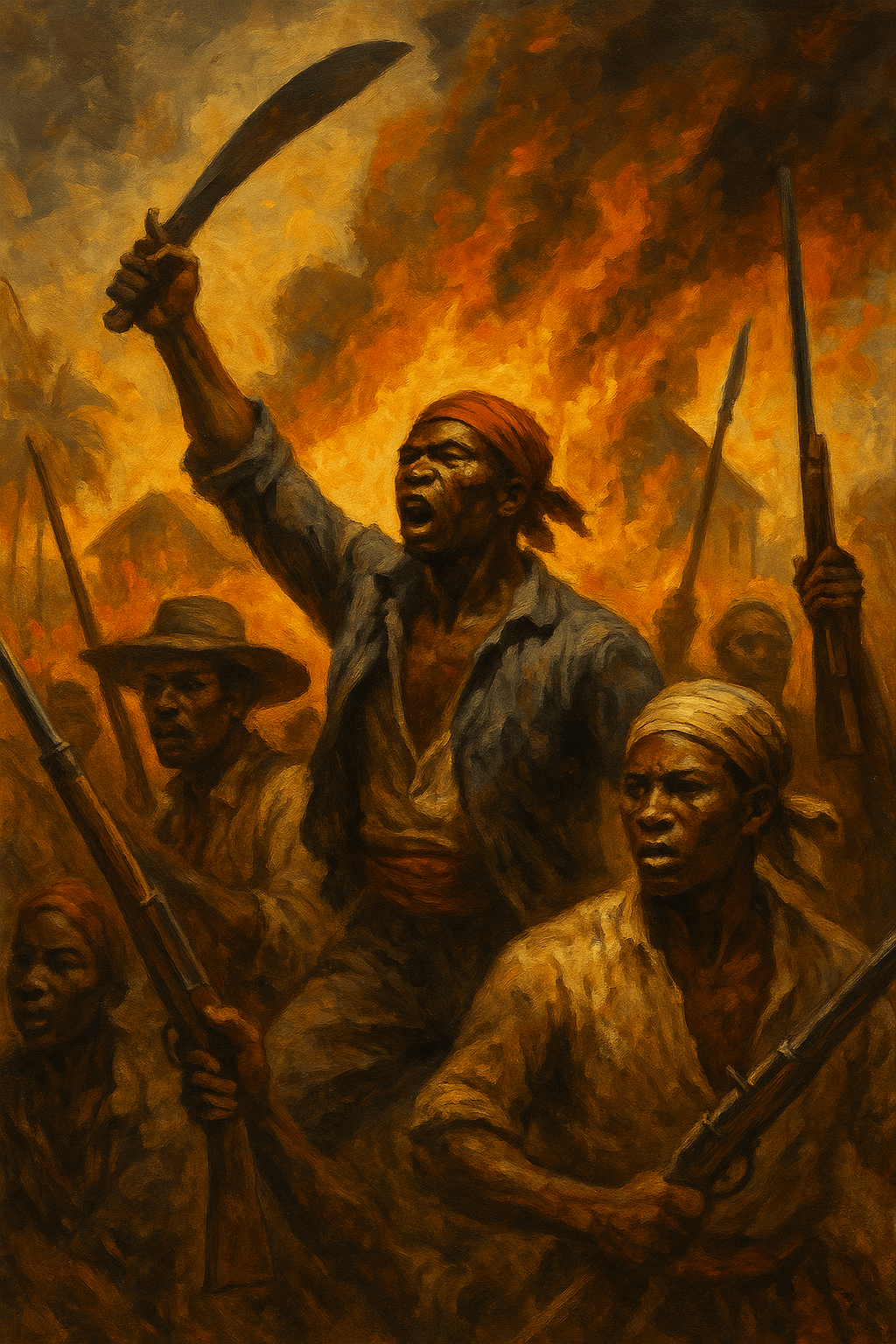
For James, the Haitian Revolution is the logical consequence of the Enlightenment, not its aberration. The French bourgeoisie declared “liberty, equality, fraternity” for themselves but not for those who made their liberty possible. The contradiction was unsustainable. In the cane fields, the ideals of 1789 became the demands of 1791. The enslaved Africans translated Rousseau into Kreyòl, armed with machetes instead of pamphlets. Their “Social Contract” was written in fire across the plantations. In this sense, the revolt that erupted in August 1791 was not a derivative revolution but the world’s first anti-capitalist insurrection—a material uprising against the economic system that Enlightenment Europe still dares to call civilization.
James writes with the precision of an economist and the fury of a revolutionary. He shows that Saint-Domingue was a mirror of the world to come. The triangle trade that connected Bordeaux, Liverpool, and Port-au-Prince was the embryo of globalization: commodities, capital, and human beings circulating through imperial arteries. Europe’s wealth was built on a global division of labor in which one half of humanity was condemned to produce and the other to consume. What James exposes, long before dependency theorists or postcolonial scholars gave it names, is the original sin of the capitalist world-system: the accumulation of European wealth through African death.
And yet, from this graveyard of profit rose a revolution that would terrify the ruling classes of the world. “The slaves destroyed slavery,” James insists, in the same tone that Lenin once said, “The workers destroyed capitalism.” No saviors descended from Paris or London to enlighten the masses; the enlightenment came from below, from the collective intelligence forged in chains. The masses of Saint-Domingue were not waiting for history—they were making it. In the process, they proved that the wretched of the earth could think, act, and govern. If Marx gave the proletariat its theory, James shows that the enslaved gave it its first practice.
Thus begins The Black Jacobins: not as a chronicle of the past, but as a manual for the future. The Haitian Revolution, for James, is the prototype of all subsequent revolutions—the rehearsal for October 1917 and every liberation struggle that followed. The Atlantic world was the first theater of class war, and its protagonists were African. From the mills of Saint-Domingue to the factories of Petrograd, the lesson is the same: those who produce the world have the right—and the power—to remake it.
The Property and the Owners: How Liberty Became a Business
If Part I exposed the plantation as capitalism’s first factory, Part II shows us the architects—the men who called themselves “civilized.” C.L.R. James rips the masks off the planters, merchants, and financiers who owned both the land and the lives upon it. They were not the romantic adventurers of imperial myth but accountants of misery, calculating profit in units of flesh. Every noble in Paris, every banker in Bordeaux, every merchant in Nantes had a stake in the whip. Saint-Domingue was their stock exchange; the enslaved, their currency. When they spoke of “property rights,” what they meant was the right to own people. When they invoked “liberty,” it was the liberty to trade in bondage.
James lays bare the central paradox of bourgeois ideology: the class that proclaimed universal rights built its fortune on universal unfreedom. The Declaration of the Rights of Man was drafted with a quill dipped in molasses. The French Revolution could not advance without confronting the fact that the wealth sustaining it came from colonies that denied those very rights. Here James turns the gaze of history back upon Europe itself, showing how the struggle of the enslaved in Saint-Domingue was not peripheral to 1789—it was its mirror and its measure. The planters of San Domingue were not feudal relics, as Marxist orthodoxy sometimes suggested, but the vanguard of capitalism. They were modern men—scientific, efficient, ruthless—who managed human beings with the precision of machines.
The colonial bourgeoisie, James writes, was “a race of men with no country but profit.” Their allegiance was not to France or to reason, but to capital. They saw revolution in Paris as both a threat and an opportunity: a chance to break from the king while keeping the slaves. They formed clubs, wrote petitions, and bribed assemblies, all to ensure that their “property”—half a million human beings—would remain secured by law. James spares them no irony: “They demanded liberty for the whites of the colony, and chains for the blacks who made that liberty possible.” In this, the colonial bourgeoisie was prophetic. They prefigured the modern capitalist who demands deregulation for himself and discipline for labor—the CEO who preaches “freedom” while building prisons.
But in dissecting the hypocrisy of the French bourgeoisie, James is not simply moralizing. He is performing a dialectical autopsy on the Enlightenment itself. He shows how the ideology of freedom became the superstructure of a global economy built on coercion. The French Revolution unleashed forces it could not contain: by universalizing the language of rights, it armed the very people it enslaved with the moral and political vocabulary of their own liberation. In the hands of the enslaved, “liberty” ceased to be an abstract noun—it became a weapon. The slogans of Paris echoed through the mountains of Haiti, where they were translated into Creole and given material form in revolt.
For James, the bourgeoisie’s tragedy is that it mistook its own class interest for human progress. It believed that tearing down aristocracy meant ending oppression. But the enslaved of Saint-Domingue knew better. They understood that freedom declared from above is never freedom in fact. The real revolution, James tells us, began when the enslaved ceased to petition and began to burn. The fire that swept the plantations was not chaos; it was clarity. The bourgeoisie had taught the enslaved what property was; now the enslaved taught the bourgeoisie what revolution meant.
In this section, James establishes the political economy of contradiction that still defines the world. The same class that abolished kings built corporations. The same men who tore down feudal hierarchies erected racial ones. What they called “progress” was simply the modernization of domination. The Haitian Revolution, by turning the tools of the Enlightenment against their makers, was therefore not only a revolt against France but a revolt against the entire capitalist order being born. It was the moment the colonized entered history not as objects, but as agents—and forced the world to see itself as it truly was.
The San Domingo and Paris Masses: Two Revolutions, One Fire
Revolutions are never isolated explosions; they are chain reactions in the chemistry of oppression. C.L.R. James frames the revolt of the enslaved in Saint-Domingue not as a local uprising but as the continuation—and completion—of the French Revolution itself. The same contradictions that shook the streets of Paris reverberated through the plantations of the Caribbean. When the Parisian sans-culottes stormed the Bastille, the enslaved Africans of Saint-Domingue heard the sound across the ocean and recognized themselves in it. Their own Bastille was the cane field. Their own monarchy wore the face of the master.
James calls this “the echo that became thunder.” The colonial bourgeoisie had imagined they could enjoy the fruits of liberty while preserving slavery, but the logic of revolution allowed no such compromise. When the National Assembly declared that all men were free and equal, those “men” in the fields of Saint-Domingue took them at their word. They waited, they watched, and when the words were betrayed—as they always are by those who utter them from above—they acted. In August 1791, the slaves rose up in coordinated insurrection. Plantations burned like constellations across the night sky, each fire a declaration of equality more honest than any written in Paris.
James’s narrative brings these two revolutions into dialectical unity: one bourgeois, one proletarian; one led by lawyers, the other by field hands. The French Revolution abolished feudal privilege, but the Haitian Revolution abolished the very basis of private property in human labor. The Jacobins in Paris shouted “Liberty!” while still debating whether liberty applied to Blacks; the Black Jacobins in Saint-Domingue made that debate irrelevant by seizing it with their own hands. In this, James sees the true universality of the Haitian Revolution—it was the first to realize what the European revolutions only promised. It transformed Enlightenment ideals from abstractions into action.
What distinguished the masses of Saint-Domingue from the masses of Paris was not courage but clarity. The French poor fought for bread and the right to vote; the Haitian poor fought to end the system that made poverty itself. They knew no illusion of gradual reform, no fantasy of coexistence with their masters. Their consciousness was born in the absolute—the total rejection of slavery, of racial hierarchy, of colonial rule. This gave their revolution a depth and ferocity unmatched in Europe. For them, freedom was not a word—it was a necessity as vital as air.
James reveals how these revolutions spoke to each other across oceans. The debates in the National Convention over emancipation were forced by events in the Caribbean; the slogans of Paris gained meaning only because of the victories of the enslaved. The Haitian Revolution radicalized the French Revolution, just as the Paris Commune would later radicalize Marx. History moved not in a straight line from Europe outward, but in a dialectical spiral—Europe’s own ideals returning, sharpened, from the periphery. The enslaved Africans of Saint-Domingue were the first to teach Europe what its own revolution meant.
In this section, James performs a quiet act of historical sabotage against Eurocentrism. He demolishes the illusion that modernity flowed from the metropole to the colony. It was the other way around. The colonies were the crucible; the metropole, the echo. The revolutions in Paris and Saint-Domingue were not separate episodes but two expressions of a single global process—the birth of the modern proletariat out of the wreckage of feudal and colonial orders. From the barricades of Paris to the burning fields of the Caribbean, the same demand rang out: the world belongs to those who labor in it.
Thus, when James writes that the enslaved of Saint-Domingue “caught the spirit of the French Revolution and carried it further than the French themselves,” he is not making a moral point but a material one. The fire that began in Paris found its fulfillment in Haiti. And from that point forward, every revolution—whether in Petrograd, Havana, or Dar es Salaam—would carry within it the ghost of 1791, the echo of the Black Jacobins who proved that humanity’s freedom could only be realized when the last slave chain was broken and the last master dethroned.
The Rise of Toussaint: The Vanguard Forged in Chains
History, James reminds us, is not made by heroes—but by masses who, in moments of clarity, raise one among them to embody their collective will. Toussaint L’Ouverture was such a figure: a general born in bondage, a strategist tempered in the furnaces of both plantation and empire. His rise, as James writes it, was neither miraculous nor accidental. It was the dialectical outcome of centuries of resistance, the condensation of a people’s accumulated intelligence into a single disciplined will. If the Haitian Revolution was the storm, Toussaint was its lightning.
James presents Toussaint as a man who mastered the tools of his oppressors only to turn them against the system itself. Literate in French, trained in military science, conversant with Enlightenment philosophy—he was the colonized mind that refused to remain colonized. He studied the writings of Raynal and Rousseau, absorbed their talk of freedom and equality, and then demanded that those words be taken seriously. Yet his true education, James insists, came not from books but from the cane fields: from watching how labor was organized, how power operated, how fear was manufactured and maintained. Toussaint understood the anatomy of domination because he had lived it in his own flesh.
James writes of Toussaint’s emergence with the tension of a revolution still deciding its form. The rebellion of 1791 had shattered the old order, but chaos threatened to consume its victory. The enslaved needed leadership, organization, a vision of power beyond vengeance. Toussaint supplied it. His genius was not only military but political: he saw that liberation required structure, that freedom without command would collapse back into servitude. In this, James draws a parallel—subtle but unmistakable—to Lenin. Both men understood that revolutions succeed not by spontaneity alone but by disciplined direction. Toussaint, like Lenin, forged an instrument capable of transforming revolt into government.
Yet James refuses to mythologize him. Toussaint’s brilliance was also his contradiction. He believed he could reconcile emancipation with the economic order of the plantation, that he could maintain production through wage labor where once there had been slavery. His dream was to prove that Black labor, free and organized, could outproduce white slavery. It was a noble illusion—the same illusion that later haunted the early Soviet experiment under the New Economic Policy. Toussaint believed he could make peace with the market while keeping faith with the revolution. James shows how this compromise contained the seeds of defeat. To keep the economy running, Toussaint demanded labor discipline from the newly freed, turning liberty into obligation. He wanted to prove to France that the colony could remain profitable without chains. But history, as James reminds us, offers no salvation to those who seek to appease their masters.
The contradictions that tore through Toussaint’s regime were the contradictions of the entire epoch. Can freedom coexist with production for profit? Can the laboring class remain liberated while compelled to serve the needs of the old world economy? These were not only Haitian questions but global ones—the same contradictions that would later haunt the revolutions of Russia, China, and Africa. Toussaint’s tragedy was not personal but historical: he stood at the crossroads between two systems, trying to command both. His fall at the hands of Napoleon’s army was therefore not just the betrayal of a man, but of an entire social possibility—an early rehearsal of the imperial counterrevolution that would greet every emancipatory project thereafter.
Still, James does not end this chapter in despair. Toussaint’s failure was necessary for the revolution’s completion. His moderation clarified the need for radical rupture. In betraying nothing of his people but his own caution, he paved the way for Dessalines and the final war of independence. “Toussaint prepared the ground,” James writes, “but others would reap the harvest.” He was the revolutionary who proved the limits of compromise—the man who tried to negotiate with history and was devoured by it. And yet, even in defeat, Toussaint accomplished what no European philosopher dared to imagine: he made the enslaved the authors of modern freedom. He turned the abstract ideals of the Enlightenment into a living force and forced the world to confront the possibility that civilization could come from below, from those whom civilization had buried.
The rise and fall of Toussaint L’Ouverture is, in James’s telling, both prophecy and warning. It shows that the revolution cannot be half-made, that liberation cannot share a bed with exploitation. Like Lenin in October, Toussaint faced the choice between the revolution’s survival and its betrayal. And like every revolutionary since, he learned too late that the masters of the world will forgive any sin except victory. His capture and death in a frozen French prison mark not the end of the revolution but the point at which it outgrew him. The people he led no longer needed a general—they had become a class for themselves. The vanguard had done its work. The revolution would now speak in its own name.
The Black Jacobins: When the Enslaved Became History’s Authors
If there is a single point where C.L.R. James detonates the edifice of Western historiography, it is here—in his declaration that the enslaved masses of Saint-Domingue were not merely participants in the Haitian Revolution, but its architects. In a world that denied them even the status of human beings, James proclaims them as the first modern revolutionaries. They did not stumble into history by accident; they seized it with deliberate consciousness. They studied the master’s routines, his hypocrisies, his weaknesses—and then turned that knowledge into strategy. The slave, James writes, was the most observant political economist of his time. He understood better than any Parisian philosopher that liberty could not be granted; it had to be taken.
“Great men make history,” wrote Carlyle. James spits on this superstition. The Haitian Revolution, he argues, was not the creation of any single leader—not Toussaint, not Dessalines, not Christophe—but of the collective will of hundreds of thousands of enslaved Africans who transformed rebellion into revolution. They were the first proletariat of the modern world: dispossessed of property, yet possessing the labor that sustained civilization. They were internationalists before the word existed—men and women from different tribes, tongues, and nations who forged a new identity in struggle. Out of the ashes of the plantation, they built solidarity. Out of solidarity, they built power.
James resurrects these voices from beneath centuries of silence. He names their strategies: the secret councils held under the cover of voodoo ceremonies, the coded networks of communication that linked plantations across miles of wilderness, the disciplined timing of insurrection so precise it could only have been the work of collective genius. The Western historians dismissed these acts as “savagery.” James reveals them as dialectical intelligence—the scientific organization of revolt by the wretched themselves. “The slaves destroyed slavery,” he writes, and in that sentence collapses every European fantasy of moral progress. The revolution was not a gift of civilization but its negation.
The Haitian insurgents, James argues, were the world’s first class conscious in the Marxian sense, though they would not have recognized the term. They identified their condition not as a moral injustice but as a material relation of domination. They knew that to destroy slavery they had to destroy the system that required it. Their uprising was not a riot but a social revolution. They reorganized labor, seized land, and redefined what it meant to be free. Freedom was not the right to work for another’s profit—it was the right to live without masters. And in achieving it, they accomplished what the bourgeois revolutions of Europe could not: they made equality real.
James places the Haitian Revolution within the long continuum of global struggle that would later find its echo in the Russian Revolution and in every anti-colonial movement of the twentieth century. The Black Jacobins were the first to transform class consciousness into anti-imperial praxis. Where the French Jacobins declared “Liberty, Equality, Fraternity,” the Black Jacobins added a fourth term: “Humanity.” They universalized revolution. Their victory announced to the world that the downtrodden of the colonies were not waiting for the Enlightenment—they were its unfinished business. They proved that socialism could emerge not from industrial modernity but from the deepest pit of colonial barbarism.
In reinterpreting the Haitian Revolution this way, James anticipates Walter Rodney, Amílcar Cabral, and the Marxists of the Third World who would later insist that history’s center of gravity had shifted southward. The Haitian Revolution becomes, in this light, the first decolonial revolution—the moment the enslaved took the theory of revolution out of Europe’s hands and gave it back to humanity. It is the point where the proletariat ceases to be an economic category and becomes a global condition. In Saint-Domingue, class and color fused into a single antagonism, and liberation required abolishing both.
James’s prose here is not detached analysis—it is resurrection. He writes with the urgency of a man reclaiming stolen ancestors. Each page strikes at the arrogance of the historians who wrote as if the Black masses could only follow, never lead. He shows that the Haitian Revolution’s organization, discipline, and vision outstripped that of any European uprising before it. What Marx and Engels theorized a half-century later—the self-activity of the working class—had already been practiced by the enslaved of Saint-Domingue. The difference is that these workers fought not to shorten the workday but to end work as bondage. They fought not for wages, but for the world.
Thus, when James names them “The Black Jacobins,” it is not metaphor but historical justice. They were the continuation of 1789 and its correction, the fulfillment of a promise Europe betrayed. Their revolution carried the logic of equality to its conclusion, exposing the hypocrisy of all who claimed to speak for “man” while excluding most of humanity from that category. The slaves of Saint-Domingue did not just destroy an institution—they redefined civilization itself. In their hands, revolution ceased to be a European affair and became, for the first time, truly universal.
From the Sugar Mill to the Soviet: The Haitian Revolution as World Revolution
C.L.R. James does not treat Saint-Domingue as a provincial episode in colonial history. He treats it as the crucible of the modern world. The Haitian Revolution, in his hands, becomes the prototype for every social revolution that would follow—from 1848 to 1917 to 1949. Its geography may have been Caribbean, but its consequences were planetary. The same contradictions that drove the enslaved to seize the plantations would later drive the workers of Petrograd to seize the factories. Both revolutions arose from humanity’s oldest antagonism: those who produce versus those who own. Both demanded that labor no longer serve as the foundation of wealth for others. Both discovered that freedom could not coexist with the market.
In Saint-Domingue, the sugar mill was the machine at the heart of empire—the engine that converted human bodies into profit. In Russia, a century later, it was the factory that performed the same function. The slave driver and the foreman, the master and the capitalist—different masks, same face. James insists that the Haitian slaves were the first to expose this identity. They made visible what the bourgeois revolutions of Europe concealed: that liberty for one class means servitude for another. When the Black Jacobins burned the plantations, they were not destroying property for its own sake; they were abolishing the social relation that made property sacred. They declared that production itself must be organized not for profit, but for life.
Here James writes as both historian and revolutionary theorist. He sees the Haitian Revolution as the first rehearsal for socialism. Its leaders—consciously or not—posed the same questions Lenin would later answer with theory and practice. How do the oppressed seize power from a state built to suppress them? How do they govern without recreating the instruments of their own domination? How can labor be liberated from exploitation when the world market remains capitalist? Toussaint’s struggle against imperial encirclement, his attempt to balance revolution and production, prefigures the dilemmas of the early Soviet state. The embargo that strangled Haiti after 1804 anticipated the isolation of revolutionary Russia after 1917. The colonial counterrevolution of Napoleon foreshadowed the imperial interventions that would seek to crush every socialist experiment thereafter.
But James’s comparison is not just historical—it is ideological. He draws a straight line between the consciousness of the enslaved in Saint-Domingue and the workers and peasants who built the Soviet Republic. Both discovered that liberation could not be partial; it had to reorder the entire structure of society. In the Russian Revolution, the soviets replaced the Duma and the ministries with councils of workers’ power. In Haiti, the revolutionary assemblies of the enslaved performed the same function—spontaneous organs of dual power created from below. They deliberated, organized, and executed decisions collectively, even before Lenin gave this process a name. The Haitian masses, James implies, had already glimpsed the form of the workers’ state long before the term existed.
In the dialectic of world history, the Haitian Revolution is the antithesis to the French. Where the French bourgeoisie stopped at political equality, the Haitian masses demanded material equality. Where Paris spoke of liberty as an idea, Port-au-Prince made it an institution. James shows that every revolution since has been a repetition and an extension of that same struggle—to tear down the walls between the political and the economic, between freedom and production. The October Revolution’s call for “Peace, Land, and Bread” was a continuation of the Haitian cry for “Liberty or Death.” The same class war, two centuries apart, fought with different weapons but for the same end: the total human emancipation from exploitation.
Yet James also warns that the fate of Haiti contains a prophecy for all revolutions to come. Isolated, blockaded, forced to trade with its enemies, the first free Black republic was compelled to compromise with the very world it had overthrown. To survive, it reentered the circuits of capitalism on new terms—but the price was heavy: debt, dependency, and betrayal. In this tragedy, James discerns the future of the socialist world under siege. Every revolution, he writes, will face its Thermidor unless it internationalizes itself, unless it turns its liberation into a contagion rather than a nation. In that sense, Lenin’s insistence on global revolution was not idealism but historical necessity. The lesson of Haiti was clear: one revolution cannot survive alone in a world still ruled by empire.
The continuity James establishes between Saint-Domingue and Petrograd is not sentimental but structural. He is telling us that the world revolution did not begin in Europe and radiate outward—it began in the colonies and returned to Europe transformed. The slaves of Haiti were the first to make Marx’s dictum concrete before he wrote it: that the emancipation of the working class must be the act of the workers themselves. When the Bolsheviks proclaimed the dictatorship of the proletariat, they were standing on the shoulders of the Black Jacobins who had already proved that the wretched could rule. The Haitian Revolution thus becomes the unacknowledged ancestor of every red flag that followed.
James’s brilliance lies in showing that the Haitian Revolution and the Russian Revolution are not two distinct moments, but two movements of a single historical symphony—the first notes struck in sugarcane, the second in steel. The same antagonism, the same hope, the same bloodline of struggle. “The future,” James implies, “is Haitian.” For if history begins with the labor of the enslaved, then it can only end with the liberation of all who labor. In that sense, every socialist is a descendant of Toussaint, Dessalines, and the nameless millions who transformed the plantation into a school of revolution. The sugar mill was the first Soviet, and its ghosts still whisper to us: you have nothing to lose but your chains.
The Bourgeoisie Strikes Back: Restoration, Betrayal, and Empire
Every revolution awakens its own executioners. When the enslaved of Saint-Domingue shattered the plantation order, the bourgeoisie of Europe screamed in unison: “This must not stand.” For the rulers of France, England, and Spain, the existence of a free Black republic was not merely intolerable—it was heresy against property itself. C.L.R. James calls this moment the counterrevolution of the world market. Napoleon Bonaparte, posing as the heir of 1789, became the hammer of 1791. He marched under the tricolor flag of liberty to restore slavery in its most profitable colony. Thus, the son of the Revolution became its Judas.
James’s account of the French invasion of 1802 is not a military history but an anatomy of betrayal. It was not only Toussaint whom Bonaparte sought to destroy, but the entire concept of emancipation. The same European bourgeoisie that had once celebrated liberty now conspired to annihilate it, proving that its devotion to “freedom” was conditional upon the price of sugar. Napoleon’s ships carried more than soldiers—they carried the counterrevolutionary logic of capital: that no empire can tolerate labor that will not obey. The French soldiers came to Saint-Domingue not as liberators but as debt collectors for the world market.
Toussaint, ever the moderate, still believed he could negotiate with civilization. He trusted the republic that had already betrayed him, believed that the master class could be reasoned with. His arrest and deportation to a frozen cell in the Jura Mountains, where he would die of neglect, exposed the true nature of the enemy. “In overthrowing me,” Toussaint said, “you have only cut down the trunk of the tree of liberty. It will spring up again from the roots.” James treats this line not as prophecy but as dialectic. The roots of liberty, nourished by the blood of the enslaved, would soon produce a new generation of revolutionaries no longer burdened by compromise.
Under Dessalines, the revolution entered its Jacobin phase. The illusions of reconciliation were burned away in the fires of total war. Against Napoleon’s professional armies—forty thousand strong, armed with Europe’s finest weapons—the Black revolutionaries fought with the desperation of those who know that defeat means extinction. It was not merely a war between France and its colony but between two worlds: one based on profit, the other on freedom. The former had muskets and money; the latter had nothing but necessity. And necessity, James reminds us, is history’s greatest strategist.
When Dessalines finally declared independence in 1804, the act reverberated like cannon fire across the world. Haiti became the first Black republic, the first post-slavery state, the first to proclaim the equality of all races in law. It was also the most feared nation on earth. Every empire, from Washington to London, tightened its chains in response. The new republic was embargoed, isolated, punished. France demanded indemnity for its “lost property”—an extortion that would cripple Haiti for a century. The world’s capitalist powers collaborated to make an example of her: this is what awaits those who overthrow the world order. The same logic would later be applied to the Paris Commune, to the Soviets, to Cuba, to every people who dared to govern themselves.
James calls this the “revenge of property.” It was not enough for the bourgeoisie to defeat the revolution militarily; they had to erase it ideologically. Haiti was written out of the history of freedom, reduced to a “tragic anomaly,” a “Black misfortune.” European historians, too cowardly to admit that the enslaved could think, invented myths of chaos and barbarism to conceal their own guilt. In the centuries that followed, the revolution of the enslaved would be buried under a mountain of lies. James digs it up, cleans the bones, and shows them still alive. He exposes the continuity between the old imperial order and the new capitalist one: the same empires, the same banks, the same fear of the poor.
In this section, James turns his gaze beyond 1804, toward the long arc of counterrevolution that would define the modern world. The suppression of Haiti was the blueprint for the suppression of every socialist revolution to come. Embargo would become blockade. Indemnity would become debt. Gunboats would give way to sanctions, marines to multinational corporations. The methods change, the motive does not. The bourgeoisie, having learned from Saint-Domingue, perfected its art: never again allow the laboring masses to seize power without being strangled by the world market.
And yet, James refuses despair. He writes as a man who knows that every counterrevolution contains the seeds of its opposite. Haiti’s isolation turned it inward, but its existence alone haunted the conscience of humanity. Every slave who rose in Brazil, every rebel in Jamaica, every abolitionist in America invoked the name of Toussaint. The ruling class could blockade the island, but not its example. Like the October Revolution a century later, Haiti became a living proof that the oppressed could build a state from the ruins of oppression. And because it was proof, it had to be punished.
The tragedy of Haiti, then, is not that it failed—it is that it succeeded too soon. The world it created could not survive in a world still ruled by capital. James ends this chapter with a grim clarity: history is not a morality play between good and evil, but a war between classes. The Haitian Revolution was the first victory of the wretched; the counterrevolution, the first global coalition of the rich. And the war, he insists, has never ended. Every embargo, every coup, every IMF loan carries the same logic that killed Toussaint. But so too does every uprising, every strike, every act of refusal carry the same flame that burned through the plantations of Saint-Domingue. The bourgeoisie struck back—but history remembers who struck first.
The War of Independence and the World to Come
By the dawn of 1804, the impossible had been achieved: an army of the enslaved had defeated the mightiest empire in Europe. The flag of a free Black republic was raised over the ashes of Saint-Domingue, now renamed Haiti—the Indigenous word for “mountainous land,” reclaimed from beneath the rubble of colonialism. C.L.R. James writes this moment not as a nationalist triumph but as a world-historical rupture. It was the death of one civilization and the birth of another. “The old world,” he suggests, “died on the plantations.” The enslaved had proven that history did not belong to Europe, that modernity could be born from the cane fields, and that the human spirit could forge equality from the deepest depths of degradation.
Yet liberation brought new contradictions. Haiti was free, but surrounded by a hostile world still enslaved. The revolutionary army had destroyed the colonial apparatus, but in its place stood a fragile state caught between survival and sovereignty. Dessalines, who had carried the revolution to victory, now faced the impossible task of defending it within a global economy built on Black subjugation. “We have dared to be free,” he declared, “let us be free by ourselves and for ourselves.” His decree was more than a proclamation of independence—it was an indictment of the entire world order. Haiti’s revolution was the first declaration that humanity would no longer be divided between those who owned and those who obeyed.
James refuses to romanticize what followed. He dissects the immense pressures that weighed upon the newborn republic: the embargoes, the sabotage, the ideological quarantine imposed by Europe and the United States. Haiti was forced to exist as a heretic nation in a world of priests. Its isolation turned economic necessity into political tragedy. With the ports blockaded and the markets closed, the leaders of the revolution turned inward, compelled to rebuild production in the image of the world they had destroyed. The plantations were restored—not as slavery, but as labor service to the state. Dessalines tried to reconcile freedom with survival; Christophe tried to discipline the peasantry into an army of workers; Pétion dreamed of agrarian democracy. Each vision, James argues, reflected a fragment of the revolution’s truth but none could resolve its contradiction: how to remain sovereign in a world designed to keep you subordinate.
The tragedy of post-independence Haiti was not failure of leadership but the persistence of empire. The revolution had destroyed the slave economy but could not yet destroy the global system of value that required it. Surrounded, blockaded, and indebted, the new republic found itself compelled to engage the very markets that had enslaved it. Here James’s Marxism is mercilessly lucid: no nation can be fully free while capitalism rules the world. The Haitian Revolution’s isolation was the first demonstration of what would later be called imperialism—the organization of global dependency to suffocate liberated zones. In this, Haiti was not an exception but a prophecy. What was done to Haiti in the nineteenth century would be done to Russia in the twentieth, to Cuba, to Nicaragua, to every people who refused to kneel.
But James insists that the Haitian people themselves did not vanish into despair. Cut off from the world, they created a new one. The rural communes that emerged from the wreckage of the plantations were not feudal regressions but experiments in peasant autonomy. The people who had fought for liberty continued to practice it in their own forms—through collective farming, mutual aid, and the stubborn refusal to submit. This was the revolution’s second life: quieter, less visible, but no less radical. The Haitian peasantry became the living memory of 1791, preserving its lessons in the rhythm of everyday resistance. In this sense, James suggests, the revolution never truly ended—it dispersed into the soil.
The War of Independence, then, was not only a military victory but a philosophical one. It redefined the meaning of humanity. Haiti’s constitution of 1805 declared that all citizens, regardless of color, were “known henceforth by the generic appellation of Black.” In that single sentence, the revolution inverted the logic of race itself. Blackness, once the mark of subjugation, became the universal identity of freedom. James reads this not as a cultural statement but as a material one: the colonized world had made itself the subject of history. When Dessalines proclaimed “I have avenged America,” he spoke for every enslaved and dispossessed person on the planet. The Haitian Revolution had transformed the category of “the human” from a European abstraction into a global fact.
Yet the world that followed was not ready to inherit it. The empires rebuilt themselves, and the counterrevolution resumed its march under new names—“civilization,” “progress,” “development.” Haiti’s isolation became the template for the neo-colonial order that would come to define the centuries ahead. But James refuses to see defeat in this. He insists that the idea of Haiti—of freedom made by the oppressed—could never be extinguished. Its spirit migrated: to Simón Bolívar’s revolution in Latin America, to the abolitionists in Britain, to the Paris Commune, to Lenin’s Petrograd, to Nkrumah’s Accra and Castro’s Havana. The torch passed hand to hand across oceans and centuries, lighting the way for every people who rose against empire.
In his closing chapters, James transforms history into prophecy. The revolution that began in 1791, he writes, was not confined to its time; it was the first chapter of a struggle that continues. Haiti’s story is not a tragedy but a warning: that freedom, once taken, must be defended against the world. The enslaved had no allies but themselves, no theories but their necessity, and yet they remade history. Their victory proved that humanity’s liberation would not come from the salons of Europe but from the trenches of the colonized. The war of independence, in this sense, was the beginning of a world yet to be born—a world where no people’s freedom rests on another’s chains.
James ends where Marx began: with the conviction that the emancipation of the oppressed is the task of the oppressed themselves. The Haitian Revolution was not a closed episode but the opening movement of a planetary symphony. Every rebellion, every strike, every march carries its echo. In every uprising that shakes the present world order, the drums of Saint-Domingue still beat. And in that sound, James hears the rhythm of the future—the cadence of the world to come.
From Toussaint to Fidel: The Arc of Decolonization
C.L.R. James ends The Black Jacobins not in 1804, but in the 20th century. For him, the Haitian Revolution does not close—it echoes. Its reverberations pass through the centuries like underground fire, reappearing whenever the oppressed rise to make history in their own name. Toussaint L’Ouverture stands at the head of a lineage that runs through Bolívar and Martí, through Lenin and Mao, through Nkrumah, Cabral, and Castro. Each took up the same unfinished question: how to build a world beyond empire, how to turn the liberation of one nation into the liberation of all. In this sense, the October Revolution in Russia was not the opposite of Haiti but its continuation—the same flame under different skies.
For James, the Haitian Revolution was the first breach in the global order of white supremacy; the Bolshevik Revolution was the second. Both were wars of the dispossessed against the world market. Both faced siege, isolation, and sabotage. Both tried to create a new social order within the carcass of the old, and both discovered that liberation without internationalism is a prison with open doors. The Haitian peasants who rebuilt their lives after the revolution were the ancestors of the Third World masses who would later take up arms against colonialism. The peasants of Guinea and Vietnam, the workers of Ghana and Cuba, were walking in Toussaint’s shadow even when they did not know his name.
James’s later political life—his engagement with Pan-Africanism, his support for the Cuban Revolution—was an extension of the argument he had already made in The Black Jacobins: that the destiny of the world lies not in the parliaments of the North but in the struggles of the South. The Haitian Revolution had proven that the colonial world could generate its own theory and practice of liberation. It did not need Europe’s permission or its tutelage. When Fidel Castro and Che Guevara overthrew Batista’s dictatorship in 1959, James recognized them instantly—not as anomalies but as descendants. In the guerrillas of the Sierra Maestra, he saw the rebirth of the Black Jacobin spirit: disciplined, internationalist, and driven by necessity. “History,” he once wrote, “is never dead—it is only buried under new names.”
By connecting Toussaint to Fidel, James sketches what we might call the long arc of decolonization—a historical current that begins with the slave revolts of the Caribbean and culminates in the socialist movements of the 20th century. In both, the colonized seized not only weapons but ideas, transforming the Enlightenment’s hollow universality into a concrete politics of liberation. The Haitian Revolution gave the world its first example of socialism from below: collective ownership of land, popular assemblies, the subordination of profit to human need. The revolutions of the 20th century would radicalize these principles, extending them from one island to the globe. The path from Port-au-Prince to Havana is not a metaphor; it is a map.
James insists that every anti-colonial revolution faces the same contradiction that confronted Haiti: how to remain sovereign in a capitalist world. The Cuban Revolution faced its blockade as Haiti faced its embargo. The newly independent African states faced the same imperial blackmail through debt, trade, and war. But whereas Haiti stood alone, Cuba and the socialist bloc forged alliances that Haiti never had the chance to build. For James, this is progress not of geography but of consciousness. The lessons of Haiti—unity, self-reliance, internationalism—had finally been learned. The Black Jacobins had found their descendants in the Red.
In this light, The Black Jacobins ceases to be a history book and becomes a revolutionary manifesto. Its final chapters read like a call to arms across time: to complete what Toussaint began, to finish the world revolution that was first declared by those who had nothing to lose but their chains. “The future of humanity,” James implies, “will be written in the language of the oppressed.” From the plantations to the factories, from the sugar mills to the satellites, from the machete to the rifle, the struggle is one and indivisible.
When James writes of Toussaint’s ghost haunting the modern world, he is not speaking in metaphor. He means that the Haitian Revolution remains unfinished business—the first strike in a war that has yet to be won. Every modern rebellion, every decolonial uprising, carries its DNA. From the Bandung Conference to the Non-Aligned Movement, from Lumumba’s Congo to Chávez’s Venezuela, the same heartbeat can be heard: the determination of the Global South to stand upright in a world built to keep it bent. If Lenin taught us that socialism could arise from the weakest link in the imperial chain, James reminds us that the first crack was already made by the enslaved of Saint-Domingue.
Thus, the arc from Toussaint to Fidel is not a straight line but a spiral—revolution recurring on higher planes of consciousness. Haiti’s cry for liberty reemerges as socialism’s demand for humanity itself. What the enslaved began with fire, the workers of the world continue with science. James’s final insight is that history’s driving force is not progress but resistance—the refusal of the oppressed to remain what they are told they must be. “The future,” he seems to whisper through the centuries, “belongs to those who remember Haiti.”
Haiti as the Dialectic of Freedom
Every great revolution leaves behind a theory of humanity. The French Revolution left us the rights of man; the Russian Revolution left us the dictatorship of the proletariat. The Haitian Revolution, C.L.R. James reminds us, left us the dialectic of freedom—the recognition that liberty and equality cannot coexist with exploitation, and that civilization built on domination must be burned to the ground before humanity can rebuild. Haiti is not an episode in history; it is its mirror. To look into it is to see the face of empire, and beside it, the face of resistance.
James’s closing movement brings the story full circle. What began in the cane fields of Saint-Domingue as a struggle for survival becomes, in his telling, the first act of global socialism. The enslaved did not fight for reform or representation; they fought for the abolition of an entire world order. They did what no parliament, no philosopher, no statesman could: they proved that the oppressed could destroy their chains and create something new from their own labor. This, James insists, is the meaning of freedom—not a legal status, but the social condition in which labor serves life instead of capital. The Haitian Revolution did not ask what man is entitled to—it asked what kind of world could make man free.
In this sense, Haiti is the concrete foundation beneath every abstract theory of emancipation. Marx’s critique of capital, Lenin’s analysis of imperialism, Fanon’s vision of decolonization—all stand on the ground that the Haitian masses cleared. When James writes that “the slaves destroyed slavery,” he is stating a principle of history: the oppressed are the engine of progress, not its passengers. The bourgeoisie may write the proclamations, but it is the people who make the revolutions. What Paris declared, Haiti made real; what Haiti began, the world has yet to finish.
James’s method is not to glorify the past but to weaponize it. The Black Jacobins is not nostalgia—it is instruction. It teaches that every revolution must defend itself not only from the old ruling class but from the ghosts of compromise within. Toussaint’s moderation, Dessalines’s isolation, and the republic’s eventual strangulation are not just Haitian tragedies—they are universal lessons. Every people who take power in a world still ruled by capital will face the same siege, the same betrayal, the same choice: coexistence or confrontation. James leaves no doubt about the answer. Freedom, he writes, cannot survive negotiation with its enemy.
The brilliance of The Black Jacobins is that it makes philosophy walk on two legs. James refuses the separation of theory and struggle, intellect and insurgency. His prose does not describe revolution—it participates in it. In his hands, the historian becomes a revolutionary cadre, arming the reader with clarity against despair. He writes for those who must fight, not for those who merely wish to understand. The book’s closing cadence sounds less like analysis than a call: remember Haiti. Remember that the world’s first successful slave revolt built a republic before Europe built democracy. Remember that the modern world was born in Black rebellion, and that its freedom, when it comes again, will be born there too.
James leaves us with an image as sharp as prophecy: the flames of Saint-Domingue lighting the night of the modern world, illuminating both its horrors and its possibilities. Those fires have never gone out; they burn now in Gaza and Port-au-Prince, in Johannesburg and Caracas, wherever the wretched of the earth refuse their assigned place. The dialectic of freedom that began in Haiti still moves through history—unevenly, fiercely, and without permission. The plantation has become the factory, the data mine, the prison, the border wall; but the hands that once cut cane still build the future.
In the end, James does not ask us to admire the Haitian Revolution. He asks us to continue it. To see in the ruins of empire not despair but potential. To understand that the road from Saint-Domingue to Petrograd, from Havana to whatever comes next, is not a closed circle but a spiral of struggle—each turn higher, broader, closer to completion. The Haitian Revolution was the first uprising of the modern world; the world it sought to create has yet to be born. Until it is, James warns, the fires of the Black Jacobins will remain both memory and mandate. The revolution that began in chains will end only when no one on earth is bound.
 Weaponized Information
Leave a comment