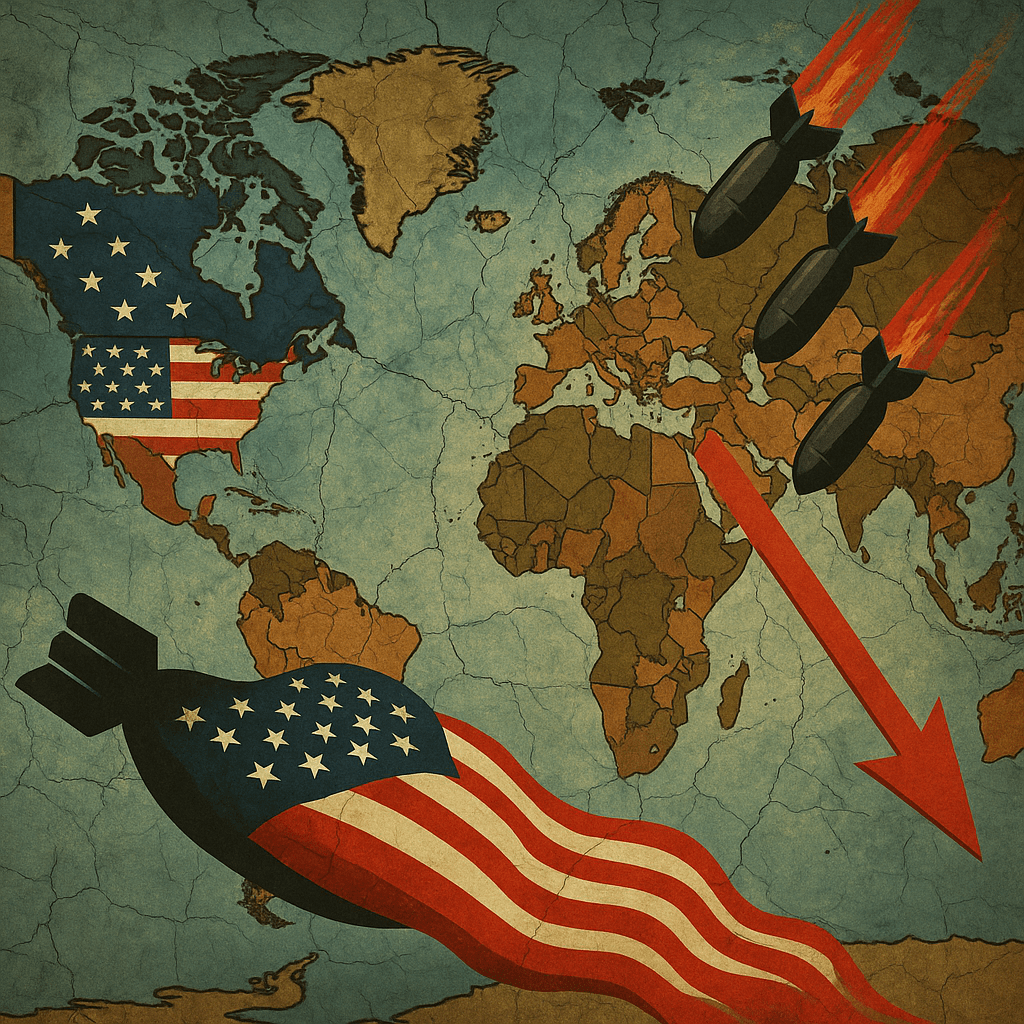
America Falls in the Global Peace Index, But the Story Behind the Numbers Remains Untold
By Prince Kapone | Weaponized Information | October 26, 2025
Rankings Without Responsibility: How a Peace Index Becomes a Weather Report
KTLA’s “U.S. ranks among the least peaceful nations in 2025” reads like a calm forecast for storm season: numbers, arrows, and a little drizzle of concern. The United States is placed at 128 out of 163—behind South Africa, Kenya, and Uganda—while Iceland sits on top like a high-pressure system and Russia anchors the bottom like a cold front. The article carries the tone of neutral science: the world is “less stable,” peacefulness “declined 0.36%,” and conflicts are “more internationalized.” What we never get is the engine under the hood. Violence appears as weather, not policy; turbulence as nature, not decision.
The narrative is built from stacked rankings and tidy percentages. By aggregating the United States with “87 countries that became less peaceful,” the piece dilutes particular responsibility into a global blur. The move is subtle but effective: place the U.S. on a long list, wrap it in averages, and the reader is guided to see a general problem, not a specific role. The moral temperature is lowered through statistics—harm is a bar chart, not a body count.
The diction is antiseptic. “Ongoing conflict,” “militarization,” “state-based conflicts,” “stability”—terms that evacuate agency. Wars don’t have authors; policies don’t have architects; weapons don’t have manufacturers; they exist as passive conditions, like humidity. By stripping verbs of accountable subjects, the prose performs ideological dry-cleaning: stains out, fabric crisp, nothing to see.
Authority is laundered through the metric. The Institute for Economics & Peace is treated as a neutral instrument, a ruler held up to the planet. The article lists “23 qualitative and quantitative indicators” and three “domains,” which reads like instruction manual prose: precise enough to feel technical, vague enough to escape scrutiny. The authority flows from the appearance of measurement, not from any confrontation with why the world is measured this way in the first place.
Comparative framing does a second job. After noting the U.S. slip, the text immediately gestures to the usual rogues’ gallery at the bottom—Russia, Ukraine, Sudan, DRC, Yemen—by which the reader is nudged to scan elsewhere for the source of disorder. Western and Central Europe is still the “most peaceful region,” we’re told, even as its peacefulness “has declined for four consecutive years.” The trick is familiar: domestic turbulence is normalized, external spaces are dramatized, and the core remains the reference point of sanity.
Time is handled like a dimmer switch. We’re told this is the “13th deterioration in 17 years” and that conflicts today “are less likely to end through traditional means.” The phrasing produces inevitability without inquiry. Decline becomes a background condition. History is converted into a trendline, not a chain of choices. You can almost hear the shrug: that’s just how things are now.
Even the tonal staging works to numb. The article moves briskly from rankings and regional notes to a stray newsroom insert—an unrelated headline about a hospital abuse lawsuit—before snapping back to the index’s bottom five. The effect is cable-scroll ambience: crisis as content, content as wallpaper. When everything is news, nothing is accountable.
In the end, the piece performs three linked maneuvers. First, it normalizes U.S. placement through aggregation and statistical coolness. Second, it depersonalizes violence by removing agents from actions, turning wars into weather. Third, it recenters legitimacy by outsourcing judgment to a metric presented as self-evident. What’s left is a story where peace is a number, war is a climate pattern, and the reader is invited to worry without asking who built the storm.
What the Numbers Don’t Say: Establishing the Factual Ground
The KTLA report highlights that the United States is ranked 128th out of 163 countries on the 2025 Global Peace Index, and notes a broader trend of declining global stability. It cites figures showing that global peacefulness fell by 0.36% this year, that 87 countries became less peaceful, and that there are now 59 active state-based conflicts, the highest number since World War II. These claims are consistent with findings from the Institute for Economics & Peace, which publishes the index, and the article presents them as indicators of a world growing more violent and unpredictable.
However, the article provides no factual context for understanding the material conditions that shape these outcomes. To establish that context, certain well-documented realities must be introduced. The United States is, by every major accounting, the world’s largest military spender, responsible for about 40% of all global military expenditure according to data from SIPRI. It also maintains the single largest overseas military footprint on Earth, with more than 877 bases spread across at least 95 countries. In addition, the United States is the leading global exporter of weapons, accounting for 43% of all arms transfers worldwide. These are not interpretations or arguments—they are measurable structural facts that directly shape the international environment the Peace Index attempts to quantify.
Another major factor absent from the KTLA narrative is the role of economic coercion. The United States is the most sanction-intensive state in the world, with Treasury Department records showing that U.S. sanctions now affect nearly one-third of the global population. Meanwhile, military alliances led or heavily influenced by Washington continue to expand their activities, especially NATO, whose recent posture shifts in Eastern Europe and the Asia-Pacific have intensified geopolitical flashpoints. These developments are part of the same global landscape referenced by the Global Peace Index, yet the KTLA article omits them entirely.
Another critical omission in the KTLA narrative is the indirect violence carried out by U.S.-backed client states, whose military power and political immunity are sustained through American financing, weapons transfers, and diplomatic protection. Israel is the single largest cumulative recipient of U.S. foreign military aid, receiving billions annually from the U.S. State Department to arm its ongoing assault on Palestinians. The UN Independent International Commission of Inquiry on the Occupied Palestinian Territory has determined that Israel is committing genocide in Gaza, and UN human rights experts have accused Israeli forces of carrying out “genocidal acts,” as documented by the UN Human Rights Office. The scale of civilian killing and destruction has been extensively recorded by Human Rights Watch, all while U.S.-supplied weapons and U.S. diplomatic protection ensure Israel’s assault continues without accountability. In Central Africa, U.S.-aligned regimes such as Rwanda have also received military support and training through AFRICOM, even as UN investigators have documented Rwandan involvement in atrocities and resource-looting in the Democratic Republic of the Congo, as reported by Human Rights Watch. These cases show that U.S. militarism operates not only through its own forces, but also through client states that act as regional enforcers, extending the reach of U.S. power through proxy violence.
The article also gestures toward global instability without providing broader empirical context. The United Nations reports that armed conflict and political violence have displaced more than 114 million people worldwide, based on findings from the UNHCR. Armed conflicts have increasingly drawn in external states, with more than half of today’s wars involving foreign military participation. At the same time, the world is undergoing a measurable geopolitical reconfiguration, including expanding cooperation among the BRICS countries and a documented shift in global economic weight, trends noted in reporting from the CFR and the International Monetary Fund. These realities do not interpret the KTLA narrative—they simply complete the picture it gestures toward.
Taken together, the verifiable facts show that contemporary conflict patterns exist within an international system shaped by unprecedented levels of militarization, foreign intervention, displacement, internationalized warfare, and geopolitical restructuring. By restoring these missing elements, we can now establish a complete factual baseline from which deeper historical and political analysis can proceed. Section III will take up that task.
Violence by Design: Reframing Disorder in a World Built by Empire
If we take the facts as they stand, a different picture emerges from the one presented by KTLA’s neutral arithmetic. The United States is not just another country caught in a storm of rising instability. It is the world’s dominant military spender, the world’s largest arms merchant, the planet’s only nation with hundreds of foreign bases, and the chief sponsor of militarized alliances that project force across continents. These facts, taken together, reveal that global “disorder” is not an accident of history or an outcome of mysterious geopolitical weather patterns. It is the inevitable byproduct of an international system built to enforce U.S. primacy through military and economic power.
The post–World War II order codified this structure. With Europe shattered and colonial empires collapsing, Washington positioned itself as the guarantor of a new global stability—one that rested on open markets abroad, resource access for U.S. capital, and a permanent military footprint to secure both. The long arc of the Cold War, followed by the unipolar moment after the Soviet collapse, only deepened the pattern: when persuasion failed, bases, bombs, sanctions, and alliances filled the gap. Peace in this system meant compliance. Conflict, rebellion, or sovereign development meant instability, intervention, or punishment. None of this context appears in KTLA’s narration of rankings and percentages, yet it is the skeleton beneath every statistic the article cites.
When we understand this structure, the Global Peace Index reads differently. The KTLA article treats violence as a dispersed condition, but the factual baseline demonstrates concentration, not diffusion. The world’s leading military power is also the central node in the global arms trade, the core of the largest military alliance in history, and the chief administrator of sanctions that immiserate populations on multiple continents. In a world where one state holds this position, instability does not arise from many equal actors making chaotic choices—it radiates outward from a hierarchy that compels nations to align, submit, or resist under threat. The map of today’s conflicts mirrors the map of yesterday’s interventions.
This framework also clarifies why KTLA’s narrative leans so heavily on abstraction. To describe violence without describing power is to imply that no one is responsible. By describing an international crisis without naming the architecture that produces it, the article reduces war to climate—tragic, unpredictable, and ungovernable. But war is governed. Death is governed. Displacement is governed. The scale of today’s conflict, the spread of militarization, and the hardening of global fault lines all flow through the same command centers, boardrooms, bases, and alliance structures that Section II’s factual record exposed. The absence of these forces in the KTLA article is not a minor oversight. It is the mechanism that protects the ideological core of U.S. foreign policy: the notion that, despite its power, America is never the cause—only the concerned observer.
From the standpoint of the global working class and the colonized nations, the meaning of this landscape shifts again. What appears as “instability” from the top often appears as resistance from below: nations refusing dictates, peoples refusing occupation, societies refusing to be instruments of someone else’s wealth. The index collapses all of this into a single measure of peacefulness, blurring the difference between violence inflicted to dominate and violence wielded to break domination. A drone strike and an uprising occupy the same mathematical space. The slaveholder’s whip and the slave’s revolt would score similarly in such a system.
Meanwhile, the multipolar developments emerging in the world economy—whether through new alliances, currency arrangements, or development blocs—do not represent random fluctuations in geopolitics. They represent the material attempts of nations to escape a system that has historically delivered war, sanctions, coups, and underdevelopment as the price of disobedience. KTLA’s narrative treats multipolar shifts as irrelevant background noise. The factual record shows they are central to the story of why today’s order is cracking.
Once these dynamics are made visible, the contradiction becomes clear: the very state most responsible for global militarization is ranked as merely “less peaceful,” as though its role were incidental rather than foundational. The Global Peace Index, filtered through media like KTLA, invites us to lament the temperature of the world while ignoring the furnace. Section II established the empirical terrain. Section III reveals the structure beneath it. The violence being measured is not accidental. It is administered.
From Exposure to Struggle: Peace as a Question of Power
If the architecture of violence is global, then so too must be the movement that dismantles it. The KTLA narrative invites us to mourn statistics, to shake our heads at instability, to hope the numbers go down next year. But peace has never arrived through handwringing. Peace has arrived only when the people who suffer war, sanctions, occupation, austerity, and extraction organize power strong enough to confront the systems that rule them. Around the world, that struggle is already underway. From the anti-NATO mobilizations across Europe, to the movements resisting sanctions in Cuba and Venezuela, to the mass uprisings defending Palestinian life, to the workers and students in the United States who refuse to let empire speak in their name, millions are refusing the script that the Global Peace Index quietly normalizes. The index measures the temperature; the people are fighting the fire.
The truth that Section III exposed is simple: violence is not a moral failure of humanity. It is a political instrument of empire. Which means peace is not a plea — it is a confrontation. Every base, every bombing campaign, every sanction regime, every weapons shipment, every foreign intervention requires vast systems of consent, obedience, and silence. Breaking that machinery begins where people live: in communities, schools, unions, streets, and networks that refuse to be managed by someone else’s fear. Across the Global South, nations are attempting to reclaim sovereignty through multipolar alliances that weaken the grip of a single military center. Their struggle is not abstract. It is a material fight to breathe, trade, develop, and live without a boot at the neck. Their resistance opens new space. But space is not freedom unless the people fill it.
In the United States and across the imperial core, the responsibility falls on those who live inside the engine room. It is not enough to denounce war while remaining politically idle. Movements must align themselves with those who resist empire abroad and those who suffer it at home. That means joining and building anti-war organizations that target the military-industrial complex, supporting sanctions solidarity campaigns that break economic sieges, strengthening independent media that expose the narrative war, and organizing workers, tenants, students, and communities in struggles that weaken the state’s capacity to rule through violence. Peace is not won by asking the powerful to behave. It is won by making their violence ungovernable, unprofitable, and unsustainable.
The multipolar world taking shape will not guarantee justice on its own. It only creates the conditions in which justice becomes possible. Whether that possibility becomes reality depends on us: the exploited, the excluded, the dispossessed, the working classes of every nation, the peoples whose lives are treated as statistics in reports like the one KTLA reproduces. A world that measures peace without confronting empire tells us everything about the system we are fighting. A movement that confronts empire without fear will tell the world something different: that peace is not the absence of conflict, but the presence of liberation. The task is immense, but history has never required permission from the powerful. It has only required that the oppressed decide to stand, link arms, and move.
 Weaponized Information
Leave a comment