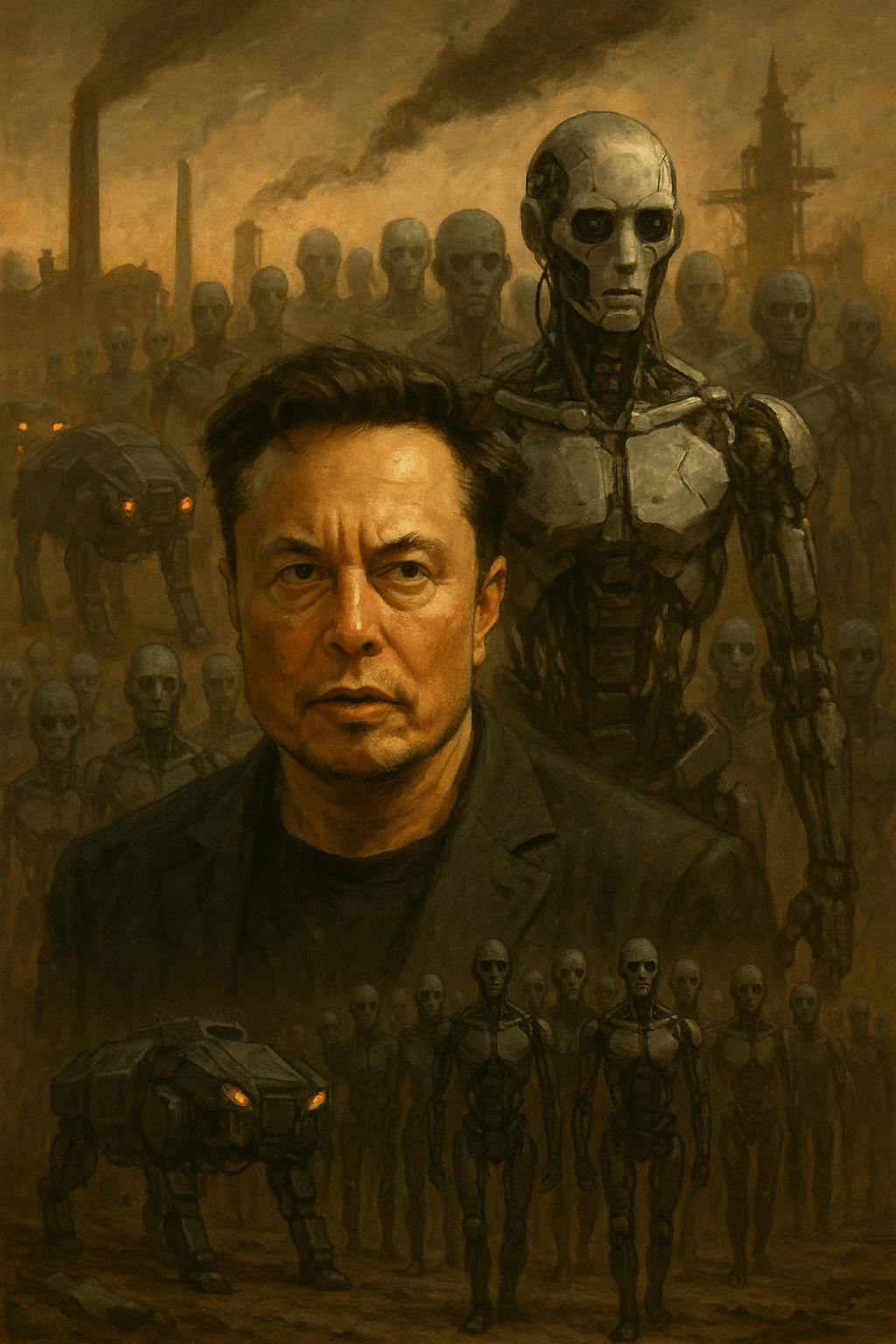
WIRED sells a billionaire’s fantasy of mechanical salvation. The real future being built is one of private power, automated exploitation, and global resistance.
By Prince Kapone | Weaponized Information | October 24, 2025
“Strong Influence” Over a Robot Army: How WIRED Sells the Future as Common Sense
Aarian Marshall’s WIRED piece (Oct. 22, 2025) packages Elon Musk’s latest earnings-call soliloquy into a tidy parable about tomorrow: Tesla isn’t just cars, it’s artificial intelligence, software, and “world-shaking robots.” The article opens with the hook—Musk wanting “strong influence” over a coming “robot army”—and then walks us through his valuation dreams, his pay package ambitions, and his promise that Optimus will make work optional and poverty obsolete. The cadence is familiar: sensational line, glossy vision, mild skepticism, soft landing. Like a good stagehand, the copy keeps the spotlight on the star while the machinery of the narrative does its quiet labor in the wings.
First, the framing elevates Musk as the horizon of possibility. His posts and call quotes drive the plot: a $20 trillion fantasy valuation, a trillion-dollar compensation vote, a million robotaxis, a million humanoids—metrics as myth. The prose treats his goals as the measure by which reality must be judged, even when they sit on stilts. The article notes the conditions, the “if he hits” caveats, but those hedges function like velvet ropes: they dress the claim without ever blocking the entrance. The reader is nudged to accept the premise that these numbers are a relevant way to think about human futures. It’s the oldest trick in business journalism: let the CEO’s scale set the scale of the story.
Second, the piece leans on visionary benevolence to neutralize the menace baked into the phrase “robot army.” Musk is quoted promising an end to poverty and universal access to surgical skill, asserting that work will become a quaint hobby like growing your own vegetables. The utopia is offered in the broadest, most frictionless strokes, and the article allows those strokes to stand as self-evidence. The menace is domesticated by cafeteria cameos—Optimus serving drinks, dancing, playing rock-paper-scissors—like a cop in a community baseball game. Call it charm offensive journalism: the scary words are wrapped in popcorn and a smile.
Third, the narrative tucks its skepticism into safe corners. We hear that earlier demos were tele-operated, that humanoid hands are hard, that internal production targets were dialed down, and that “production-intent” might arrive next spring. These caveats are honest, but they are also carefully placed. They don’t challenge the central arc—that the robot future is coming and that this man is the courier—they merely caution that the delivery may run late. The temporal move is subtle: when you treat delay as the story, inevitability becomes the assumption you never had to argue.
Fourth, the article’s structure performs a quiet moral laundering. Revenue dreams (“infinite money glitch”) live side by side with promises of universal care. The proximity itself does the ideological work. If the money machine funds the miracle, then greed and grace walk hand in hand. The copy doesn’t have to say that outright; it simply places the quotes in sequence and lets the reader stitch the halo. Meanwhile, the phrase “strong influence” over a “robot army” is presented as a corporate governance concern—can he be ousted later?—rather than a political question about private claims to power over systems that could govern labor, safety, and everyday life. By translating power into voting control, the horizon of the conversation shrinks to boardroom etiquette.
Fifth, the piece deploys the spectacle economy to smooth over the contradictions. The Tesla Diner, the shots of Optimus doing chores, the rock-paper-scissors bit—these are not incidental details; they are narrative sedatives. They make the extraordinary feel domestic, transforming social reorganization into product demo. The reader is invited to be a customer in a theme park where history is a showroom and power is a subscription tier. Even the mention that past robots were remotely operated lands as a charming glitch rather than a warning label; the show goes on, and we are thanked for our patience.
Finally, the article’s silences are as loud as its quotes. The piece flags hurdles—hands, forearms, timelines—but leaves unspoken the human questions that the “robot army” formulation throws in our faces. Who gets to decide what work becomes “optional”? Whose bodies are displaced, disciplined, or disposable when a million general-purpose laborers are rolled onto the shop floor? What is the chain of command when private “influence” extends over machines that move through public life? These are not “gotcha” facts to be corrected; they are absences that shape the reader’s sense of what counts as a reasonable concern. By omitting the social stakes, the story encourages us to see a political project as an engineering challenge, and to meet power with curiosity rather than scrutiny.
This is how the piece works: it borrows urgency from Musk’s most theatrical phrase, mutes its teeth with convenience-store utopia, balances the awe with manageable caveats, and lands on calendars and prototypes instead of conflicts and control. The result is smooth and readable, like a brochure written by someone who believes in punctuation. It never has to lie; it only has to groom the horizon—tilting our expectations until a private man asking for “strong influence” over a “robot army” feels like a reasonable chapter in a quarterly report. That is the craft on display here. The copy doesn’t tell us how to think; it arranges the room so thinking walks where it’s told.
The Material Terrain Behind the Hype: What the Article Says—and What It Buries
The WIRED article throws a glossy coat of paint over a handful of surface-level facts about Elon Musk and Tesla’s newest dreamscape. We’re told Musk wants more voting power at Tesla; that humanoid robots are now a core product; that shareholders will vote on a massive compensation package; and that this Optimus project will supposedly transform labor, healthcare, and everyday life. These claims form the skeleton of the piece. But before we can understand what’s really at stake, we have to strip the narrative down to its bare components—free of the hype, spectacle, and futurist stage lighting.
Here are the article’s main factual assertions: Musk wants Tesla to dominate artificial intelligence and robotics, not just electric cars; he is seeking a pay package worth up to $1 trillion over the next decade; the goals attached to that payout include producing one million robotaxis, 20 million electric vehicles, one million Optimus humanoids, and reaching an $8.5 trillion valuation; Musk claims Optimus will end poverty and revolutionize labor; and he insists he must maintain “strong influence” over Tesla’s voting structure to secure this robotic future. The article also notes engineering hurdles—hands and forearms that don’t yet work, scaled-back goals, and production delays. All of this aligns with the public record found in Tesla’s investor communications. But listing a billionaire’s promises and projections without examining the world they enter is not journalism—it is transcription.
And here’s where WIRED’s omissions speak louder than its inclusions. There is no mention of the global automation race or the class consequences that come with it. The International Federation of Robotics has already mapped the explosive growth of industrial robots—particularly across East Asia. In that context, Optimus is not the dawn of a new age—it is one weapon in a crowded geopolitical contest. Nor does WIRED mention the most basic truth about poverty: the International Labour Organization shows, decisively, that poverty is the outcome of exploitation, not a shortage of machines. Musk’s promise to “eliminate poverty” through robots is a fairytale; WIRED repeats it without ever asking why poverty exists in the first place.
When Musk demands “strong influence” over his robot army, WIRED treats it like a simple matter of boardroom housekeeping instead of a social threat with profound implications for democracy and labor. This framing erases the documented dangers of concentrating technological power in private hands. Research has already shown how tech corporations are asserting control over digital infrastructure and public-facing systems, beyond democratic oversight. At the same time, decades of automation have displaced workers, depressed wages, and intensified exploitation, particularly in logistics, manufacturing, and service sectors. Yet none of this material reality appears in WIRED’s narrative. Instead, capital’s power is naturalized, and the working class—the people whose lives are most immediately reshaped by automation—is erased from the story entirely.
The omissions continue in healthcare. Musk claims robot surgeons will deliver universal medical care, yet the World Health Organization shows that billions lack access to basic services because of privatization, austerity, debt, and underfunded public systems—not because the planet ran out of surgical hands . WIRED lets a fantasy stand in for a crisis with known, measurable causes. That is not harmless—it is ideological work on behalf of the system that created the crisis.
Even on robotics itself, WIRED narrows the frame to consumer spectacle and investor optimism. Boston Dynamics, Honda, Hyundai, and military robotics programs are already reshaping logistics, policing, and warfare. DARPA’s own archives make clear that robotics has long been tied to militarization and state power. By erasing this, WIRED hides the real historical trajectory of automation: it has been built to control labor, territory, and populations—not to fold our laundry and make us tea.
Finally, the article erases workers entirely. Around the world, workers are fighting algorithmic exploitation and job displacement—from Amazon warehouse campaigns to global legal strategies against digital management. Yet in WIRED’s future, the working class does not resist, organize, or even exist. The only actors are CEOs, gadgets, and investors. In other words: history without people.
What we are left with, then, are two layers. The first layer—WIRED’s layer—is a tight collage of Musk’s claims, timelines, and corporate aspirations. The second layer—the one WIRED buries—is the world those claims will collide with: the political economy of labor, the global contest over technology, the history of exploitation, and the struggles of people who refuse to be replaced or erased. Without the second layer, the first is propaganda. And without both layers, we cannot honestly ask what a “robot army” means—not for shareholders, but for the working class and the oppressed who will live under its shadow.
Reframing the Horizon: Automation, Power, and the Machinery of a New Imperial Order
Once the smoke of WIRED’s corporate futurism clears, the terrain looks very different from the brochure version of tomorrow. The facts extracted in Section II show a world not on the brink of techno-liberation, but on the cusp of intensified struggle. Musk’s “robot army” is not an innocent gadget fantasy—it sits at the crossroads of automation, empire, and capital. If we follow those facts to their logical conclusions, a different story emerges: one where automation accelerates the concentration of power, where private control over robotic systems substitutes for democratic control over human labor, and where the future of work, wealth, and sovereignty is decided not by the many, but by the few. In this story, Musk is not a quirky inventor—he is a representative of a class project already in motion.
The first contradiction is between the article’s utopian promises and the documented reality of global inequality. If poverty exists not because of a lack of machines but because of the way wealth is produced and distributed, then a million robots do not overturn that system—they deepen it. Automation under capitalism has always served one fundamental purpose: to reduce labor costs, discipline workers, and expand profit. The global data on automation’s impact on warehouses, factories, and logistics show the same pattern: as machines enter, workers are squeezed, monitored, or discarded. Musk’s guarantees of freedom from toil sound poetic, but capitalism does not invest trillions to make labor optional—it invests to make labor obedient or unnecessary. The WIRED narrative treats machines as neutral saviors; the facts reveal them as instruments shaped by whoever owns them.
The second contradiction sits at the level of power. Musk insists he needs “strong influence” over his robotic future, and WIRED casually frames this as a corporate governance question. But the facts we have show automation expanding not just in factories, but in militaries, police functions, logistics chains, and critical infrastructure. When machines occupy those spaces, control over robots becomes control over life itself. That is not a shareholder issue—it is a political question of sovereignty. The omission of DARPA’s history, global automation competition, and the well-documented link between robotics and state security is not accidental. To acknowledge those realities would force the reader to confront the stakes: that private capital is positioning itself as a governing force above nations, above workers, and above democratic accountability. What the article shrinks to a boardroom issue is in truth a question of power at a civilizational scale.
The third contradiction is about who disappears in this vision of the future. The facts show workers organizing against algorithmic control, unions fighting automated exploitation, and billions lacking basic rights and services because of political and economic structures—not technological limitations. Yet the WIRED narrative imagines a future without workers, without class struggle, without social conflict, as though history ends when a robot folds laundry. This erasure is essential to the propaganda: to sell the fantasy, the human beings who stand in contradiction to it must be written out. The article replaces the working class with machines and replaces struggle with speculation. But the facts reassert themselves: there is a global contest underway—not between robots and poverty, but between capital and the people whose labor makes society run.
The final contradiction is geopolitical. Automation is not unfolding in a vacuum; it is part of a global race over production, logistics, and sovereignty. The IFR data, the military robotics programs, and the international expansion of automated industry show that the future is being built atop the old foundations of empire and competition. The WIRED story treats Musk’s horizon as universal, but the factual context shows automation as a weapon in an unequal world system. When capital and the imperial core control the machines, they control the chokepoints of economic life. The beneficiaries are not “humanity”—they are the same powers that already command the heights of the global economy.
Once we reassemble the facts without WIRED’s narrative scaffolding, the meaning clarifies: automation under capitalism does not transcend exploitation, it reorganizes it. The “robot army” is not a metaphor—it is the emerging machinery of a system that seeks to rule more efficiently, extract more ruthlessly, and suppress resistance with fewer risks. The future Musk envisions is not a post-scarcity democracy; it is an automated empire with a private engineer at the helm and the rest of us written out of the script. The task before us is not to debate whether robots will come—it is to decide who they will serve, and at whose expense. That is the real horizon, and the working class must enter the picture not as spectators, but as protagonists.
From Exposure to Struggle: Building Power Against the Automated Empire
Now that the mask has slipped, the task is no longer to argue with the fantasy—it is to organize against the project behind it. The facts show that automation, under the command of private capital, is being built as a weapon: against workers, against democratic control, and against the sovereignty of nations struggling to develop outside the imperial core. The only meaningful answer to this is collective power — not nostalgia for old forms of labor, not blind rejection of technology, and not passive awe before billionaire futurism. The question is not whether robots will exist, but who will command them, and toward what end. If we accept a future where the machines serve profit, we accept a future where human beings serve the machines.
Around the world, people are already resisting the terrain Musk and WIRED take for granted. Tech workers are beginning to revolt against the industries they are trapped inside, from walkouts at major firms to organizing drives among programmers and warehouse workers who refuse to build tools of their own dispossession. Rank-and-file union campaigns — from Amazon Labor Union on Staten Island to logistics workers in South Africa and Europe — are demanding control over the technological transformations of their workplaces. These are not symbolic gestures; they are the early forms of a new battlefield, where workers fight not just for higher wages, but for the right to shape the future itself.
At the international level, a parallel struggle is unfolding. Nations in the Global South are building new blocs, pursuing technological sovereignty through South–South cooperation, BRICS-aligned infrastructure, and public investment in domestic scientific development — resisting the old pattern where the imperial core monopolizes innovation while the rest of the world pays tribute. Whether in communications satellites launched by Latin American states, African campaigns for data autonomy, or Asian industrial strategies that refuse Silicon Valley’s leash, the message is the same: technological power must not be left in the hands of billionaires and their military partners.
What does this mean for us — for workers, tenants, students, and organizers in the heart of empire? It means the fight must be waged on three fronts. First, we must strengthen rank-and-file labor movements and support any organizing effort that challenges automated exploitation, algorithmic management, and the replacement of human dignity with machine supervision. Second, we must build and fund independent institutions of media, research, and political education capable of exposing and resisting the merger of corporate technology and state power. Third, we must forge ties of solidarity with anti-imperialist movements abroad, refusing to let our struggles be isolated inside national borders while capital and its machines operate globally.
The billionaire press wants us to believe the future is already written. But the future is not a product Musk can unveil onstage. It is a terrain of class struggle, geopolitical struggle, and human struggle. The so-called “robot army” will serve whoever commands society’s power — and that power is not immutable. Workers have shut down ports, factories, and industries before. Sovereign nations have broken empires before. The choice before us is the same choice our ancestors faced in different form: submission or struggle. If the machines are coming, then so is our response. And if capital intends to automate our dispossession, then we must automate our resistance — through organization, solidarity, and a vision of a world where technology serves humanity, not the other way around.
 Weaponized Information
Leave a comment