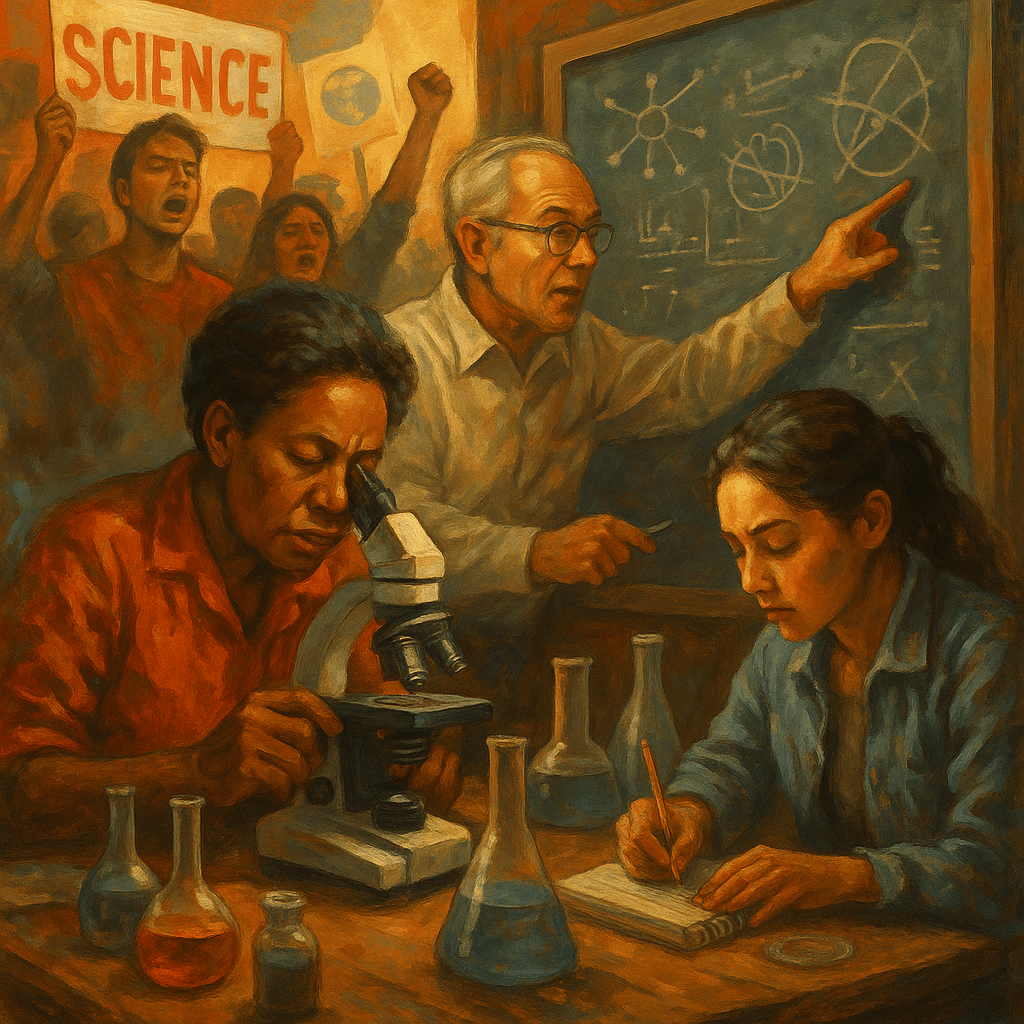
How the Associated Press’ “anti-science” investigation conceals an imperial civil war over who controls knowledge—and how the global working class can reclaim it.
By Prince Kapone | Weaponized Information | October 23, 2025
How AP Stages “Science Under Siege”
The Associated Press wants you to know that science is under attack. It tells this story in the familiar key of American moral drama: level-headed reporters, sober “experts,” and a besieged public squaring off against a swarm of irrational activists who, we are told, have flooded statehouses with more than four hundred anti-science bills. The script is crisp. The villains have names, the heroes wear lab coats, and the narrator—AP itself—stands above the fray as guardian of the realm of fact. Our job in this opening is simple: read the text as it is written and listen for the gears turning beneath the sentences.
The article opens with a numerical blast—“more than 420 bills”—before we meet a single human being. That is not an argument; it is a drumroll. By starting with a number large enough to feel like a stampede, the piece manufactures urgency first and explanation later. Within a few lines, the narrative assigns roles: people “with close ties” to Health Secretary Robert F. Kennedy Jr. are advancing measures that “attack longstanding public health protections,” while unnamed “experts” counter them. The word “anti-science” appears again and again like a liturgical response, not a definition. It does not need to prove its case; it needs to echo until it feels true.
The structure is moral theater. We are walked from legislative counts to organizational choreography—the Zoom calls, the email floods, the testimony days—so that mobilization itself feels suspicious. The organizers speak, but their sentences arrive pre-neutralized: almost every quote from the accused is immediately escorted offstage by the line “many experts disagree.” It is a clever bit of stagecraft. The reader is permitted to hear the defense, but not to dwell on it. The authority of “experts say” returns like a metronome to keep the tempo steady and the doubts brief.
Then comes the tightening of the heart. A child’s death is introduced near the middle of the piece, after the anti-science procession is firmly established. The placement is doing work. Grief becomes a hinge that quietly fuses two ideas—legislation and loss—without ever stating a causal chain. The story does not need to say “A caused B.” It only needs to make “A beside B” feel like “A therefore B.” That is how sadness is turned into a syllogism.
The language polishes the drama. Policies the authors favor are “science-based,” while those they disfavor “undermine,” “roll back,” or “pose dangers.” Supporters of the bills “claim” and “deny,” while critics “note” and “find.” This is not accidental grammar; it is a hierarchy of verbs. “Claim” is what you do when you have an opinion; “find” is what you do when you have the truth. By the time we reach the closing paragraphs, the article’s cadence has taught us who gets which verbs and why.
There is also the choreography of sources. Organizations aligned with the bills are grouped and labeled as networks with “growing clout,” a phrase that drips menace without needing evidence beyond quantity. Meanwhile, the piece repeatedly assures us that “clear medical evidence” backs the protections under attack, yet the evidence itself remains offstage. The appeal here is to institutional trust, not to the substance of the debate. Authority is invoked, not demonstrated, because the point is to stabilize the reader’s faith in who should be believed, not to persuade through contested detail.
Notice, too, the article’s sense of closure. After pages of “anti-science” alarms, the narrative turns toward its own masthead. “Independent journalism, powered by you,” it reminds us. The donation ask is not a stray footer; it is a final binding spell that sutures support for the outlet to allegiance with “facts.” The brand and the truth are welded together in a single gesture, and the reader is invited to defend both with a contribution. In this way the investigation investigates itself: the text constructs a crisis, assigns roles, conducts a brief morality play, and exits with a call to fund the custodian of reason.
Read on these terms—on the page, in its voice—the article is less a neutral inventory than a tightly framed parable. It relies on scale to create alarm, on repetition to create reality, on grief to create causality, and on institutional voice to create authority. That is the work of the prose. We do not correct facts here; we mark how the story is built. The excavation ends where the scaffolding shows: a tidy world in which “science” speaks with one voice, dissenters speak in scare quotes, and the narrator is the last honest broker left on earth.
What the Story Doesn’t Tell: Mapping the Real Terrain of the Anti-Science Offensive
Once the dust of moral outrage settles, we can look at the ground the Associated Press refused to map. Its investigation stops at the surface—tallying bills on vaccines, fluoride, and raw milk—without tracing the political economy or institutional machinery driving them. What appears as a patchwork of eccentric crusades is, in fact, a coordinated restructuring of how knowledge itself is governed in the United States. The first step is to separate the verifiable from the invisible, the reported from the omitted, and then to build a factual picture broad enough to hold both.
The AP’s count of roughly more than 420 bills introduced across all fifty states is accurate as a measure of volume but deceptive in scope. The legislation does not end with health regulations; it extends deep into the schoolhouse and the federal bureaucracy. In twenty-six states, lawmakers have introduced or advanced over 70 bills and policies aimed at censoring higher-education curricula and classroom science instruction. Tracking by the Silencing Science Tracker shows multiple state bills allowing teachers or districts to question the validity of evolution or climate-science standards. A 2025 Pew-derived survey found only 33 % of Americans believe humans evolved purely through natural processes—a dramatic marker of the epistemic divide fueling this legislative wave.
These classroom battles are not isolated moral panics; they are the cultural wing of an economic project. Years of austerity and voucher expansion have drained public-school budgets while subsidizing private Christian academies, shifting public funds into sectarian education under the banner of “school choice.” In states such as Texas, Florida, and Ohio, voucher growth coincides with legislative attempts to curtail scientific curricula. The goal is not merely to debate the content of science but to privatize its transmission—replacing secular instruction with theological certainty funded by taxpayers.
The second tier of this architecture operates at the federal level. The Heritage Foundation’s Project 2025: Mandate for Leadership — The Conservative Promise, a nine-hundred-page transition manual prepared for a second Trump term, outlines a plan to reengineer the federal government from the top down. The document calls for sweeping changes to science and research policy, including major reductions in climate- and health-related programs across agencies such as the EPA, NIH, and CDC, and the consolidation of science oversight directly under the Executive Office. Reporting by The Guardian describes the project’s intention to strip job protections from tens of thousands of career civil servants through a revived Schedule F executive order. Analysis by Protect Democracy confirms that up to 50 000 federal workers could be reclassified and removed under this scheme. A Center for American Progress report further details how Project 2025 seeks to centralize all federal science communication, giving the White House near-total control over what counts as official knowledge. Together, these initiatives constitute an unprecedented attempt to fuse political loyalty with scientific authority — transforming evidence into an instrument of rule.
This is not the first time Heritage has written a script for the state. The 1980 version of Mandate for Leadership guided the Ronald Reagan administration’s assault on environmental regulation and deregulation. Meanwhile, the George W. Bush era’s “Faith-Based & Community Initiative” folded evangelical organizations into government contracting and sidestepped secular oversight. Project 2025 completes the trilogy by merging technocratic command with theological discipline — an epistemological counter-revolution packaged as administrative reform.
The deeper contradiction appears in the data that the Associated Press never cites. Analyses from the Congressional Budget Office and the Federal Reserve Bank of Dallas show that immigration and STEM labor are key engines of U.S. economic growth. A detailed study by the Institute for Defense Analyses found that foreign-born STEM workers contributed roughly 1.7 to 1.9 percent of total U.S. GDP in 2019, while data from the American Immigration Council show that immigrants made up more than 23 percent of the nation’s STEM workforce. Yet the same legislatures rolling back vaccine mandates are advancing laws that restrict visas for foreign researchers and students—undermining the very scientific labor force on which U.S. industry depends. What looks like populist rebellion is, in practice, the empire sawing through its own foundation.
Historically, this pattern is familiar. The Scopes Trial of 1925 exposed the clash between scientific education and religious orthodoxy at a moment when industrial capitalism sought cultural control over a rapidly modernizing society. The anti-communist purges of Cold War laboratories in the late 1940s and 1950s similarly targeted scientists and intellectuals under the guise of national security, dismantling independent inquiry in the name of political conformity. The Reagan-era “creation science” crusades again weaponized religion and populist rhetoric to erode secular science curricula, serving both corporate deregulation and evangelical revivalism. The new wave follows the same rhythm but operates across a broader terrain—public health, classrooms, and federal agencies—united by overlapping funding networks and a shared rhetorical playbook. The anti-science bills that the Associated Press tallies are therefore not isolated local aberrations but coordinated experiments in a national campaign to subordinate evidence to authority and inquiry to obedience.
When read against these absences, the Associated Press article functions like a keyhole view of a house on fire. It shows the smoke curling out of the windows but refuses to turn the handle and see the blaze inside. The verifiable record reveals a coordinated attempt to reshape how knowledge is produced, taught, and authorized—from county health boards to the executive branch itself. The omissions are not oversights; they are the blind spots of a media class that cannot afford to recognize the scale of the structure collapsing around it.
The Empire’s Civil War Over Knowledge
The story that the Associated Press tells—of a nation drifting away from reason—only begins to make sense when set against the long arc of imperial decline. Once the facts are gathered—the school bills, the Project 2025 directives, the economic data—they trace a single line through the history of U.S. capitalism: every time the empire reaches the limits of its expansion, it turns inward and attacks the very knowledge systems that made it powerful. The crisis is not a “war on science” led by a few demagogues; it is a war within the ruling class over who will control science, who will define truth, and who will profit from both.
In the early twentieth century, the U.S. state elevated scientific management to organize industry and empire. From Taylorism and Fordism to the Manhattan Project and NASA, science became the secular priesthood of capital. But each boom contained its backlash. The 1925 Scopes Trial was not about Darwin—it was about an industrial working class being disciplined by small-town moralism. McCarthyism, in the 1950s, was not simply paranoia—it was the purge of intellectual independence during the Cold War’s militarized reconstruction. Today’s anti-science legislation follows the same pattern: a knowledge system forged in service of profit now collides with a social order that can no longer sustain it.
The contradiction lies in the structure of late imperial capitalism itself. The United States remains the command center of a global network of laboratories, data centers, and defense contractors that depend on advanced research. Yet its political legitimacy rests on a mass base trained to see that same research as alien, elitist, and sinful. One wing of the ruling bloc—the financial, technological, and military elite—needs the instruments of science to compete with rising powers. The other—the evangelical and nationalist base—needs the myth of a holy nation persecuted by cosmopolitan elites. Trump’s coalition stitches them together by offering each what it craves: for the elite, deregulated control of scientific production; for the base, symbolic revenge against the secular modern world.
Project 2025 translates this unstable alliance into bureaucratic form. Its proposals to purge federal agencies of career scientists and to redirect research toward “Biblical values” are not aberrations—they are the institutional language of this marriage between capital and faith. The plan envisions an America where the market owns the laboratories and the church blesses the results. It is a vision of rule where knowledge flows upward as intellectual property and downward as revelation. The state no longer mediates between reason and belief; it fuses them into an instrument of control.
The statehouse bills attacking evolution and climate science play their part in this machinery. They are the grassroots rehearsals for the same logic: replace evidence with authority, debate with decree. In the classroom, that means “academic freedom” to teach superstition as science. In the bureaucracy, it means “administrative freedom” to dictate policy by ideology. Each prepares the population for obedience to power that no longer pretends to be rational.
This internal war over knowledge is also an international one. As U.S. hegemony wanes and multipolar centers of innovation emerge—from Beijing’s state-planned laboratories to Havana’s cooperative medical research—the empire’s managers face a problem of legitimacy. They can no longer claim to be the universal custodians of scientific progress, yet they cannot imagine power without that claim. The answer, for them, is to nationalize truth: to make “American science” synonymous with loyalty, and to treat dissenting or foreign research as heresy. The same press that laments “anti-science populism” at home will cheer export bans, tech sanctions, and intellectual property wars abroad. The banner of science still flies, but it flies over a fortress.
From the standpoint of the global working class and the colonized nations, this contradiction opens a different horizon. The issue is not whether the United States believes in science, but whose science it believes in. There is the science of profit, which measures progress in patents and missiles. There is the science of people, which measures progress in health, soil, and solidarity. The first demands obedience to capital; the second demands liberation from it. The anti-science movement is the grotesque mirror of a system that long ago divorced knowledge from human need.
The Associated Press calls this crisis “a danger to liberty.” It is half right. It is not liberty that is in danger—it is the liberty of capital to dictate what counts as knowledge. The empire’s laboratories and its pulpits now compete to speak for God. But beneath their quarrel, a quieter truth is taking shape: science, stripped of empire, still belongs to humanity. The question is whether humanity can reclaim it before the empire burns the libraries to keep its myth alive.
Reclaiming Science, Rebuilding Solidarity
The Associated Press ends its story with a plea to “defend facts.” We end ours with a plea to defend people—the scientists, teachers, and communities who keep producing knowledge even as the state turns against them. The contradictions we have uncovered are not abstract. They cut through the everyday lives of millions: the nurse told to work without vaccination mandates while her hospital cuts staff; the public-school teacher punished for teaching evolution; the climate scientist silenced by a gag order; the immigrant researcher whose visa is frozen in the name of “national security.” The anti-science movement thrives on their isolation. The first act of resistance is to connect them.
Across the country, small circles are already doing this work. The volunteer epidemiologists of the People’s CDC continue to publish community health data long after federal reporting collapsed. Union scientists have organized within the Union of Concerned Scientists Rank-and-File Network to defend research integrity and workplace democracy. Teachers’ coalitions like Educators for Social Justice and the Freedom to Learn Network are linking curriculum freedom to the fight against privatization. These are not think tanks; they are laboratories of solidarity.
Beyond U.S. borders, the map of possibility widens. Cuba’s public-health workers continue to share vaccine technology through open cooperation rather than patents. China’s renewable-energy scientists train students from the Global South in state-funded institutes. The BRICS Open-Science Platform, launched in 2025, is building digital commons for data sharing outside Western control. Each of these efforts grows from the same recognition: that scientific progress divorced from human equality becomes barbarism dressed in white coats.
What, then, can be done from within the belly of the empire? We start where the contradictions are sharpest. In workplaces, defend scientific labor from political purges—form unions that protect researchers, teachers, and health workers targeted by the coming wave of “ideological audits.” In communities, create cooperative science hubs: small labs, open classrooms, citizen research collectives where working people can test water, map pollution, or trace infection chains without corporate permission. In universities, organize campaigns to cut ties with weapons contractors and pharmaceutical monopolies that turn knowledge into property. And across borders, build alliances with the scientists of the Global South through open data exchanges and joint study programs that break the monopoly of English-language publication and U.S. patent law.
These actions are not charity; they are the groundwork for a new internationalism. To rebuild science as a common good is to rebuild the solidarity that empire has spent a century destroying. Every grassroots lab, every classroom that resists censorship, every shared dataset that crosses the border of sanctions is a small act of decolonization. They prefigure a world in which the right to know and the right to live are the same thing.
The ruling class has already chosen its path: to preserve power by burning the archives, censoring the classrooms, and blessing ignorance in the name of God and country. Our task is to choose the opposite. We defend the curiosity that built every tool and every poem our species has ever made. We defend the working class that keeps the hospitals open, the power plants running, and the students learning. We defend the idea that knowledge belongs to everyone. Against the empire’s war on understanding, we answer with solidarity and creation—the science of the people, for the people, in service of the planet we share.
 Weaponized Information
Leave a comment