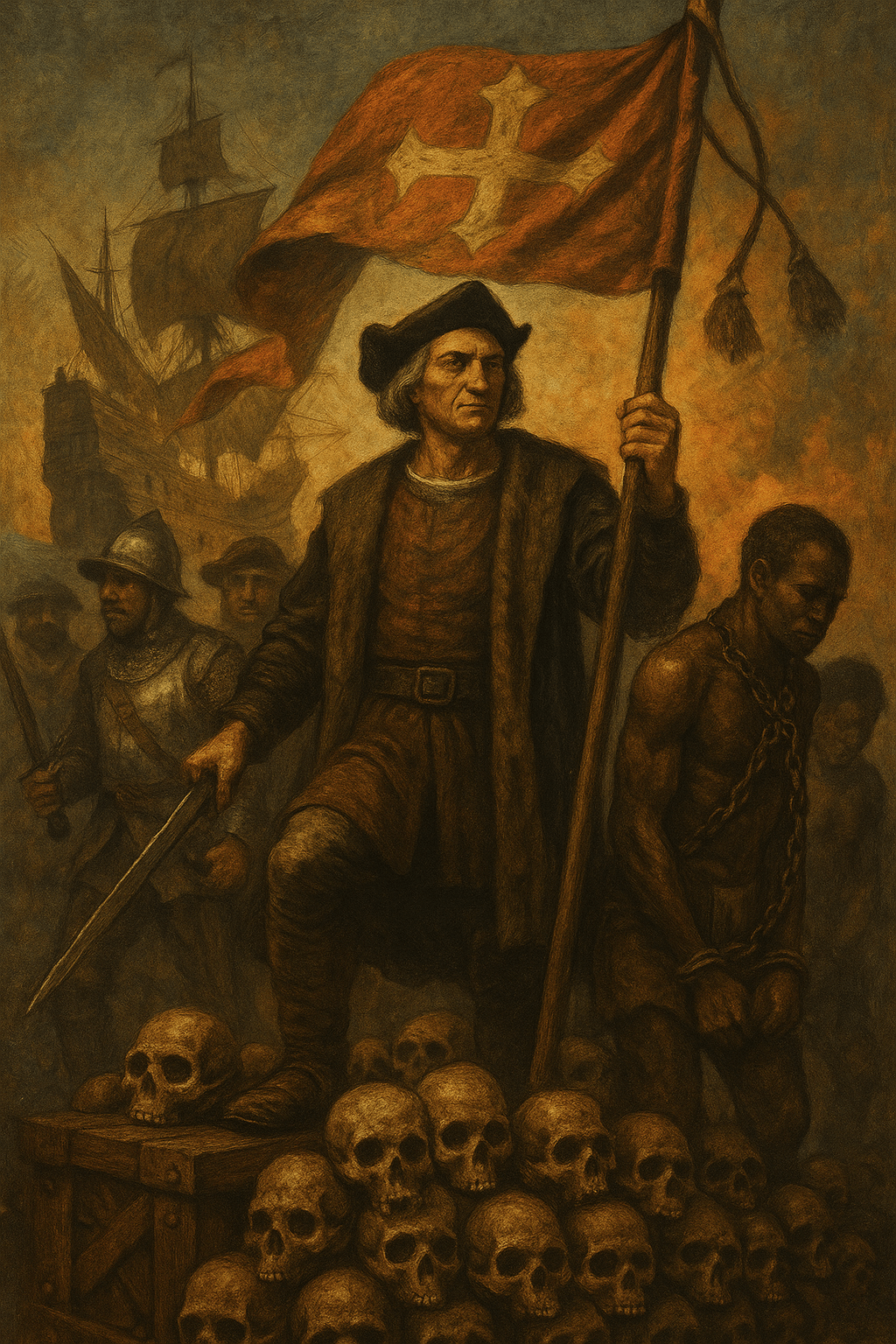
This “Columbus Day,” we bring you a special edition Weaponized Intellects Book Review that turns the holiday inside out with John Henrik Clarke’s Christopher Columbus and the Afrikan Holocaust—a revolutionary autopsy of empire. Clarke tears apart the myth of “discovery,” exposing how Europe’s feudal decay and capitalist hunger fused into genocide, slavery, and global plunder. This review weaponizes his analysis against the colonial lies that still haunt the left and the world today, reminding us that capitalism was born in chains—and will die the same way.
By Prince Kapone | Weaponized Information | October 13, 2025
Clarke Opens Fire: Tear Down the Myth, Name the Crime
From the opening pages of Christopher Columbus and the Afrikan Holocaust, Clarke strips the sugarcoat off the word “discovery” and shows us the iron underneath: conquest, chains, and a ledger book fattened on African lives. Columbus isn’t a sailor with a dream—he’s the quartermaster of genocide, the man who helps refit Europe’s feudal wreck into a global pirate ship. Clarke writes like a teacher with calloused hands and a revolutionary’s patience: no jargon, no sentimental lies. Just the truth, loaded and aimed.
He names the era and the crime in the same breath. The Columbus Era isn’t a story of brave men and blue oceans—it’s the opening act of the Afrikan Holocaust. Millions stolen, millions murdered, whole civilizations broken into ballast for Europe’s climb out of poverty. The point is not to mourn politely; the point is to understand the engine. Capitalism wasn’t born in a workshop—it was born in the hold of a ship. It learned to walk on the auction block, learned to count in sugar and cotton, and learned to speak through the whip. That’s the origin story Clarke shoves back into the schoolbooks they kept white and clean.
And he does what the liberal historian and the Western Marxist both refuse to do: he centers the colony, not the factory. The liberal sings hymns to Columbus and calls it “civilization.” The Western Marxist rewrites the same fairy tale with smarter footnotes—capitalism as a tidy European family drama, born of “internal contradictions,” politely ignoring the plantation that fed the mill. Clarke breaks the spell. No Africa, no Europe. No slavery, no surplus. If you erase the colony, you erase the truth—and you leave the ruling class with its favorite alibi.
Don’t place this in a museum. Look around. The Columbus system didn’t retire; it rebranded. The cross and flag became the NGO and the loan. The conquistador put on a suit. Gaza is disciplined in the name of “security.” Congolese children pull cobalt for our “smart” future. Refugees drown while Europe holds another conference on human rights. The script is the same: plunder wrapped in moral language. Clarke’s insistence lands like a hammer—Columbus is not a statue, he’s an operating system.
So he writes like a man who loves his people enough to be hated for telling the truth. History, for Clarke, is not a hallway of portraits; it’s a war map. Columbus is not a chapter heading; he’s the gate through which white world supremacy marched onto the world stage carrying ledgers and guns. You can either keep polishing the gate—or you can blow the hinges. Clarke picks the latter and hands us the charge. In our time, with technocrats managing hunger and algorithms sorting life from death, his lesson isn’t a metaphor. It’s a method: name the crime, smash the myth, follow the money, and take the side of the people who bleed. If theory can’t do that, it belongs to the other side.
Naming the Crime: The Afrikan Holocaust
Clarke does not waste ink on politeness. In the introduction, he names the system by its true name: the Afrikan Holocaust. He refuses the cowardly euphemisms of textbooks that call it a “trade,” a “discovery,” or a “migration.” It was genocide, planned and executed on a continental scale. A holocaust that ripped millions from their land, annihilated entire cultures, and laid the foundation stones of Europe’s wealth. Clarke reminds us that this was not incidental or accidental—it was policy, it was structure, it was the birth cry of capitalism itself.
The lie of “discovery” is dismantled with precision. What Columbus “discovered” was not a new world, but new victims. Africa and the Americas were not empty or waiting; they were full of people, nations, civilizations, and histories. What Columbus brought was not knowledge but terror—an organized system of robbery, enslavement, and extermination that the West still dares to call progress. Clarke forces us to stare at the truth: Europe did not discover the world, it declared war on it.
This act of naming is revolutionary. To call it the Afrikan Holocaust is to refuse the colonizer’s grammar and to insist that the crimes against African people be remembered in the same register of world-historical atrocity as those Europe never lets us forget. Clarke exposes the double standard: monuments, museums, and textbooks sanctify Europe’s dead, while Africa’s dead remain unmarked. This is not oversight—it is design. Because to memorialize Africa’s genocide would be to indict Europe’s civilization at its root.
And this, comrades, is where the struggle of the past becomes the struggle of today. Gaza under siege, Sudan starved by sanctions, Haiti strangled by debt—all are chapters of the same unfinished book. The Afrikan Holocaust is not over; it has been digitized, militarized, and globalized. The ships became drones. The whip became the algorithm. The chains became the World Bank loan and the prison sentence. Clarke’s introduction is not a history lesson—it is a siren. It tells us that if we do not name the crime in our own time, we are destined to live it again in more sophisticated chains.
Western Marxists choke on this truth. For them, colonialism is a footnote, slavery an unfortunate preface to the “real” story of class. Clarke tears that script in half. He reminds us that you cannot speak of capitalism without speaking of the colony, and you cannot speak of freedom without confronting the holocaust that made Europe rich and left the Global South in ruin. To name the Afrikan Holocaust is to draw the battle line with clarity: between those who excuse the crime and those who will fight to end its continuation.
The Gathering Storm: Europe’s Crisis Becomes the World’s Catastrophe
Clarke’s first chapter is more than background—it’s an X-ray of Europe in the fifteenth century, a continent fractured and clawing at survival. Europe was not the confident center of civilization it pretends to have been. It was a debtor, a backwater, a crisis-ridden patchwork of kingdoms gnawing at each other’s throats. The so-called “Age of Discovery” was born from desperation, not genius. Clarke pulls back the curtain and shows us a Europe starved of gold, drained by feudal collapse, divided by religious strife, and cut off from the wealth of Asia by Ottoman power. It was this storm of contradictions—not curiosity—that launched Columbus into the Atlantic.
He explains how Portugal and Spain, small kingdoms on the edge of Europe, gambled on maritime expansion as a way to leapfrog their stronger rivals. Their rulers were not visionaries but gamblers, backed by monarchies nearly bankrupt from endless wars and propped up by a Catholic Church desperate to reassert its power. Clarke details the papal bulls that sanctified conquest, legal documents that read like criminal contracts: licenses to enslave non-Europeans, dispossess whole continents, and baptize robbery as salvation. In these documents we see the birth of the legal and ideological infrastructure of white supremacy.
Clarke digs into the class contradictions inside Europe itself. The old feudal order was collapsing, aristocrats bleeding peasants dry while merchants demanded new markets. The Black Death had shaken Europe’s economy and workforce. Revolts from below threatened the fragile balance of power. The ruling classes needed a release valve, a way to redirect their crises outward. Overseas conquest became that outlet. Columbus’s voyage was not a heroic adventure; it was a desperate maneuver by Europe’s elites to export their contradictions onto the rest of the world.
And Clarke reminds us of another crucial fact: Europe was behind. The Islamic world, China, and Africa were far more advanced in science, trade, and wealth. Europe’s hunger was not for discovery but for theft, a shortcut to leap from provincial poverty to global power. The “gathering storm” was not an inevitable triumph of European civilization—it was the last gamble of a civilization on the edge of collapse, saved only by turning outward and preying on others.
This chapter is where Clarke’s brilliance shines because it demolishes the smug Eurocentric myth that Europe was destined to rise. He shows instead how fragile and contingent it all was. Had Africa, Asia, or the Islamic world not been destabilized by war and internal contradictions of their own, Europe might have remained a marginal player in world history. Columbus’s voyage was not the dawn of progress but the outcome of a continent exporting its crisis.
Today we can see the same storm clouds gathering again. A declining West, wracked by debt, inequality, political decay, and ecological collapse, once more looks outward for salvation. It raids the Global South through debt traps, sanctions, and drone strikes. It weaponizes NGOs and social media instead of papal bulls, but the purpose is the same: to resolve its own contradictions by displacing the costs onto the rest of the world. Clarke’s “gathering storm” was the fifteenth century’s crisis; ours is technofascism in the twenty-first. Different sails, same logic.
Western Marxists, of course, rarely mention this storm. They narrate capitalism as if it was born cleanly in the workshops of Europe, as if the contradictions of feudalism evolved into capitalism without conquest. Clarke shows us the truth: Europe could not solve its contradictions internally, so it externalized them through colonialism. That is why Columbus mattered. That is why the storm that launched him was not just weather—it was a world-historical crime. And that is why Clarke insists that the real birthplace of capitalism was not Europe alone but the shattered villages of Africa and the enslaved plantations of the Americas.
Africa Before the Chains: Civilizations Erased by Lies
Before the slave ships, before the auction blocks, before Europe began its centuries-long theft, Africa was not a blank slate. Clarke insists on this with righteous clarity. Africa was not a “dark continent” waiting for discovery—it was a world of civilizations, trade networks, universities, and empires that dwarfed much of Europe in sophistication. From the Nile Valley to Timbuktu, from Mali to Songhai, Africa was already connected to the global flow of commerce and culture. Gold, salt, science, medicine, and philosophy were not Europe’s gifts to Africa—they were Africa’s gifts to the world.
The myth of a primitive, empty Africa is the colonizer’s most enduring lie. It provided the excuse for enslavement and conquest, the ideological grease for the ships’ chains. Clarke refuses to let this lie stand. He reminds us that the very Europe which later enslaved Africa was, in the Middle Ages, dependent on African and Arab science to climb out of its own darkness. The library at Timbuktu put Europe’s monasteries to shame. The kingdoms of West Africa ran thriving economies when much of Europe was still clawing at the dirt. This was the world Europe had to destroy in order to rise.
Clarke’s point is not to romanticize a golden past but to expose the crime with its full weight. Africa was not lifted by slavery; it was bled. Its trajectory was not accelerated by European contact; it was violently derailed. Every story of Africa as “undeveloped” begins not in truth, but in the colonial erasure of what was already there. This erasure continues today every time Africa is described as a continent of poverty rather than a continent impoverished by five centuries of theft.
The lesson is clear: when you erase a people’s history, you erase their claim to dignity and power. That is why textbooks still talk of Africa as a place “without history” before Europe’s arrival. It is why Western Marxists, trapped in Eurocentric frameworks, talk about capitalism’s birth without ever mentioning the civilizations it destroyed to get there. Clarke’s intervention here is decisive. He restores Africa’s voice before the chains, so that the world can never again pretend it was mute.
Today, the same colonial lie is alive in new form. The IMF and World Bank speak of “bringing development” to Africa, as if the continent had never known it. Silicon Valley vultures speak of “connecting Africa” as if Timbuktu’s scholars had not been writing treatises while Europeans still burned witches. Clarke forces us to see the continuity: the lie of emptiness is not a mistake—it is a weapon. It justified the slave trade then; it justifies resource plunder now.
By recovering Africa before the chains, Clarke gives us more than history. He gives us a shield against the ideological war that still tells the colonized they have no past worth defending and no future worth building. He reminds us that Africa was whole before Europe broke it, and that memory itself is a battlefield. To forget is to surrender. To remember is to fight.
New Enemies Disguised as Friends
Clarke pivots in this chapter to expose one of empire’s oldest tricks: the colonizer never arrives announcing conquest. He comes smiling, cloaked in friendship, bearing trinkets, treaties, and crosses. At first, Europeans approached African kingdoms as merchants and allies, asking for trade, requesting passage, offering gifts. But behind the gestures was a dagger. The so-called friendships were foot in the door operations, early rehearsals of the betrayals that would define centuries of European expansion.
Missionaries preached salvation while scouting land for conquest. Traders promised wealth while laying the groundwork for plunder. Diplomats talked of peace while preparing for war. Clarke reminds us that Europe’s empire was not built on brute force alone—it was built on deception. And deception requires performance. The performance of friendship was the colonizer’s opening act, the mask he wore to soften resistance until it was too late.
The pattern is unmistakable, and it has never stopped. The United States does not bomb a country without first offering “aid.” The IMF does not shackle a nation with debt without first sending in its consultants promising partnership. NATO does not invade without first promising to protect. Clarke shows us the lineage: the handshake that conceals the shackle. What was true in the fifteenth century is true in the twenty-first. Empire always sells itself as your friend before it reveals itself as your master.
For Clarke, the lesson is not academic but strategic. He wants his readers to recognize the disguise when they see it. To understand that colonialism was never just a matter of guns and ships—it was also a matter of words and masks. The empire that smiles at you is more dangerous than the empire that bares its teeth, because it disarms you before the fight begins.
And here again Western Marxism stumbles. So obsessed with its own internal debates, it rarely recognizes this masquerade. It takes the rhetoric of “development,” “democracy,” or even “human rights” at face value, never asking whose hands are hidden behind the curtain. Clarke will not allow such naiveté. He tells us plainly: the colonizer in disguise is still the colonizer. To trust him is to invite your own destruction.
What Clarke arms us with in this short but cutting chapter is an instinct—a revolutionary radar for deception. Empire cannot be taken at its word. Its smiles are traps, its gifts are debts, its friendships are occupations in waiting. To survive, the oppressed must see through the mask and prepare for the blow that always follows. In our world of NGO missionaries, Silicon Valley saviors, and liberal allies who recoil at revolution, this lesson is as urgent as ever.
The Birth of Chains: The Slave Trade Emerges and Expands
With Chapters Four through Seven, Clarke turns the knife into the heart of Europe’s self-made myth. Here he lays bare the crime in full: the transatlantic slave trade was not a tragic accident, not an unfortunate detour in history, but the central engine of modern capitalism. These chapters are the marrow of the book, and Clarke lingers on them because the devastation demands it. He does not let us look away, and neither should we.
He begins with a retrospective. The slave trade must be seen not as a side story but as the main story of Europe’s rise. It was not an economic afterthought but a deliberate design, crafted to supply Europe with the labor it could not compel at home. The plantation was not an accessory to capitalism—it was its foundation stone. Clarke is explicit: without the blood and sweat of enslaved Africans, Europe would have remained a provincial peninsula on the edge of Asia, begging for scraps. The so-called “miracle” of Western civilization was nothing more than organized theft.
Clarke dismantles the tired propaganda that Africans “sold themselves” into slavery. Yes, collaborators existed—no system of domination operates without them. But this narrative is a lie designed to absolve Europe of guilt. The trade was imposed by force, by trickery, by destabilization of African societies, by wars fueled and armed by Europeans for the purpose of extraction. Africa was set aflame by a fire it did not start, and the smoke still chokes us today. To repeat the lie of voluntary African participation is to repeat the colonizer’s alibi. Clarke smashes it with precision.
In “The Time of Troubles,” Clarke details the chaos unleashed across the continent. Once-stable kingdoms buckled under the weight of European intervention. Villages were burned, populations scattered, wars multiplied. The social fabric of Africa was deliberately torn apart so that human beings could be captured and sold like livestock. This was not just physical destruction but cultural sabotage, a ripping of memory and tradition that still scars African societies. Europe did not just steal bodies; it stole futures.
Then comes the chapter that no reader escapes unscathed: “Sorrow in a New Land.” Clarke forces us into the hull of the ship, into the suffocating terror of the Middle Passage. Shackled, starved, brutalized, Africans were packed tighter than cargo, many never surviving the voyage. Those who did were thrown into an alien world where their humanity was systematically denied. Clarke describes the horror not to shock but to indict. The “New World” was built on the graves of the stolen, its wealth measured in human misery. The Americas were not discovered—they were desecrated.
These chapters are where Clarke’s indictment is strongest, and where our responsibility to weaponize his history is clearest. The slave trade was the prototype of globalization. It was the first supply chain, a system of extraction and profit that stretched across continents, enriching the few while devastating the many. And it continues. The mines of Congo where children dig for cobalt to feed Silicon Valley are the new slave ships. The sweatshops of Bangladesh, the prisons of the United States, the fields where migrant laborers collapse from heat—these are the modern plantations. The pattern remains: wealth for the metropole, suffering for the periphery.
Western Marxists reduce slavery to a footnote, a prelude to the “real” story of industrial capitalism. Clarke refuses. He shows us that slavery was not peripheral but central, not archaic but modern, not outside capitalism but its beating heart. To erase this is to protect Europe from its greatest crime. To remember it is to understand that the fight against capitalism has always been a fight against colonialism, against white supremacy, against the ongoing holocaust of the colonized.
Clarke does not write these chapters to produce guilt. He writes them to produce clarity. And clarity is the weapon we need. Because when we understand that the modern world was built on chains, we can also understand that breaking those chains is not metaphorical—it is revolutionary necessity.
Exile and Plantation: Forced Migration in the New World
Clarke moves from the capture to the aftermath, from the chains of the Middle Passage to the fields of the Americas. Chapters Eight and Nine confront the reality of forced migration as more than just displacement—it was a deliberate depopulation of Africa and a mass transplantation of labor designed to build Europe’s wealth overseas. Millions of African men, women, and children were uprooted not simply as bodies in motion but as the raw material of a new global economy. This was not migration; it was removal. It was not work; it was slavery. And it did not just reshape Africa and the Americas—it reshaped the entire world.
Clarke insists that we see this forced migration for what it was: the largest and most brutal labor transfer in human history. Whole regions of Africa were emptied, their populations siphoned off to fuel Europe’s plantations. The so-called “New World” was built as a prison camp in open air, a vast economic machine powered by African muscle and African death. Sugar, cotton, tobacco—all the commodities that lined the pockets of Europe’s merchants—were watered with blood. Clarke strips away the illusion of “progress” and shows us the economic logic that made genocide profitable.
He also exposes the dialectic of underdevelopment and overdevelopment. As Walter Rodney would later echo, Africa was underdeveloped precisely because Europe was overdeveloped. The two processes were inseparable. Europe’s wealth did not emerge in isolation—it was stolen, transferred, extracted, and consolidated at the direct expense of Africa. For every plantation built in the Americas, an African village was destroyed. For every mansion in London or Lisbon, there was a graveyard in the Congo or Angola. Clarke makes clear: capitalism did not just happen—it was engineered through this brutal imbalance.
What emerged in the New World was not simply slavery but a total system of domination. Enslaved Africans were stripped of names, languages, cultures, and kinship, forced into a new identity defined entirely by property relations. They were not just workers without wages—they were living capital, units on a balance sheet. Clarke insists that we understand this system not as a deviation from capitalism but as its purest expression. In the plantation, the capitalist dream was fully realized: maximum profit extracted from human beings reduced to things.
The parallels today are unavoidable. The global supply chain that stretches from African mines to Asian factories to American consumers is the descendant of this forced migration. The undocumented migrant in the fields of California, the sweatshop worker in Dhaka, the prisoner in Louisiana sewing uniforms for pennies—these are the inheritors of the plantation. Clarke does not let us mistake history for the past. The system has changed its appearance but not its essence. Forced migration continues, repackaged as globalization, as refugee crises, as the precarious labor that props up the imperial core.
Western Marxism once again fails here, treating slavery as a temporary aberration on the way to the “real” story of the European proletariat. Clarke will not allow it. He centers the enslaved, the displaced, the uprooted, and insists that they are not margins but core. To tell the story of capitalism without them is to tell a lie. To fight capitalism without them is to fight a ghost. These chapters sharpen the point: the struggle of the enslaved and the colonized is not an adjunct to class struggle—it is the heart of it.
Clarke’s voice is not mournful—it is urgent. He is not asking us to remember as an act of charity but as an act of strategy. Because the same system that stole Africa’s children five centuries ago is still stealing lives today. And unless we recognize the plantation in its modern disguises, we will continue to live in its shadow.
The Broader Dimensions of the Crisis
By Chapter Ten, Clarke shifts the lens outward. He has shown us the capture, the passage, the plantations, the devastation of Africa and the Americas. Now he demands that we see the slave trade not as a regional catastrophe but as a world-historical turning point. The transatlantic system was not simply a brutal episode of human suffering—it was the foundation of the modern world. Capitalism itself, the system we still breathe, was baptized in the blood of enslaved Africans.
Clarke argues plainly: slavery was not feudalism’s leftover, it was capitalism’s debut. The ships, the banks, the insurance companies, the ports—these were the arteries of a new global economy. London and Amsterdam did not grow rich because of ingenuity; they grew rich because of chains. The industrial revolution was not a miracle of European genius—it was the direct outcome of African bodies worked to death in fields thousands of miles away. Every machine in Manchester hummed to the rhythm of a whip cracking in the Caribbean. Clarke shows us the connection Western history hides: Europe did not rise despite slavery, it rose because of it.
This chapter is also where Clarke sharpens his indictment of Eurocentric theory. He ridicules the idea that capitalism can be understood apart from colonialism, that the story of the factory can be told without the story of the plantation. He exposes the hypocrisy of Western Marxists who obsess over the European proletariat while ignoring the fact that the first and largest proletariat of the modern world was enslaved, racialized, and scattered across colonies. For Clarke, to separate class from colonialism is not just bad analysis—it is betrayal.
The broader crisis is not only economic but civilizational. By making slavery its foundation, Europe infected the entire modern order with a contradiction it has never resolved: the contradiction between the universal claims of freedom and the particular reality of racial domination. This contradiction echoes still in every U.S. constitution that declares liberty while building prisons, in every European declaration of human rights that coincides with bombing campaigns in Africa and Asia. Clarke insists that this is not hypocrisy but logic—the logic of a system that needs lofty ideals to mask blood-soaked reality.
And he warns us: the crisis is not past. The plantation may have been abolished on paper, but the structures it birthed remain. Debt peonage, mass incarceration, wage slavery, forced migration—all are updated forms of the same system. The global poor are still shackled, only now the shackles are less visible, hidden in contracts, interest rates, border walls, and biometric scanners. Clarke’s insight here is prophetic. What he called the “Afrikan Holocaust” has not ended; it has simply modernized.
For us in 2025, the broader dimensions of the crisis mean technofascism, climate apartheid, and endless war. The same ruling class that once trafficked Africans now traffics in data, resources, and debt, all while ensuring that the costs fall hardest on the Global South. The names change, the uniforms change, but the logic is the same. Clarke’s chapter is a call to recognize this continuity and to reject the comforting lie that the system has evolved into something more humane. It has not. It has only become more sophisticated.
By placing slavery at the center of the story of capitalism, Clarke does more than correct history. He arms us with clarity. And clarity, for the oppressed, is a weapon. It tells us that to fight capitalism we must fight colonialism, and that to fight colonialism we must fight capitalism. They are not separate fronts—they are the same battlefield. This is the lesson Western Marxism still refuses to learn, and the lesson we must never forget.
When Will the Afrikan Holocaust Be Memorialized?
Clarke ends his book with a challenge that still burns. He asks when the world will finally recognize and memorialize the Afrikan Holocaust with the same weight and solemnity it grants Europe’s tragedies. He is unsparing: the absence of monuments, the absence of reparations, the absence of honest education about slavery and colonialism are not oversights. They are deliberate acts of erasure. Because to fully memorialize the Afrikan Holocaust would mean to indict the very civilization that still rules the world.
This is not about guilt, nor is it about mourning as charity. Clarke insists it is about power. The refusal to remember is itself a weapon of empire. It keeps Africa’s dead anonymous, Africa’s history invisible, Africa’s demands for justice muted. Meanwhile Europe never stops sanctifying its own losses, building museums and holidays and curricula that center its suffering. The message is clear: some victims are remembered because their memory strengthens empire, while others are buried because their memory would expose it.
Clarke warns that a new form of slavery could emerge—more sophisticated, less visible, but just as devastating. In 2025, we can see this warning realized. Surveillance states, debt bondage, prison labor, climate apartheid, and militarized borders are the new chains. The whip has become an algorithm, the slave ship a detention center, the overseer a drone operator. The system Clarke described did not end; it evolved. It no longer calls itself slavery, but it extracts labor, destroys communities, and disciplines whole populations with the same cold logic.
For those of us in the imperial core, especially for white revolutionaries who refuse the comfort of denial, Clarke’s challenge demands humility. This is not “our” Holocaust to claim as identity or to center as experience. It is the holocaust that made the world we live in, the crime that enriched the class we belong to, and the system we are called to betray. Our task is not to appropriate memory but to stand in solidarity with those who demand that the Afrikan Holocaust be recognized and never repeated. Our duty is to turn remembrance into rupture, to translate clarity into action, to fight so that the same system cannot continue under new names.
Clarke closes with urgency. History is not simply what happened—it is what we choose to remember and what we are forced to forget. As long as the Afrikan Holocaust remains unmemorialized, the system that birthed it remains intact. The statues of Columbus still stand, the textbooks still lie, and the empire still thrives on stolen wealth. To truly honor the dead is to destroy the system that killed them. That is the only memorial worthy of their memory. Clarke’s final words are not a call to grief but a call to struggle. The holocaust of Africa will only end when the system that began it is overthrown.
Why Clarke Matters: A Weapon for Every Revolutionary
Clarke’s book is not just African history. It is world history told truthfully, and that makes it revolutionary history. For communists, for anti-imperialists, for anyone serious about ending capitalism, Christopher Columbus and the Afrikan Holocaust is indispensable. Because if you do not understand that capitalism was born through genocide, slavery, and colonial plunder, you will misunderstand what capitalism is—and you will be disarmed in the fight against it.
This is why Clarke’s work cuts across nationality, race, and origin. For African people, it restores memory and dignity stolen by centuries of lies. For the colonized across the world, it affirms that their oppression is not a footnote but the very foundation of the global order. And for those of us in the imperial core, especially white revolutionaries, it shatters the myths we were raised on and forces us to confront the price paid for the privileges we live among. Clarke teaches that solidarity must be material, rooted in betrayal of the empire that raised us, and loyalty to the struggles of the oppressed who have always carried the heaviest burden of capital’s rise.
Every revolutionary should read Clarke because he clears the fog left by liberal historians and Western Marxists alike. He shows us that capitalism is not simply an economic system but a global hierarchy built on stolen lives. He demonstrates that the colony is not peripheral to the story—it is central. And he reminds us that to ignore this truth is to fight with a broken weapon, striking only at shadows while leaving the enemy intact. Clarke’s history arms us with clarity, and clarity is the first step toward effective struggle.
This book is also a rebuke to the “left” that treats colonialism as secondary, that speaks endlessly of class while forgetting how class itself was reshaped by conquest. Clarke’s analysis is a direct challenge to Eurocentric Marxism, reminding us that the revolution will not be made by theory detached from struggle, but by the oppressed seizing their own destiny. That is why his work resonates not only with Africans but with the Vietnamese in their rice paddies, the Cubans in their sugar fields, the Palestinians in their refugee camps. It is the same fight, against the same system, by people who understand that liberation is not given—it is taken.
Clarke’s value lies in the fact that he does not write for academia. He writes for the people. His prose is clear, sharp, uncompromising—accessible to a worker as much as to a scholar. He models what it means to turn history into a weapon, stripping it of myth so that it can be wielded in the present. In this sense, Clarke belongs to the lineage of Rodney, Du Bois, Fanon: thinkers who never separated thought from struggle, who never flattered the empire, who never mistook analysis for action.
For communists and revolutionaries of every nation, Clarke’s lesson is simple but profound: if capitalism was built on the colonization of Africa and the Americas, then the destruction of capitalism will require the liberation of Africa and the Americas. No revolution can be victorious unless it confronts the colonial contradiction head-on. This book is not just a history of the past—it is a manual for the present, a call to remember that the struggle against empire is the struggle against capitalism itself.
That is why Christopher Columbus and the Afrikan Holocaust remains one of the most valuable texts a revolutionary can read. It does not comfort, it does not reconcile, it does not polish the myths of the powerful. It arms. It clarifies. It points the way forward. Clarke leaves us with no excuse for ignorance and no refuge in neutrality. The question his book throws in our faces is the same one history always demands: which side are you on?
 Weaponized Information
Leave a comment