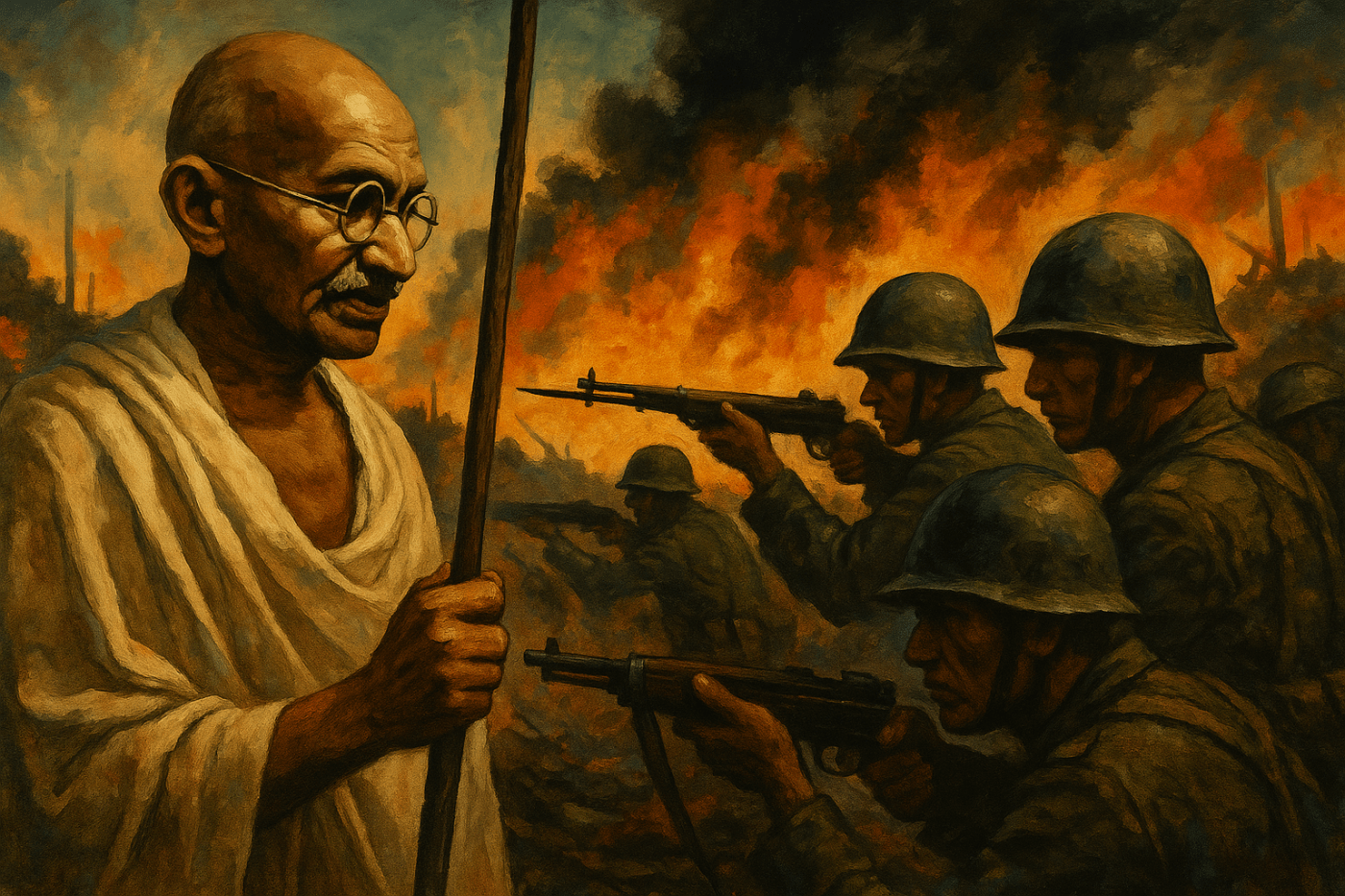
How the gospel of peace became the moral language of empire—and why revolution must reclaim it from liberal hands.
By Prince Kapone | Weaponized Intellects Book Review | October 2025
The Saints of Surrender
They tell us that peace is sacred, that if we just bow our heads and love our enemies, the world will change. They build monuments to the men who didn’t fight back—Gandhi in Delhi, King in Washington, the Dalai Lama in Hollywood—and they call this “the moral conscience of humanity.” But Domenico Losurdo reminds us that every conscience has a class character. The saints of non-violence didn’t fall from heaven; they were raised on the soil of empire, watered by guilt, and harvested by those who feared revolt more than they feared injustice. His Non-Violence: A History Beyond the Myth is not a hymn to purity but an autopsy of ideology.
Losurdo begins with a simple but heretical observation: non-violence, like every political doctrine, has a history—a history written in the contradictions of empire. The gospel of peace is not universal; it emerged from the anxious heart of Christian Europe, torn between the blood on its hands and the salvation it preached. Tolstoy’s pacifism was not born in the fields of the peasantry but in the despair of an aristocrat who had seen the abyss and wished to wash it away with moral confession. Gandhi, heir to both empire and Tolstoy, translated this moral anguish into a political language fit for colonial management: resistance without insurrection, dignity without power. It was genius as strategy, but tragedy as history.
Losurdo doesn’t sneer at Gandhi or King; he studies them like a dialectician studies a paradox. How could men so committed to justice end up canonized by the very order they resisted? The answer, he shows, lies in the political function of their sainthood. Non-violence works best when the empire needs to rebrand. It offers moral theater in place of revolution. It turns defiance into devotion. Every statue of a barefoot pacifist in bronze stands where a barricade might have been. Every quote about love disarms the exploited who might otherwise have learned to hate productively.
In the liberal imagination, violence belongs only to the savage and the tyrant. The policeman’s gun, the sanction strangling a nation, the factory floor wringing out a worker’s life—these are never called violent. Only the response of the oppressed earns that name. Losurdo’s scalpel cuts through this hypocrisy. He reminds us that the greatest violence of all is the slow, bureaucratic, everyday destruction called “order.” Non-violence, when divorced from its material context, becomes the moral alibi of that order. It teaches the colonized to aspire to sainthood instead of sovereignty.
To call this book timely would be an understatement. In an age where protest is livestreamed and pacified in the same breath, Losurdo’s history feels prophetic. Every NGO workshop on “strategic non-violence,” every foundation grant to train activists in “peaceful regime change,” is the latest chapter in the same long story—the weaponization of moral virtue. And yet Losurdo’s purpose is not cynicism. It is liberation through demystification. To understand how non-violence became an instrument of domination is the first step toward recovering it as a conscious, revolutionary choice—not a commandment handed down by empire, but a tactic wielded by the oppressed on their own terms.
This is where the essay must begin: not with saints, but with power. Not with moral purity, but with political clarity. Losurdo asks us to stop worshipping the symbols of surrender and start reading the world as it is—a battlefield where every idea wears a uniform. Before we talk of peace, we must know whose peace it is, who pays for it, and who is buried beneath it. Only then can non-violence be rescued from the museum of liberal virtue and returned to the arsenal of human liberation.
The Genealogy of a Myth
Losurdo traces the story of non-violence not as a moral evolution, but as an ideological mutation. What begins as a whisper in the conscience of empire becomes a chorus that drowns out rebellion. The early Christian pacifists, persecuted by Rome, spoke against worldly power; but as soon as their church fused with the empire, their peace became policy, their meekness became doctrine. The Sermon on the Mount turned into the spiritual sedative of the oppressed. “Render unto Caesar” became the first great slogan of moral disarmament. Losurdo follows this lineage like a forensic investigator, showing how every stage of its development carries the fingerprints of class rule.
By the nineteenth century, the contradictions of industrial capitalism had produced a new priesthood of peace. Count Tolstoy, trembling at the cruelty of czarist Russia, turned his disgust into a religion of withdrawal. He denounced the violence of the state yet recoiled from the organized resistance of the masses. His pacifism was an aristocrat’s repentance—a way to cleanse the soul without changing the system. Losurdo doesn’t mock him; he understands that moral revulsion without revolutionary direction becomes its opposite: paralysis. It was from this soil of guilty privilege that Gandhi drew his seed.
When Gandhi inherited Tolstoy’s mantle, he translated it from Christian guilt into Hindu metaphysics, but the class logic remained intact. His doctrine of ahimsa—non-violence as universal truth—was born in a colony whose rulers commanded the world’s largest army. To practice non-violence under British domination was not merely an ethical stance; it was an impossible wager. Gandhi’s genius lay in turning submission into spectacle, suffering into strategy. Yet Losurdo warns us not to confuse strategy with ideology. The empire saw in Gandhi a useful prophet: a man who could discipline a rebellious population while baptizing its submission in moral grandeur. Non-violence, for the colonizer, became a form of crowd control dressed as enlightenment.
Losurdo’s point is not that Gandhi was a traitor; it’s that his sainthood was constructed precisely because he was safe to sanctify. The British lion could afford to praise the lamb it had already eaten. And so, after Gandhi, the myth of non-violence took on a global life of its own. It became the moral export of a world system built on war. Hollywood would later frame it in close-ups and slow motion, NGOs would package it as “civic resistance,” and universities would teach it as a science of social change. The oppressor had found the perfect dialectical inversion: rebellion without revolution, struggle without rupture.
By unearthing this genealogy, Losurdo forces us to ask the forbidden question—who benefits when the oppressed renounce violence? The answer, as always, is written in capital letters across the ledger of history. The plantations of the Americas, the mines of South Africa, the sweatshops of Asia—none were liberated by moral persuasion. The ruling class respects only that which threatens it. Every gain the people have made—from the Paris Commune to the Cuban Revolution—was paid for in blood. To erase that truth is to erase history itself.
But Losurdo does not celebrate bloodshed for its own sake. He seeks to reintroduce materialism into morality, to remind us that peace without justice is the tranquility of the graveyard. His genealogy of non-violence is not an argument against peace, but against pacification. It is a warning to every generation that the moral vocabulary of the oppressor will always masquerade as universal truth. And it is a challenge to the revolutionary: if you wish to end violence, you must first dismantle the system that requires it. That is the true meaning of humanism—not to suffer beautifully, but to struggle consciously.
The Morality of the Master: Non-Violence and the Class Struggle
Every ruling class needs a language to conceal its violence. The landlords call their greed “order.” The factory owners call their exploitation “progress.” The imperialists call their plunder “civilization.” Into this lexicon of lies they added another jewel—“non-violence.” Losurdo shows how pacifism, stripped of context, functions as the moral ideology of the master. It condemns the slave’s uprising as barbarism while blessing the slaveholder’s whip as law. What it fears is not brutality, but insurrection. Non-violence, in its liberal form, is a weapon of class discipline aimed at the conscience of the oppressed.
Here Losurdo turns to Lenin’s demolition of Tolstoy. For Lenin, the old count was a mirror reflecting the contradictions of his age—repulsed by the cruelty of czarism but incapable of joining the collective struggle that could overthrow it. His pacifism, Lenin wrote, was the “cry of a man crushed by the contradictions of his environment,” not a solution to them. Losurdo revives this insight for our own time. The moral protester who refuses to dirty their hands in politics becomes, however unwillingly, the priest of paralysis. Every sermon against “extremism” is a hymn to property.
The working class has always been lectured on restraint. When it strikes, it is told to negotiate. When it revolts, it is told to pray. The bourgeoisie insists that change must come peacefully—meaning without cost to itself. Losurdo drags this hypocrisy into daylight. He reminds us that every so-called “peaceful transition” in history was backed by the threat of organized force. The abolition of slavery, the eight-hour day, the right to vote—none were granted by polite request. They were seized, wrested from the hands of those who swore they would never yield. To demand non-violence from the exploited is to demand their continued exploitation.
Losurdo’s argument is not a hymn to bloodshed but to clarity. Violence, he insists, is not an ethical category but a social one. The violence of the oppressed is reactive, born of necessity; the violence of the oppressor is structural, born of power. To equate the two is to erase the difference between the boot and the neck. Yet this is precisely what bourgeois morality does. It condemns the storm while praising the calm that preceded it—the calm of hunger, humiliation, and despair. In this way, pacifism becomes the highest form of complicity.
In the modern world, this logic has been refined to a science. Corporate media praise “peaceful protests” so long as they pose no real threat to capital. The moment resistance grows teeth, it is branded “terrorism.” The non-violent are televised; the insurgents are buried. Losurdo’s Marxist scalpel cuts through this theater of virtue. He restores to the concept of violence its dialectical meaning: as both the symptom of oppression and the instrument of liberation. To reject violence in the abstract is to reject the very process through which humanity has broken its chains.
Thus the question is not whether violence is moral, but whether it is necessary—and against whom it is directed. A system that feeds on human suffering cannot be reformed with compassion alone. History, Losurdo reminds us, is a slaughterhouse not because the oppressed love blood, but because the ruling class refuses to surrender its feast. The tragedy is not that revolutions are violent; the tragedy is that they must be. Only when exploitation itself is abolished will non-violence cease to be a privilege of the powerful and become a right of all.
When the Pacifists Met the Fascists
Losurdo’s history reaches its critical test in the twentieth century—the era when pacifism confronted the naked brutality of fascism and failed. The liberal dream of reason and dialogue met the cold steel of Hitler’s tanks, Mussolini’s militias, and the imperial armies that had trained them in conquest. The apostles of non-violence preached patience as the world burned. They mistook the roaring engines of war for the noise of misunderstanding. Losurdo shows that beneath their good intentions lay a deeper cowardice: the inability to grasp that peace without justice is merely organized submission.
In the years between the two world wars, “peace” became an industry. Conferences, manifestos, and petitions multiplied, while colonial slaughter in Africa and Asia continued uninterrupted. European pacifists could weep for Verdun yet ignore the Congo. Their non-violence was provincial—it defended white civilization from its own nightmares while leaving the colonized to theirs. Losurdo calls this the moral double standard of pacifism: universal in language, selective in application. Its horizon ended at the borders of empire. The same moralists who denounced Bolshevik revolution as violence cheered the imperial “civilizing missions” that starved and bombed the Global South.
The rise of fascism exposed this hypocrisy. The bourgeois pacifist, terrified of social revolution, preferred appeasement to resistance. Better to negotiate with Hitler than to arm the working class. Better to lecture the antifascists on civility than to join them in battle. Losurdo dissects this pathology with surgical precision: pacifism, when detached from the struggle against exploitation, inevitably sides with reaction. The call for peace becomes a call for order, and order is always the slogan of those who rule. In this sense, pacifism and fascism are not opposites but dialectical twins—one moralizes domination, the other militarizes it.
World War II shattered the illusion that evil could be shamed into surrender. It took the Red Army, not the Sermon on the Mount, to tear the swastika from Europe. Yet after the smoke cleared, the victors wrote a new mythology: fascism had been defeated by “the free world,” not by socialist arms or colonial uprisings. And into this myth they folded a sanitized pacifism to regulate the postwar order. The horror of the camps was turned into an argument against revolution itself: never again should humanity resort to violence—even against fascism. Losurdo identifies this as the final twist of the knife—the transformation of anti-fascism into a moral taboo against resistance.
This rebranding of pacifism would serve the Cold War perfectly. Western powers could bomb Korea and Vietnam while quoting Gandhi. They could overthrow governments in the name of peace. The pacifist vocabulary, now globalized, became an instrument of imperial legitimacy. Losurdo forces us to confront the irony: the same civilization that worshipped non-violence in theory practiced industrial violence in fact. It preached peace to the poor and sold weapons to the rich. It canonized Gandhi while assassinating Lumumba.
Through this historical lens, Losurdo’s argument cuts deep. The failure of pacifism was not merely strategic; it was ontological. It could not recognize the world as a battlefield of classes and empires because to do so would require choosing a side. And neutrality, as every colonized person knows, is a luxury of the powerful. When the fascists came, the pacifists clung to neutrality—and neutrality marched under the banner of the swastika. To defend humanity required something more dangerous than moral purity. It required partisanship.
By the time Losurdo closes this chapter, the lesson is unmistakable. Pacifism without power is surrender disguised as virtue. The oppressed cannot afford to worship peace in a world organized by war. To seek non-violence without dismantling imperialism is to negotiate with the hangman over the softness of the rope. The next phase of Losurdo’s inquiry, then, turns to the aftermath of these betrayals—to how the empire rebuilt its moral arsenal by canonizing selective saints and burying revolutionary sinners.
Sanitized Rebellion: Gandhi, King, and the Liberal Canon of Peace
By the mid-twentieth century, empire had learned its lesson. It could not outlaw rebellion outright—it could only curate it. Losurdo shows how the same powers that once condemned Gandhi as a seditionist and King as an agitator later canonized them as icons of conscience. Their images were scrubbed clean, their politics embalmed in marble and parades. The radical became respectable. The cry for land and bread was translated into the language of moral uplift. What could not be crushed by force would be neutralized by reverence.
Losurdo insists that Gandhi’s genius was tactical, not transcendental. His campaigns drew upon the masses’ capacity for sacrifice and discipline, yet the colonial administrators quickly discovered their silver lining: a movement that disciplined itself was a movement that could be managed. The empire learned to prefer moral drama to material struggle. Gandhi’s ahimsa could embarrass the empire, but it could not expel it; and once the British left, it remained as a spiritual inheritance that counseled moderation, compromise, and the rejection of revolutionary socialism. In this, Losurdo finds the enduring contradiction of non-violence: it mobilizes the oppressed but confines them within the boundaries of the permissible.
The same script was replayed across the Atlantic. Martin Luther King Jr. began his career as an organizer against segregation and economic exploitation. By the end of his life, he had condemned capitalism and imperial war itself—positions that rarely appear in the state-approved curriculum. The FBI called him dangerous; history textbooks call him saintly. In the long war against Black liberation, the U.S. state converted a revolutionary into a monument. Losurdo treats this not as coincidence but as policy: the conversion of resistance into ritual. Non-violence, once a living method of struggle, became an instrument of social control, a kind of civic religion that taught the colonized of the internal empire how to suffer politely.
The moral spectacle of non-violence thus became part of the imperial aesthetic. Television beamed images of disciplined protestors facing riot police, and the liberal viewer was moved to tears—tears that required no transformation. The problem was not injustice, but incivility; not exploitation, but hatred. The demand for liberation was rewritten as a plea for reconciliation. Losurdo calls this the “theater of virtue”: a stage where dissent performs obedience for the cameras. Once the curtain falls, the same police state that applauded King’s speeches raids the homes of Black radicals who chose a different path.
Every empire needs its saints. They humanize domination. The British have their Gandhi, the Americans their King, the global liberal order its Dalai Lama. Each serves as a moral alibi for violence conducted elsewhere. The saint assures the world that goodness survives, even as the bombs fall. Losurdo’s critique is merciless because it is material: he measures sainthood not by words, but by consequences. Who benefits from the canonization of peace? Who profits when resistance is stripped of its teeth? The answer is found in every boardroom, embassy, and university where the language of non-violence now circulates as soft power.
Losurdo’s excavation leaves us standing amid the ruins of sincerity. He does not deny the courage of Gandhi’s marches or King’s marches through Montgomery; he asks instead what became of that courage once it was franchised by empire. Moral resistance became a brand—exported, funded, and franchised in the name of democracy. As the twentieth century gave way to the twenty-first, a new phase began: the globalization of non-violence as a weapon of soft-power conquest. And this is where Losurdo’s historical scalpel cuts deepest—into the color revolutions, the NGO revolts, and the corporate coups sold to the world as “people’s power.”
The Empire of Peace: Color Revolutions and the New Machinery of Consent
By the dawn of the twenty-first century, non-violence had completed its metamorphosis—from spiritual doctrine to political technology. Losurdo tracks its mutation across continents, from Gandhi’s ashram to the strategy manuals of Western intelligence agencies. The same slogans that once condemned empire now fuel it. “People Power” becomes a code word for regime change; “civil resistance” a euphemism for soft invasion. What began as a moral appeal to conscience ends as a logistical model for subversion. The empire no longer needs to send marines when it can send memes.
Losurdo identifies this as the highest stage of pacifist counterinsurgency. After the failures of Vietnam and the spectacle of Iraq, Washington discovered that moral optics could achieve what military force could not—legitimacy. In Serbia, Georgia, Ukraine, and beyond, the export model was perfected: youth movements trained in “strategic non-violence,” funded by Western NGOs, coached by public-relations firms masquerading as civil-society organizations. The script is familiar—protests swell, cameras roll, the state responds, and within days the world is told that tyranny has fallen to the power of peace. Behind the stage lights stand the usual sponsors: the State Department, the National Endowment for Democracy, USAID, the Open Society networks. The pacifist becomes the proxy.
Losurdo calls this phenomenon “the globalization of the non-violent pantheon.” The empire has learned to baptize its conquests in moral water. Just as Christianity once sanctified the crusades, humanitarianism now sanctifies intervention. Every soft coup is accompanied by the rhetoric of peace and human rights. Every new client regime poses as the fulfillment of Gandhi’s dream, while the bombs continue to fall somewhere else. Losurdo dissects this with the precision of a surgeon: non-violence, divorced from anti-imperial struggle, becomes a weapon in the arsenal of imperialism itself.
In this new order, the battlefield is psychological. The spectacle of peaceful protest is broadcast globally, framing imperial power as the guardian of democracy and dissent. Meanwhile, the same governments that fund “non-violent revolution” abroad criminalize protest at home. The lesson is clear—non-violence is permissible only when it serves capital’s agenda. The moment it challenges property, it becomes extremism. Losurdo’s insight anticipates the digital age of managed dissent, where hashtags replace barricades and moral outrage is monetized into content.
Yet Losurdo’s critique is not cynical; it is revolutionary. He does not dismiss non-violence outright—he rescues it from the clutches of empire. He reminds us that non-violence, to be meaningful, must confront power, not beg for mercy. It must refuse to become a franchise of the global North’s moral economy. When the oppressed choose peace on their own terms, it can be a weapon of discipline and solidarity. But when peace is prescribed by those who hold the gun, it is merely a new form of occupation.
The so-called “color revolutions,” for Losurdo, represent the latest dialectical inversion of moral struggle. They turn resistance into brand management, activism into export policy. The empire, having lost faith in its own ideals, now sells them wholesale. And as the empire’s own legitimacy collapses under the weight of inequality and war, it clings to the image of non-violence like a relic—a moral fig leaf covering the nakedness of domination. What Losurdo exposes is not just hypocrisy but continuity: the same imperial system that once used the cross and the musket now wields the hashtag and the halo.
Here the circle of history closes. Non-violence, born as conscience within empire, ends as empire’s conscience itself. The pacifist, once persecuted by power, is now employed by it. Losurdo’s historical method leaves no escape from this conclusion: in the absence of revolutionary struggle, peace becomes profitable. The NGOs call it freedom; Wall Street calls it stability. The colonized world calls it what it has always been—occupation by other means. And it is from this bitter realization that Losurdo leads us toward his final question: if both violence and non-violence can be co-opted, what remains for those who still believe in liberation?
Revolutionary Humanism: Beyond the Fetish of Purity
Losurdo ends where all true dialecticians begin—with contradiction. If empire can weaponize both the gun and the olive branch, what then is the path of the oppressed? He refuses the easy answers of both the moralist and the militarist. Violence, he insists, is neither a commandment nor a curse; it is a relation born from history. To abolish it, one must abolish the conditions that make it necessary. Until that day, the oppressed do not owe the world pacifism—they owe it survival.
The liberal world prefers the opposite lesson. It wants martyrs, not revolutionaries; saints who die quietly, not comrades who organize. Its museums are full of the former. Losurdo reminds us that every empire builds its pantheon out of those it once feared. Gandhi and King stand enshrined beside the very institutions that strangled their causes. This is not reconciliation—it is containment. The ideology of non-violence becomes a liturgy of defeat, teaching the colonized to find dignity in despair. The task of revolutionaries, Losurdo implies, is to desecrate these shrines and return their idols to history, where they can fight again.
For Losurdo, the antidote to pacifist illusion is not cynicism but revolutionary humanism—a humanism grounded not in suffering but in struggle. He finds this spirit in those who refused to separate ethics from emancipation: in the Haitian revolutionaries who shattered slavery’s theology, in the Soviets who buried fascism, in the Vietnamese who forced empire to taste its own medicine. Their violence was not hatred of life, but defense of it. They fought because peace had become impossible under the old order. “Those who make peaceful revolution impossible,” Losurdo echoes, “make violent revolution inevitable.”
To understand Losurdo is to understand that moral purity is a trap. The oppressed do not have the luxury of choosing the conditions under which they fight. The question is not whether struggle will be violent, but whether it will be emancipatory. A riot in the ghetto, a strike on the dock, a guerrilla war in the jungle—each is a response to a system that made peace conditional on obedience. Non-violence, when it is conscious of this, becomes something different: a tactic, not a theology. Violence, when disciplined by purpose, becomes something different too: the birth cry of the new world.
Losurdo’s final lesson is simple but devastating: morality that ignores material power is immorality in disguise. To speak of peace while profiting from plunder is to baptize bloodshed in the language of virtue. To preach non-violence to the hungry is to ask them to starve with grace. Real peace requires the destruction of the system that feeds on war—capitalism itself. Anything less is sentimental cruelty. Revolutionary humanism demands we love humanity enough to fight for it.
And so Losurdo leaves us at the crossroads where every generation must choose. The road of moral comfort leads back to empire, paved with good intentions and decorated with statues of non-violent saints. The road of liberation is rough, uncertain, and soaked in the blood of those who walked before us. But it is the only road that leads forward. To take it is not to reject peace—it is to demand a peace worthy of the living. That is Losurdo’s challenge, and it remains ours: to turn morality from a sermon into a strategy,
 Weaponized Information