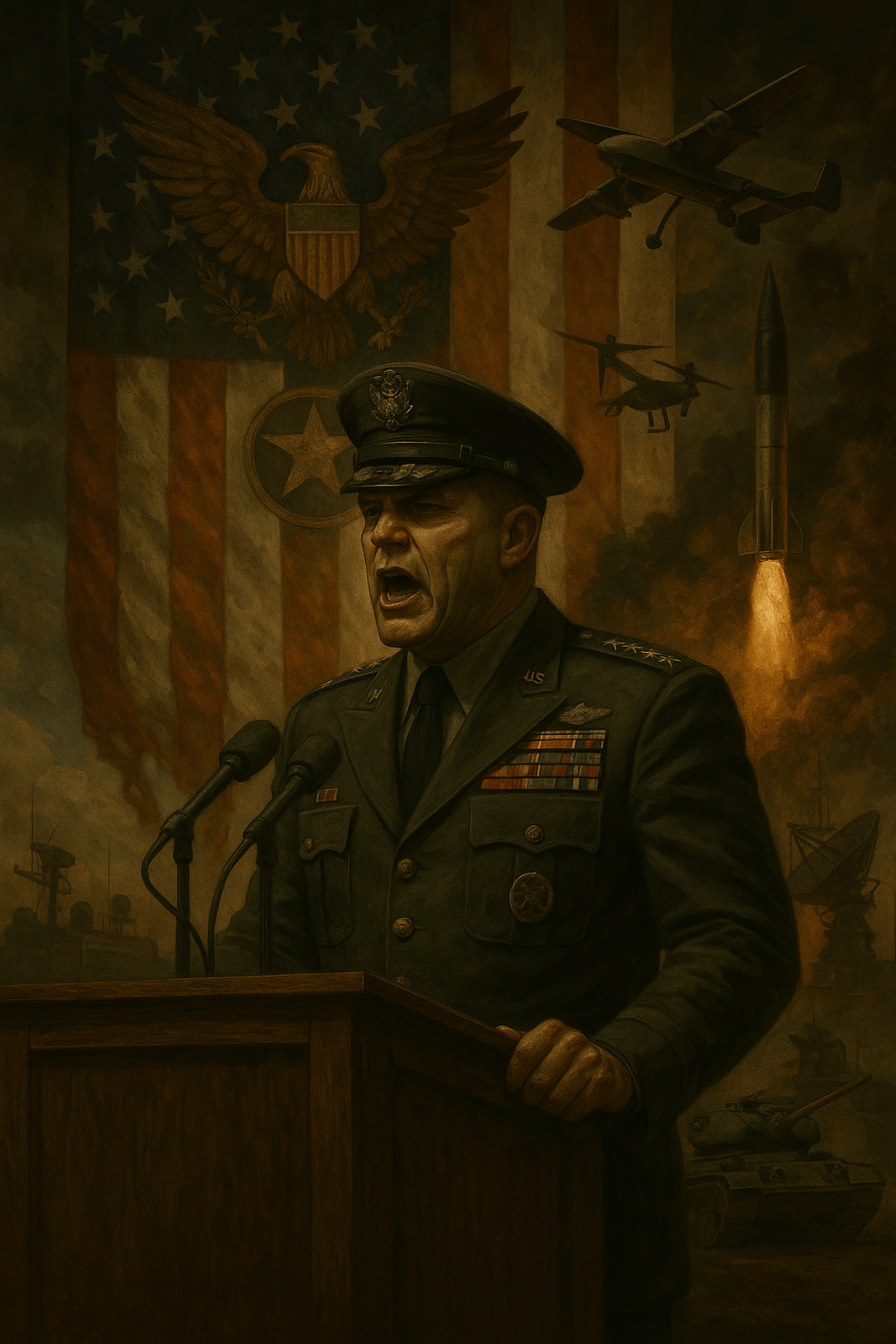
How a culture-war purge, Christian-nationalist legitimation, and AI-driven militarization reforge the U.S. military into a permanent war-state at home and abroad
By Prince Kapone | Weaponized Information | October 1, 2025
The War Department Returns
At Quantico, Pete Hegseth gathered hundreds of generals and admirals in a spectacle that felt less like a professional briefing and more like the unveiling of a new creed. With Trump at his side, he declared that “the era of the Department of Defense is over” and that the United States now stands under the banner of a “War Department.” The rebranding is not cosmetic. It is a signal that the permanent war economy no longer feels obliged to clothe itself in the language of defense or deterrence. Hegseth was not speaking to the rank-and-file, nor even primarily to the officers assembled in the hall—he was announcing a doctrine to the ruling class, a line of march for how the armed forces will be retooled to serve technofascism both abroad and at home.
The staging told its own story. Rarely are so many senior commanders convened in one place, let alone subjected to such overtly political declarations. The implicit threat of purges and forced resignations hovered in the air: generals would either fall in line or be cast aside. In this way, the speech operated less as a motivational call and more as a test of loyalty. A moment of alignment, where the brass were asked to accept not just a new slogan but a transformation of their institution’s identity—from an apparatus that claimed to “defend” the nation into one that openly wages war as its civic purpose. In other words, the Quantico address was a Bonapartist move, an assertion of executive authority that fuses military command with political theater.
What is crucial for us to see is that this was not merely a speech. It was the announcement of a governing doctrine for the U.S. military under Trump’s second regime. The rhetoric of defense has collapsed under the weight of endless wars and domestic crises, and in its place stands an unapologetic war-state. This is how technofascism consolidates: by stripping away the democratic façade and declaring violence itself to be the organizing principle of social life. The War Department is not a return to some older, simpler model of empire; it is the formal declaration that monopoly-finance capital, Big Tech, and the security state will govern by permanent mobilization. Hegseth’s performance at Quantico must be read, then, not as an isolated event but as a milestone in the transformation of the U.S. military into the central institution of a collapsing empire that has chosen repression over reform.
From Deterrence to Permanent War
Having torn the mask off the Pentagon by declaring it a War Department, Hegseth wasted no time in redefining the military’s purpose. The old Cold War language of “defense” and “deterrence” has been cast aside. In its place stands a blunt declaration: “we fight wars to win.” The mantra of “maximum lethality” is not simply about battlefield efficiency—it is a statement of civic philosophy. Violence is no longer framed as a tragic necessity, it is elevated as the highest civic virtue. To be a citizen in this order is to be a warrior, to find meaning not in community or democracy but in readiness for “close and brutal combat.” This is not just a doctrinal tweak; it is the rewriting of the social contract into a war contract.
The implications reach far beyond military manuals. By rebranding deterrence as preemption, and defense as aggression, Hegseth is articulating the Bonapartist logic of technofascism: in a society torn by legitimacy crises, class contradictions, and collapsing trust in institutions, the state seeks stability not by consensus but by mobilization. If the economy cannot produce prosperity, it will produce weapons. If democracy cannot yield legitimacy, the state will seek it in the cult of the warrior. War itself becomes the organizing grammar of political life, the glue meant to bind a fractured settler base to a ruling class that has already abandoned them materially. Hegseth’s applause lines about “winning wars” are thus not about China or Iran alone—they are about managing crisis inside the United States.
Here the continuity with earlier U.S. militarism is obvious: presidents from Kennedy to Bush invoked “strength” and “resolve.” But the rupture is equally clear. Where past leaders at least gestured toward peace as the horizon, Hegseth strips away the pretense. There is no peace in this doctrine, only perpetual conflict. Technofascism thrives on this redefinition. It normalizes endless mobilization, casting suspicion on dissent and turning war-making into the central measure of civic worth. By making lethality the telos of the military and the ethos of the nation, Hegseth’s speech locks the crisis of U.S. capitalism into a permanent war footing—at once external against multipolar rivals, and internal against the working class and colonized peoples inside the empire’s borders.
The Ten Directives: Bureaucracy as Weapon
Having laid down the war contract, Hegseth moved from philosophy to mechanics. His “ten directives” were not the vague slogans of a stump speech but administrative levers designed to rewire the military from the inside. Every empire knows that power is not secured only by generals in the field but by clerks in the office. Forms, standards, promotion boards, complaint channels—these are the gears that grind down dissent and reward obedience. What Hegseth unveiled at Quantico was the technofascist blueprint for turning bureaucracy itself into a weapon.
The directives begin with the body. Standards for combat roles are reset to “the highest male,” presented as “gender neutral” but in practice erasing decades of struggle by women and LGBTQ+ service members. Appearance rules are tightened—no beards, hard PT, back to the days when conformity was measured in sweat and shaved chins. These edicts discipline not just bodies but identities, policing who belongs and who is pushed out. It is a revival of a hyper-masculinist order that claims to produce “warriors” but in fact produces obedience to a hierarchy built on exclusion.
Then comes the crushing of accountability. The overhaul of inspector general and equal opportunity systems is framed as “efficiency” but functions as a gag order. Anonymous complaints are eliminated, so whistleblowers must risk career suicide to speak. “Frivolous” grievances are redefined at the commander’s discretion, stripping protections against harassment and abuse. Even the term “toxic leadership” is rebranded, no longer a mark against abusive commanders but a cudgel to punish subordinates who question authority. The message is clear: speak out and you will be silenced; conform and you will be protected.
Finally, the directives weaponize promotion and records. “Merit” is invoked as the guiding principle, but behind this language lies a system to purge dissenters and shield loyalists. Adverse information can be scrubbed for those deemed “risk-takers,” while a single mark can derail careers for those who refuse the new orthodoxy. In this way, the personnel file becomes an instrument of ideological sorting, a hidden battlefield where the future command structure is purged, polished, and aligned with the Quantico doctrine.
What emerges from these directives is not simply a harsher chain of command but a bureaucratic lattice designed to enforce technofascism at every level. Discipline is centralized, dissent is chilled, and the machinery of HR and legal offices is weaponized against targeted groups. The speech that began with grandiose talk of “war-fighting” thus descends into the details of paperwork and promotion boards. This is the genius of authoritarianism in crisis: it recognizes that control is secured not just through speeches and parades but through the daily grind of administrative power. In Hegseth’s Quantico doctrine, bureaucracy itself becomes the frontline of the war state.
Culture-War Purge and Settler Revanchism
The directives did not stop with the management of bodies and files. Hegseth made clear that this new War Department would be the spearhead of a cultural purge. He mocked “identity months,” dismissed climate change as a distraction, sneered at “dudes in dresses,” and spat out DEI as if it were a foreign infection. The message to the assembled generals was blunt: purge your ranks of anyone unwilling to serve in a hyper-masculinist, Christian-nationalist, settler order. Those who will not bend to this vision should “resign.” This is not policy refinement—it is ideological cleansing by ultimatum.
The nostalgia Hegseth invoked was telling. He held up the 1990s—the era of Tailhook scandals and backlash to sexual harassment reforms—as the baseline for “discipline” and “readiness.” In doing so he revealed that this was never about military effectiveness, but about reasserting a cultural order that had been partially unsettled by decades of struggle from women, LGBTQ+ people, and anti-racist organizers within the ranks. To turn the clock back is to restore the settler revanchism that always lurks beneath U.S. militarism: a longing for the days when whiteness, masculinity, and obedience went unquestioned, when the chain of command mirrored the plantation hierarchy without apology.
What we see here is the ideological face of technofascism. Just as the plantation and reservation disciplined populations through both violence and culture, the modern military is remade as a laboratory for revanchism. Excluding women from combat under the guise of “highest male standards,” policing appearance, mocking diversity, and sanctifying the heterosexual family as the backbone of the warrior ethos—these are strategies for producing a compliant, loyal corps steeped in settler identity. It is not only a war against “wokeness,” it is a class project that aims to restore obedience by rolling back every crack in the edifice of patriarchal, colonial power.
In this sense, the culture-war purge is not a sideshow or a gesture to the Trump base—it is a governing logic. It tells us that technofascism will not be held together by prosperity, for the rulers have abandoned that pact. It will be held together by exclusion, resentment, and revanchist myth. Hegseth’s Quantico doctrine makes the military the vanguard of this purge, setting the tone for a society where obedience is demanded, diversity is vilified, and violence is sanctified as the path back to a mythical order that never truly existed. It is the plantation spirit reborn in digital fatigues.
The Theocratic Varnish
After declaring war on “wokeness,” Hegseth shifted gears into something more solemn: prayer, scripture, the “Golden Rule test.” He framed the military not only as a fighting force but as a sacred institution, sanctified to defend “the nation” under God’s gaze. It was an invocation that went beyond personal faith. It was a political theology, wrapping the doctrine of permanent war in the language of divine mission. By the time the hall bowed its head, the fusion was complete: the warrior ethos baptized by Christian nationalism.
This move matters. For decades, U.S. militarism has leaned on civil religion—flag, anthem, “support the troops.” Hegseth goes further, grafting a theocratic varnish onto the war state. Violence becomes not just a policy but a moral duty, obedience not just a chain of command but a commandment. To fight, to kill, to dominate—these are no longer strategic necessities but sacred obligations. In the same way colonial settlers once saw themselves as chosen instruments to “civilize” the land, today’s generals are asked to see themselves as guardians of a biblical republic at war with secular decay.
For technofascism, this is more than pageantry. It provides the moral glue that austerity and surveillance cannot supply. When prosperity is gone and legitimacy evaporates, rulers reach for religion to sanctify their rule. The Quantico doctrine shows this plainly: Christian nationalism is not an add-on, it is the moral architecture that binds a militarized bureaucracy, a culture-war purge, and a high-tech arsenal into one regime form. By sacralizing the war state, Hegseth offers the ruling class a shield against dissent and a sword against the colonized—domestically and abroad. The sermon and the drone orbit together, each legitimating the other.
The Tech Stack of War
Having baptized the warrior state in scripture, Hegseth turned to its machinery. He promised “more AI in everything,” more drones, counter-UAS, space programs, and on-shoring of the industrial base. This was not a laundry list of procurement—it was a declaration that the future of U.S. war-making lies in automation, digitization, and planetary reach. The speech linked the sacred with the technical: the soldier as God’s instrument, the machine as God’s multiplier. What emerges is not just a stronger arsenal but a new kind of arsenal, where the coercive power of the state is automated and amplified through code, sensors, and satellites.
Here is the technics of technofascism laid bare. The Pentagon bankrolls research, Big Tech monopolies refine it, private equity funds capture it, and the cycle of public risk/private profit spins faster than ever. The AI that times your bathroom breaks at Amazon is the same AI that targets bodies through drone feeds. The cloud that hosts your social media also hosts the Pentagon’s intelligence archives. What Hegseth unveiled was not “innovation” but the formal integration of monopoly-finance capital and the war state through digital-kinetic systems. It is the political economy of death dressed up as progress.
The promise of “speed” and “generational acquisition reform” reveals the real aim: to lock war production into a permanent fast lane. The usual delays of oversight, public debate, and budgetary wrangling are recast as weaknesses to be eliminated. In their place comes a pipeline where venture capitalists, contractors, and generals move seamlessly from prototype to battlefield. This is War Keynesianism for the digital age—trillions in public funds funneled into an industrial-tech complex that treats every advance in automation as both consumer commodity and military asset.
In this fusion, we glimpse the beating heart of technofascism. The cultural purge supplies the ideological conformity, Christian nationalism supplies the moral glue, and the tech stack supplies the machinery to enforce both. The drone does not just patrol foreign skies; it looms over protests at home. The AI does not just sort logistics; it sorts populations into risk categories. The satellite does not just map terrain; it maps behavior. By fusing the sacred and the technical, Hegseth’s Quantico doctrine turns the military into a laboratory where the future of repression is engineered—and where every advance in technology becomes another nail in the coffin of democracy.
Purges and Loyalty Tests
The Quantico address was not only about rebranding departments and acquiring new weapons. Hegseth turned the spotlight directly onto the generals themselves, telling them in no uncertain terms: get in line or get out. He mocked the era of Milley and promised a return to “Patton-like” command, where hesitation is weakness and loyalty is the measure of worth. It was a purge announced in real time, draped in the language of merit and warrior ethos but backed by the threat of removal. The room’s uneasy silence, noted by press accounts, testified to the fact that this was not the usual pep talk. It was a demand for personal fealty to a regime project.
This is Bonapartism from above. The executive asserts itself over the military bureaucracy, stripping away the pretense of neutral professionalism. Promotion and record reforms, already laid out in the directives, give the tools to carry it out: scrub “adverse information” for loyalists, derail careers for dissenters. What emerges is not simply discipline but alignment—a command corps selected as much for ideological obedience as for tactical competence. Officers are told plainly: if you disagree, resign. Those who remain are bonded less to the Constitution than to the leader’s doctrine.
Such purges are not unprecedented. History is littered with regimes that reshaped their militaries by loyalty tests. What makes the Quantico moment distinctive is its timing: the U.S. faces both external rivals and internal legitimacy collapse. In this context, the purge is not a show of strength but a confession of weakness. A ruling class that once trusted in institutional inertia now demands personal allegiance because it no longer trusts its own institutions. The armed forces become less a professional body and more a praetorian guard, selected to defend the regime against both foreign enemies and domestic unrest. This is how technofascism consolidates: through purges that make loyalty to the project itself the highest qualification for command.
The Homeland as Battlespace
From loyalty tests within the officer corps, Hegseth’s doctrine turns outward to the terrain of everyday life inside the United States. Trump’s suggestion that U.S. cities could be used as “training grounds” was not a throwaway line—it was a signal. The war contract unveiled at Quantico does not end at foreign borders; it folds the homeland into the battlefield. Counterinsurgency, once tested in Vietnam, Iraq, and Afghanistan, is openly imported into American streets, wrapped in the language of readiness and discipline.
The administrative rewiring of IG and EO channels fits neatly here. By neutering complaint systems and narrowing avenues for whistleblowers, the regime creates the conditions for domestic deployments with minimal dissent. A soldier ordered to police a protest or occupy a neighborhood has fewer institutional protections if they refuse or expose abuse. The very bureaucratic reforms hailed as “efficiency” become the shield behind which the military can turn inward, blurring the line between external enemy and internal dissenter.
This is the collapse of Posse Comitatus by policy, not legislation. Where past administrations stretched the law in emergencies, the Quantico doctrine erases the distinction altogether. Cities, towns, and reservations become potential “training environments,” where drones, surveillance towers, and armored vehicles can be deployed under the pretext of preparing for war abroad. In reality, the war is already here—directed at migrants, protestors, Indigenous defenders, and the poor. The homeland is reclassified as a battlespace, its inhabitants as populations to be pacified.
In this way, the War Department becomes both foreign and domestic in a single stroke. The same technologies and tactics that dominate overseas territories return home, turning Ferguson into Fallujah, Minneapolis into Mosul, Atlanta’s forests into Kandahar. Technofascism thrives on this convergence, dissolving the boundary between empire and republic, treating both as zones of occupation. Hegseth’s speech at Quantico did not just promise victory abroad—it promised occupation at home.
Industrial Policy for War
The Quantico doctrine did not confine itself to culture and command—it reached directly into the economy. Hegseth called for the rebuilding of shipyards, the expansion of munitions plants, and a new round of industrial on-shoring. He spoke of “sharing the burden” with allies, but the subtext was clear: a return to War Keynesianism, where state funds flow into the coffers of contractors under the banner of national security. This is not about self-reliance or jobs for workers—it is about guaranteeing profit streams for the primes and their venture-capital satellites, using the crisis of legitimacy as cover for an orgy of rearmament.
Here again we see the mechanics of technofascism at work. The state assumes the risk—guaranteeing contracts, subsidizing R&D, speeding acquisitions—while monopoly capital captures the reward. New drones, hypersonics, and AI systems are rolled out as both battlefield necessities and economic lifelines. The war state becomes the only reliable growth sector, its contracts the substitute for a failing social contract. Where schools close and hospitals crumble, weapons factories hum. The promise of bread is replaced with the certainty of bombs.
This industrial pivot is sold as patriotism, but it is in fact a consolidation of class power. Workers are drafted into the role of war laborers, their livelihoods tied to the production of weapons they will never afford, defending wars they will never benefit from. Communities gutted by deindustrialization are told salvation lies in missile plants and naval yards. In truth, the War Department offers no prosperity, only dependency: a society tethered to endless militarism as its sole economic engine. Technofascism thrives in this arrangement, where the line between industrial policy and war policy disappears, and where the crisis of capitalism is managed not by production for life but by production for death.
Gender Policy as Class Discipline
Among the “directives” that drew the loudest applause was Hegseth’s decree that all combat roles be held to the “highest male standard.” He presented it as gender-neutral, a restoration of rigor. But the framing conceals the reality: it is a targeted rollback, a mechanism to shrink the pool of who belongs, to reassert a rigid model of masculinity as the foundation of the warrior caste. Shaving standards, fitness tests, bans on beards—all flow from the same logic. Discipline the body to discipline the mind. Police appearance to police thought. Gender becomes the hinge on which class discipline is enforced inside the barracks.
This move is not about combat effectiveness—no serious military study has shown that women, trans, or queer service members undermine capacity. It is about purging difference, restoring conformity, and stamping an old settler order back onto the military’s internal life. The “highest male standard” is code for the nostalgia of a hyper-masculinist hierarchy where obedience and aggression are fused into one ethic. By narrowing who counts as a soldier, the regime manufactures cohesion not through solidarity but through exclusion. This is how technofascism works: it forges loyalty by disciplining bodies, binding conformity to survival.
The implications spill beyond the barracks. To normalize this standard is to broadcast a broader message: that the state values only a certain kind of body, a certain kind of loyalty, a certain kind of citizen. It is an ideological sorting that mirrors the digital and kinetic apparatus outside the military—where predictive policing profiles neighborhoods, where immigration policy criminalizes entire populations. Gender discipline inside the ranks is of a piece with class discipline in society at large. Both seek to enforce obedience to a decaying order by narrowing who belongs and punishing those who resist. Hegseth’s doctrine makes clear that the War Department is not just about fighting wars abroad—it is about reshaping social life at home, one body, one file, one life at a time.
Old Patterns, New Masks
Hegseth’s Quantico doctrine dresses itself up as rupture, as a bold new era of “war-fighting,” but much of what it proclaims is a remix of old patterns. The U.S. has always claimed that war is the price of peace, that force is the guarantor of freedom. From the Monroe Doctrine to the War on Terror, the logic has remained: violence abroad to stabilize contradictions at home. In this sense, nothing in Hegseth’s speech is new. The glorification of the warrior, the suppression of dissent, the sanctification of the flag and the cross—these are the familiar tools of American militarism, honed over centuries of settler conquest and empire.
Yet within this continuity lies something distinct. The explicit purge of DEI, the public threat of mass resignations, the overt sacralization of the military as a Christian institution—these break from the usual liberal cloak. Past rulers often disguised militarism in the rhetoric of defense, diversity, or humanitarianism. Hegseth dispenses with the mask. He speaks not of peace but of “maximum lethality,” not of inclusion but of “highest male standards,” not of democracy but of obedience. What is new is the open embrace of technofascism as a governing form, the proud admission that repression and exclusion are the pillars on which the war state now rests.
This combination of old and new reveals the mutation we have been tracing. The cultural purge and Christian varnish are the ideological face; the AI drones, acquisition reforms, and industrial on-shoring are the technical skeleton. Together they form a state that no longer bothers to promise prosperity or democracy. Instead, it offers only permanent war, rebranded as virtue. The Quantico address is thus both continuity and departure: a continuation of the American empire’s violent tradition, and a departure in its frankness, its refusal to pretend, its willingness to announce that the mask of “defense” is gone for good.
The War-State Unmasked
The Quantico doctrine ends where it began: with the open declaration that the United States will be governed as a war-state. Externally, the signal is clear. Though Hegseth deferred specifics about China and the hemisphere to a “future speech,” the outlines are already visible: an expansion of AI-driven surveillance and drone warfare, a more aggressive maritime and space posture, and the tightening of chokepoints through sanctions and kinetic threats. This is the geography of technofascism—an imperial map redrawn with satellites, algorithms, and bases designed not for defense but for coercion.
Internally, the speech crystallizes the consolidation of a war culture inside the bureaucracy during a time of austerity and social fracture. The administrative purge of DEI, the loyalty tests for generals, the gendered standards for bodies, the sacralization of violence through Christian nationalism—all of these remake the military into the vanguard of technofascist governance. In a society where the ruling class has abandoned prosperity as a means of legitimacy, the barracks and the battlefield become the only glue left to bind the nation. Democracy is reduced to theater, while obedience and repression become the true civic virtues.
For us, the counter-line is urgent and clear. Democracy cannot coexist with a permanent war economy. Every promise of “readiness” is a euphemism for repression, both foreign and domestic. The rank-and-file inside the military must be defended—not by IG channels neutered by Hegseth’s reforms, but by alternative avenues of solidarity, by resurrecting the GI movement traditions that once challenged the war machine from within. Outside the barracks, workers and communities must see through the lie that prosperity will return through weapons contracts. Bread will not come from bombs, and freedom will not come from drones.
Our task is to build counterpower: anti-war labor blocs that refuse to be conscripted into the arsenal of austerity, multipolar solidarity that links Ferguson to Gaza and Atlanta to Caracas, movements that resist the automation of coercion and the sacralization of violence. The Quantico speech unmasked the war-state. Now we must unmask the lies that sustain it, and organize to ensure that the brittle edifice of technofascism collapses under the weight of its own contradictions. Permanent war is not destiny. It is the ruling class’s last resort. Our destiny will be written in how we resist it.
 Weaponized Information
Leave a comment