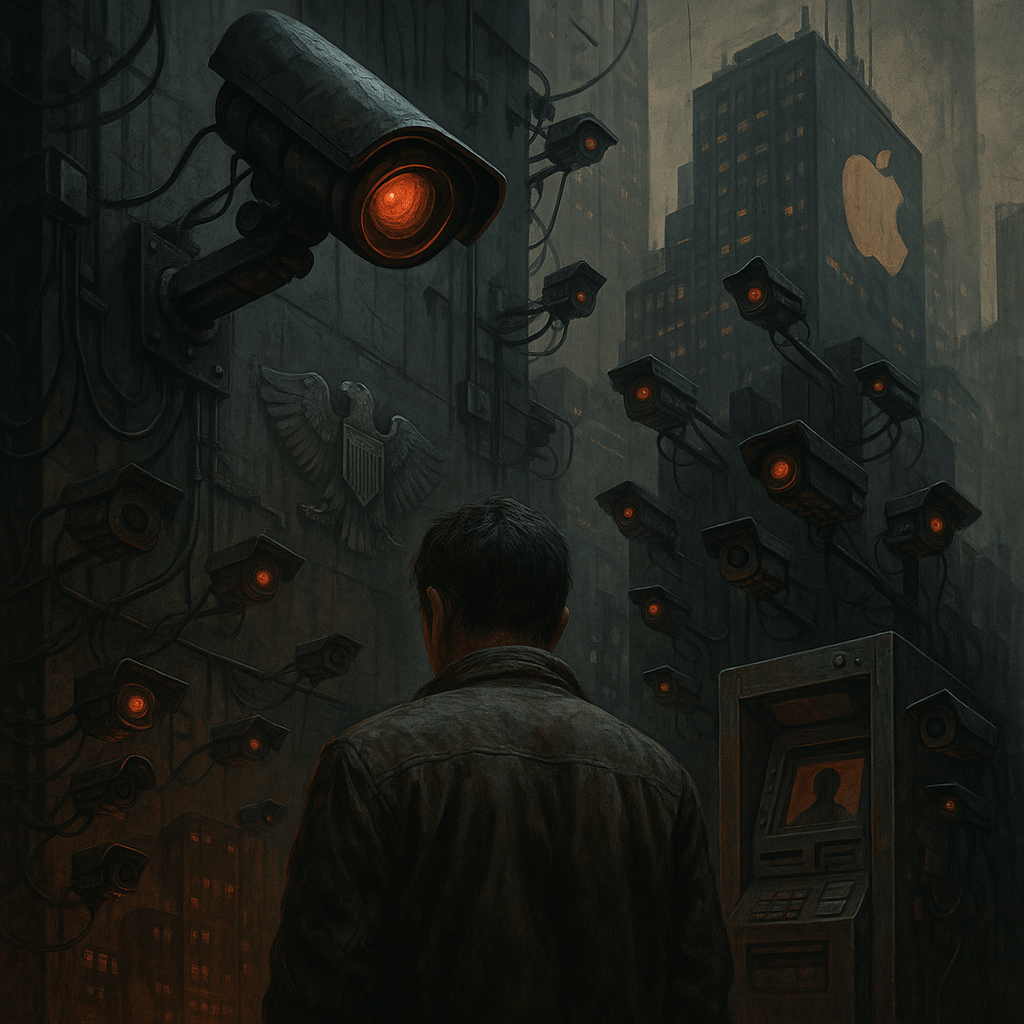
Behind the panic in boardrooms lies a deeper truth: the U.S. ruling class is hardening its grip through economic coercion, media intimidation, and corporate-state fusion — not the erosion of democracy, but its consolidation as class dictatorship.
By Prince Kapone | Weaponized Information | September 22, 2025
Democracy as a Business Risk
CNN Business ran with a story by Matt Egan under the alarmist headline, “The US economy has a new problem: Democracy is under siege”. The article paints a picture of a nation slipping into crisis, not because working people cannot afford rent or medicine, but because executives and policy elites are unsettled by the president’s heavy hand. In this telling, the threat to democracy is not disenfranchisement, dispossession, or repression on the ground—it is the queasy feeling in the boardrooms that the rules of their game are being rewritten without their consent.
The author presents himself as a sober chronicler of the business desk, but the very selection of sources betrays the orientation. Voices elevated are those of think tank fellows and CEO whisperers, whose credibility is taken for granted because they sit close to the engines of power. Their concerns—about “independence,” “stability,” “markets”—are treated as the legitimate vocabulary of democracy itself. By extension, anything that disturbs them can be branded an attack on democratic foundations. What disappears is the experience of ordinary people whose lives are upended by these policies in material ways.
The outlet amplifying this narrative, CNN, is not a neutral conduit. It is a flagship in a corporate media empire owned by Warner Bros. Discovery, a conglomerate whose fortunes rise and fall with advertising contracts, subscriptions, and investor confidence. For such an institution, the boundary between “threats to democracy” and “threats to capital” is paper thin. Democracy becomes shorthand for investor-friendly predictability, while challenges to capital’s comfort are coded as authoritarian menace. The outlet positions itself as watchdog, but in practice it guards the prerogatives of its own class.
The propaganda devices in the article flow smoothly beneath the surface. One is the conflation of democracy with GDP growth, a sleight of hand that reduces a complex social struggle to a corporate balance sheet. Another is the moral theater of crisis language—“horrifying,” “alarming,” “rapidly eroding”—that invites the reader to panic without pausing to ask who defines the stakes. A third is the personalization of systemic patterns into the figure of Trump alone, as if the long corrosion of institutions arrived suddenly with one man’s signature. Then there is the strategic silence: absent is any discussion of why business leaders have such power to define democracy, or how decades of bipartisan policy paved the road for today’s executive excesses. The omissions are themselves techniques, smoothing history into a morality play where capital plays the victim and the only remedy is a return to “independent” technocracy.
The result is a story that scolds the president for playing too rough with the referees, not for crushing the players on the field. Its concern is that the rules of capitalism are being bent in ways that unsettle the investor class, not that those very rules have long dispossessed the majority. By dressing up elite discomfort as a democratic crisis, the piece executes a quiet maneuver: it positions the reader to equate democracy with the stability of capital, and to fear any turbulence that might shake that stability. That, comrade, is the essence of the propaganda at work here.
What the Article Establishes and What It Leaves Out
The CNN article sets down its factual scaffolding with little ambiguity. It notes Trump’s failed attempt to remove Federal Reserve Governor Lisa Cook and his firing of Bureau of Labor Statistics Commissioner Erika McEntarfer after a jobs report he dismissed. It records that FCC Chair Brendan Carr threatened action against Disney and ABC after Jimmy Kimmel mocked Trump, and that ABC suspended Kimmel’s show with Trump’s approval. It details Trump’s pressure on Intel’s leadership before orchestrating an $8.9 billion federal investment in the company, as well as the government’s purchase of a “golden share” in U.S. Steel and a controlling stake in MP Materials. The article adds Trump’s $100,000 H-1B visa fee hike and his tariff threat against Mattel, portraying these as evidence of executive intrusion into the economy. To underpin its thesis, it cites studies linking democracy with stronger growth and populist leaders with long-term economic decline.
But what CNN omits is that many of the very corporations and business associations now portrayed as anxious about “democracy under siege” have long lobbied for and profited from the same coercive tools. The Information Technology Industry Council’s lobbying profile on OpenSecrets shows that tech trade associations and corporations have spent millions lobbying both parties — pushing for surveillance-friendly legislation, gig-economy loopholes, and expanded border enforcement infrastructure. The Citizen report “Big Tech, Big Cash: Washington’s New Power Players” shows how Amazon, Apple, Facebook, and Google massively increased their lobbying and campaign contributions — pressing Congress to block privacy regulation while expanding data collection regimes — laying groundwork for the algorithmic control mechanisms now under technocratic rule. Similarly, the defense sector summary on OpenSecrets shows that companies like Lockheed Martin and Raytheon (now RTX) spend tens of millions each cycle lobbying both Republicans and Democrats on militarized policing, surveillance budgets, and privatized security markets — mechanisms of state-corporate fusion built over decades.
Even in the realm of immigration and labor discipline, corporate fingerprints are everywhere. The ProPublica investigation “The U.S. Business Community Used to Be a Force for Immigration Reform. What Happened?” shows how major business groups including Microsoft, Intel, and the National Association of Manufacturers have long lobbied administrations of both parties to shape visa and immigration policy in ways that serve corporate supply of cheap, disposable labor rather than guaranteeing worker protections. The Economic Policy Institute’s report on the H-2B visa program shows that temporary worker programs systematically underpay migrant workers, deny them basic rights, tie their visa status to employers, and suppress wages — the very foundations of a legal architecture of super-exploitation that corporate America now disclaims when the pressure becomes overt.
Beyond tech, defense, and immigration, finance capital has been no less complicit. Wall Street spent decades lobbying for deregulation, culminating in the post-1999 repeal of Glass-Steagall via Gramm-Leach-Bliley, and reaped the rewards when taxpayers bailed out the banks after the 2008 crash. Pharmaceutical giants have poured millions into lobbying to protect monopolistic pricing and privatized healthcare, ensuring that crises like COVID-19 became bonanzas of profiteering rather than moments of public investment. In media, corporate consolidation has concentrated power in a handful of conglomerates. Companies like Comcast and Disney lobbied heavily against net neutrality protections dismantled by the FCC in 2017, entrenching private control over the flow of information while posturing as defenders of “free expression.”
Omitted as well is the larger truth that what CNN frames as authoritarian excess is part of a deeper project of class warfare. The Washington Post report “How billionaire Charles Koch’s network won a 40-year war to curb regulation” shows how the Koch network has spent decades organizing legally and politically to weaken regulatory protections, break down labor rights, and hollow out institutions in both parties — shaping a regime of power that prioritizes capital over people. The Roosevelt Institute report “Powerless: How Lax Antitrust and Concentrated Market Power Rig the Economy Against American Workers, Consumers, and Communities” details how corporations leveraged concentrated market power to suppress wages, weaken labor protections, and tilt antitrust, tax, and regulatory policy to their benefit — institutionalizing a regime where state power routinely disciplines workers on behalf of capital. Meanwhile, Human Rights Watch’s report “Unfair Advantage: Workers’ Freedom of Association Under Attack in the United States” documents how employer-interference, legal delays, weak penalties, and political collusion combine to undermine workers’ right to organize, strike, and bargain collectively — practices that echo through the same economic coercion matrix now deployed more broadly in technofascist consolidation.
This continuity is not accidental. The Bush administration’s PATRIOT Act expanded surveillance architecture, granting the state sweeping powers to service private records, secret searches, and warrantless wiretapping while weakening checks and oversight. Obama’s record on immigration was not one of compassion but of mass expulsion. As the Migration Policy Institute shows, his administration deported more people than any before it, turbo-charging programs like Secure Communities that turned every traffic stop into a potential deportation. At the same time, the much-celebrated Affordable Care Act was hardly the product of grassroots demand for health justice. As PBS Frontline and the Sunlight Foundation have shown, the bill was hammered out in backroom deals with pharmaceutical and insurance lobbyists, who secured sweetheart protections for their profits. The result was predictable: millions deported, millions insured through a program written by the very industries it was supposed to regulate. This is not democracy betrayed — it is democracy performing exactly as designed, a stage play where capital writes the script and workers pay for the ticket. Each administration, Republican and Democrat alike, has handed new tools of coercion to the state and its corporate partners. Internationally, these same corporations have honed their practices abroad — from surveillance technologies first tested on Palestinians and migrants at the border to union-busting strategies pioneered in Mexico’s maquiladoras — before bringing them back home as normalized instruments of discipline.
Taken together, the omitted evidence reveals a pattern CNN refuses to acknowledge: corporate elites are not innocent bystanders “horrified” at creeping authoritarianism. They are long-standing architects of the very measures that constitute it. What now appears as an alarming rupture is in fact the continuation of class warfare by other means, with the same beneficiaries at the helm.
From Elite Panic to Technofascist Consolidation
The story told in CNN’s business pages frames a string of events as a frightening drift toward “autocracy.” But when the facts are put together, what they reveal is not a scattershot decline but a deliberate hardening of class rule. The firings of officials, the intimidation of media companies, the golden shares and corporate bailouts, the punitive tariffs and visa fee hikes — these are not isolated outbursts. They are the visible stages of Technofascist Consolidation, the process by which a governing class fuses state power, corporate privilege, and technological coercion into a stable machinery of control. What looks like chaos is in fact the architecture of a new regime taking shape.
This consolidation does not rely on tanks in the streets or even new laws. It works through what can be called an Economic Coercion Matrix: the interlocking levers of tariffs, visa restrictions, targeted subsidies, golden shares, and regulatory threats. Each of these instruments disciplines a different sector — workers, corporations, migrants, or media — but together they form a system that can be switched on at will to punish dissent and reward obedience. Where the United States once projected such coercion abroad through sanctions and blockades, it now redeploys similar tactics inward, weaponizing everyday economic instruments against its own population and business sectors. The effect is to normalize permanent precarity for workers and permanent compliance from capital.
The crackdown on Jimmy Kimmel’s show illustrates how seamlessly this logic extends into the realm of speech. What appears as a spat between a president and a comedian is actually the operation of the Imperialist Media Apparatus: a structure where licensing, mergers, and regulatory discretion serve as pressure points to enforce conformity. By suspending a show under the shadow of FCC reprisal, the media sector demonstrates that the boundaries of “free expression” are policed not by open debate but by corporate calculation under state threat. Just as tariffs and visa fees discipline the economy, licensing regimes discipline the narrative.
In this framework, “instability” is not the problem — it is the governing method. Sudden tariff threats, overnight visa fee hikes, executive purges, and abrupt regulatory menaces create shocks that keep labor disoriented, corporations cautious, and media obedient. What CNN portrays as alarming unpredictability is, in reality, the logic of technofascist rule: a system where volatility itself is the mechanism of control. CEOs may grumble in private, but they remain complicit, because the same apparatus that frightens them also guarantees their dominance over workers and markets.
To describe all this simply as “erosion of democracy” is to fall for the façade. What is consolidating in the United States is not the end of democracy but its mutation into a shell emptied of popular content and filled with the direct instruments of class domination. The crisis is not a departure from capitalism but its preservation by harsher means. Technofascist consolidation is the ruling class’s answer to imperial decline and domestic discontent: strip away the pretense, tighten the screws, and make volatility itself the guarantor of order. For the working people at the heart of this system, the message is clear — your lives, your labor, and your voices are variables in an equation whose solution is permanent discipline.
Building Power in the Shadow of Technofascist Consolidation
The contradictions traced in this essay are not abstractions. They are lived daily by workers, migrants, and communities already organizing against them. If the administration raises H-1B fees to stratospheric levels, it is immigrant workers and their families who bear the weight. On the ground, formations like the National Day Laborer Organizing Network and the Coalition of Immokalee Workers are not debating “democracy indices” but waging campaigns against wage theft, deportation raids, and visa bondage. Their fights expose the same logic we described: the use of economic levers to keep labor precarious and silent. Strengthening these struggles means widening solidarity across industries, not appealing to courts already captured by capital.
When federal regulators silence comedians under threat of licensing reprisal, it is media workers who understand what is at stake. Grassroots unions such as the Writers Guild of America–East and independent media cooperatives from Oakland to Chicago have been building alternatives for years, often on shoestring budgets. Their existence demonstrates that dissent survives only where workers themselves hold the means of production and distribution of information. To defend them is to defend our collective ability to speak and hear truth outside the shadow of the imperialist media apparatus.
The golden share in U.S. Steel and the takeover of MP Materials point to another front. Here, rank-and-file organizers in the United Steelworkers and militant shop-floor caucuses face not only corporate bosses but the state itself as employer and shareholder. Their wildcat strikes and contract fights, often downplayed in mainstream coverage, show that even under conditions of direct state ownership, workers can assert power that disrupts the economic coercion matrix. Solidarity with these struggles means amplifying their voices, sharing resources, and refusing to let state-corporate propaganda paint them as obstacles to “national security.”
Nor is the battlefield only industrial. Tenant unions like KC Tenants and debt abolition collectives such as the Debt Collective have been confronting the volatility that technofascism deliberately produces — sudden price shocks, punitive interest rates, evictions. Their campaigns are not charity but counter-power: practical schools of struggle where working people learn to defend themselves against the permanent precarity engineered from above. These are laboratories for the kind of dual power that can meet technofascist consolidation head on.
The lesson from these fronts is clear: the resistance is already in motion. It does not speak the language of boardrooms or think tanks, but of picket lines, marches, rent strikes, mutual defense, and media insurgency. To build on it, revolutionaries in the Global North must recognize these fights as the cutting edge of the struggle against technofascism. Support them materially, amplify them politically, and join them in practice. The contradiction is no longer abstract: it is in the factory, the field, the newsroom, the clinic, and the street. And it is there that the answer will be written — not by CEOs lamenting “instability,” but by the people organizing to tear down the system that keeps them in chains.
 Weaponized Information
Leave a comment