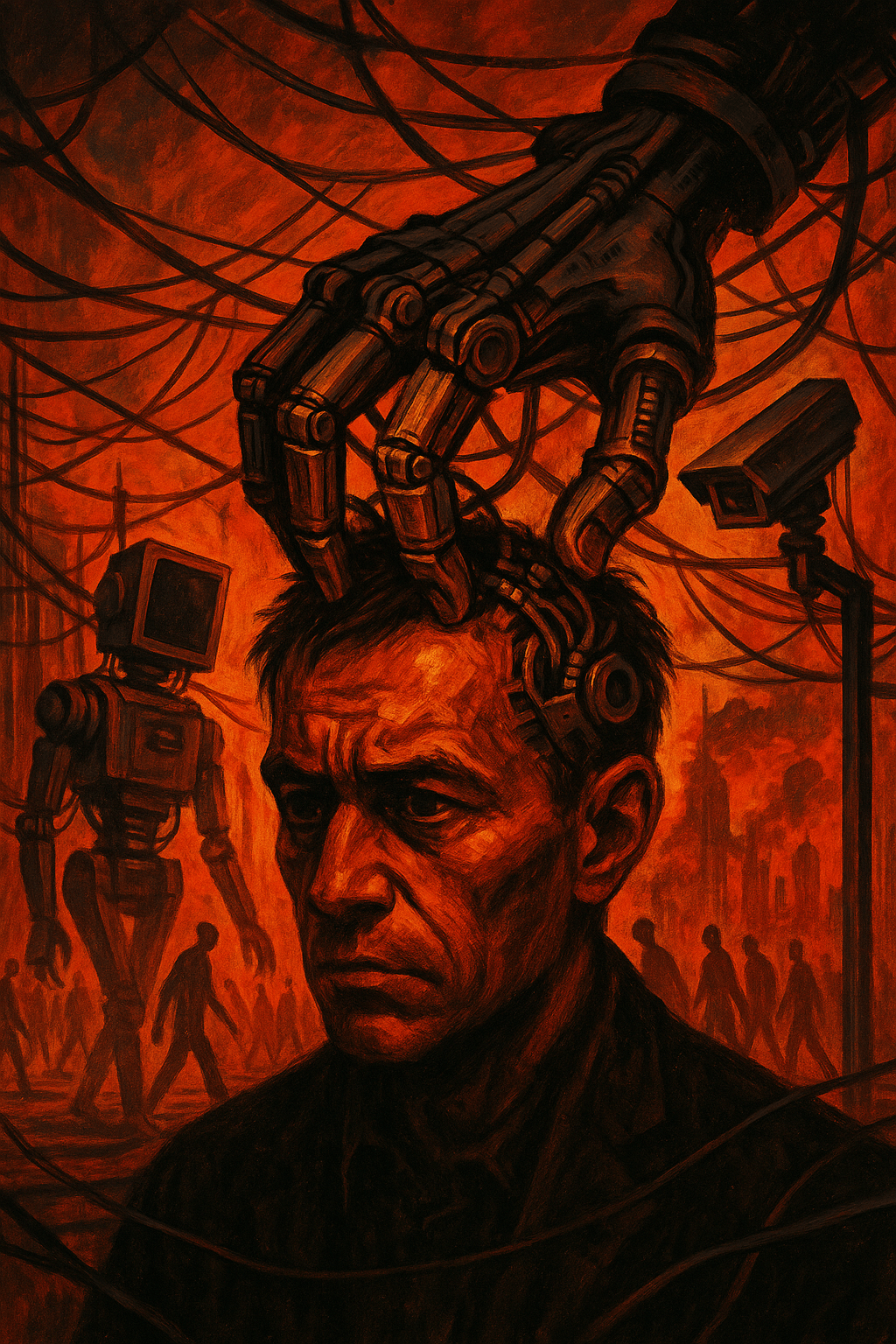
A WI review of China’s Colonization of the Mind white paper, exposing how Washington weaponizes propaganda, algorithms, and culture as the nervous system of empire.
By Prince Kapone | Weaponized Information | September 20, 2025
A War Without Smoke, A Battle Over Consciousness
The Chinese think tank that put out Colonization of the Mind is saying something most of the world’s poor and working people have known for a long time: the United States doesn’t just drop bombs and launch invasions—it colonizes how you think. They call it a “war without smoke,” a war where the battlefield isn’t land or oil fields but your head, your sense of self, your idea of what’s possible. And in that war, Washington has been marching for centuries. From the Monroe Doctrine to the “Summit for Democracy,” it’s the same story: cavalry one day, hashtags and algorithms the next.
The report lays it out plain. U.S. power doesn’t just sit on top of aircraft carriers and Wall Street banks. It seeps through Hollywood blockbusters that turn every invasion into a superhero saga. It hides in the soft language of NGOs with names like “Freedom House,” planting opposition movements like weeds in someone else’s garden. It waves the banner of “universal values” that really mean one thing: the United States makes the rules, and everyone else learns how to obey. White propaganda, black propaganda, gray propaganda—the outfits change, but the face underneath is always the same: imperial domination. And you’ve got to give them credit, the Chinese did their homework. They track it from Cold War radio broadcasts right up to deepfake videos and bot armies on social media.
But here’s the thing. Xinhua calls this “colonization of the mind,” which is true enough. But they stop at the water’s edge. Weaponized Information calls it by its full name: technofascism when it locks down the population at home, and hyper-imperialism when it stretches its claws abroad. This isn’t just a foreign policy problem—it’s the nervous system of a decaying empire. The same machine that floods the Global South with propaganda is the one that tells poor and working people in the U.S. that their misery is their own fault, that racism is a personal prejudice not a system, that cops are heroes, and that capitalism is freedom. Colonizing the mind isn’t an export business—it’s also domestic counterinsurgency.
That’s why the paper is both sharp and blunt at the same time. Sharp because it pulls the curtain back on the machinery—AP wires, CIA fronts, corporate media giants, the algorithms of Silicon Valley. Blunt because it won’t name the system for what it is: a settler-colonial capitalism in crisis, mutating into a new form, technofascism, and seeking to extend its lifespan through hyper-imperial conquest. Reviewing this paper through the lens of Weaponized Information means respecting what it uncovers, but also pushing further. We need to speak in the language of class, race, and colonial contradiction. Only then can we see that the answer isn’t just “protect sovereignty.” It’s something bigger: liberation from the whole system that makes sovereignty impossible in the first place.
Mapping the Arsenal of Empire
The strength of Colonization of the Mind lies in its careful inventory of the weapons the United States has deployed to dominate not just bodies and borders, but thought itself. The report doesn’t stumble around with polite euphemisms. It tells you flatly that Washington has refined a machinery of influence over generations, a system that has moved step by step from propaganda war to information war to ideological war, and now to cognitive war. Each stage was not a replacement of the last but an upgrade, the way a new operating system keeps the same basic function but with more reach, more speed, more invasive control.
The Chinese analysts show how the empire’s arsenal is layered. At the top, the state agencies—the CIA, Pentagon, State Department—direct the flow. Below them, the NGOs and “civil society” outfits, dressed up as charity but acting as relay stations for regime change. Around them swarm the think tanks and universities that translate imperial needs into academic jargon, producing reports that sell war as peace and plunder as growth. Threaded through all of this are the media corporations and tech monopolies that appear to be neutral platforms but are in fact the pipelines of empire’s narrative.
The report also emphasizes how U.S. ideology smuggles itself in under the cover of so-called “universal values.” Democracy, freedom, human rights—words that should belong to all of humanity—are repurposed as weapons. They are wielded like hammers to smash nations that refuse U.S. dictates, while at the same time serving as velvet gloves covering the claws of imperial power. In this sense, the values are not neutral ideals but operating codes, designed to compel obedience while masking domination.
And then there is the technological layer—the cutting edge of cognitive war. The U.S. doesn’t just own the news channels or the social media feeds; it owns the wires, the satellites, the very infrastructure of global communication. From Starlink satellites orbiting above to the algorithms buried in your phone, Washington has built an architecture where information itself is militarized. This is not just about spreading lies or censorship in the old sense. It is about shaping the terrain of thought before ideas even form, managing the conditions under which people see, hear, and imagine the world.
By laying all this out, Colonization of the Mind does what many so-called “independent” analysts in the West refuse to do: it shows the totality of the system. It reveals propaganda not as an occasional tactic, but as the bloodstream of empire. This is what makes the report valuable. It gives us a map of the arsenal—who commands it, how it is structured, and what tools it deploys. For revolutionaries, that map is indispensable. Because if you don’t know the enemy’s weapons, you’re not preparing for liberation—you’re waiting to be ambushed.
Cognitive Warfare as Technofascist Governance
What Colonization of the Mind calls “cognitive warfare,” Weaponized Information names as the operating logic of technofascism. This is not simply one tactic among others, nor a passing phase of U.S. foreign policy. It is the very mode of governance of a capitalist empire in crisis, where managing perception has become as important as managing production. Cognitive warfare is the nervous system of technofascism, the circuitry that allows monopoly capital, the state, and the digital barons to act in unison.
Look closely and you see that the battlefield is not somewhere “out there.” It is daily life. The same media system that broadcasts color revolution slogans in Eastern Europe beams soft censorship into Black communities in Detroit. The same NGO model that grooms a pro-U.S. elite in Hong Kong builds “community leadership programs” in U.S. ghettos that strip radicalism from the oppressed. The same algorithm that buries Palestinian voices online manipulates white workers into thinking their problems are caused by migrants instead of by Wall Street. Cognitive war is not an export commodity—it is the domestic counterinsurgency of technofascism, refined on colonized people abroad and then turned inward against the poor and oppressed at home.
This is why it must be understood as governance. A state that can no longer guarantee rising living standards, that cannot maintain legitimacy through prosperity, must resort to manufacturing reality itself. It stitches together obedience not with bread but with spectacle, not with security but with distraction. Here the media conglomerates, the Pentagon, Silicon Valley, and Wall Street are not separate actors—they are different organs in the same body. Their integration is what we mean by technofascism: the convergence of digital capital, finance capital, and state repression into a seamless system of rule.
Cognitive warfare is the mechanism that allows this system to function. It is the algorithm that determines which truths can circulate and which are shadow-banned into silence. It is the branding campaign that turns austerity into “responsible budgeting.” It is the news cycle that transforms imperial invasions into “humanitarian interventions.” It is the data-mining that anticipates dissent before it emerges and guides police boots to the right door at the right time. This is not simply propaganda as in the old days; it is counterinsurgency by other means, an unending campaign to foreclose the possibility of rebellion before rebellion even takes form.
In this way, cognitive warfare is not a separate category from technofascism. It is its infrastructure, its bloodstream, its logic of survival. The empire rules through it, disciplines through it, reproduces itself through it. To name it as such is not only to critique U.S. foreign policy, but to identify the anatomy of domestic rule: a system where the counterinsurgency never ends, and where the most important prison is not made of iron bars but of stories, images, and algorithms that keep the majority docile while the ruling class continues its plunder.
From Counterinsurgency to Cognitive War: A Long History
What today’s strategists call “cognitive warfare” is not some sudden innovation of Silicon Valley or the Pentagon’s newest think tank. It is the digital consummation of a practice as old as the U.S. empire itself: counterinsurgency. From the very beginning, the settler project required not only the physical conquest of land and labor, but the conquest of thought—the systematic effort to prevent unity, to fracture resistance, to demoralize rebellion before it could ignite. Cognitive war is simply the latest mask worn by this long tradition of colonial repression.
We can trace the lineage. In the seventeenth century, colonial elites divided indentured European servants from enslaved Africans, dangling “whiteness” as a bribe for loyalty to the settler project. This was ideological warfare in embryo: manufacture racial hierarchy to block class solidarity. In the centuries that followed, the U.S. state perfected counterinsurgency against Indigenous nations, where conquest was accompanied by boarding schools that sought to “kill the Indian, save the man”—an early campaign of mind colonization. During slavery, every plantation was a laboratory of counterinsurgency: slave patrols enforced terror, while religious and cultural indoctrination tried to fracture the enslaved and dull the memory of freedom.
Fast forward to the twentieth century and the logic only deepens. When Black sharecroppers and poor whites threatened to unite in radical unions, propaganda was deployed to inflame racial divisions. When anti-colonial movements abroad shook empire, Hollywood and Voice of America beamed a steady stream of images portraying U.S. capitalism as prosperity and Soviet socialism as tyranny. COINTELPRO and the FBI’s psychological warfare against Black, Indigenous, Puerto Rican, and revolutionary white organizations were nothing less than cognitive war: infiltrating movements, spreading disinformation, turning militants against each other, breaking the bonds of trust that are the lifeblood of insurgency.
The so-called “War on Drugs” of the 1980s was another layer of the same story. It was not just about narcotics—it was about criminalizing an entire generation of Black youth, associating resistance with pathology, and saturating the public consciousness with images of crime and punishment. It was counterinsurgency dressed as law and order. After 9/11, the “War on Terror” globalized these tactics, wedding them to digital surveillance and predictive policing, with Muslims and Arabs cast as the new permanent enemy.
Today, in the age of technofascism, the tools have changed but the logic has not. Where once the FBI planted rumors in a meeting hall, now algorithms quietly erase radical voices from the feed. Where once the CIA funneled cash into newspapers abroad, now the same function is performed by NGOs and platform “fact-checkers” funded by the very corporations they are supposed to police. Where once colonial officials spoke of “hearts and minds,” now generals speak of “cognitive dominance.” The continuity is unmistakable.
The point is simple: cognitive warfare is not a new front of empire—it is the updated form of counterinsurgency that has always been at the heart of U.S. power. It runs like a thread from the burning of Indigenous villages to the shadow-banning of Palestinian solidarity posts. Technofascism is the digital crystallization of this history, a system in which counterinsurgency has become permanent and universal, saturating the terrain of daily life. To see cognitive warfare without its genealogy is to mistake a new mask for a new monster. The monster is the same—it has simply upgraded its software.
The Colonial Contradiction and the Global South
If cognitive warfare is the nervous system of technofascism, then the colonial contradiction is its heartbeat. The U.S. empire could never survive on military firepower and financial coercion alone—it has always needed to colonize the imagination, to convince both the oppressed and the oppressor that the world belongs to the settler. That logic was first tested on Native nations and enslaved Africans; today it is applied across continents, binding the Global South into the same net of control.
The Xinhua report is strongest when it shows how U.S. soft power operates abroad: the NGOs and “democracy promotion” outfits, the cultural infiltration through Hollywood and Silicon Valley, the economic bullying dressed as “development aid.” It catalogs the ways entire societies are nudged toward dependency, destabilized when they refuse, and disciplined when they resist. But where it frames these as threats to sovereignty, WI extends the analysis to show how they are the international face of the same domestic project: colonial domination.
The parallels are clear. The same propaganda that floods Eastern Europe with calls for regime change also floods U.S. airwaves with images of Black rebellion as criminality. The same financial “shock therapy” that shattered the Soviet bloc was imposed on Black and Brown neighborhoods through redlining, deindustrialization, and austerity. The same discourse of “human rights” that is weaponized against independent states is wielded internally to justify mass incarceration as a civilized necessity. Abroad and at home, the playbook is the same: fracture, pacify, and control.
This is why WI insists that you cannot separate cognitive war abroad from cognitive war at home. The empire doesn’t make that distinction. It tests its strategies of disinformation, infiltration, and cultural co-optation on internal colonies first—Black, Indigenous, and migrant peoples inside U.S. borders—and then exports the perfected model to the Global South. The colonial contradiction is not a side note to U.S. history; it is the key to understanding how the empire functions today. Cognitive warfare is simply the high-tech continuation of this colonial logic.
So when we see social media algorithms erasing Palestinian voices, we should remember that this is the same digital counterinsurgency that erases the testimony of prisoners in Rikers or the organizing of migrant workers in the fields of California. When Washington destabilizes governments in Latin America through media manipulation and NGO networks, we should see the echo of how it destabilized the Black Panthers and AIM through COINTELPRO. From Ferguson to Gaza, from Standing Rock to Caracas, the same colonial war is being fought on different frontiers.
The white paper points us toward sovereignty as the shield against U.S. mind colonization. But sovereignty, without reckoning with the colonial contradiction, risks being too narrow. What is needed is not just the defense of states but the liberation of peoples—internally colonized, externally colonized, globally dispossessed. That is the leap from sovereignty to emancipation, from resisting intrusion to dismantling the entire technofascist order that thrives on dividing, deceiving, and dominating across every border it can find.
From Sovereignty to Emancipation
The Xinhua white paper ends on the note of sovereignty: nations must guard their cultural independence and defend their people from U.S. ideological invasion. That is a necessary position for any state under siege, but it is not sufficient for the rest of us. Sovereignty tells us how to hold the line; emancipation tells us how to break it altogether. The difference is decisive.
Sovereignty accepts the terrain as it is—separate nations fending off the empire’s advances. Emancipation sees the terrain for what it could be—a united front of the oppressed, workers and colonized alike, tearing down the machinery of technofascism itself. Because let’s be clear: you can shield a nation from Hollywood films or Silicon Valley algorithms, but as long as the empire exists, as long as monopoly capital rules, it will invent new ways to seep in. The problem is not just the penetration of ideas; the problem is the system that produces them.
This is where Weaponized Information insists on a sharper frame. Cognitive warfare is not simply an external strategy of infiltration, it is the governance logic of a global capitalist order in decay. To fight it piecemeal is like trying to patch leaks in a sinking ship. The only way forward is to scuttle the vessel itself—to dismantle the political economy of technofascism that makes cognitive warfare inevitable. And that cannot be done by states acting alone; it requires a revolutionary movement of the colonized and the proletariat, inside and outside the empire, uniting their struggles against the same enemy.
Sovereignty is a shield, but emancipation is a sword. One deflects, the other cuts. If the white paper is a call for defense, WI is a call for offense. To defend sovereignty without pushing for emancipation is to remain trapped in a cycle of defense forever, always reacting, never advancing. Emancipation demands that we transform this permanent counterinsurgency into permanent insurgency—an unbroken struggle for the dismantling of empire and the building of a world where minds, bodies, and lands are no longer colonized.
 Weaponized Information
Leave a comment