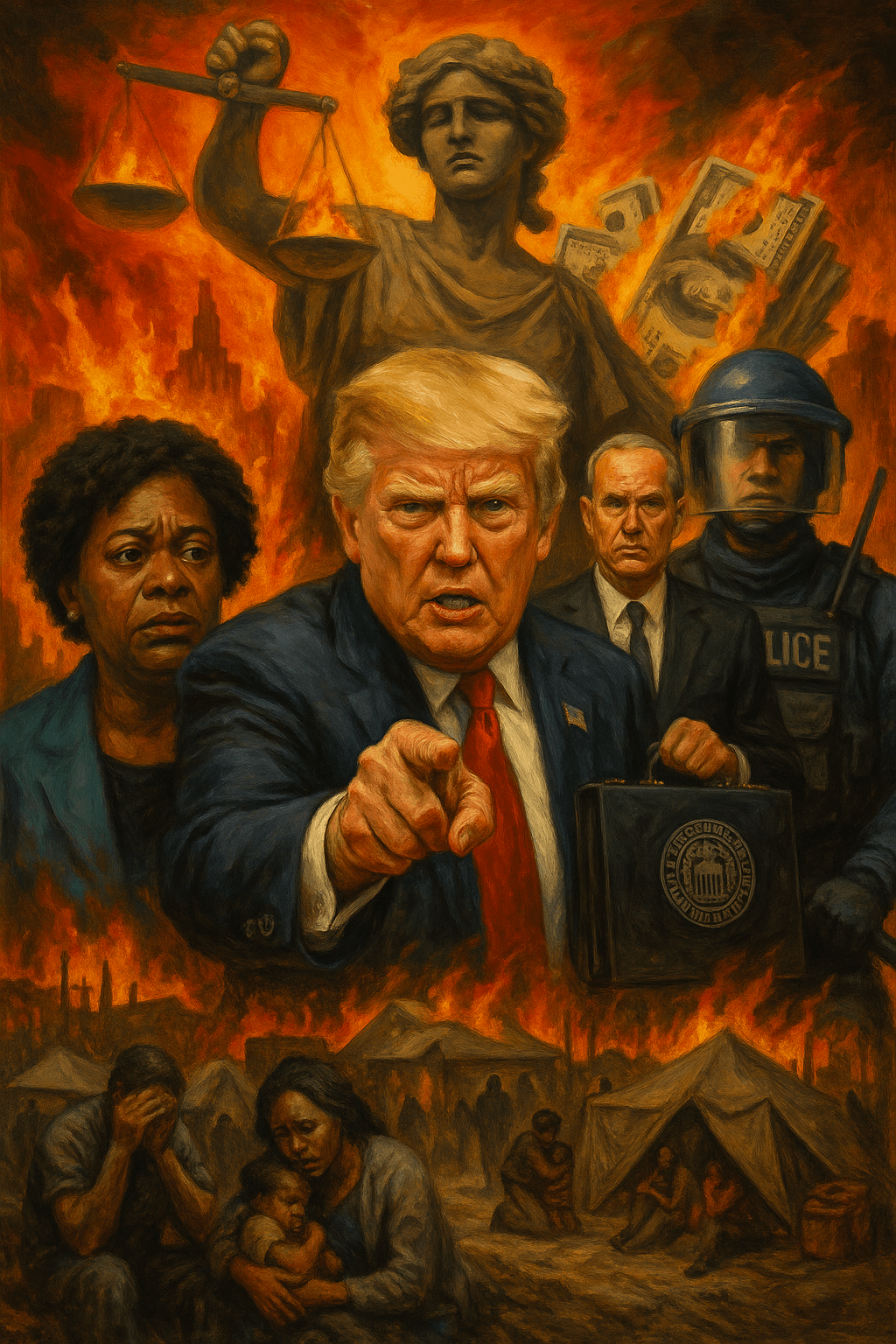
The Associated Press calls it “unprecedented.” We call it what it is: the white ruling class tightening its grip on finance, disciplining labor at home, strangling nations abroad, and weaponizing every institution to enforce obedience.
By Prince Kapone | Weaponized Information
September 18, 2025
Turning Allegations into Spectacle, Burying the System Beneath
The Associated Press article “Trump asks the Supreme Court for an emergency order to remove Lisa Cook from the Fed board”, written by veteran correspondent Mark Sherman on September 18, 2025, appears on the surface as straightforward reporting: Donald Trump is petitioning the Supreme Court to remove Federal Reserve Governor Lisa Cook, citing alleged mortgage irregularities that supposedly call her credibility into question. The piece notes the unprecedented nature of such a move, sketches the legal back-and-forth, and gives the impression of sober coverage of an institutional dispute. Yet the story is less about “facts” than about how power and perception are arranged. It does not inform; it naturalizes. It does not clarify; it obscures. What it leaves buried is precisely what matters most.
Sherman himself is no neutral scribe. He has spent decades moving within the cloistered world of the U.S. Supreme Court and its satellite institutions, his career tethered to the elite beat of Washington’s legal and political establishment. This proximity shapes the orientation of his prose: authority flows downward from courts and executive offices, while the people are absent. He writes not for those who must live under the weight of monetary policy, but for those whose portfolios rise and fall on the Fed’s decisions. His social function is that of a translator for the managerial classes, someone who converts raw power into digestible copy, always with the presumption that institutions deserve reverence even when they are under fire.
The outlet he writes for, the Associated Press, is itself a monument to imperial information management. Founded in 1846, AP is structured as a cooperative, yet in practice it is financially and politically bound to Western corporate media conglomerates, governments, and transnational capital. Its product—wire copy meant to be reproduced without alteration in newsrooms across the globe—ensures uniformity of narrative. It is not merely a news service but a distribution mechanism for ideological consensus. When AP calls Trump’s petition “unprecedented” or presents allegations against Cook as central to the story, that framing ricochets across thousands of platforms. This is how imperial legitimacy is standardized: repetition at scale, wrapped in the language of neutrality.
When we dig beneath the copy, we see the mechanics of propaganda at work. The article’s fixation on “unprecedented” status makes Trump’s move appear as a one-off aberration, thereby sanitizing the longer history of presidential pressure campaigns against the Fed. This exceptionalism conceals continuity. By centering Cook’s alleged personal improprieties—claims about how she listed her properties years before her appointment—the article personalizes what is actually structural: a president’s attempt to bend the machinery of monetary sovereignty to his will. Trump’s solicitor general is quoted at length, his accusations laid out with gravity, while Cook’s defense is collapsed into cursory denials. This asymmetry elevates the prosecutorial voice and diminishes the target, producing a hierarchy of credibility on the page that mirrors the hierarchy of power in Washington.
The rhetoric of “emergency order” lends Trump’s gambit a sense of urgency, as though the very functioning of the economy hinges on the rapid removal of one Black woman from a seven-member board. Here the journalist becomes a stenographer of spectacle, reproducing the drama staged by the executive branch rather than interrogating its purpose. What goes unexamined is how the Fed itself, whether insulated or captured, serves the same master: the preservation of capitalist order at home and dollar dominance abroad. By couching the conflict in terms of personal integrity and institutional etiquette, the article conceals that the struggle is about who commands the levers of finance in a moment of imperial crisis.
In this way, the AP transforms a fundamental confrontation over power into a morality play about one woman’s alleged missteps. The audience is left with the image of Trump pushing boundaries, Cook defending herself, and the courts refereeing the clash. Missing are the workers crushed by the Fed’s rate hikes, the global South subjected to dollar strangulation, the racial dynamics of targeting the first Black woman ever seated on the Fed’s board. Sherman’s article is not a neutral dispatch. It is a carefully curated silence, a text in which the omissions speak louder than the sentences printed. It is the imperial order whispering through the language of “news,” ensuring that what is most vital is left unsaid.
What the Article Leaves Out: The Material Terrain of Technofascist Consolidation
The Associated Press framed Trump’s petition to remove Lisa Cook as an “unprecedented” clash of personalities, but what disappears in that telling is the broader economic program already being rammed through under Trump 2.0. Since returning to office in January 2025, Trump has pursued a package of tax cuts and budget changes whose distributional effects are plain: as I previously reported, his signature bill increases deficits by trillions while redistributing benefits upward. Analysts noted that the vast majority of relief flows to corporations and the wealthy, locking in austerity for the poor while freeing new streams of capital for the ruling class. This is not fiscal prudence but open class war. According to the Congressional Budget Office, the bill will add $2.4 trillion to deficits while stripping health insurance from nearly 11 million people. Oxfam further notes that U.S. billionaires gained $365 billion in wealth over the past year, underscoring how public sacrifice and private accumulation are two sides of the same policy.
Trump has also escalated his executive orders on tariffs, reviving a “reciprocal tariff” system first announced on April 2, 2025. The White House fact sheet and follow-up legal trackers show how categories of goods are continuously added and removed to maximize leverage. The short-run impacts are already visible: the Yale Budget Lab estimates significant cost increases for U.S. households, while independent analyses find the burden falls largely on U.S. consumers. In agriculture, new tariffs on sugar are already raising input costs for food producers and families alike. These are not protective measures—they are nationalist instruments of austerity. At the same time, Al Jazeera’s audit of over 100 household goods found that only 30% of U.S. kitchen appliances, 16% of furniture, and 3% of clothing are made domestically. “Made in America” is revealed not as revival, but as reliance on a global plantation system of outsourced production.
Parallel to tariffs, sanctions remain a central weapon. The Treasury’s Office of Foreign Assets Control issued new maritime advisories in April 2025 targeting Iran’s shipping sector, while Reuters chronicled expanded sanctions across Russia, China, and Venezuela. Sanctions are not side notes—they are siege warfare waged through financial instruments, disciplining entire nations in the name of preserving U.S. hegemony.
On the “reshoring” front, the administration has used the pretext of national security to shovel billions toward semiconductor monopolies. In May, TSMC announced a $100 billion U.S. expansion backed by White House guarantees, adding three new fabs and advanced packaging facilities. The industry trade press confirmed the scale. But far from serving workers, these projects deepen dependency on monopoly capital, with public subsidies underwriting private profit. At the same time, “reshoring” is reshaping the warehouse sector. According to Supply Chain Dive, 80% of U.S. warehouses still lack automation, 67% run on Excel, and 62% report “limited visibility”—figures industry leaders treat as deficiencies, but which in practice mark the terrain where surveillance, deskilling, and algorithmic labor management are expanding.
Meanwhile, Trump signed an executive order opening 401(k) retirement funds to private equity and crypto markets, exposing workers’ savings to speculative looting under the banner of “modernization.” Here again, the language of freedom masks the reality of legalized plunder. Financial institutions are simultaneously scaling up tax avoidance. Bloomberg reported that BlackRock, Goldman Sachs, and Morgan Stanley are automating “tax-loss harvesting” through $3 trillion in separately managed accounts, processing billions in engineered losses to slash IRS bills for the wealthy. These practices, lauded as innovation, operate as legal tax shelters inaccessible to the working class.
Most striking is the immigration crackdown. Major workplace raids have resumed, and ICE reports expanded detention and enforcement operations. Economists at the Economic Policy Institute show how deportations are designed not just to terrorize communities but to discipline labor markets—removing undocumented workers while driving down wages for all. The CBO’s 2025 outlook projects slower growth and higher unemployment alongside policy headwinds; independent modeling by the University of Pennsylvania’s Penn Wharton Budget Model finds mass deportation would reduce GDP and depress wages.
Trump’s war on the federal workforce is another prong of the same offensive. The revival of Schedule F strips civil service protections from tens of thousands of employees, enabling mass removals and replacing them with loyalists. The creation of a Department of Government Efficiency under Executive Order 14222 mandates across-the-board cuts to contracting and grants, while consolidating executive power over spending; see also Reuters’ report on the creation of DOGE. For a running public tracker of these actions, consult the compiled list of executive orders.
Taken together, these measures form a coherent pattern: tax cuts for the wealthy, tariffs and sanctions to enforce nationalist discipline, subsidies for monopolies, speculative exposure of retirement savings, financial tax shelters for elites, mass deportations to recalibrate labor, and direct assaults on the civil service to concentrate executive control. These are not scattered initiatives—they are the pillars of technofascist consolidation, the architecture of a ruling class attempting to preserve its dominance through crisis. By omitting this terrain, the Associated Press article reduces a structural struggle over imperial survival to a soap opera about one woman’s mortgage forms.
From Institutional Drama to the Architecture of Crisis
The Associated Press casts Trump’s petition as a sensational first, a breach of precedent: a president trying to yank a sitting Fed governor from office, punctuated with whispers of personal impropriety. The script is a courtroom drama, designed to keep the spectacle on Cook’s mortgage forms and Trump’s gamble, while the real stakes disappear beneath the stage lights. But peel back the theater and the meaning is clear: Trump is not improvising. He is advancing the next phase of a ruling-class project — to discipline the Federal Reserve, seize direct control over economic policy, and fasten the economy itself to the executive’s hand.
This is not aberration. It is the trajectory of imperial decline. Abroad, dollar supremacy is eroded by the growing muscle of BRICS+ and the refusal of the Global South to keep financing U.S. deficits on Washington’s terms. At home, debt piles, wages stagnate, and the system’s old methods of expansion are exhausted. The white ruling class, fractured in its factions but united in its determination to preserve supremacy, has resolved its crisis of leadership by turning again to Trump. He is not their accident; he is their instrument, chosen to preside over the project of imperialist recalibration abroad and technofascist consolidation at home.
Cook’s targeting is not incidental. As the first Black woman appointed to the Fed board, she symbolizes the thin legitimacy liberal technocracy wraps itself in — diversity without power. Trump’s move to discredit and purge her through allegations of personal misconduct is not only a message to his base; it is a declaration to the institution itself: independence is finished. From now on, the Fed is expected to serve openly as an arm of the executive, stripped of even the pretense of autonomy. This is the essence of technofascist consolidation — the fusing of executive authority, financial command, and ideological control into one apparatus where every lever is synchronized toward preserving capital.
Seen through this lens, the move against Cook is the economic counterpart to Trump’s tariffs, sanctions, and deportations. It is part of a single campaign of domestic labor recalibration. By “reshoring” industry through subsidies like the TSMC $100 billion deal, shredding social programs, busting unions, and driving down wages, the ruling class is reengineering U.S. labor conditions to mirror those of the colonized periphery — precarious, cheap, disposable. Control of the Fed is the final tool in this arsenal: monetary power to punish dissent, discipline workers, and absorb shocks to capital without conceding relief to the people. Trump’s Schedule F orderto purge career civil servants and his mass deportation campaign reveal the domestic front of the same logic: weaken organized labor, flood workplaces with fear, and erode the capacity of workers to resist.
At the deepest level, the struggle over the Fed belongs to the logic of settler-colonial pacification. For centuries, U.S. statecraft has meant disciplining colonized peoples abroad with sanctions and bombs, while pacifying the colonized within through poverty, prisons, and police. Now, with empire faltering, those same methods are being fully retooled against the domestic population. Control over the central bank means that austerity itself can be wielded like a weapon — interest rates as shackles, liquidity as reward, credit as a system of obedience. Cook’s removal is not about her; it is about securing the last bastion of technocratic insulation and turning it into an open instrument of pacification.
What AP calls “unprecedented” is only the mask slipping. The independence of the Fed was always an illusion — a polite fiction to obscure the fact that it has always served capital first and the people never. Trump’s gambit is not a break with tradition but its logical culmination: the naked command of finance by the executive in an age of imperial decline. This is how the ruling class intends to survive its own crisis — not by reforming the system, not by offering concessions, but by tightening control, gutting the last remnants of the welfare state, and weaponizing every institution to enforce obedience. Trump’s petition is not the aberration AP claims it is. It is the future of U.S. capitalism, written in the language of emergency and enforced through the architecture of technofascist consolidation.
From Excavation to Mobilization
If the AP’s framing trains us to see Trump’s assault on the Fed as a drama of personalities, our excavation unmasks it as a maneuver in the broader crisis of imperialism: the white ruling class consolidating technofascist command, recalibrating labor through repression and austerity, and extending settler-colonial pacification under the guise of legality. The question is what we do with this knowledge. Critique alone is insufficient. The point is to locate where resistance is already alive, and to join forces with those who fight on the very fronts Trump and his class seek to lock down.
Across the United States, grassroots organizations are mobilizing in ways that strike directly at the pillars of this consolidation. The Black Alliance for Peace insists that the U.S. war machine abroad is inseparable from the police-prison regime at home, tying imperial decline to racialized state violence. The International League of Peoples’ Struggle – U.S. chapter builds bridges between workers in the belly of the beast and those in the Global South, framing deportations, austerity, and sanctions as parts of the same system of imperial extraction. The Anti-Imperialist Action Committee in Massachusetts organizes locally against militarism and corporate capture, showing that even in small towns, imperialism can be confronted at the grassroots. The Troops Out Now Coalition continues to agitate against war spending and state violence, cutting through bipartisan consensus on militarism. And Witness for Peace, rooted in solidarity with Latin America and the Caribbean, demonstrates how U.S. imperial violence abroad and austerity at home are fused in the same circuitry of empire.
These formations do not simply protest—they organize. They build campaigns against mass deportations, they defend Black and Indigenous communities against colonial violence, they expose the revolving door between corporate lobbies and the state, and they link every cut to social spending with every expansion of the Pentagon’s budget. Their terrain is not abstract. It is concrete: in the barrios of Los Angeles resisting ICE, in the streets of D.C. where Black liberationists demand an end to police occupation, in Massachusetts towns where local committees name and confront U.S. imperialism, in solidarity networks stretching from Honduras to Haiti where empire’s fallout is resisted daily.
The call, then, is clear. To the global working class, to the colonized nations, to the multipolar and socialist forces rising across the world, and to defectors from empire in the North: align with these struggles, strengthen them, and learn from them. The technofascist project cannot be confronted by waiting for courts or elections to correct it. It must be disrupted where it feeds—on labor, on land, on lives. Campaigns already exist; what remains is to scale them, connect them, and sharpen their clarity.
The Fed, the presidency, the lobbies, the deportation machine—all are nodes in the same imperial architecture. To fight them is not a matter of charity or reform. It is the condition for survival, and the horizon for liberation. The mask has slipped; now the work is to tear it off completely.
 Weaponized Information
Leave a comment