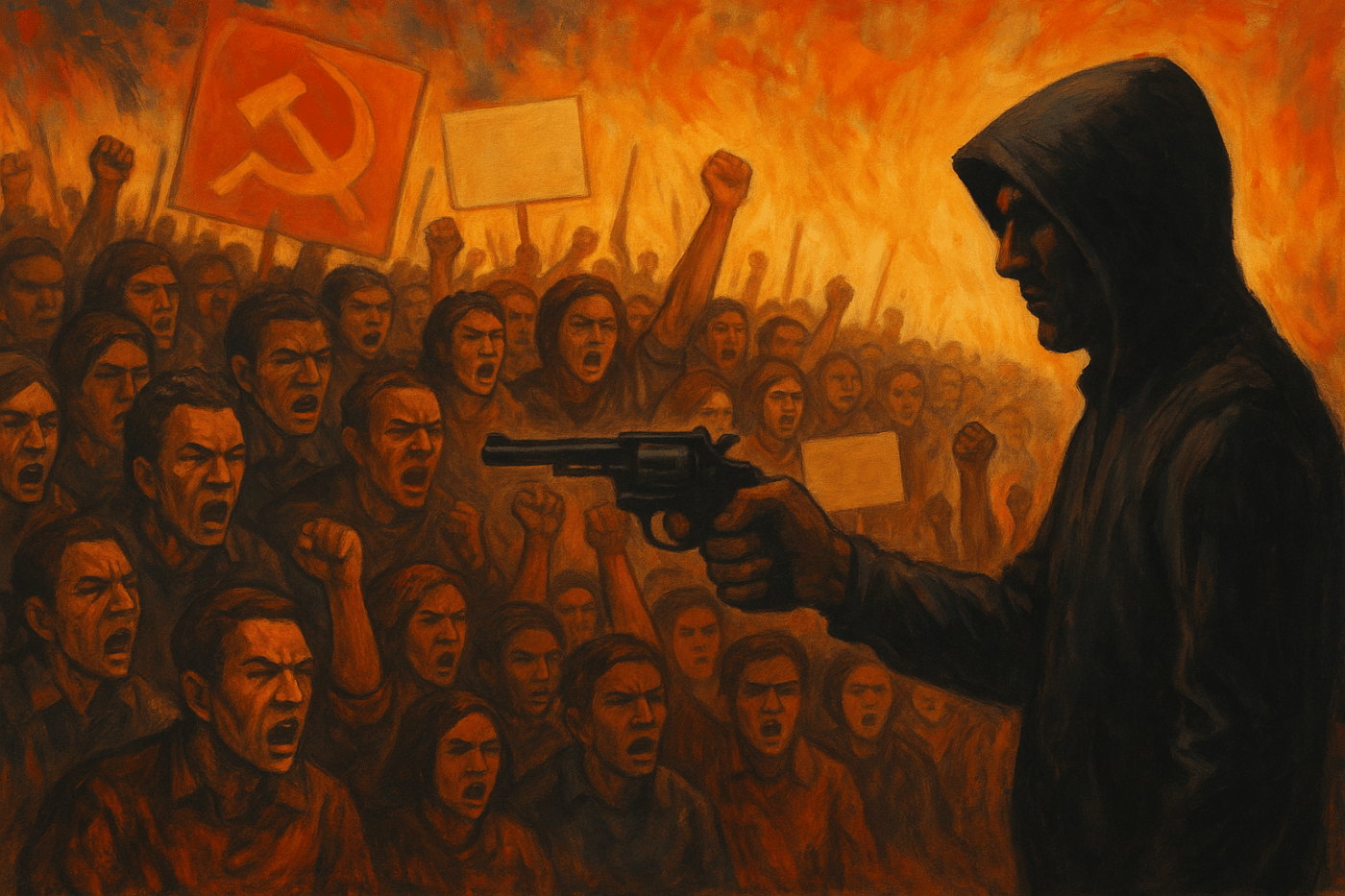
Assassination is a spectacle that feeds repression, not revolution. Terrorism creates martyrs for the ruling class and pretexts for the state. History proves only the organized masses can topple empires. Communists reject illusions to build the discipline of real liberation.
By Prince Kapone | Weaponized Information | September 11, 2025
The Mirage of the Gunshot
The image is seductive: a single bullet, a lone hand, a tyrant collapsing, and history itself pivoting in that instant. Popular culture feeds us this fantasy over and over—the idea that liberation is just one assassination away, that injustice can be toppled by a pistol hidden in a coat pocket. But revolutionaries, those who live and die with the oppressed, know this is a mirage. The state is not a man to be shot; it is a machine, a network of class power, an empire with a thousand heads. Cut one down and another grows in its place. Assassination is a story told to pacify the desperate, to trick us into believing that individual heroics can substitute for organized struggle.
The truth is harsher and clearer: the ruling class thrives on these acts. Each assassination is recycled into propaganda, a justification for new laws, new prisons, new armies of surveillance. Each bomb in the marketplace or bullet on the stage is used to tighten the net around the very people who had no part in it. The ruling class knows how to turn tragedy into leverage, grief into handcuffs. They do not tremble at terrorism; they feed on it. The spectacle of the lone gunman does not terrify them—it validates them, giving them the excuse to intensify repression in the name of safety and order.
Communists do not fall for this trick. We know that liberation is not born in the echo of a gunshot but in the roar of the masses. The power of the oppressed is not the despairing act of one individual but the collective discipline of millions. To believe otherwise is to chase shadows, to mistake a spark for the sunrise. Real revolution is not assassination; it is organization. It is the slow, patient, and dangerous work of building class consciousness, of uniting workers and colonized peoples into a force strong enough to topple not just a man but a system. That is the lesson written in blood across history: the mirage of the gunshot fades, but the power of the masses endures.
The Class Basis of Assassination and Terrorism
Political assassination and terrorism carry a certain romance for those who stand outside the struggle, or for those so crushed by despair that they cling to the fantasy of one dramatic act altering the course of history. But when we analyze it through the lens of class struggle, the reality becomes clear: these tactics are not born from the organized power of the oppressed. They emerge from impatience, from the isolation of the petty bourgeoisie, or from the desperation of individuals cut off from mass movements. They are acts that substitute the will of a few for the action of millions, and in doing so, they betray the very essence of revolutionary politics.
For communists, history moves not by assassins but by classes in conflict. Kings, generals, presidents—they are not the engine of oppression but the representatives of a class order. To believe that killing one figure topples the system is to misunderstand power itself. The ruling class does not rest on the shoulders of a single leader; it is embedded in institutions, armies, banks, and police. When anarchist conspirators in 19th century Europe declared that “the deed” would inspire the masses, what followed was not liberation but backlash. The bullets felled individuals, but the system adapted instantly, often stronger than before. Each act confirmed to the masses not the possibility of freedom but the futility of violence divorced from organization.
Terrorism, in this sense, is the politics of substitution. A handful act “for” the people, imagining themselves as the spark, while the people remain spectators. But the working class does not need saviors who bomb in its name; it needs organization, strategy, and power built in its own hands. That is why communists reject assassination and terrorism as class strategies. They are not the tools of the proletariat but of adventurists who mistake spectacle for revolution. The path to liberation cannot be paved by individual despair; it must be constructed by collective struggle, disciplined, conscious, and rooted in the material force of the oppressed.
Why It Doesn’t Work
The appeal of assassination and terrorism rests on a fatal illusion: that the state is fragile, that a single act of violence can unmask its weakness and bring the edifice crashing down. But the modern state is not a windowpane waiting for a stone—it is a fortress. Its walls are built of institutions, armies, prisons, banks, and a propaganda apparatus that can spin any event into its own advantage. When a revolutionary falls into the trap of terrorism, the only thing shattered is the credibility of the movement itself. The state does not falter; it grows stronger, feeding off the act like a parasite that thrives on blood.
Every assassination is immediately recoded by those in power. The fallen leader becomes a martyr, their image polished into innocence, their legacy weaponized to justify new laws and harsher repression. Reactionary figures in particular benefit most—death grants them sanctity that life never could. The lone gunman or the hidden bomb delivers not weakness to the ruling class but legitimacy. Governments invoke “national unity,” unleash new surveillance powers, and expand the machinery of police and intelligence. The supposed blow against the system becomes the excuse for the system to tighten its grip.
Even worse, terrorism alienates the very people in whose name it claims to act. Workers and oppressed communities do not see themselves in isolated acts of destruction; they see danger, fear, and chaos. Instead of inspiring solidarity, terrorism breeds suspicion and resignation. Instead of opening space for organization, it closes it. History is littered with examples: anarchist bombings in 19th century Europe that rallied support not for the revolution but for the police; assassinations that provoked crackdowns, demoralizing the movements they were meant to ignite. This is why communists insist that liberation cannot come from spectacle. The enemy is not surprised by these acts; it counts on them. Only mass struggle—organized, disciplined, collective—can withstand the fortress and bring it to the ground.
Historical Lessons Written in Blood
History offers no shortage of examples for those willing to study instead of fantasize. In the late 19th century, anarchist militants in Europe declared that “the deed” would awaken the people. They hurled bombs, they struck down kings and presidents, they spilled blood in the name of liberation. But what followed was not revolution. What followed was repression. Police powers expanded, workers’ organizations were raided, and the masses were left watching from the sidelines as their supposed champions were executed or jailed. The state did not crumble—it fortified itself. The lesson was clear even then: terrorism does not build class power; it isolates and destroys it.
Consider 1914, when the assassination of Archduke Franz Ferdinand did not shatter empires but helped ignite a world war. Millions of workers and peasants across Europe were dragged into the slaughterhouse of trench warfare, not liberated from imperialism. The ruling classes seized the act, wrapped it in nationalist fervor, and marched humanity into catastrophe. The bullet of a lone assassin became the pretext for one of the deadliest chapters in human history. Far from weakening the system, it gave the system the war it wanted.
The same pattern recurs in the modern era. States themselves have long learned to weaponize the spectacle of terrorism. Intelligence agencies sponsor or provoke attacks to justify new crackdowns, painting dissenters with the same brush. From COINTELPRO’s infiltration of radical groups in the U.S. to the false-flag operations of dictatorships abroad, the line between authentic terrorism and state-manufactured provocation blurs. In every case, the outcome is the same: repression deepens, surveillance expands, and genuine revolutionary struggle is smeared. Contrast this with the great victories of the oppressed—the Russian Revolution, the Chinese Revolution, Vietnam, Cuba, the anti-colonial struggles of Africa. None were won by assassinations or isolated bombs. They were won by masses organized in disciplined struggle, armed with consciousness as much as with weapons, and rooted in the collective power of the people.
These lessons are written in blood: terrorism delivers martyrs to the ruling class, not victories to the oppressed. Assassination creates crises that the state knows how to exploit. Only when the masses move—through strikes, uprisings, wars of liberation—does history bend toward revolution. Communists do not worship the lone act; we study the record and choose the path that builds power where it matters: in the hands of the people themselves.
The Revolutionary Alternative: Mass Power, Not Spectacle
If assassinations and terrorism are dead ends, what then is the path forward? Communists answer without hesitation: the road to liberation is built through the mass power of the oppressed. It is the strike that halts production, the uprising that overwhelms police lines, the people’s army that defends liberated ground, the dual institutions that replace the authority of the old state with the beginnings of the new. Revolution is not the fantasy of a single gunshot; it is the disciplined movement of millions who have come to recognize their collective strength.
The distinction is crucial. Terrorism substitutes the will of a few for the struggle of the many. Revolution does the opposite: it transforms the anger of the many into a disciplined will. When the masses act together, the state cannot simply mourn a fallen leader or pass another law; it faces the paralysis of its own foundations. A general strike can do what no bullet can—halt the flow of profit and reveal who actually makes society run. A people’s uprising can do what no bomb can—replace fear with solidarity and crack open space for a new order. Assassination individualizes the struggle; revolution collectivizes it.
Violence, when it comes, is not abandoned by communists but placed in its proper context: defensive, collective, and inseparable from mass organization. No revolution has succeeded without confrontation, but no revolution has succeeded through terrorism alone. The Red Army, the Viet Minh, the Cuban guerrillas—each fought, but they fought as the organized expression of entire peoples, not as isolated cells chasing headlines. Their victories flowed from class power, not spectacle. This is why we insist: the revolutionary alternative is not in the mirage of the lone act but in the hard, patient, and disciplined work of organizing the oppressed into a force capable of seizing history.
The Discipline of Liberation
The appeal of assassination and terrorism comes from desperation, from the hunger to see the enemy fall in one dramatic stroke. But revolutionaries cannot afford illusions. We measure tactics not by how they feel in the moment, but by whether they build power for the oppressed. Assassination builds nothing. Terrorism isolates, provokes repression, and feeds the ruling class the martyrdom it craves. These are not the weapons of the proletariat. They are the traps laid by history, into which too many have already fallen.
Communists insist on another path—the long, disciplined road of mass struggle. We study history not to repeat its tragedies but to inherit its victories: the revolutions that succeeded because they rooted themselves in organization, in consciousness, in the collective power of workers and the colonized. Our fight is not against a single politician or general; it is against a system that breeds them endlessly. To topple that system requires patience, clarity, and discipline. It requires millions, not martyrs. It requires strategy, not spectacle.
This is why communists reject assassination and terrorism: not because we are pacifists, but because we are serious. We know that liberation demands more than a bullet. It demands the organized force of the oppressed, acting in unison, seizing history with their own hands. That is the discipline of liberation: to refuse the mirage, to name the traps, and to build the power that no assassination can ever deliver. Only then will the oppressed rise, not as spectators to a single act, but as authors of a new world.
 Weaponized Information
Leave a comment