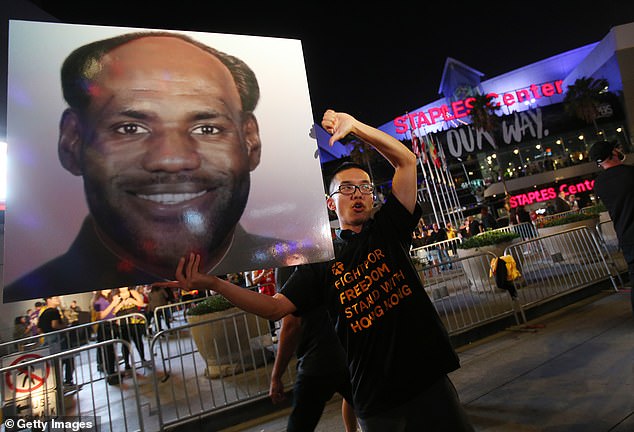
When the NBA sees profit, LeBron sees people—and the struggle over who owns the game reveals the larger struggle over who owns our future.
By Prince Kapone | Weaponized Information | September 9, 2025
The Court as a Stage for Empire
Reuters wants you to believe that LeBron James publishing an essay in the People’s Daily marks the end of a long corporate misunderstanding between the NBA and China. Eduardo Baptista’s article frames it like the tidy resolution of a soap opera: the curtain rises, the fans cheer, and the billion-dollar machine starts humming again. The story is dressed up as sentimental homage, LeBron praising Chinese fans for their warmth while the league readies its first games on Chinese soil since 2019. But beneath the applause track is the propaganda device: culture is smoothed into capital, memory into market, and basketball into a diplomatic anesthetic. The subtext is clear—reconciliation is measured not by the freedom of peoples but by the restoration of profits.
The author’s own place in this drama is worth a look. Baptista is a Beijing correspondent for Reuters, the global wire service that feeds headlines to nearly every major outlet in the West. His job is to narrate the official line of capital in a voice that feels objective. He is no villain, merely a functionary. Like the stenographers of empire before him, his pen works by omission. The riots of history—Hong Kong’s colonial contradictions, the NBA’s dependence on Chinese markets, the machinery of censorship and spectacle—are swept under the court so the game can continue uninterrupted.
And then there’s Reuters itself, the empire’s news factory disguised as neutral broker. Owned by Thomson Reuters, wired into global finance, it is less a newspaper than an infrastructure, a pipeline carrying the ideological crude oil of capital to every trading floor and newsroom. Its “Trust Principles” claim impartiality, but impartial to whom? Impartiality to empire is not impartiality at all—it is loyalty to the system that pays the bills. When Reuters speaks, it speaks the language of markets, smoothing jagged contradictions into legible stories for investors and officials alike.
The propaganda devices are easy enough to read once you learn their grammar. First, the framing trick: LeBron’s essay is sold as a romantic reconciliation, as though the NBA were a family mending fences rather than a corporation restoring revenue streams. Second, the omission: nowhere is there discussion of how U.S. corporations weaponize sport for soft power, how the league’s China policy has always been about market access rather than cultural respect. Third, the affective bait: LeBron’s genuine affection for Chinese fans is transmuted into the league’s affection for Chinese sponsorships, an emotional alchemy where sincerity becomes branding. Fourth, the laundering of authority: the very fact that the People’s Daily printed his words is presented as a quaint symbol of friendship rather than a calculated gesture of state signaling. Fifth, the elastic vagueness: we are told the NBA’s recovery is “almost complete,” though no numbers or conditions are ever offered. Sixth, the anesthesia of geopolitics: the U.S.–China rivalry is erased under the soft lighting of basketball diplomacy, as though the contradictions of empire could be solved by a jump shot.
None of this is about whether LeBron himself means well—he almost certainly does. He has always been more than a player, a man conscious of his role as a cultural ambassador, whether in Beijing or Akron. What Reuters is doing here is different. It is drafting him into a narrative where his sincerity becomes cover for a corporate and geopolitical recalibration. The article isn’t about LeBron, or the fans, or even the game. It’s about smoothing the ground for empire’s cultural export to resume its march, about ensuring that when the ball tips in Macao, the machinery of profit and propaganda is already humming. That is the excavation, the archaeology of the text. Strip away the gloss and what remains is the empire selling nostalgia in a new jersey.
Facts Buried Beneath the Hardwood
Once we strip away the sentimental gloss, what remains are facts—hard, empirical fragments scattered through the article like loose change. Let us gather them: LeBron James did indeed write an essay for the People’s Daily, the official paper of the Communist Party of China. He praised Chinese fans for their kindness and said he wished to contribute to the development of basketball there. The NBA, once worth over $4 billion in China, saw its relationship collapse in 2019 when Houston Rockets general manager Daryl Morey tweeted support for Hong Kong protesters. The fallout was immediate—CCTV blacked out games, sponsors fled, and merchandise vanished. Commissioner Adam Silver admitted that the league lost “hundreds of millions.” Six years later, the league is back on Chinese airwaves, sponsors have returned, and preseason games are scheduled in Macao for the first time since the rupture. These are the skeletal facts Reuters offers, thin and unadorned, but enough to trace the outline of the story.
What the piece does not tell us is equally important. The People’s Daily is not just another newspaper—it is the official voice of the Chinese state, its pages reserved for declarations of policy and signals of intent. When it publishes LeBron, it is not sentiment; it is strategy. Nor does the article mention that in the years since the fallout, domestic Chinese brands like Anta have surged, signing NBA stars and reshaping the market. The NBA is not merely “coming back” but re-entering a battlefield where its monopoly is weaker than before. Also missing is the fact that the Nets’ upcoming games are tied to a Tencent-backed reality show, “CheersNets,” marrying basketball spectacle to platform capital in ways far deeper than a box score can show. Each of these gaps shifts our understanding from “NBA restored” to “NBA negotiating a changed terrain.”
Context matters. The 2019 rupture was not just about a tweet. It was about the tectonic plates of empire grinding against one another—Washington tightening its grip on Hong Kong while Beijing asserted sovereignty. Sport became collateral damage in a larger struggle of legitimacy and power. Now, in 2025, the contradictions are sharper: U.S. sanctions and tech controls, Chinese countermeasures, talk of a “new cold war.” And yet here comes the NBA, smiling and dribbling, pretending to float above politics. But sport is politics. It is labor, markets, diplomacy, and propaganda all braided together.
To situate this revival properly, we must see it as a commercial re-entry happening in the shadow of great power rivalry. The league’s return to Chinese screens is not evidence of harmony but proof of a managed détente in one narrow cultural sector. It is not “people-to-people” exchange in the pure sense, though that element is real and sincere in the passion of fans; it is primarily capital-to-capital exchange, with fans as the connective tissue. And the contradictions remain unresolved. The NBA may dribble in Macao, but the U.S. Navy still sails through the Taiwan Strait. The ball may bounce, but the shadow of empire still looms across the court.
From Cultural Diplomacy to Counter-Imperial Playmaking
Here is where the story changes shape. If Section II gave us the bones, now we put flesh on them. The return of the NBA to Chinese soil is not a fairy tale of reconciliation but a case study in how empires reconfigure their cultural exports when faced with resistance. What Reuters calls a “revival” is in fact the recalibration of soft power. Sport is not immune from the logic of imperialism—it is one of its most polished tools. Every dunk, every jersey sale, every broadcast deal carries with it the shadow of empire. To see LeBron James in the People’s Daily is to see the collision of two forces: the NBA as corporate empire-builder, and LeBron as an individual who, in his own way, seeks to bridge peoples and unsettle myths.
This is where the dialectic sharpens. On one side stands the NBA, a Western corporation whose business model depends on maintaining monopoly status as the one true league of global basketball. On the other side is LeBron, not just a player but a cultural figure with leverage independent of the league. His essay, tours, and potential role in a new international league all destabilize the NBA’s grip. Reports make clear that LeBron, with Maverick Carter and a network of global backers, is exploring a $5 billion touring league with equity stakes for players, men’s and women’s teams alike, playing across global cities. This is not a sideshow—it is a fundamental threat to the NBA’s model of extraction, where the players generate the value but the owners monopolize the profits. LeBron is effectively saying: why should the game belong to the corporation when it belongs to the people who play and watch it?
The NBA’s reaction tells its own story. Suddenly Adam Silver is accelerating plans for European expansion—regular-season games in London and Berlin, new circuits to reassert dominance. Like a threatened empire, the league doubles down on conquest the moment its monopoly is challenged. This is imperial reflex disguised as innovation. When Reuters gushes about the NBA’s “revival,” it masks the real struggle: the league fighting to keep its colonial grip on the game even as cracks begin to show.
We must also reckon with the ideological dimension. The Tricontinental Institute calls this moment one of hyper-imperialism: a system where finance, military power, and culture are fused into a single architecture of domination. The NBA is one strand of this web, exporting Americana as surely as the Pentagon exports bases. Its “soft power” is not benign; it is the velvet glove that hides the fist. When the league re-enters China, it is not just sneakers and hoops—it is a signal of U.S. capital’s resilience, a reminder that even amid sanctions and standoffs, empire finds ways to sell itself. Yet within this same moment lies the potential for rupture. If LeBron’s vision of an international league takes root, it could redistribute power away from monopolists and toward the players and fans who actually make the game.
From the standpoint of the global proletariat, what matters is not whether LeBron sells more jerseys or whether the NBA recovers a billion-dollar pipeline. What matters is how sport can either serve empire or disrupt it. The fans in Chengdu who cheer LeBron are not cheering for Wall Street—they are cheering for a man who, in that moment, recognizes their humanity. That is a fragile but real act of people’s diplomacy, and it stands in contrast to the NBA’s corporate hunger. This is why LeBron is dangerous to the league: his sincerity cannot be bought, only redirected. And if his international project succeeds, it could plant the seed of a basketball world less tethered to U.S. capital and more rooted in global solidarity. That is the reframing of this story: not a tidy revival, but a contested court where empire and emancipation face off at tip-off.
When the Ball Is in Our Court
What then are we to do with all this? Mobilization is not a list of instructions handed down like a corporate memo—it is something that emerges organically from the contradictions themselves. The return of the NBA to China underlines one truth: culture is never neutral, and the struggle over who owns it is as real as any factory strike or picket line. If LeBron’s essay in the People’s Daily can soften hardened narratives in the U.S., then culture is already showing its capacity to destabilize empire’s myths. The question is not how to cheer from the sidelines, but how to recognize that these openings belong to us as much as to him.
For the working class and colonized peoples in the Global North, the lesson is clear: when the empire tells you that China is your enemy, remember that the same empire wants to raise your rent, cut your healthcare, and ship your job overseas. The same machine that demonizes Chinese fans as faceless masses is the one that treats you as disposable labor. To see LeBron welcomed with warmth in Shanghai or Chengdu is to glimpse another possibility—that solidarity across borders is not only possible but already alive in the hearts of ordinary people. Mobilization begins when we stop believing the lie that we are isolated, that our only destiny is to be spectators in empire’s game.
Out of this recognition grows something more dangerous than protest slogans: memory and imagination. We remember that sport has been used before as a weapon of resistance—the boycotts of apartheid South Africa, the Black athletes who raised fists in defiance of American hypocrisy, the way entire communities rallied around teams as symbols of liberation. And we imagine what it could mean if today’s arenas were repurposed as spaces for internationalism instead of imperial branding. To mobilize is to refuse the passivity of fandom, to see every dribble and dunk as a site of contest, to talk to our neighbors, to build community, to name the empire behind the spectacle. No one needs to hand us a playbook—we already know the rules, and we already know they were written against us.
The truth is simple and urgent: we are on the court whether we asked to be or not. Empire is playing for keeps, but so can we. Mobilization is not a separate act, it is the daily choice to see through the lies and to speak them aloud, to turn conversations at work, in the street, on social media, into small ruptures of clarity. It is to connect the love of the game to the love of freedom, to insist that what belongs to the players and the fans cannot forever be owned by the billionaires. That is how we move—step by step, word by word, action by action—until the whistle blows and the court belongs to the people again.
 Weaponized Information
Leave a comment