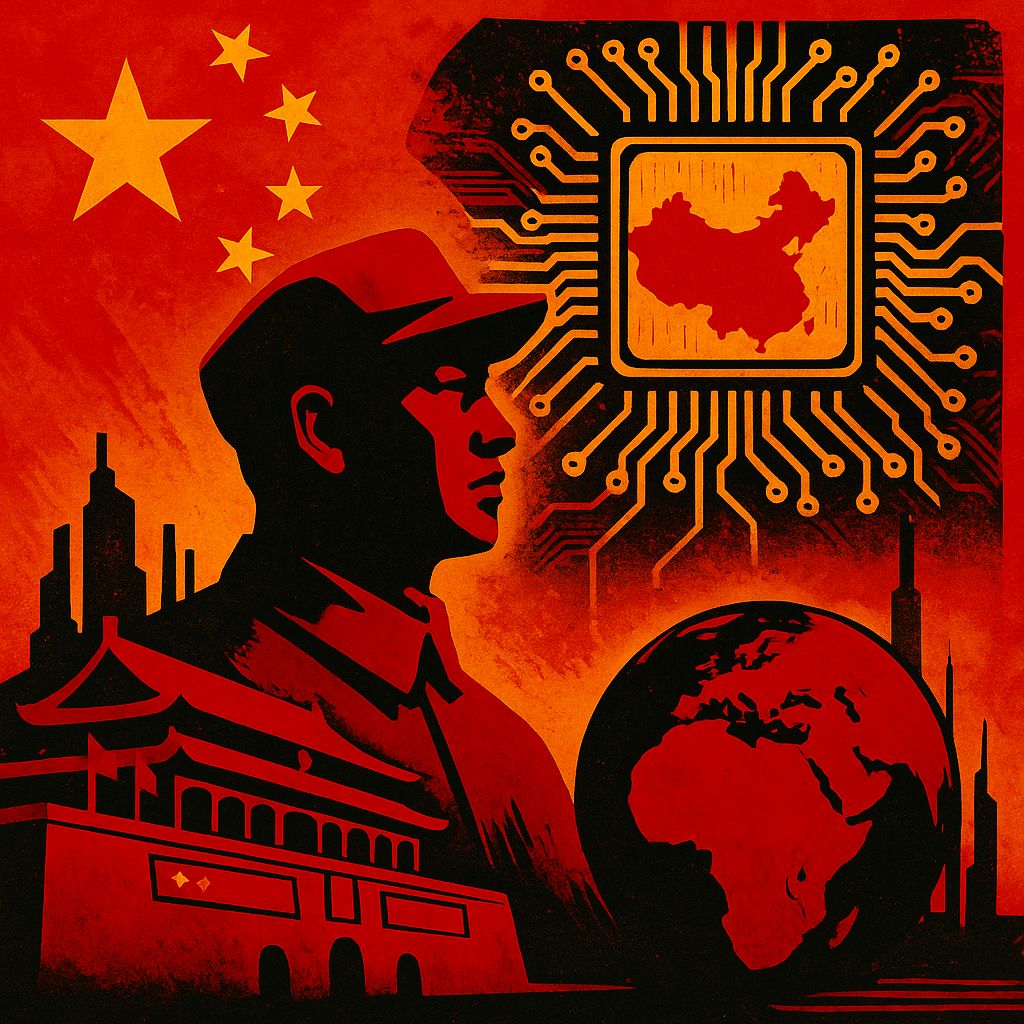
Sanctions meant to strangle Beijing’s future are instead forging a multipolar technosphere, fracturing U.S. monopolies and opening space for the Global South.
By Prince Kapone | Weaponized Information | September 7, 2025
The Sanctions That Forged a Parallel World
Reuters reported that in August 2023, Huawei unveiled the Mate 60 Pro. Inside was the Kirin 9000S, a chip designed by Huawei’s HiSilicon and fabricated in China by SMIC using an ~7nm “N+2” process. The U.S. ruling class had sworn that sanctions would keep China crawling on its knees, begging for imported chips. Instead, Huawei stood up straight, showing that pressure doesn’t just crush—it can also forge. The empire tried to tighten the noose, but the rope burned in its own hands.
TechInsights confirmed that SMIC pulled this off without the West’s crown jewel—extreme ultraviolet lithography. They used older, less “sophisticated” tools, working with precision, patience, and persistence. The so-called shackles of sanctions became the hammer and anvil for a new industrial breakthrough. Washington slammed the door shut, but Beijing learned how to build another doorframe altogether. This is what happens when the oppressed refuse to accept the limits imposed by their masters.
Reuters also noted that in May 2024 Beijing poured 344 billion yuan—about $47.5 billion—into its “Big Fund Phase III.” This is not venture capital gambling on a quick return; this is socialist planning with Chinese characteristics, directing resources to secure national survival. Another Reuters report showed that in the same year, Chinese buyers purchased $41 billion worth of wafer fabrication equipment, nearly 40% of all global sales. The message is clear: while Wall Street speculates, Beijing builds.
The Diplomat observed that Washington patted itself on the back for blocking Nvidia’s A100 and H100 GPUs, convinced that China’s AI labs would go dark. But the empire doesn’t understand what it means to struggle under siege. Sanctions cut off the easy path, forcing workers and engineers to carve a harder one. They take away the shortcut, but in doing so they force self-reliance. Marx reminded us that necessity is the mother of invention; Washington just reminded China of that lesson.
Sanctions were supposed to be weapons of suffocation, but in practice they became sparks of creation. Huawei’s Mate 60 Pro was not just another phone—it was a declaration. It told Washington: your monopoly is broken. It told the colonized world: if we can build under siege, so can you. And it whispered to the ruling class in the West, with a grin Marx himself would have loved: “You’ve dug your own grave with your own sanctions.”
Innovation Under Siege
Sanctions are supposed to freeze time. Washington thought that by banning high-end chips and cutting off access to Nvidia’s A100 and H100 processors, it would lock China out of the future. The Diplomat even noted how U.S. officials congratulated themselves, convinced Chinese engineers would be left staring at darkened labs. But history doesn’t move backwards just because empire wants it to. Blockades don’t erase hunger; they sharpen appetites. They don’t stop invention; they make invention a matter of survival.
That survival instinct has now been institutionalized. In May 2024, Beijing created the “Big Fund Phase III,” pouring 344 billion yuan—about $47.5 billion—into building the country’s semiconductor backbone. This isn’t Wall Street’s casino capitalism, where capital chases profit like a dog chasing its tail. This is a state making a conscious decision to funnel collective wealth into the foundations of independence. It’s what socialist planning looks like under siege: patient, methodical, armed with the knowledge that every yuan spent is another chain link broken.
By the end of that year, Chinese buyers had accounted for nearly 40% of all global wafer fabrication equipment sales, spending roughly $41 billion. Think about the scale: while Washington tightens export controls, Chinese firms quietly buy the machines that will outlast any sanction regime. It is the difference between hoarding coins and buying the mint that makes them.
Even analysts at the RAND Corporation—those perennial courtiers of empire—have admitted the contradiction. They warn that restricting advanced chips was meant to throttle China’s AI sector, but instead has given birth to a parallel ecosystem that may eventually be stronger because it is self-sustained. What they don’t say out loud is the obvious: sanctions have become a training program. Every ban forces engineers to improvise, redesign, and retool, sharpening the very skills the U.S. hoped to suppress.
And so the paradox sharpens. U.S. companies that once dominated over 90% of the Chinese chip market now struggle to keep half of it. In trying to preserve their monopoly, they’ve burned the bridge to their most lucrative customers. Wall Street may gnash its teeth at lost profits, but the deeper wound is strategic: Washington has produced the very independence it feared.
Sanctions were meant to be chokeholds. Instead, they have become weights in a training gym. Every squeeze builds muscle, every attempt at suffocation expands lung capacity. China’s chip industry today is not the brittle workshop the empire imagined—it is a forge under siege, hammering out the weapons of its own emancipation. And the more Washington swings the hammer, the sharper the blades become.
The Architecture of Artificial Intelligence
When Washington moved to choke off access to advanced processors, it assumed that China’s ambitions in AI would wither. Yet the opposite happened: the state doubled down. In 2023 and 2024, Beijing announced a raft of national initiatives, from a dedicated AI Industry Investment Fund worth over $8 billion to a series of provincial guidance funds that collectively funneled more than $130 billion into the sector. These figures are not inventions of party slogans — even RAND, a core think tank of U.S. empire, has tracked the scale of these investments, warning that subsidies and state planning are creating a foundation the West cannot easily match.
The goal is not scattershot speculation but a coordinated push: to make China the world’s AI leader by 2030. That is why cities like Shanghai are issuing “computing vouchers,” effectively subsidizing GPU time for startups and small firms. According to Tom’s Hardware, Shanghai alone allocated 600 million yuan to this program. Think of it: while U.S. venture capitalists demand monopolies and quick exits, Chinese municipal governments are treating compute like a public utility — as basic as water and electricity.
Of course, there are contradictions. Overinvestment breeds inefficiency. Entire data centers stand underutilized, and multiple provinces have rushed to build overlapping AI hubs. Reuters columnists sneer that China is “backseat driving” its AI future, suggesting that too much central direction stifles creativity. But their own reporting admits that Chinese firms like Baidu and iFlytek are producing competitive generative models, while newer ventures like DeepSeek are pushing into global benchmarks. The West calls this waste; the rest of the world can see it as redundancy — the sort of redundancy that ensures survival when empire slams the gates shut.
In policy, the emphasis has been not only on research and development but also on sovereignty of architecture. China has been promoting RISC-V, an open-source instruction set, precisely because it avoids licensing fees to Western IP holders. This is not just technical strategy; it is political economy. It is the recognition that ideas, like circuits, can be weaponized by empire. By rooting its AI in open instruction sets and domestically manufactured chips, Beijing is insulating itself from intellectual property blackmail.
None of this makes China’s AI landscape idyllic. The Cyberspace Administration enforces ideological guardrails, demanding that large language models internalize “socialist values” and censor content deemed politically destabilizing. This is a terrain of struggle — where questions of liberation and control collide. But one thing is clear: AI in China is not simply an economic gamble. It is a national project, state-directed and socially embedded. Compare that to the U.S., where AI is a playground of billionaires, trained to maximize advertising clicks, surveil workers, and target drone strikes. Here the divergence is stark: socialism with Chinese characteristics mobilizes AI for collective resilience, while technofascism in the U.S. mobilizes it for profit and repression.
The Machines That Walk Among Us
In China’s cities, the future isn’t hiding in glossy expo halls — it’s trundling down the streets. Food deliveries arrive in squat, wheeled robots, while aerial drones hum above crowded intersections carrying parcels for Meituan and JD.com. The Guardian noted this spring that embodied AI is already reshaping daily routines: surveillance carts patrolling campuses, humanoid attendants greeting patients in hospitals, machines working alongside humans rather than in distant science-fiction fantasies. These aren’t prototypes for tomorrow — they are contracts for today.
Shanghai’s AgiBot factory has taken this one step further. Built on open-source code and modular design, the company now mass-produces both wheeled and bipedal humanoid robots, part of a larger national effort to industrialize “general-purpose” machines. In the West, humanoid robotics remains trapped in spectacle — Elon Musk parading Optimus in awkward demonstrations, Boston Dynamics showing off parkour routines for YouTube clicks. In China, robots are not mascots of billionaire vanity; they are parts of a broader industrial plan, trained for logistics, care work, and service tasks.
The scale is staggering. China already leads the world in robotics patents and accounts for the largest share of installed industrial robots. Analysts warn that the U.S. is “losing the robot war,” not because of one dazzling invention, but because of the sheer manufacturing capacity behind China’s supply chains. What was once seen as the advantage of globalized capitalism — low-cost Chinese labor producing Western-designed goods — has inverted. Now the hardware of the future is designed, built, and deployed within the same ecosystem, cutting Western firms out of the loop entirely.
None of this is utopian. Machines that clean streets can also police them. Robots that carry medicine can also carry batons. The contradiction is always there. But the difference is in the logic of deployment. In the U.S., robots are appearing in prisons, border zones, and warehouses, disciplining both workers and migrants. In China, their spread is framed as part of “social modernization,” embedded in city planning, healthcare, and consumer services. Whether that promise holds depends on class struggle within China itself. What can’t be denied is that robotics has become the new terrain of geopolitical competition — and China is no longer catching up. It is setting the pace.
Warfare in the Wires
Once, fleets of gunboats signaled empire; now, the docks are in the data-centers. A Chinese state-sponsored group known as Volt Typhoon has quietly burrowed into U.S. critical infrastructure—not to wreak havoc immediately, but to plant seeds of leverage in energy, transport, and pipelines. Microsoft’s forensic reports trace the group’s tactics to built-in tools—living-off-the-land exploits that slip past detection. And yes, even U.S. officials talk about “pre-positioning,” as if this were some kind of futuristic colonization of cyberspace. Meanwhile, legal authorities describe this as realpolitik of the digital age, not hacktivism—a stealthy outpost in the wires.
And let’s not pretend this is abstract theory. Analysts from UMBC frame Volt Typhoon as a salvo in a long game—cyber footholds ready to expand if conflict ignites. Statecraft returns, not behind ships, but behind routers—just as enduring, just as ruthless.
Inside China, the wires hum with a different tune. There’s no pretense of neutrality in AI. The Cyberspace Administration of China (CAC) demands AI that “upholds socialist core values,” combines justice with ideology, and carries the imprimatur of State. Developers must submit models for review, explain training data, and sanitize outputs before they greet the public. The Financial Times adds that even ByteDance and Alibaba now line up for these inspections, their code audited for ideological purity.
And yes, they even built Chat Xi PT—an LLM trained on Xi Jinping Thought, distilled for doctrinal devotion, not user intimacy. Where Western tech hides its fusion behind corporate logos and VC press releases, China names it. Tech, ideology, state—merged.
So when empire cries “authoritarianism,” remind it: Silicon Valley’s first love was DARPA, Google was born from surveillance ambitions, and Amazon’s servers carry CIA contracts. China wears its synthesis plainly on its sleeve. Cyber war, ideological governance, and industrial strategy: not three fronts, but one. The battlefield is stitched together in fiber, code, and state ambition.
The Strategic Implications of Containment
The paradox is not that China can adapt under siege — that much is already clear. The paradox is that in trying to tighten its grip, Washington weakens the very system it seeks to preserve. Sanctions are not isolating Beijing; they are isolating the empire itself. What was supposed to defend monopoly is instead accelerating multipolarity.
European companies have begun to balk. Dutch lithography giant ASML has warned that restrictions on its equipment exports to China threaten future demand — particularly as 36% of its 2024 sales came from Chinese partners, with that share expected to drop to around 20% in 2025. The arteries of the global semiconductor economy are being squeezed — and those arteries know it.
Meanwhile, “allies” are trapped in a tightrope act. Firms like TSMC in Taiwan and Samsung in South Korea are cornered: refashion supply chains to comply with U.S. diktats, and you lose access to China’s vast market; defy them, and you risk punitive export controls. The strategy meant to contain China is cannibalizing the architecture of the U.S.-led chip order.
On the other hand, the Global South is not standing idly by. BRICS leaders are now talking about semiconductor cooperation in earnest. Brazil, for instance, is stepping up investment in design hubs, while trade corridors under Belt and Road are weaving digital infrastructure—data centers, fiber networks, assembly capacity—into a South–South supply chain that bypasses dollar-dominated enclaves. Sanctions, meant to fence China in, are enticing others to step outside the imperial fence altogether.
This is more than a technical adjustment. It is a fracture in world order. For thirty years, the U.S. claimed Silicon Valley, Tokyo, Seoul, and Taipei as the unshakable axis of digital capitalism. That axis is splintering. Two technospheres are emerging: one tethered to U.S. monopolies and its sanction regime, another clustered around Chinese self-reliance and South–South cooperation. The historical parallels are not in microchips but in money and energy: the collapse of the gold-dollar system in 1971, or the oil shocks of the 1970s, when imperial control cracked and the Global South glimpsed room to maneuver.
Thus the true paradox of containment: by trying to secure permanent technological primacy, Washington is engineering its own eclipse. The more it bans, the more it builds Beijing’s determination. The more it cuts, the more it compels others to stitch new supply chains. Sanctions are not freezing history; they are thawing out alternatives. Each fab in Shanghai, each BRICS summit, each contract signed outside the dollar system marks another fracture. The empire does not just confront a rival; it confronts the collapse of its monopoly. And that collapse is being etched into silicon.
Two Roads for the Machine
Technology is never just circuits or code; it is a social relation. Marx observed that tools were extensions of the human body — the hammer an extra fist, the plough an extra spine. In that sense, technology is always human. The question is: whose humanity does it extend? Under capitalism, the answer is monopoly capital — machines extend the power of profit over labor, of empire over colony. Under socialism, machines can extend the collective body of society itself, carrying the weight of healing, building, and sustaining life.
Ownership is the decisive factor. In China, technology development is anchored — however unevenly — in collective or state direction. Municipalities issue “computing vouchers” so small firms can access GPU time like a public utility. Hospitals pilot embodied AI assistants to guide patients and deliver medicine. State-backed research pursues brain–computer interfaces not to patent the human nervous system but to restore mobility to the paralyzed. Machines here are organs of social life, integrated into a broader project of development.
In the United States, ownership is private, monopolized, imperial. Technology must obey the profit motive, and that motive demands exploitation, repression, and waste. AI is deployed first at the border, scanning migrants like contraband. Palantir’s algorithms are rented to ICE, automating deportation dragnets. Police departments buy facial recognition systems that target Black communities. Amazon straps AI to warehouses to discipline workers’ every movement. And Elon Musk’s Neuralink — heralded as medical salvation — pivots quickly to Pentagon contracts. Here machines do not extend human capacities; they extend capital’s command over labor, war, and life itself.
This is the civilizational fork. Socialism with Chinese characteristics, for all its contradictions, retains an orientation toward collective ownership. Capitalism, especially in its U.S. technofascist form, chains every tool to the balance sheet of monopoly. One path turns technology into use-value: a prosthesis of humanity. The other twists it into exchange-value: a weapon of domination.
And so the struggle over chips, algorithms, and robots is not simply about who has more teraflops or patents. It is about ownership. Because ownership decides whether a machine becomes an extension of the human body or an instrument of its mutilation. It decides whether tools serve emancipation or empire. It decides whether the machine is a servant of life, or the overseer of death.
The Parallel Technosphere
Sanctions were meant to freeze China’s future, but they have instead set it ablaze. The empire thought it could wall off semiconductors, corner compute, and choke AI. What it created was a forge. Huawei’s Kirin 9000S, SMIC’s 7nm process without EUV, Xiaomi’s slow accumulation of silicon expertise — these are not accidents of ingenuity but the predictable results of siege. Each export control became a spark, each ban a hammer blow, and from the fire emerged something Washington never wanted to see: a parallel technosphere, built in defiance.
This technosphere is not simply industrial. It is civilizational. In Beijing’s plans, chips are not just products — they are sovereignty. AI is not just speculation — it is state-backed infrastructure, subsidized like water and power. Robotics are not curiosities — they are deployed in hospitals and on city streets. And cyber is not an afterthought — it is an integrated doctrine of resilience, governance, and defense. Ecosystem replaces gadget, planning replaces speculation, collective need replaces monopoly profit.
The United States, meanwhile, bleeds its own companies of market share — collapsing from 95 percent dominance in Chinese semiconductors to half. Wall Street cries over lost contracts, but the deeper wound is strategic: empire has accelerated the independence of its rival. RAND warns of risks, Reuters reports on industrial surges, but the truth is simpler. By trying to contain, Washington compelled. By trying to suffocate, it strengthened. The paradox of containment is that it built what it sought to prevent.
Here the question of ownership returns as the final word. Under capitalism, technology is imprisoned in the logic of exchange-value. Machines become instruments of planned obsolescence, tools of repression, extensions of capital’s need for profit. Under socialism, however partial and contradictory, technology becomes use-value, an extension of the human body, a collective organ of survival and advance. This is the fundamental divergence: one path builds digital enclosures; the other builds digital commons. One path produces technofascism; the other produces the possibility — not the guarantee, but the possibility — of liberation.
And so the struggle over chips and circuits is not only a struggle between two states. It is a struggle between two futures. Will technology continue as a cudgel of monopoly capital, disciplining labor and enforcing empire? Or will it be seized as a human good, socially owned, extending our collective capacities instead of enclosing them? That is the measure of the parallel technosphere. That is the battlefield opened by sanctions turned to sparks. And that is the wager history now forces upon us: not whether China can survive, but whether humanity can learn that the machine must belong to the people, or it will belong to no one at all.
 Weaponized Information
Leave a comment