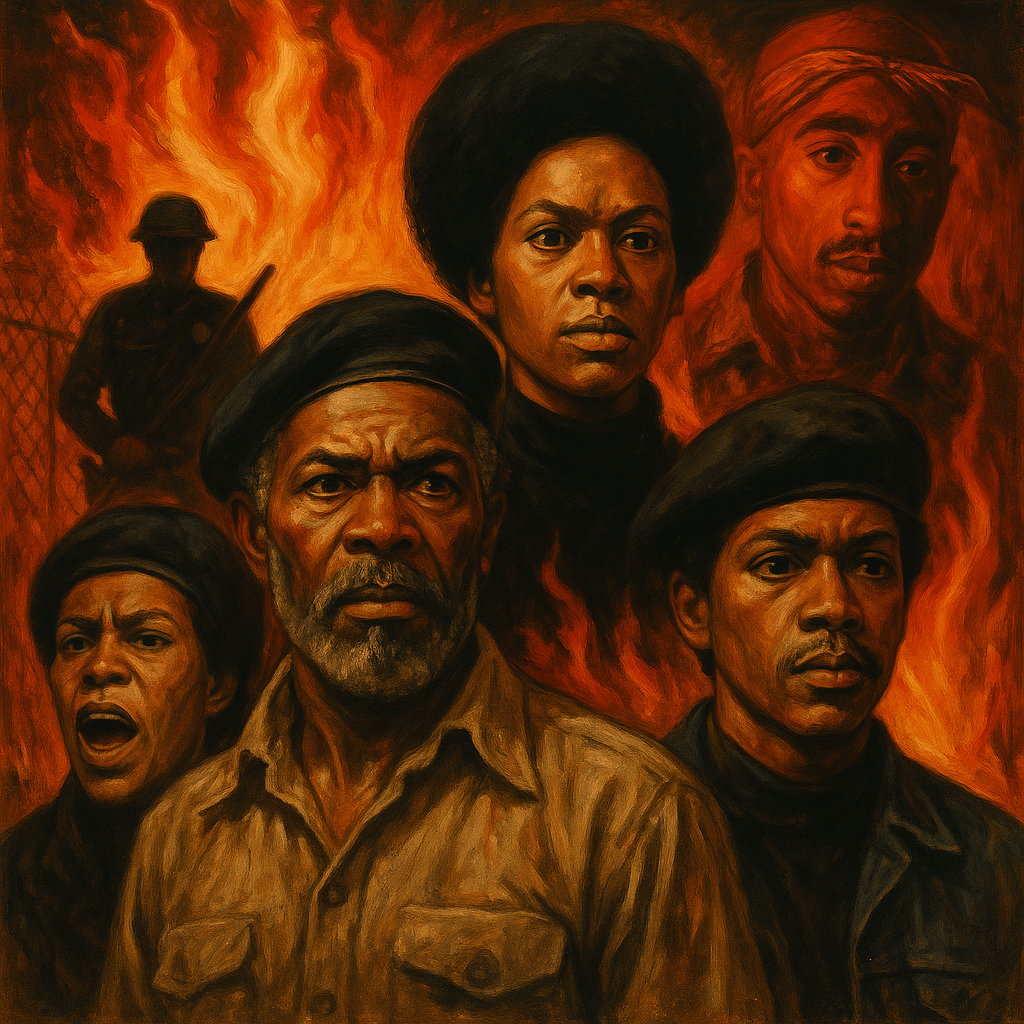
How Santi Elijah Holley’s book becomes an indictment of Western Marxism and a battlefield map of Black liberation in the heart of empire
By Prince Kapone | Weaponized Information | September 7, 2025
They Tried to Kill a Bloodline, Not Just a Man
The story doesn’t begin with Tupac. Or even Afeni. It begins with Saladin Shakur—a man whose name is mostly lost to popular history, but whose presence seeded a political dynasty. He was not a Panther. Not a public figure. But he was a man who gave his name—Shakur, meaning “thankful to God” in Arabic—to a new generation of warriors who refused to be American. And that refusal is the foundation of the Shakur legacy: a deliberate rejection of the settler name, the settler state, and the settler order.
One of the earliest architects of that order of refusal was Lumumba Shakur. Founder of the New York City chapter of the Black Panther Party. Strategist. Organizer. Ideological disciplinarian. He didn’t just talk revolution—he built the machinery. It was under his leadership that the BPP in New York established clinics, schools, and security formations while resisting the twin blades of poverty and police terror. The Party called him Chairman. The state called him subversive. Both were correct.
Holley doesn’t linger long on Saladin or Lumumba, but their presence haunts the text. Because without them, there is no Afeni as we know her. No Panther 21 trial. No political self-defense in the courtroom. No Tupac in the womb of a revolutionary. Lumumba was Afeni’s husband. But more than that, he was her comrade in arms. They weren’t a couple—they were cadre. Their marriage was forged not in sentimentality, but in strategy. This was not romance under empire. It was alliance under siege.
And that’s the core truth Western Marxism cannot grasp: the Shakurs were not a family in the liberal sense. They were a revolutionary formation. A political organism structured around survival, resistance, and power-building. Their kinship wasn’t defined by blood—it was defined by shared commitment to overthrowing a genocidal state. And because of that, the state didn’t treat them like a family. It treated them like a nation-in-formation. A threat to be neutralized in full.
Holley opens his book with Afeni not just because she’s iconic, but because she embodies this fusion of the personal and political. She didn’t stumble into radicalism. She was groomed for it—by comrades, by struggle, by betrayal, by clarity. Her defense of herself and her co-defendants during the Panther 21 trial wasn’t a miracle. It was a product of militant preparation and principled defiance. She didn’t beg the court for mercy. She exposed it as a colonial instrument. She didn’t appeal to American values. She incinerated them in front of the jury.
Western Marxism sees families as private units. It sees lineage as biology. But for the colonized, family is political infrastructure. Memory is counterinsurgency terrain. And names—Shakur—are declarations of war. Afeni carried more than a fetus into that courtroom. She carried the continuation of a revolutionary bloodline. That’s why the state tried to break her. That’s why they wiretapped, infiltrated, and imprisoned. Not to silence her, but to sever the transmission of insurgency from one generation to the next.
And still, the line survived. Lumumba was arrested, framed, and buried. Mutulu was hunted and disappeared into prison for decades. Afeni was surveilled until her final breath. Tupac was neutralized by contradictions sharpened in studios, courtrooms, and morgues. But the name remains. The blueprint remains. And thanks to Holley’s work, the archive now carries more than eulogy. It carries evidence.
Read correctly, this book is not a family story. It’s a case study in multi-generational war against empire. And the first thing it teaches is this: the Shakurs were not exceptional. They were organized. Their story is not tragic. It is incomplete. And if you’re reading from within the empire—white, sheltered, unsure—then the real question this book raises isn’t “what happened to them?” It’s “where the hell were you?”
Revolution in the Bloodstream, Repression in the Womb
The Shakur lineage begins not with Tupac, but with Afeni. Born Alice Faye Williams in the Jim Crow South, radicalized in New York, and forged in the furnace of the Panther 21 trial, Afeni’s life tears through the mythology of passive motherhood. She was not a martyr. She was not a tragic matriarch. She was a strategist. A firebrand. A Black revolutionary who studied law in jail while pregnant with Tupac and dismantled a federal prosecution in court with nothing but a stack of notes, a steel spine, and a political line. Holley gives us this story in rich detail. He makes it plain: Afeni didn’t raise Tupac in revolution. She birthed him from it.
This matters, especially because Western Marxism has long severed the umbilical cord between revolution and reproduction. Between political struggle and the lives that make it possible. In their framework, “women’s issues” are secondary. Family is private. Motherhood is apolitical. But for the colonized, there’s no such separation. Afeni’s pregnancy was not some incidental subplot in her trial—it was part of the state’s strategy to break her. To terrorize her unborn child. To remind her that the wages of rebellion were not just death or prison, but the right to raise your own children. And still, she stood firm.
Holley’s framing of the Panther 21 trial shatters the liberal fantasy of an impartial justice system. These were not isolated overreaches. They were rehearsed counterinsurgency. The FBI’s informants weren’t merely watching—they were instigating. The press wasn’t just reporting—they were scripting the public’s consent. And the prosecutors weren’t just applying the law—they were rewriting it on the fly. This was not law enforcement. It was political warfare in courtroom drag.
Here, the cowardice of Western Marxism becomes almost unbearable. While Panthers were being hunted, jailed, and assassinated, the white left debated over the Paris Commune. While Afeni was defending herself against 300 years in prison, “radical” academics were writing essays about workerism in Italy. While the Black Liberation Army was trying to exfiltrate Assata from U.S. captivity, the Western Marxist intelligentsia was romanticizing the Frankfurt School’s critiques of fascism—without ever identifying the fascist empire they lived in. Holley doesn’t name this betrayal explicitly, but the omission screams louder than words.
And it continues. Afeni is remembered as Tupac’s mother, not as a leader of the most advanced revolutionary formation in U.S. history. Her name is on museum walls now, even while her comrades rot in federal cages. Holley sees this. He threads the needle between memory and distortion. He shows how even sincere remembrance can be co-opted, how museums and memoirs can become mausoleums. The state doesn’t just crush resistance—it embalms it. It frames the fighters in soft light, mutes the gunshots, and edits out the clarity of their demands. What’s left is nostalgia without insurgency.
But if you read between Holley’s lines, you see it: Afeni didn’t fight so we could mourn her. She fought so we could learn. From every wiretap, every raid, every betrayal, every courtroom skirmish. She fought so we could name the real enemy—not “injustice,” not “racism,” but the settler-colonial, carceral, imperialist United States. And what Western Marxism refuses to say, Holley’s book dares to show: that the struggle against that enemy begins not in the factory, but in the colonial home. Not in theory journals, but in the bloodline of a people who refused to die off.
The Revolution Will Be Medicalized—Or It Will Be Crushed
What do you call a healer the state wants dead? What do you call an acupuncturist who studied Mao and Fanon, and ran detox clinics like liberated zones? If you’re the U.S. government, you call him a terrorist. If you’re a Western Marxist, you call him an outlier. But if you’re honest, if you’re paying attention, you call him what he was: a doctor of revolution. Dr. Mutulu Shakur didn’t just treat addiction. He treated capitalism’s social symptoms as the pathologies they were. And that made him a threat.
Holley devotes a powerful section of this book to Mutulu’s work at the Lincoln Detox Center in the South Bronx—a place where revolutionary health care wasn’t charity but class war. This was medicine as self-determination. Black and Puerto Rican organizers weren’t just helping people kick heroin—they were refusing the state’s methadone leash. Holley captures how these clinics, operating on the edges of legality, became schools for liberation: teaching anatomy, acupuncture, and political education side by side. It was an insurgent model of healing that took the opioid crisis—a crisis born of imperial war and colonial containment—and answered it with revolutionary science.
But no good deed goes unpunished under empire. As Holley shows, Lincoln Detox was sabotaged, defunded, and eventually dismantled—not because it failed, but because it worked. Mutulu saw it coming. He knew the state wouldn’t allow a program that actually solved the problems it claimed to care about. Because the state isn’t in the business of solutions. It’s in the business of suppression. And that suppression was brutal. Mutulu went underground. And like any serious revolutionary, he didn’t go into hiding—he went to work.
Holley treats the liberation of Assata Shakur with the respect and discretion it deserves. He doesn’t speculate irresponsibly. But he makes it clear: this was a coordinated act of political warfare, executed with discipline and precision, aimed at recovering a captured comrade from colonial captivity. It was a jailbreak, yes. But it was also a declaration. It said: our people are not your property. Your prison walls are not impenetrable. And our solidarity is not just symbolic—it is operational.
Assata’s escape, her sanctuary in Cuba, and the decades-long U.S. obsession with her recapture all reveal the state’s deepest fear: not violence, but disobedience. Not chaos, but coordinated refusal. Not “Black rage,” but Black organization. Holley details the international implications—the U.S. marshaling its diplomatic power to pressure Cuba, offering millions in bounty money, calling her a terrorist even as it arms genocidal regimes across the globe. The hypocrisy is so grotesque it barely warrants satire.
And where is Western Marxism in all this? Absent. Silent. Complicit. These were not side stories to the “real” class struggle. They were the class struggle. Mutulu’s acupuncture was Marxism in practice—applied dialectics against state dependency. Assata’s prison break was a revolutionary seizure of the means of bodily autonomy. And yet the white left, from the universities to the NGOs, continues to treat their legacy as footnote or fable. Because to acknowledge them fully would mean confronting the colonial structure that makes the Western left possible. And they won’t do that. They’d rather quote Marcuse.
Holley doesn’t indict these absences directly, but he doesn’t need to. The evidence is overwhelming. The Shakurs were building revolutionary infrastructure—health, housing, security, defense. They were theorizing and practicing sovereignty under siege. And they were punished with a brutality the white left still refuses to name. But for those of us who see clearly, the lesson is undeniable: the state has always understood this kind of work as war. It’s time we did too.
Resurrecting Tupac: Between the Studio and the Surveillance State
To understand Tupac Shakur is to understand the mutation of counterinsurgency. Holley’s portrait of Tupac is not a eulogy. It’s a diagnosis. This was not just a rapper shot in Vegas. This was a revolutionary heir—born into the wreckage of COINTELPRO, raised on the frontlines of cultural war, and stalked from adolescence by an empire that knew exactly what blood flowed through his veins. Tupac was not confused. He was conflicted—because the world he inherited made clarity a liability. And the left, as usual, left him for dead.
Holley refuses the sanitized, museum-safe version of Tupac. He follows him from his birth into Panther exile, through arts schools and poverty, into a recording industry designed to exploit his trauma while neutralizing his politics. Tupac’s early lyrics—Panther Power, Trapped, Words of Wisdom—were not entertainment. They were pedagogy. And yet, as Holley shows, the very system that marketed his rage was the one programming his downfall. The music industry gave Tupac a mic—and then fed every lyric to the surveillance machine.
The transition from revolutionary son to “gangsta rapper” wasn’t a fall from grace—it was a forced adaptation. Holley makes clear: Tupac’s contradictions were cultivated. His arrests, his brawls, his outbursts weren’t just the chaos of fame—they were the planned implosion of a threat. The FBI didn’t need to assassinate Tupac like Fred Hampton. They had learned. They could set the scene, accelerate the contradictions, and let the culture kill him for them. And when he was gone, they’d sell his image back to us with the politics removed.
Western Marxism has always been allergic to Tupac. He doesn’t fit. He’s too raw for academia, too militant for reformists, too poetic for economism. But that’s precisely the point. He was the synthesis of the Black radical tradition and post-industrial Black mass culture. He was the child of revolution and the ward of repression. His art was messy, yes—but only because it was produced under conditions of siege. Tupac didn’t betray the movement. The movement betrayed him. Or rather, the white left abandoned the movement he was born into.
Holley touches only lightly on the state’s role in Tupac’s death. But the pattern is unmistakable. The surveillance, the infiltration, the relentless media distortion—it all mirrors the tactics used on the Panthers. Just with better PR. Holley shows us the blueprint: destabilize the revolutionary, fracture their alliances, feed their image through the capitalist pipeline, and erase their politics through contradiction. When Tupac started naming names—when he called out white supremacy, the police, and the fake left—they made sure he’d never finish the album.
And yet, as Holley makes clear, Tupac’s legacy refuses burial. That’s why the state keeps reinventing him: as a hologram, as a museum exhibit, as a sad boy in a Gucci ad. They want his pain, not his politics. His passion, not his analysis. His “dear mama,” not his “white man’s world.” But the real Tupac—the one who studied Assata, who visited prisoners, who demanded reparations on MTV—he lingers like smoke in the halls of empire. They still fear him. And they should.
For those of us defecting from the settler colony, Holley’s account of Tupac isn’t just informative—it’s indicting. It forces us to ask: where was the solidarity? Why was Tupac left to be consumed by an industry of vultures and a media of spooks? The silence of the left was not just neglect. It was abandonment. Tupac died without comrades. And if we don’t learn from that, the next insurgent artist—who dares to fuse culture and class war—will meet the same fate. Or worse.
Not Just a Family—A Nation in Formation
What Holley understands—and what Western Marxism perpetually evades—is that the Shakurs were not simply a radical bloodline. They were the political infrastructure of an insurgent nation. A stateless, colonized people trying to assemble sovereignty from below. From Harlem to Havana, from Lincoln Detox to Rikers Island, from Panther 21 to the BLA exfiltrations, the Shakurs were building not just resistance—they were building power. And that’s what made them dangerous.
The U.S. settler state didn’t hunt this family because of individual crimes. It hunted them because it saw, correctly, that they were attempting to lay the groundwork for dual power inside the empire. What Western Marxism treats as myth—national liberation within the U.S.—the FBI treated as fact. That’s why Assata remains in exile. Why Mutulu died in shackles. Why Tupac was neutralized. Holley’s narrative shows this clearly: the state recognized what the left refused to see.
Afeni, Mutulu, Assata, Tupac—they weren’t simply resisting oppression. They were organizing new forms of life. Revolutionary medicine, political education, cultural production, military discipline, mutual defense, ideological clarity. That is what nation-building looks like under siege. And Holley, by following the threads of family through time, gives us something no Western theorist has: a living diagram of how colonized people resist annihilation not by retreating into identity, but by constructing liberated structure.
This is what the Panthers understood—and what their children, the Shakurs, inherited. That the U.S. was not a flawed democracy. It was a prison house of nations. That Black people were not an oppressed racial group—they were a colonized nation. And that the response could not be reform. It had to be revolution. This is the thread that ties them all together. Not just a commitment to struggle, but a shared strategic clarity: that the goal was sovereignty, not inclusion. Power, not pity.
Holley gives us glimpses of this project in motion. The Free Health Clinics. The self-defense units. The BLA actions. The exiled networks in Cuba. These weren’t isolated acts of defiance—they were components of a war for self-determination. That war didn’t end in the ‘70s. It didn’t end when Tupac was shot. It didn’t end when Mutulu died in the belly of the beast. It continues. And Holley’s book, intentionally or not, serves as a field report from the front lines of that ongoing struggle.
But where is Western Marxism in this analysis? Absent. Again. The idea of Black nationhood—of internal colonies, of liberation as secession—is either dismissed as nationalism or exoticized into metaphor. The actual work of building a revolutionary people, of surviving decades of COINTELPRO warfare, of reconfiguring kinship into cadre? Ignored. Why? Because to recognize the legitimacy of the Shakur project is to admit that the empire is not reformable. And Western Marxism can’t do that. It still thinks the U.S. is a democracy in crisis, not a settler colony in decline.
Holley never uses the term “nation-building.” But the implications are clear. The Shakurs weren’t just rebels—they were architects. Their family was not just blood—it was blueprint. A template for revolutionary survival in the empire’s core. And if we are serious about confronting technofascism, about preparing for the collapse that’s already underway, we should be studying their model. Not to copy it, but to learn what it means to forge loyalty, structure, and strategy in a system designed to annihilate all three.
This is where Holley’s book becomes more than narrative. It becomes a weapon. A living history of Black insurgent infrastructure under siege. And for defectors from the settler state, it is a challenge: to stop fetishizing theory and start building alliances with the forces that have already paid in blood. The Shakurs weren’t perfect. But they were committed. And commitment, as Holley shows us, is not measured in tweets or conference papers—it’s measured in sacrifice, in solidarity, in sustained struggle.
Western Marxism: The Theory of Cowards, the Silence of Collaborators
Let’s speak plainly: Western Marxism has blood on its hands. Not because it pulled the trigger or signed the warrant—but because it looked away. Because it refused to name the system for what it is: a settler-colonial empire built on the bones of Africans and Indigenous peoples. Because it could not, and would not, recognize the Shakurs—not as tragic figures, not as “identity” curiosities, but as the vanguard of class struggle on the internal front lines. Holley doesn’t indict Western Marxism outright. So we will.
This so-called Marxism—with its Frankfurt nostalgia and Parisian affectation—treated the Panther Party like a footnote, the Black Liberation Army like a mistake, and Tupac like a sideshow. It romanticized the Soviets while ignoring the survival struggles in the South Bronx. It quoted Fanon while ignoring the actual guerrilla praxis happening in Harlem, Oakland, and Watts. It built careers while the Shakurs built clinics, escape routes, and cadres. And when the state came for them, it said nothing.
The truth is this: the white left in the United States overwhelmingly abandoned the colonized proletariat. It chose theory over commitment, comfort over confrontation. While the Shakurs were facing raids, infiltration, exile, and execution, the Western Marxists were chasing tenure, publishing in journals no revolutionary would read, and debating the finer points of alienation. Not one of them showed up when Mutulu was sentenced. Not one lifted a finger when Tupac was being dragged through the court of public opinion. They still won’t utter Assata’s name unless there’s tenure on the line.
Holley’s book cuts through this betrayal with the blade of narrative. He shows, without saying, that the real theorists of revolutionary transformation weren’t in seminar rooms. They were dodging wiretaps. Running underground railroads to Cuba. Treating addiction with politicized acupuncture. Teaching children how to read and fight at the same time. This is Marxism in motion. Not in rhetoric, but in risk. Not in critique, but in commitment.
Western Marxism, by contrast, has become a museum of dead ideas. A mausoleum for thinkers who never picked up a gun, never ran a safe house, never saw the inside of a courtroom unless they were defending their own prestige. It cannot engage with the Shakurs because to do so would expose its own cowardice. Its own whiteness. Its own comfort as a class stratum of the oppressor nation. The Shakurs are a mirror that Western Marxism cannot bear to face.
But we must. Because the lessons of their struggle remain urgent. Holley’s An Amerikan Family forces the question: what does commitment look like inside the empire? What does it mean to build a nation in the belly of a settler-colony? What does solidarity mean when the prison gates slam shut? The Shakurs answered these questions not in words, but in action. And we owe them more than analysis. We owe them alignment.
So let this be the dividing line: between the performative and the revolutionary. Between the academic and the insurgent. Between those who write about revolution and those who join it. Holley’s book is not an artifact—it is a call. And if Western Marxism cannot hear it, then let it die in silence. The colonized are done waiting.
Weapons in the Archive, Targets in the Blood
Santi Elijah Holley’s An Amerikan Family is not just a book. It’s a dossier. A blueprint. A quiet rebellion against erasure. It gives us not the myth of the Shakurs, but the mechanics of their insurgency—the politics, the discipline, the contradictions, and the cost. It hands us the fragments of a revolution deliberately scattered by the state. And in doing so, it calls the bluff of every leftist theory that claims to speak for the oppressed while ignoring the people who actually stood and fought.
Holley does not romanticize. He narrates. He traces the Shakurs as more than victims or icons—as strategists, tacticians, nation-builders under siege. He shows the structure of their resistance, the lineages of their formation, the totality of their commitment. And in doing so, he makes one thing brutally clear: the state never feared their violence—it feared their organization. Their memory. Their clarity. Their refusal to die quietly.
And here’s the rub: if the Shakurs were the skeleton of a revolutionary nation, then Western Marxism is the necromancer of dead revolutions. It revives theories with no armies, slogans with no teeth. It quotes Fanon but refuses the decolonization of its own institutions. It critiques capitalism while collecting salaries from the empire. It reduces liberation to language. Meanwhile, the Shakurs bled.
This book is an antidote to that decay. It reminds us that revolution is not theory in search of practice—it is practice that demands theory. That nationhood is not declared, it is built. That survival under settler rule requires more than protest. It requires a political program, a disciplined base, an insurgent strategy. The Shakurs had all three. That’s why the state went after them with everything it had. And that’s why we must remember them—not in mourning, but in militancy.
For defectors from whiteness—for those of us raised within the settler colony and choosing to betray it—this book is more than history. It is a test. It asks: are you ready to break ranks with liberalism? With academic Marxism? With a left that won’t name the enemy? Are you ready to study the strategies that got so many comrades out of prison, off of dope, and into the arms of an international revolutionary movement? Are you ready to stop quoting and start building?
Holley won’t say it like this. But we will: the Shakurs were not a tragic family. They were the embryo of a new world. What killed them wasn’t just the state. It was the failure of others to join the fight. We don’t honor them by remembering. We honor them by finishing what they started.
 Weaponized Information
Leave a comment