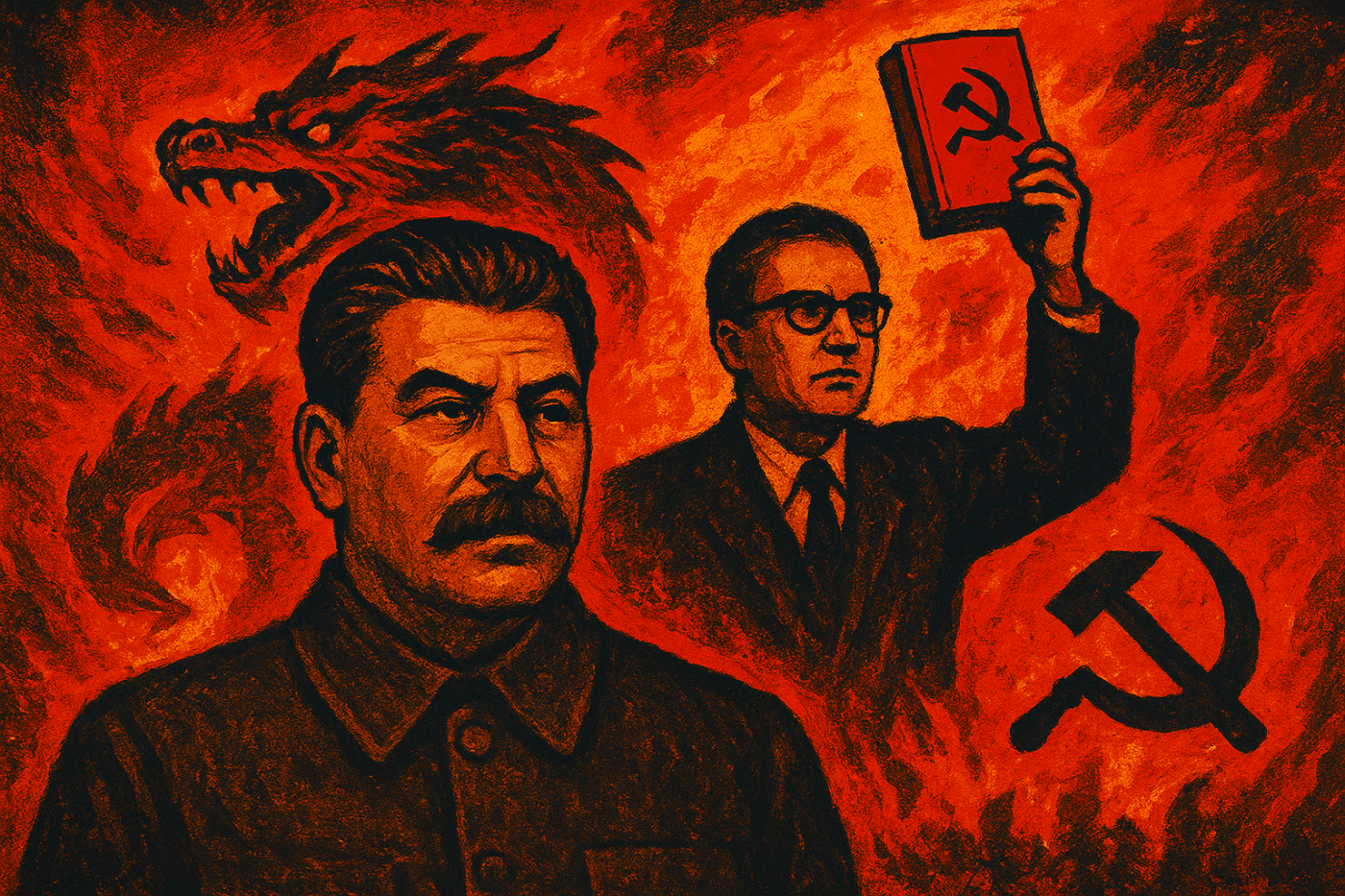
How imperial propaganda and Western Marxism conspired to weaponize the memory of the Soviet Union and disarm living revolutions
Prince Kapone | Weaponized Information | August 23, 2025
I. The Black Legend and the Class War Over History
This is not an academic exercise in “reassessing Stalin.” It’s a guided demolition of one of the most successful ideological weapons ever forged by imperialism: the Black Legend. Domenico Losurdo doesn’t tiptoe into the minefield of 20th century socialism—he walks in like a de-miner with a shovel, exposing the explosives the West planted in our historical memory. His subject is not the man alone, but the machinery that made his name synonymous with tyranny in every textbook, editorial, and Netflix docu-drama churned out by the cultural mills of the empire.
For Losurdo, the demonization of Stalin is not a byproduct of historical debate—it’s a class project. A counterrevolutionary narrative engineered to discredit the most decisive rupture with capitalism in modern history, and by extension, to delegitimize every revolution that dared to expropriate the ruling class. The Black Legend was never just about 1937; it was about 1917. It was about making the October Revolution look like a crime scene so the capitalist world could restore the old order without firing a shot. And when shots were fired—whether in the Spanish Civil War, the Great Patriotic War, or the anticolonial storms of the mid-century—they were accompanied by the same ideological soundtrack: socialism equals Stalinism, and Stalinism equals evil.
Losurdo refuses the terms of this witch trial. He doesn’t play defense. He attacks the historical fraud at its root, tracing how Cold War propaganda fused with émigré revenge narratives, Nazi collaborationist accounts, and a compliant Western left to produce the composite image of Stalin as the great executioner of freedom. Every source, every anecdote, every statistic that props up this mythology is dragged into the light and examined—not with the denialism of a hagiographer, but with the precision of a historical materialist who knows that history is written in the language of class power.
And this is where Losurdo’s method slices through the moral fog: he asks not just what was said about Stalin, but who said it, when, and why. He follows the trail from Goebbels’ propaganda ministry to the CIA’s Congress for Cultural Freedom, from Hearst’s yellow press to Khrushchev’s secret speech, from the émigré pressrooms of Berlin to the liberal op-ed pages of New York. At every turn, the same political function emerges: to construct a usable past for the capitalist order. A past in which socialism’s greatest victory over fascism is reframed as its greatest crime, and the Soviet Union’s transformation from a semi-feudal backwater into an industrial superpower is painted as a gulag archipelago stretching across time.
In this way, Losurdo makes clear that the “Stalin question” is not about the biography of one leader—it’s about the right of the oppressed to wield power at all. Strip away the historical particulars and the Black Legend becomes a general rule: any revolution that survives long enough to defend itself will be slandered as a dictatorship, its leaders vilified as monsters, its victories erased or turned into crimes. Today it’s Stalin. Yesterday it was Robespierre. Tomorrow it’s Maduro or Xi. The names change; the class politics don’t.
This is why Losurdo’s book reads less like a rehabilitation and more like a battlefield report from the ideological front. It’s a reminder that history, in the hands of the ruling class, is counterinsurgency. That the archives are not neutral. That the dominant narrative about Stalin—like the dominant narrative about every successful anti-capitalist project—is a weapon aimed at our ability to imagine, let alone organize, a future without capitalism. And it’s an invitation to do the one thing the Black Legend was designed to prevent: to learn from the actual history of socialist construction, with all its contradictions, so we can build again.
II. Khrushchev’s Gift to the Cold War
If the Nazi archives and Hearst’s headlines provided the raw material for the Black Legend, Khrushchev’s “Secret Speech” was the imperial finishing school. Losurdo doesn’t mince words—this was not a moral awakening inside the Soviet leadership, but a political coup dressed in the language of destalinization. By painting his predecessor as a uniquely depraved tyrant, Khrushchev didn’t just distance himself from the difficult years of socialist construction; he handed Washington a propaganda arsenal it has been firing ever since.
The timing was no accident. 1956 was the year of the Hungarian uprising, the Bandung Conference, and the Suez Crisis—a year when the socialist camp and the anti-colonial world were on the move. The U.S. needed a wedge to split that unity, and Khrushchev obligingly drove one through the heart of the movement. His speech at the 20th Party Congress was leaked, amplified, and weaponized not only by the capitalist press but by the respectable left in the West, which now had “official” Soviet confirmation of every lurid accusation circulating since the war.
Losurdo dissects the speech line by line, exposing its selective omissions, factual distortions, and outright fabrications. The purges are presented without the context of actual conspiracies and foreign subversion; the wartime leadership is reframed as a cult of personality instead of a military-political necessity; the mass industrial leap forward is stripped of its class content and reduced to a morality tale. In Khrushchev’s telling, socialism’s survival through encirclement, famine, sabotage, and the bloodiest war in human history becomes a case study in Stalin’s personal pathology. It’s history rewritten as courtroom drama, where the verdict was never in doubt.
The genius—and treachery—of this maneuver was its double audience. Domestically, it consolidated Khrushchev’s power against the old guard of the Party and neutralized those who might challenge his new economic and foreign policy lines. Internationally, it signaled to the imperial core that Moscow was ready to play ball, ready to exchange revolutionary intransigence for détente. The cost was paid not just in Soviet prestige, but in the morale of communists worldwide, many of whom now found themselves defending socialism while carrying the albatross of Khrushchev’s accusations around their necks.
For Losurdo, this is not a side note—it’s a central chapter in the history of how revolutions are ideologically defanged from within. The “Secret Speech” is a master class in political disarmament: give your enemies the narrative they want, cripple your allies’ confidence, and open the door to a reformism that corrodes the revolutionary project from the inside out. It’s the moment the USSR’s official story about its own past was bent to fit the contours of the Black Legend, legitimizing it for generations to come.
This is why the question of Stalin’s legacy is never just a historian’s debate—it’s a struggle over the revolutionary legitimacy of the entire 20th century. By allowing the imperial narrative to set the terms, Khrushchev transformed criticism into confession, and confession into capitulation. Losurdo’s warning is clear: when you repeat the enemy’s accusations to win points in an internal dispute, you are not just weakening your opponent—you are fortifying the class enemy’s position for decades. The ruins left behind are not only in the archives; they are in the shattered capacity of the working class to defend its own history.
III. From Goebbels to the Graduate Seminar: How the Black Legend Went to College
Losurdo makes a ruthless point here: the Black Legend of Stalin didn’t just survive the Second World War—it graduated with honors from the Nazi propaganda ministry and was tenured in the universities of the imperial core. The through-line is as damning as it is direct. The collapse of the Third Reich didn’t scatter its ideological machinery; it transplanted it. Anti-Soviet propagandists, many with SS and Abwehr résumés, were quietly folded into the U.S. and West German state apparatus, their “expertise” repurposed for the Cold War.
Operation Paperclip wasn’t just about rocket scientists. It was also about archivists, linguists, and propagandists who had spent the war fabricating atrocity stories, inflating death counts, and portraying the Eastern Front as a clash between “civilization” and “Asiatic Bolshevism.” These narratives, refined in the service of Hitler, were dusted off and reissued under new management in Langley, Washington, and Bonn. The names changed; the ideological DNA did not. The same tropes—Stalin as bloodthirsty despot, the USSR as prison of nations, socialism as mass grave—were now presented not as Nazi propaganda but as scholarly consensus.
The CIA understood what Khrushchev had given them: an opening to launder fascist-origin narratives through the filter of Soviet “self-criticism.” Cultural fronts like the Congress for Cultural Freedom, publishing houses, and Cold War area studies programs took it from there. Suddenly, émigré historians with impeccable anti-communist credentials were lecturing at Ivy League schools, editing journals, and training a new generation of “Sovietologists” whose mission was not to understand the USSR but to delegitimize it. Western Marxists, eager to prove their distance from “Stalinism,” proved to be some of the most efficient carriers of these narratives into the so-called radical milieu.
Losurdo names the class function of this apparatus: it created a “respectable” anti-communism that could operate in both The New York Times and The New Left Review. It allowed liberal academics and leftist intellectuals to recycle the Black Legend without ever acknowledging its Nazi lineage. They could denounce the Soviet experience as totalitarian barbarism while keeping their radical credentials intact—so long as their critiques never challenged the structural dominance of the imperial core. This was anti-communism with a human face, sold in bookstores between Sartre and Simone de Beauvoir.
The effect was corrosive. By the late 20th century, the idea that Stalin’s USSR was history’s ultimate cautionary tale was no longer even debated in the West; it was assumed. And because it was assumed, it was built into the mental software of the left itself. You could be a Maoist, a Trotskyist, a postmodern anarchist, or a social democrat—if you wanted to be heard, you genuflected before the altar of the Black Legend. Any defense of Soviet achievements was immediately pathologized as fanaticism. Any refusal to repeat the ritual denunciations was taken as proof of authoritarian sympathies.
This is where Losurdo’s critique becomes lethal. The victory of the Black Legend inside the Western left was not simply the victory of imperial ideology over socialist memory—it was the internalization of that ideology by those who claimed to oppose it. It was, in other words, ideological counterinsurgency. By accepting the enemy’s narrative as the baseline, even radicals helped erase the material gains of socialism: the industrial transformation of a peasant country, the defeat of fascism, the decolonization of Eurasia. All of it disappeared behind the curtain of the “Gulag Archipelago” and the fetishized body counts that originated in Goebbels’ offices.
Losurdo’s warning is not just about historical truth—it’s about strategic survival. When your own side inherits and repeats the slanders crafted by its deadliest enemies, you are not engaged in critique. You are engaged in self-disarmament. You are dismantling the legitimacy of revolutionary state power in the eyes of those who might one day need to wield it. You are doing the empire’s work for free. And as the 21st-century socialist experiments in Latin America, Africa, and Asia come under renewed attack, the machinery of the Black Legend is already revving its engines—ready to turn any people’s victory into another “cautionary tale” for graduate syllabi and NGO reports.
IV. The Class That Loves Revolution—As Long as It Loses
Losurdo doesn’t let the discussion stay at the level of propaganda tricks or ideological infiltration. He drills into the material foundations of why the Black Legend could be smuggled so easily into the bloodstream of the Western left. His answer is blunt: the petty-bourgeois intelligentsia of the imperial core—the professors, editors, cultural producers, NGO operatives, and career activists—have a structural allergy to revolutionary power. They love revolution as image, as symbol, as moral high ground, but once the barricades fall and the work of building a new society begins, they turn away in disgust. Their radicalism is calibrated to be harmless to the very order that feeds them.
This is not simply hypocrisy; it is class logic. The imperial petty bourgeoisie’s material survival is tethered to the smooth functioning of the imperial system: stable markets for their publishers, state grants for their research, international prestige for their “critical” lectures. The moment socialism seizes and defends state power, it disrupts the global balance that guarantees these privileges. The Soviet Union’s industrialization threatened the idea that the West had a monopoly on modernity. Its military defeat of Hitler humiliated the West’s ruling class. Its support for anti-colonial movements endangered the resource flows that underwrite imperial prosperity. In such conditions, the petty bourgeoisie’s relationship to revolution becomes like a tourist’s to a wildfire: fascinating from a distance, intolerable up close.
Losurdo’s diagnosis is merciless: Western Marxism and its fellow travelers in the “compatible left” function as a kind of ideological fire brigade—not to put out the flames of oppression, but to make sure any fire of actual revolutionary power is safely contained, morally condemned, and reinterpreted as a cautionary tragedy. They offer solidarity to the oppressed only on the condition that the oppressed never win. Vietnam was noble until it governed. Cuba was heroic until it nationalized foreign property. China was inspirational until it fed itself. Once power is seized, the petty bourgeoisie’s romance with rebellion curdles into denunciation.
The Black Legend provides the perfect moral alibi for this reflex. If “Stalinism” is the inevitable outcome of any successful revolution, then the petty bourgeoisie can cheer for uprisings without ever having to commit to the messy, dangerous, disciplined work of building and defending a socialist state. They can claim the moral high ground while delegitimizing any revolutionary that survives the honeymoon period of rebellion. This posture doesn’t just protect their class position—it protects the entire imperial system by keeping revolutionary legitimacy off the table.
And here’s where Losurdo draws blood: the adoption of the Black Legend by the Western left wasn’t a mistake. It was a class adaptation to the realities of imperial capitalism. The petty-bourgeois intelligentsia is rewarded for moral critiques of capitalism that don’t translate into revolutionary capacity. They are granted platforms, book deals, fellowships, and cultural capital in exchange for playing their role: to keep the dream of revolution alive while making its victory impossible. To be the velvet glove over the iron fist.
This is why the Cold War’s cultural counterinsurgency apparatus found such eager partners among left intellectuals. They didn’t have to be bribed into repeating the Black Legend—it aligned perfectly with their class instinct to oppose any socialism that might actually hold state power and, by extension, hold them accountable. It’s the same instinct that drives today’s NGO “progressives” to denounce Venezuela’s PSUV government while praising “civil society” groups funded by USAID, or to condemn China’s poverty eradication as “authoritarian” while applauding the World Bank’s development loans.
Losurdo’s warning lands hard for those of us organizing in the imperial core: if we do not identify and break with this class reflex, we will become its prisoners. We will mistake moralism for militancy, critique for combat, symbolism for strategy. We will inherit a Marxism that can only speak of the working class in the past tense, a socialism that exists only as a negation, and a left whose function is to manage dissent on behalf of empire. The petty bourgeoisie’s allergy to power will become our own—and when the chance to seize power comes, we will recoil as if it were betrayal.
To build a revolutionary movement that can survive the propaganda war of the Black Legend, we must not only expose its origins—we must also expropriate its social base. We must organize in ways that make allegiance to actual revolutionary power the litmus test of credibility. We must be willing to lose the prestige, platforms, and invitations that come with being a “respectable” critic in order to stand, without qualification, on the side of those who win. Anything less, and we will remain in the role imperialism has assigned to us: caretakers of a revolution that never arrives.
V. The Fetish of Purity: How the Cult of “Perfect” Revolution Serves Empire
By the time Losurdo reaches the question of revolutionary “purity,” he’s already dismantled the romantic illusions that fuel the Black Legend. But here, he goes for the jugular. The Western left’s favorite escape hatch—the idea that they “support” revolution, just not that revolution—collapses under his critique. He calls it what it is: a theological hangover. A messianic longing for a revolution so pure, so spontaneous, so untainted by compromise, that it never has to face the real-world contradictions of power. This isn’t Marxism—it’s a political religion for those terrified of actually winning.
In this worldview, the revolution must arrive like divine intervention, uncorrupted by alliances, unburdened by governing, untouched by the necessity of repression against counterrevolution. Once the first bureaucrat appears, the first grain requisition is enforced, the first deviation from doctrinal “perfection” is made—the revolution is declared dead, sold out, or worse, “Stalinist.” This is not a political critique; it’s a ritual excommunication. It allows Western Marxists to cheer for uprisings while preemptively condemning any socialist state that emerges from them, no matter its achievements or its context.
Losurdo exposes the function of this purity fetish: it weaponizes the inevitable contradictions of socialist construction against the project itself. Every revolution, from the Paris Commune to the Cuban Revolution, has had to balance repression of enemies with expansion of freedoms, to navigate between strategic retreat and offensive advance. Lenin’s New Economic Policy was not a betrayal—it was a calculated adjustment to survive famine, war, and isolation. Mao’s zigzags between rural industrialization and cultural upheaval were not proof of failure—they were attempts to resolve contradictions without surrendering to imperialism. But in the purity cult’s eyes, these necessary complexities are unforgivable sins.
This is precisely why the Black Legend has such power in the imperial core: it collapses all revolutionary contradictions into a morality play where the only acceptable revolution is one that dies quickly, before it can compromise itself with the “dirty” business of governance. The martyrs of revolution are canonized; the survivors are demonized. Guevara in the mountains is a romantic icon; Castro in the Council of Ministers is a “dictator.” Sankara at a rally is heroic; Sankara issuing decrees to dismantle neocolonial trade structures is “authoritarian.” The purity fetish demands that the oppressed fight, bleed, and die—but never rule.
Losurdo’s counterpoint is simple: the only “pure” revolutions are the ones that fail. Victory always contaminates. It contaminates because it forces you to confront the state apparatus, international relations, economic development, class contradictions within the revolution itself. It contaminates because it demands the use of force against those who would roll back every gain the revolution has made. And it contaminates because it requires making strategic compromises—not with imperialism, but with reality itself.
What the purity fetish really conceals is a colonial arrogance: the belief that revolutions in the Global South must conform to the moral-aesthetic expectations of petty-bourgeois intellectuals in the metropole. If China trades, it’s “betrayal.” If Cuba allies tactically with a non-socialist government, it’s “selling out.” If Vietnam enters the world market to survive the U.S. embargo, it’s “state capitalism.” These verdicts are handed down from people whose own “revolutionary” practice rarely extends beyond the campus, the NGO circuit, or the podcast studio.
Losurdo flips the script. He reminds us that the test of a revolution is not whether it remains untarnished by compromise, but whether it advances the material and political power of the oppressed. Did it expropriate the exploiters? Did it break the colonial chains? Did it survive the counterattack of empire? Did it improve the lives of the working class and peasantry? These are the questions that matter—not whether it aligns with the fantasies of a Eurocentric left that has never had to defend a village from aerial bombardment.
For revolutionaries in the imperial core, Losurdo’s challenge is clear: abandon the cult of purity and learn to measure revolutions by their capacity to seize, hold, and use power for the liberation of the exploited. Stop treating contradictions as proof of betrayal. Stop using the inevitability of imperfection as a pretext for disengagement. And above all, stop demanding that the oppressed deliver you a revolution so clean that it can be consumed without changing your own material position in the imperial order.
Because the truth—ugly to some, liberating to others—is that there is no such thing as a perfect revolution. There is only the imperfect, necessary, and disciplined process of building power in the face of annihilation. And if we cannot commit to defending that process, with all its compromises and contradictions, then we are not on the side of liberation at all. We are just spectators, applauding from the bleachers as history passes us by.
VI. The Black Legend Reloaded: Targeting Living Revolutions
Losurdo’s historical excavation isn’t an exercise in nostalgia—it’s a manual for decoding the ideological weapons aimed at today’s revolutions. The Black Legend that once smeared the Soviet Union has been retooled for the twenty-first century, deployed with surgical precision against every socialist or anti-imperialist project still standing. The language is modernized, the messengers updated, but the logic is identical: delegitimize the revolution, isolate it, and prepare the ground for its overthrow.
Take China. In the Western imagination, it’s framed as an authoritarian juggernaut, a techno-dystopia, or a capitalist mutation—anything but a socialist state that lifted hundreds of millions out of poverty while navigating the minefield of global imperialism. Losurdo would have us note the continuity: the same imperial capitals that decried Stalin’s “dictatorship” in the 1930s now clutch their pearls over the CCP’s “lack of democracy,” while conveniently ignoring their own history of slavery, colonialism, and racial dictatorship at home. The purity fetish demands that China’s revolution either remain forever in 1949, armed peasants waving red flags, or be condemned as a betrayal for surviving and adapting in a hostile world order.
Or look at Cuba. For sixty-plus years it has defied the empire on its doorstep, sending doctors instead of drones, and surviving the most relentless economic siege in modern history. Yet the Western left’s “support” often comes with an asterisk: praise for its healthcare and literacy programs, paired with handwringing about its political system, its media laws, its one-party structure. As if a besieged island 90 miles from Miami owes its oppressor the luxury of a multi-party free-for-all funded by CIA front groups. The subtext is clear: Cuba’s achievements are acceptable only if they play by the rules of its executioner.
The same script runs in Venezuela and Nicaragua, where elected socialist governments are painted as corrupt, repressive, or illegitimate—not because they’ve abandoned their people, but because they’ve dared to wrest control of resources from foreign corporations and use them for domestic development. The sanctions that strangle their economies are framed not as acts of imperial war, but as justified “responses” to alleged authoritarianism. It’s regime change wrapped in the moral language of human rights.
Losurdo’s method slices through this hypocrisy by returning to the material facts. Who benefits from these narratives? Who funds the NGOs, think tanks, and media outlets that generate them? Why does every revolutionary government in the Global South receive the same treatment the moment it begins to deliver tangible gains for the working class? The answer, as ever, is that the Black Legend is not just a story—it’s a weapon of imperial strategy, designed to mobilize liberal outrage and leftist disengagement in service of capitalist restoration.
And make no mistake: the Western left plays a role here. Sometimes as willing accomplices, parroting State Department talking points under the guise of “critical solidarity.” Sometimes as useful idiots, repeating claims from imperial media without interrogating their sources. Sometimes as self-appointed moral arbiters, declaring revolutions “invalid” because they fail to live up to theoretical blueprints drawn in European seminar rooms. In all cases, the result is the same: the left flank of empire participates in the ideological softening-up of the target, making the work of sanctions, coups, and invasions that much easier.
For revolutionaries in the imperial core, the task is to break this chain of complicity. That means refusing the poisoned language of “both sides” when the battlefield is between empire and the colonized. It means defending socialist states not because they are flawless, but because they are under attack for the very reason they exist—to block the advance of imperial domination. It means rejecting the Black Legend in all its contemporary forms, from the op-eds of The New York Times to the tweets of self-styled left influencers who denounce every revolution that survives long enough to govern.
Losurdo’s warning is blunt: if we cannot learn to defend living revolutions, we have no right to speak of revolution at all. If our solidarity evaporates the moment a movement takes power and faces the contradictions of statecraft, we have chosen the side of the counterrevolution—no matter how radical our rhetoric. The purity fetish, dressed up as principled critique, is in practice a death sentence for any project that threatens imperial interests. And every time we indulge it, we reload the weapon aimed at the heart of the global struggle.
To side with the living revolution is not to abandon critique—it is to root critique in defense, to make it serve the survival and advance of the project rather than its destruction. It is to recognize that, in the age of sanctions, drone strikes, and hybrid war, the first duty of a revolutionary is to keep the revolution alive. And that means rejecting the Black Legend not just as a historical smear, but as a living instrument of empire.
VII. Stalin Without the Myth: Losurdo’s Reckoning With the Black Legend
Losurdo does what almost no one in the imperial core dares to do: he drags the image of Stalin out of the haunted house of Cold War propaganda and forces it into the daylight of historical materialism. Not to canonize him. Not to erase his crimes. But to strip away the layers of myth that have turned the man, the period, and the revolution he helped lead into a demonic caricature—an image so effective that it still paralyzes much of the left a century later.
The “Black Legend” of Stalin, as Losurdo calls it, was not the product of dispassionate scholarship. It was a weapon of political war—assembled by the Nazi propaganda machine, refined by the liberal democracies, and industrialized by the postwar U.S. intelligence apparatus. The aim was never to understand the Soviet experience; it was to delegitimize the very possibility of a socialist state holding power in the face of capitalist encirclement. And in this project, the Western left—especially the Western Marxists—too often served as eager amplifiers, laundering the legend through “critical” theory until it became common sense.
Losurdo’s demolition of this legend begins with the basic historical record. Under Stalin’s leadership, the Soviet Union industrialized at breakneck speed, transforming from a largely agrarian society into a global power capable of smashing Nazi Germany—a feat no liberal democracy achieved on its own. This was not an accident of history; it was the outcome of conscious political strategy, mass mobilization, and a ruthless prioritization of survival in a world where the alternative was annihilation. The purges, the repression, the harsh measures—Losurdo does not excuse them. But he insists on understanding them in the context of a siege society, born in revolution and forced to build socialism with enemies at the gate and saboteurs within the walls.
He also refuses the moralism that judges Stalin’s USSR against the fantasy of a perfect, frictionless socialism. Every revolution that takes power inherits not a blank slate, but the rubble and contradictions of the old order. In the Soviet case, that meant civil war, famine, foreign intervention, and a world capitalist system committed to strangling it in the cradle. To expect the Bolsheviks to navigate this terrain without harshness is to demand they lose. For Losurdo, the central question is not whether Stalin’s USSR was pure, but whether it defended and advanced the cause of socialism in the concrete conditions it faced. On that score, he argues, the record speaks for itself.
Losurdo is clear: the cult of Stalin as omnipotent tyrant erases both the collective nature of Soviet decision-making and the real, material gains achieved—universal education, electrification, industrialization, defeat of fascism, and a level of social mobility unheard of in the capitalist world. It also erases the role of the Soviet masses themselves, treating them as passive victims rather than active participants in the building of a new society. This is no accident. The Black Legend requires Stalin to be a lone monster because acknowledging the collective will and sacrifice of millions would make the revolution harder to dismiss—and harder to repeat.
By confronting this legend head-on, Losurdo does not ask us to worship Stalin. He asks us to recover the historical capacity to evaluate revolutionary leadership outside the moral vocabulary of the oppressor. He asks us to see Stalin not as a mythic figure—good or evil—but as a revolutionary statesman operating under unprecedented pressures, whose successes and failures must be measured by the strategic imperatives of defending and advancing socialism in the most hostile environment imaginable.
In the end, Losurdo’s assessment is both sobering and liberating. Sobering, because it strips away the illusions that socialism can be built without coercion, discipline, or hard decisions. Liberating, because it reclaims the right to judge revolutions on their own historical terrain, not by the standards of the very system they fought to overthrow. The Black Legend lives on because it serves the living needs of imperialism; dismantling it is not about rehabilitating a man, but about disarming a weapon aimed at every people’s struggle for power.
This is Losurdo’s final gift in this work: a reminder that history is a battlefield, and that memory itself is contested ground. If we surrender that ground to the enemy’s narrative, we make the next revolution easier to isolate, smear, and destroy. To fight the Black Legend is to defend not just the Soviet past, but the revolutionary future. And in the war for that future, clarity is ammunition.
 Weaponized Information
Leave a comment