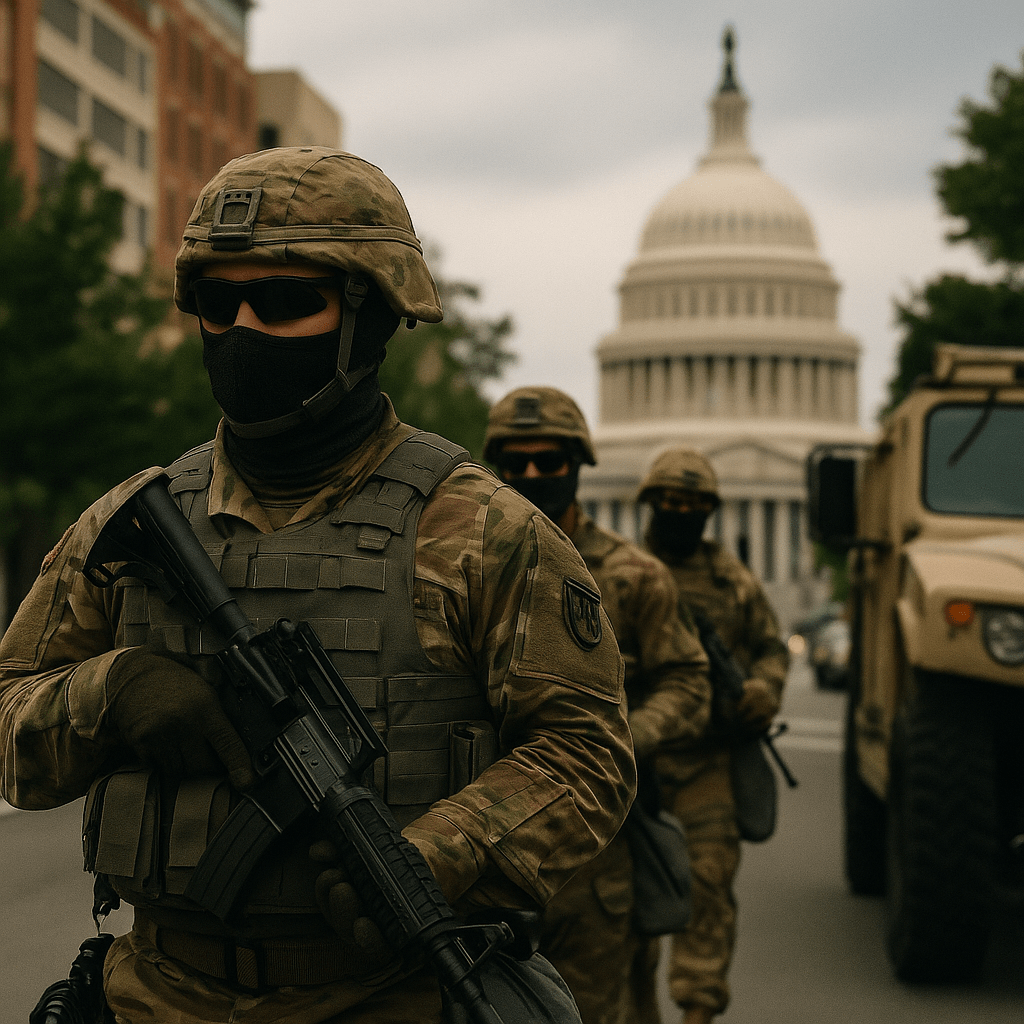
Behind USA Today’s framing of Trump’s D.C. troop deployment lies a deeper history of domestic counterinsurgency — the same imperial playbook used to crush liberation movements at home and abroad.
Prince Kapone | Weaponized Information | August 11, 2025
Crime Crackdown as Theater: How a Headline Sells Federal Muscle
In USA Today’s report by Joey Garrison, the curtain rises on a familiar stage: the president promises to “clean it up real quick,” vows that “we’re not going to lose our cities,” and announces 800 National Guard troops for Washington, D.C., with a traveling show hinted for New York, Los Angeles, Baltimore, Chicago, and Oakland. The article gives us the beats of the performance—announcement, bravado, executive orders, a roll call of officials—then sprinkles in a measured aside that crime is actually down. But the sequence is the message: fear first, facts later. By the time the numbers arrive, the hero shot has already landed.
This is how a spectacle is scripted. The piece frontloads the president’s voice, saturating the frame with lines about “taking back our capital” and warning other cities to “learn their lesson.” What follows is a chorus of credentialed backing: Defense and Army chiefs promising troops who are “strong” and “tough,” an assurance that this is “nothing new” for the Pentagon, and a nod to law-and-order as if it were a neutral instrument rather than a political hammer. Authority speaks early and often; dissent, when it appears, is fenced in—mayors asking for local control, polite statements about statistics—respectable, tidy, and structurally harmless. The article gives opposition just enough oxygen to look balanced without ever threatening the frame.
Notice the absences that do the loudest talking. The story touches the legal lever—Section 740 over D.C. policing—then moves on, leaving the reader with the impression that extraordinary power is ordinary procedure. No probing of why a military footprint follows falling crime; no interrogation of who benefits when federal muscle substitutes for public debate. Instead we get the soft focus of institutional normalcy: officials at the podium, numbers in the margins, and the promise that exceptional force is simply another policy option.
The emotional architecture is simple and effective. Words like “strong,” “tough,” “take back,” and “clean up” cue the body before the brain. Cities are cast as wayward wards in need of discipline; the targeted municipalities are name-checked as Democratic, turning federal intervention into partisan theater without ever asking what material interests are being secured. Crime data appears as an awkward extra, not the main character it should be. That is the quiet genius of the piece: it doesn’t have to lie; it only has to arrange.
Read this way, the article is less a neutral report than a well-lit runway for executive force. The camera angle flatters power, the quotes rehearse strength, and the editing makes escalation feel like common sense. By the end, the audience is ushered to a single conclusion: the center knows best, and when the center brings troops, that’s governance, not a warning. The headline sells a crackdown; the copy sells consent. Our job here is to mark the sell, name the stagecraft, and refuse the invitation to mistake theater for truth.
🟨 II. The Facts They Give, the Revolutions They Erase
The USA Today article gives you the surface-level facts: on August 11, 2025, Trump ordered 800 National Guard troops into Washington, D.C.; invoked Section 740 of the Home Rule Act to seize control of the city’s police; dangled the threat of similar deployments in New York, Los Angeles, Baltimore, Chicago, and Oakland; empowered the Secretary of Defense to activate more Guard units “as necessary”; and provided perfunctory quotes about troops being “strong,” “tough,” and aligned with local law enforcement. As an afterthought, crime statistics are inserted — a 26 percent drop in violent crime in D.C., a 12 percent reduction in homicides, and falling national rates.
What the article buries is the deeper history — an archive of domestic counterinsurgency that reads like a manual for repression. It omits COINTELPRO, the FBI’s secret war from 1956 to 1971 against Black, Indigenous, Chicano, radical, and anti-war movements. COINTELPRO deployed surveillance, infiltration, disinformation, and violent disruption to “expose, disrupt, misdirect, discredit, or otherwise neutralize” revolutionary organizing. The Black Panther Party was a primary focus, as extensive federal case files and directives attest.
Left out as well is the long record of National Guard deployments to suppress Black revolt and to “restore order” amid white mob violence. During the 1919 Red Summer, authorities mobilized armed force under the banner of public order while Black communities defended themselves against racist mobs. In 1957 Little Rock, federal authority ultimately federalized the Arkansas National Guard to enforce school desegregation against vigilante resistance. During the 1965 Watts Rebellion, nearly 14,000 Guard troops patrolled Los Angeles — a reality captured even in contemporaneous Library of Congress photographs. And in Detroit in 1967, Guard units and federal paratroopers were deployed as the city endured a days-long uprising, documented in official after-action reports such as the Cyrus Vance report to the Secretary of Defense and in President Johnson’s own address announcing federal troop deployment.
The Guard has also been repeatedly turned on organized class struggle. In the 1914 Ludlow Massacre, the Colorado National Guard attacked striking coal miners and their families, an episode extensively chronicled in state and national archives and histories such as the Colorado Encyclopedia and Encyclopaedia Britannica. During the 1934 West Coast Waterfront Strike, California National Guard troops were deployed to the docks as part of a broader campaign against longshore workers, a sequence documented in legal and historical records including the California Supreme Court Historical Society’s account. And in the 1921 Battle of Blair Mountain, the largest armed labor uprising since the Civil War, federal troops intervened after mass mobilization by coal miners — an event preserved in the Library of Congress research guides on the Mine Wars.
The legacy continues — or repeats — in the War on Drugs, launched under Nixon. As Dan Baum reported in Harper’s, Nixon aide John Ehrlichman described the strategy as a political weapon; the policy’s racial impact is documented in analyses such as the Sentencing Project’s report to the United Nations on racial disparities.
What emerges from this excavation is not merely a pattern but a structure: the tapestry of state repression woven through decades of “law and order” rhetoric. The Guard’s deployment today is not an emergency — it’s an iteration of the same logic that turned political dissent into a security problem, community organizing into a target set, and labor militancy into a battlefield.
Viewed through a historical-materialist lens, the National Guard is not neutral — it is the domestic edge of a long counterinsurgency continuum that includes COINTELPRO, racial pogroms, the War on Drugs, and the suppression of working-class struggle. Now, as the empire’s global grip threatens to slip, those streets — and those communities — are preparing to be tested once more. These facts are not detached; they are living legacies of an empire unwilling to tolerate liberation at home or abroad.
The Colonial Contradiction Comes Home
What we are witnessing is the colonial contradiction turned inward — the governing logic of empire now deployed inside the metropole. This is the imperial “boomerang effect” described by Aimé Césaire and later theorized by others: the counterinsurgency techniques perfected abroad eventually return home. The armored troop convoys in Washington are cut from the same cloth as patrols in Baghdad or Kandahar. The drone surveillance tested over Yemen is now adapted for domestic crowd monitoring. The legal architecture built for the “war on terror” is quietly refitted for urban “crime control.”
This phase of statecraft fuses militarized policing, centralization of executive authority, and high-tech surveillance into a single system of population management. It is less about emergency response than it is about restructuring the relationship between the state and its subjects — from governance to occupation. The first targets are predictable: the Black nation, Indigenous nations, Latino barrios, and poor urban districts that have long been treated as internal colonies. But the logic does not stop there. Once normalized, these tools will be used to discipline segments of the white working class and poor whites whenever they fall outside the circuits of profit and political compliance.
In the past, the settler contract allowed the white working class to trade loyalty for tangible benefits — land, wages above the global average, and the spoils of conquest. That bargain is breaking down. As the ruling class recalibrates to maintain its position in a changing world system, the domestic security state is being readied to manage not only the historically colonized but also those once included in the settler deal.
Seen from the global South, this is simply the empire applying to its own cities the same logic it applies abroad: concentrate force, override local autonomy, and frame resistance as criminality. The barrios of Los Angeles, the housing projects of Chicago, the blocks of Baltimore are treated as insurgent zones to be pacified. The precedent being set is dangerous — once the federal government can override local control and garrison a city at will, there is no legal or political barrier to doing so anywhere, for any reason.
For movements in both the metropole and the periphery, the lesson is clear: the architecture of repression is now truly global in scope. The distinction between foreign war and domestic policing is dissolving. The same hands that hold the whip over Gaza or Port-au-Prince are tightening their grip on Washington and Oakland. The target list may start with the most oppressed, but history shows it never ends there.
From the Streets of D.C. to the Global South — Build a United Front of Struggle
The armored patrols in Washington are not a “local” crisis. They are part of the same global architecture that enforces settler colonialism in Palestine, wages police massacres in Brazil’s favelas, hunts peasant organizers in the Philippines, and tightens the military grip on Haiti. The domestic deployment of federal troops is simply the empire turning its foreign counterinsurgency doctrine inward. We must meet it with an organized, united resistance that bridges the streets of the United States to the liberation struggles of the Global South.
Across the U.S., there are forces already resisting these contradictions:
- Unión del Barrio — A Chicano/Mexicano liberation organization rooted in barrios of the Southwest, fighting for self-determination, education, and defense of immigrant communities.
- Brown Berets — A Chicano community defense formation with a long history of confronting police brutality, defending barrios, and mobilizing against imperialist wars.
- African People’s Socialist Party — A revolutionary African nationalist party fighting for the liberation and unification of Africa and African people worldwide, with a sharp analysis of U.S. settler colonialism.
- Black Alliance for Peace — An anti-imperialist formation opposing U.S. militarism at home and abroad, and linking the struggles of the African diaspora with anti-colonial movements globally.
- Cooperation Jackson — A Black-led cooperative federation in Jackson, Mississippi, building economic democracy, people’s assemblies, and community self-defense as tools of dual power.
- Anti Police-Terror Project — An Oakland-based collective organizing abolitionist emergency response systems and support for families targeted by police violence.
- Red Nation — A leftist, Indigenous-led socialist organization based in Albuquerque, New Mexico. The organization advocates for Native liberation through revolutionary socialism, anti-imperialism, and Indigenous feminism.
These are not symbolic actors — they are building structures of resistance that can and must be reinforced. That means joining their campaigns, funding their defense work, participating in their assemblies, and amplifying their reports to break the corporate media’s silence. It means defending targeted communities through coordinated mutual aid, legal support, and on-the-ground mobilization.
At the same time, we must connect these efforts to parallel fronts in the Global South:
- Samidoun Palestinian Prisoner Solidarity Network — Linking the struggle against Israeli settler colonialism to anti-imperialist movements worldwide.
- Alianza Territorial Mapuche — Defending Indigenous land and autonomy in Chile against state and corporate militarization.
- Kilusang Magbubukid ng Pilipinas — A mass peasant movement in the Philippines resisting land grabs and state counterinsurgency.
- Haitian Popular Organizations — Mobilizing against U.S./UN occupation and IMF-imposed austerity.
Our immediate points of unity:
- Reinforce local defense networks — Integrate with existing grassroots formations in your city; if none exist, form them with trusted organizers.
- Build cross-border solidarity — Organize joint actions, exchanges, and statements that tie domestic militarization to foreign occupation.
- Advance political education — Expose the shared logic of occupation, from D.C. to Gaza, from Jackson to Port-au-Prince.
If we let federal troop deployments become normalized here, we will have normalized occupation everywhere. But by building a united front — grounded in the discipline of African, Chicano, Indigenous, and working-class movements, and tied to the insurgent currents of the Global South — we can turn this repression into a catalyst for revolutionary unity. The empire’s war is global. So must be our resistance.
 Weaponized Information
Leave a comment