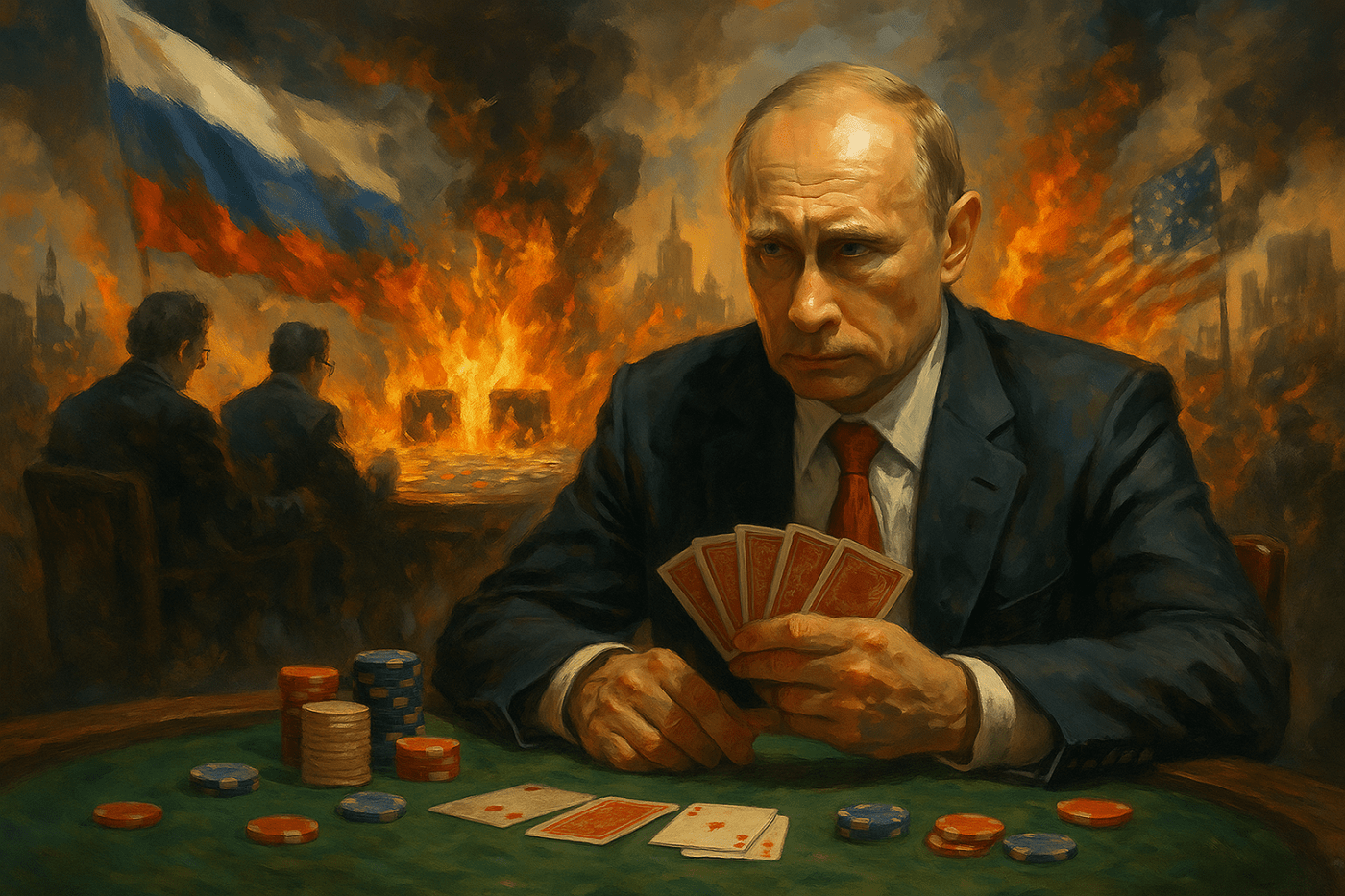
We expose Foreign Policy’s Putin-as-gambler smear for what it is: imperial narrative control. The real record shows decades of NATO expansion, coups, sanctions, and economic warfare. Russia’s moves are part of a deliberate multipolar strategy shaking U.S. dominance. We close by linking readers to the global forces already fighting back.
By Prince Kapone | Weaponized Information | August 10, 2025
House Odds: The Imperial Script Behind the Shuffle
The target under excavation is “Putin Is a Gambler, Not a Grand Master”, written by Anastasia Edel and published in Foreign Policy on June 3, 2025. The piece tells its readers that Vladimir Putin is not a long-game strategist but a reactive opportunist, using disinformation, hybrid warfare, and political stunts to cling to power while presiding over a fragile, corrupt state. It casts this figure of a fearful Kremlin against a supposedly unified and militarily resurgent West, framing the outcome as preordained: the gambler will lose, the house will collect.
That framing isn’t neutral reportage — it’s the voice of a publication that has long served as a messaging hub for the U.S. foreign policy elite, NATO-aligned think tanks, and the corporate and state actors who make up the transatlantic policy machine. Edel’s narrative leans on a Cold War moral geometry where “democracy” and market capitalism are the universal yardsticks, and Russia’s global posture is illegitimate by definition. In this frame, the West is the steward of order, Russia the disruptor, and the only acceptable outcome is one that restores Western primacy.
The article moves on rails laid by familiar amplifiers: NATO-friendly policy experts, recycled U.S. and EU government talking points, syndication of mainstream Western press narratives, Cold War analogies smuggled in as common sense, and corporate media tropes like the card table illustration — all underpinned by the unspoken assumption that “rules” and “order” are exclusive properties of the imperial core. These choices aren’t aesthetic; they’re the architecture of consent.
The propaganda techniques are textbook. Framing tricks strip Russia’s moves of strategic logic while depicting Western actions as reluctant, measured, and inevitable. Absences are used as rhetorical devices — NATO’s provocations, coups, and military expansions vanish from the page. Emotional triggers appear in images of bombed hospitals, grieving civilians, and sepia-toned European unity, all designed to bind sympathy to the West before analysis begins. Cognitive warfare tactics paint Russian disinformation as a unique threat without acknowledging the West’s own industrial-scale narrative operations. Orientalist tropes elevate Western liberalism as the apex of political civilization, rendering Russia a regressive periphery. And the legitimacy framing treats NATO’s expansion and Western economic dominance as natural facts of life, while branding any resistance as criminal.
By the final paragraph, the table has been set and the reader’s chips placed: the empire as the sober house, the adversary as a petty schemer, and history itself as the dealer. What’s left unsaid — and what we will drag into the light — is how much the “house” fears losing control of the game, and how hard it works to make sure no one notices the deck is already marked.
Pulling the Facts Out from Under the Cards
The Foreign Policy article embeds a number of concrete claims within its narrative of a weakened, reactive Russia and a resurgent West. These include: the Trump administration pressuring Ukraine to sign a deal ceding territory and barring NATO membership; Russia’s annexation of Crimea in 2014; the launch of RT in 2005 as a foreign propaganda outlet; the Internet Research Agency’s interference in Brexit and the 2016 U.S. election; Russia’s GDP growth being driven by military spending; rising inflation, an overheating economy, and ongoing brain drain; Russia’s primary allies being Iran, North Korea, and a transactional China; and Gulf oil producers’ ability to undercut Russia due to lower production costs. These factual elements, stripped from their framing, form the raw material for examining both the present confrontation and the deeper history that the piece leaves untouched.
What the article leaves out is as telling as what it includes. There is no mention of NATO’s eastward expansion since the 1990s, despite earlier security assurances to Moscow after the Cold War. The record of U.S. and European backing for “color revolutions” in the post-Soviet space, including in Ukraine in 2004 and 2014, is absent—see, for instance, the leaked Nuland–Pyatt call and the NED’s 2014 Ukraine grants. The web of sanctions regimes, financial blockades, and legal warfare deployed against Russia over the last decade is unacknowledged, even though these measures shape much of the economic terrain the author describes—e.g., the immobilization of roughly $300 billion in reserves. The Trump administration’s foreign policy shift toward transactional bilateral deals, which unsettled NATO’s cohesion while courting rival powers, also goes unmentioned, as does Russia’s engagement in multipolar initiatives such as BRICS+ and the Eurasian Economic Union.
To situate the article’s claims in context, it is necessary to trace the preceding policy arcs. NATO’s 1999 bombing of Yugoslavia set a precedent for military interventions outside the UN framework. The U.S. withdrawal from the Anti-Ballistic Missile Treaty in 2002 signaled a readiness to discard Cold War–era arms control in favor of unilateral strategic advantage. The enlargement of NATO—integrating states along Russia’s western border—has been paired with the development of energy transit routes designed to bypass Russian pipelines, turning oil and gas into instruments of geopolitical leverage. Western financial institutions, through mechanisms like the IMF and World Bank, have shaped post-Soviet economies toward debt dependency and privatization, undermining sovereign industrial bases.
In the present, the contest over Ukraine is inseparable from these longer trajectories. Energy markets remain a central battleground: control over supply chains, pricing power, and export routes is as decisive as military deployments. Sanctions and asset freezes function not just as punitive measures but as tools to reorient global trade patterns and lock targeted states out of high-value markets and technologies. Meanwhile, the shift in global economic gravity toward Asia and the Global South complicates the West’s efforts to maintain a coherent front—captured in UNCTAD’s 2025 outlook on a world economy under pressure and divergence—fractures that are smoothed over in the article’s portrayal of an unshakable, unified “democratic order.”
The factual record, taken together with the omitted history, reveals a more complex and interlocked set of forces than the article’s gambler metaphor allows. Understanding these dynamics requires holding in view the interplay between military posturing, economic coercion, and the slow but visible formation of alternative power centers—developments that the narrative either compresses into background noise or erases entirely. These are the cards left facedown on the table, and they change the game.
Turning the Cards Over: How Russia Outmaneuvers Empire
The premise of the Foreign Policy piece rests on the assumption that Russia’s moves are reactive, defensive, and doomed to collapse under the weight of Western pressure. This is the oldest imperial trick in the book — to pretend that those resisting are flailing, while the empire itself is the master of strategy. But when we strip away the Cold War nostalgia and the NATO-friendly framing, the reality looks very different: Moscow is not staggering from one desperate gambit to another, it is reshaping the board entirely.
From the perspective of the global working class and the colonized nations, what Russia has been doing is neither accidental nor improvised. The integration of its energy exports, currency settlements, and defense partnerships into the architecture of BRICS+ and Eurasian alliances represents a calculated effort to break the monopoly the West has held over trade, finance, and technology for decades. This is not just “survival” — it is the deliberate construction of an alternative economic geography, one in which the IMF’s debt traps and the dollar’s chokehold are less decisive. Every ruble traded for yuan, every pipeline that bypasses Western-controlled chokepoints, every arms contract with a sanctioned state chips away at the scaffolding of U.S. hegemony.
On the military front, Russia has forced the West into a war of position rather than a quick, decisive blow. By hardening its defense industry under sanctions, integrating battlefield lessons into production cycles, and leveraging asymmetric tools — from hypersonic missile development to strategic depth in logistics — Moscow has ensured that NATO’s military superiority on paper translates far less cleanly into advantage on the ground. This blunts the West’s favorite tactic: overwhelming force followed by occupation and regime change.
Politically, the Kremlin’s message lands differently outside the NATO echo chamber. In much of Africa, Latin America, and Asia, Russia is not seen as the gambler of Edel’s metaphor but as a counterweight to the imperial powers that looted, destabilized, and dictated terms to the Global South for centuries. Moscow’s backing of sovereign governments under siege — from Syria to Venezuela — is read not through the lens of liberal “values,” but through the lived memory of coups, sanctions, and debt bondage. Where Washington demands alignment or punishment, Moscow offers military aid, energy deals, and infrastructure investment without IMF-style austerity strings. For states under constant threat of regime change, that difference is existential.
The real tell — the sign that Russia is winning more than the West will admit — lies in the fractures within the imperial core itself. U.S. allies are hedging, buying discounted Russian energy, trading in non-dollar currencies, and refusing to fully enforce Washington’s sanctions dictates. These are not the moves of a “unified” democratic order; they are the cracks in the façade of inevitability. And the more those cracks spread, the more room the multipolar and socialist forces of the world have to maneuver.
For the global working class and the colonized, the stakes are clear. If the West succeeds in breaking Russia, it will not usher in a stable “rules-based” peace; it will remove one of the few major states willing to defy the imperial order and embolden NATO to tighten its grip everywhere from Caracas to Harare to Hanoi. But if Russia continues to outplay the empire — economically, militarily, and politically — it opens a window for all who seek to build a world beyond the dictates of capital and the gunboats of empire.
Make the Links, Build the Power: From Reading to Doing
The forces we’ve named aren’t theoretical—they’re moving right now, opening lanes that our readers can enter today. In the Global South, popular currents like ALBA Movimientos and Brazil’s Movimento dos Trabalhadores Rurais Sem Terra (MST) are securing land, food, and sovereignty against privatization. Pan-African formations clustered around Pan Africanism Today are tying labor struggles to anti-sanctions, anti-base campaigns from Accra to Johannesburg. In West Asia, broad, legal solidarity infrastructures—trade union federations, professional associations, and the Palestine-anchored Boycott National Committee (BNC)—continue to coordinate non-military pressure on the imperial supply chain. Across the Sahel, popular committees and civic organizations are consolidating the sovereignty break of Mali, Burkina Faso, and Niger into tangible social programs, placing external basing and extractive contracts under public scrutiny instead of imperial seal.
In the imperial core, the on-ramp is already paved. The International Peoples’ Assembly and the Tricontinental Institute knit together party cadres, unions, and popular movements across continents, providing analysis and coordination that directly serve organizing. On the street and at the ports, groups like the Black Alliance for Peace, the ANSWER Coalition, and CodePink carry the anti-war, anti-sanctions line into city councils, congressional offices, and corporate headquarters. Material solidarity networks—National Network on Cuba, community-run Gaza medical supply drives, and sanctioned-country aid corridors—turn money and equipment into life, not headlines. Legal shields—from the National Lawyers Guild and aligned civil-liberties outfits—keep pickets, divestment fights, and whistleblowers moving when repression knocks.
Here is how we convert analysis into organized force: first, choose a choke point you can actually touch. If you’re in a port or logistics city, link with local dockers, warehouse workers, and anti-war coalitions to identify shipments, contractors, and financing routes; commit to sustained, lawful pressure on one target (a weapons maker, a sanctions lobby shop, or an energy giant pivoting war profits into “green” cover). Second, build material corridors: pair with Cuba solidarity committees, diaspora medical associations, and trusted humanitarian partners to move supplies where sanctions bite hardest; set monthly fundraising goals and publish transparent ledgers so working people can see their power land. Third, stand up a proletarian cyber cell: map corporate, banking, and public-sector ties to sanctions, bases, and extractive contracts in your metro; publish a plain-language dossier and keep it updated, so unions, students, and faith groups can act without waiting on think tanks. Fourth, lock in political education: join or launch a study circle with Tricontinental syllabi, turn teach-ins into recruitment drives, and cycle new comrades from reading to campaign work within two meetings—no spectators.
None of this requires permission. It requires discipline, continuity, and comradeship. The organizations above are already in motion; plug into the one that matches your terrain, report back, and widen the lane for the next crew. The empire’s advantage is fragmentation. Ours is linkage. Make the link, hold the line, and move the goods.
 Weaponized Information
Leave a comment