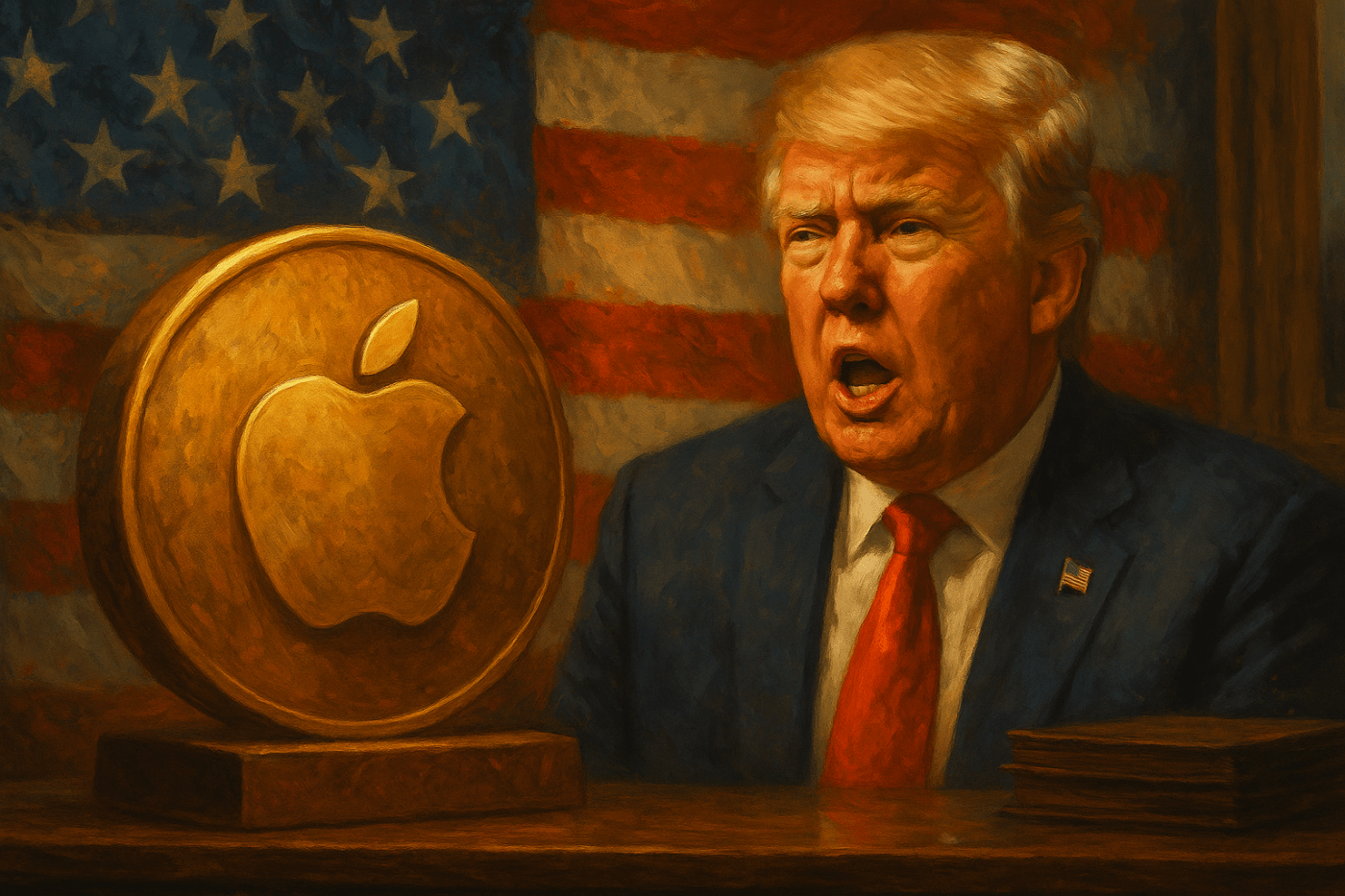
The Apple-Trump investment spectacle is not about reviving American industry—it’s about consolidating imperial command over capital, labor, and logistics through economic blackmail and digital extraction.
By Prince Kapone | Weaponized Information | August 6, 2025
Manufacturing Consent: How CNBC Turned a Contract Into a Covenant
On August 6, 2025, CNBC published an article titled “Apple and Trump detail $100 billion U.S. spending expansion, including $2.5 billion for an iPhone glass factory.” Authored by CNBC technology correspondent Kif Leswing, the piece reports on Apple’s announcement of a $100 billion investment in U.S.-based suppliers over the next four years, with a $2.5 billion expansion of iPhone glass production in Kentucky and promises of an “end-to-end” domestic supply chain. Framed as a historic achievement for American manufacturing, the article presents Apple’s collaboration with the Trump administration as a patriotic industrial partnership, emphasizing factory construction, semiconductor self-sufficiency, and tariff exemptions as signs of national renewal.
Kif Leswing has made a career reporting on Big Tech with a focus on Apple, routinely covering product launches, supply chain moves, and executive interviews. His reporting lacks any material analysis of labor conditions, corporate power, or political economy, reflecting the ideological posture of an embedded PR surrogate rather than a critical journalist. He works for CNBC, a business media platform owned by Comcast-NBCUniversal, whose primary function is to frame the global economy from the standpoint of capital. CNBC does not investigate power—it manages perceptions of it. It speaks not to workers or communities but to boardrooms, hedge funds, and the executive class. Its coverage of Apple operates as a communications wing for monopoly tech, channeling corporate talking points through the vernacular of economic patriotism.
From the opening sentence, the article performs a subtle sleight of hand. Apple’s self-interested capital deployment is recoded as an act of national service. The headline doesn’t say Apple announces an investment—it says Apple and Trump “detail” it, drawing the reader into a coordinated choreography rather than a transaction. The text then proceeds to treat this corporate press event as a moment of historical importance, framing the announcement as the largest of its kind in American history without even a trace of skepticism. The decision to emphasize round numbers and geographic breadth (“$100 billion,” “all glass for iPhones,” “19 billion chips”) is not incidental—it’s a deliberate attempt to overwhelm the reader with scale, replacing scrutiny with spectacle. Numbers stand in for analysis, and repetition of magnitude serves as a substitute for relevance.
Language throughout the article is engineered to trigger emotional resonance while obscuring class and power dynamics. Tim Cook is depicted presenting the president with a “souvenir” made of iPhone glass—a gesture stripped of context but rich in symbolism. This image, like the ceremonial gifting of tokens between emperors, operates to signify alliance without declaring it outright. The repetition of phrases like “American supply chain,” “resilience,” and “manufacturing revival” serves not as neutral descriptors but as ideological wallpaper—terms designed to invoke comfort, continuity, and collective interest while hiding corporate concentration and state privilege. Absent is any mention of labor, wages, or working conditions. Workers exist only as hypothetical beneficiaries, invoked abstractly through the word “jobs,” which functions less as a material category and more as a political incantation.
Perhaps the most revealing narrative tactic deployed is the strategic use of omission layered beneath the illusion of transparency. The article claims that “many of the parts inside the iPhone are made in the U.S.,” a vague assertion presented without evidence or scrutiny. Simultaneously, there is no mention of where the iPhones themselves are actually assembled, or by whom. The author dodges this omission by anchoring the reader’s attention to domestic fragments—glass, lasers, chips—divorced from the global process that binds them together. In doing so, the article performs a geographic decontextualization that erases the international circuits of labor and logistics on which Apple depends. Instead of exposing contradiction, the narrative smooths it over. The result is an ideological product: a clean, digestible myth of benevolent capital and industrial renewal, delivered in language designed not to question power, but to confirm it.
Supply Chains and Smoke Screens: Building the Factual Terrain
The CNBC article under excavation offers a parade of numbers and claims, but like any imperial accounting, the key is in what’s left off the ledger. What it does tell us is this: Apple has announced an additional $100 billion in U.S.-based spending over the next four years, on top of a $500 billion pledge made earlier in 2025. This includes a $2.5 billion investment in Corning’s Kentucky facility to produce iPhone glass, and expanded data center operations in North Carolina, Iowa, Oregon, and Nevada. The company claims that “all” iPhone and Apple Watch glass will now be manufactured domestically, alongside chip fabrication and Face ID modules. A total of 19 billion chips are expected to be produced through U.S.-based suppliers, including TSMC’s Arizona facility. Apple also boasts tariff exemptions on incoming semiconductors, framing its investment as a ticket to industrial sovereignty and economic resilience.
But these figures are contextless without the facts the article refuses to name. The most glaring is the geographic sleight of hand around where Apple’s actual products are assembled. According to Supply Chain World, India has now overtaken China as Apple’s top assembly hub, producing 44% of iPhones imported into the U.S. as of Q2 2025. Between January and May alone, India assembled 23.9 million iPhones, with nearly 78% exported directly to the U.S. This shift is not a footnote—it is the material backbone of Apple’s production strategy. The CNBC article references “parts” made in America but never discloses that the final products are built elsewhere. That omission is not editorial laziness; it is an ideological maneuver. As documented in “Apple Walks Away from China”, this shift is the product of calculated Cold War pressure, not voluntary patriotism. The U.S. state has effectively weaponized tariff policy to reroute global supply chains through political allies like India while maintaining access to cheap labor and regulatory impunity.
The celebration of “domestic manufacturing” also obscures the reality of what gets extracted, and from where. The iPhone depends on cobalt, lithium, tantalum, and rare earth minerals sourced through violent extraction regimes across Africa and Latin America. In the Democratic Republic of Congo, cobalt mining has long relied on child labor and dangerous hand-dug shafts. In 2017, The Washington Post confirmed Apple’s direct links to Congolese mines using children as young as seven to harvest cobalt for batteries. Apple temporarily suspended some sourcing at the time, only to resume operations under new contractors and deeper layers of obfuscation. The CNBC article makes no reference to this global raw material base. Instead, it isolates the production story within U.S. borders, creating a sanitized, self-referential loop in which supply chains begin and end with Apple, not with the communities displaced or the children buried under collapsed tunnels.
Beyond physical production, the article also ignores the extensive public subsidies that grease the wheels of Apple’s so-called investments. In 2021, Apple secured nearly $846 million in tax breaks from North Carolina alone to build a campus in the Research Triangle. That figure doesn’t include the federal funds funneled through the CHIPS and Science Act or Apple’s ability to avoid taxes through offshore accounting. As detailed by the Institute on Taxation and Economic Policy, Apple has long used subsidiaries in Ireland, Jersey, and the British Virgin Islands to shelter hundreds of billions in profits. These are not abstract numbers—they are stolen public funds, laundered through economic development rhetoric and funneled back to shareholders through record-setting stock buybacks. None of this financial architecture appears in the CNBC report, which treats Apple’s capital flows as natural, apolitical acts of benevolent industry.
The domestic side of this supply chain makeover is also whitewashed. While Apple’s factories are described as national triumphs, there is no mention of the labor regime that underpins them. As “Farm Raids, Forced Displacement, and the Colonial Border Regime” exposes, the U.S. maintains a militarized deportation system that destabilizes undocumented labor pools, driving down wages and criminalizing resistance. These border raids don’t just enforce immigration law—they shape the labor market to meet the needs of capital. The factories that Apple is expanding in Texas, Kentucky, and elsewhere are not displacing sweatshops abroad—they are reproducing them under U.S. law, with fewer rights, deeper surveillance, and ICE at the door. Yet the CNBC article reduces this entire domestic terrain to a single word: “jobs.” It is a euphemism so broad it erases the conditions under which those jobs exist, who gets them, and at what cost.
Finally, the article’s portrait of tariff immunity as a reward for American investment ignores the broader context of trade coercion. In July 2025, President Trump announced plans for a 100% tariff on semiconductors, targeting companies that fail to relocate their operations to U.S. soil. According to The Tariff Wall and the Sanction Noose, this policy functions not just as international pressure but as domestic economic warfare—punishing disobedient capital while rewarding compliant monopolies. Apple’s exemption is not a sign of success. It is the transactional payoff of a loyalty program enforced through executive decree and market blackmail. This is the unspoken logic beneath CNBC’s story: cooperate, and you’ll be protected. Resist, and you’ll be priced out. The truth isn’t that Apple is bringing production home. The truth is that empire is re-routing its chokeholds—and calling it investment.
The Contract State and the New Supply Chain Mandate
What the CNBC article hides beneath a fog of investment language and presidential theater is the sharp edge of an imperial system in crisis. This isn’t Apple “coming home.” It’s empire circling the wagons. The $100 billion pledge, dressed up in patriotic language, is the down payment on a new social contract—not with the people, but with the state. This is not a reinvestment in workers, communities, or public infrastructure. It is a procurement compact between monopoly capital and a dictatorial state apparatus: the Contract State, where executive discretion, economic coercion, and corporate obedience replace law, regulation, and collective bargaining. Beneath every photo op is a non-negotiable directive—build here, comply, or be cut off. The logic is neither free market nor protectionist. It is enforced loyalty, secured through tariff threats, industrial subsidies, and a rewired supply chain regime.
This realignment is not a return to Fordist manufacturing. It is the consolidation of Technofascism: the mergence of corporate, state, and big tech power. Apple’s role in this system is not merely as a phone maker, but as a node in the imperial logistics machine. Its factories are not symbols of revival—they are logistical bunkers. Its investments are not patriotic—they are cartel-style tribute paid in exchange for market access and regulatory immunity. The narrative of “Made in America” is not just a lie—it’s a smokescreen. The truth is that America makes little. It assembles less. What it does manufacture—at scale—is ideology, enforcement, and economic siege. The CNBC article launders this fact, transforming corporate compliance into civic virtue.
The glass, chips, and lasers produced in Kentucky and Arizona are not isolated miracles of productivity. They are fragments in a system whose foundation rests on Neocolonial Extraction. Every touchscreen begins in the red earth of the Congo or the lithium flats of Latin America. Every battery is tied to child labor and resource militarization. This is not anecdotal. It is systemic. The raw materials, human beings, and territories of the Global South remain captive to the U.S.-led tech order. What changes now is not the dependence—but the geography of enforcement. India, now elevated as Apple’s primary assembly zone, does not rise through sovereign development. It rises through Comprador Capitalismisn: the collaboration of its national bourgeoisie with Western capital, in exchange for prestige, subcontracted growth, and a seat at the imperial table. As documented in “The Double Bind”, this role is not new. It is the colonial repetition of a state forced to serve two masters: Washington and its own oligarchs.
Within this recalibration, labor becomes an afterthought—something to be surveilled, displaced, and regimented, not empowered. In the U.S., factories serve not just production needs but political ones. They symbolize a broken promise repackaged as progress. But for the colonized poor—both abroad and inside U.S. borders—they represent the deepening of control: ICE raids, workplace surveillance, union suppression, and algorithmic productivity targets. For India’s Dalit and migrant workers, Apple’s expansion means informalized jobs, minimal protections, and intensified caste-class exploitation. For workers in Kentucky and Texas, it means low-wage tech zones subsidized by public funds and secured by a deregulated state. This is not an industrial renaissance. It is a fortress economy—designed not to uplift, but to harden.
And behind it all is the imperial logic of survival through control. As multipolar blocs like BRICS+ gain momentum, and as the dollar’s grip weakens, the U.S. responds not by democratizing its economy, but by militarizing it. Its tech giants become command centers, its trade policy becomes extortion, and its “investments” become front-line positions in a global conflict over capital, resources, and information. CNBC won’t tell you that. Because its job is not to inform. Its job is to make sure you don’t ask the wrong questions. But here’s the answer anyway: what we are living through is not a new deal—it’s the back end of a dying empire. And it doesn’t need your support. It needs your silence. That’s why we speak.
Break the Circuit: Action Against the Contract State
If the Apple-Trump alliance signals anything clearly, it’s that capital no longer pretends to belong to the public. It belongs to the state it underwrites, the borders it fortifies, and the machines it feeds. But all empires that centralize too much power eventually forget the one thing they cannot program: refusal. The global working class has never relied on tech firms to liberate them, and they’re not starting now. The resistance is already underway. In Tamil Nadu, iPhone assembly workers have staged walkouts against exploitation and broken the myth of passive labor. In the Congo, miners organizing for safety and autonomy continue to expose the hidden cost of every lithium-ion boast. In Apple Stores across the U.S., retail workers and technicians have begun to push back against union suppression and surveillance discipline. And across ICE’s shadow empire of detention and deportation, migrant workers resist a system designed to criminalize their very survival. These are not isolated struggles. They are the front lines of a global revolt against the Contract State.
The forces building the future are not in the boardrooms—they are in the blocs. In July 2025, BRICS member states announced a new multilateral technology initiative aimed at breaking dependency on U.S.-dominated infrastructure and digital monopolies. According to Al Mayadeen, the proposal includes a shared cloud network designed to protect communications, data flows, and critical computing infrastructure from Western surveillance and coercion. This initiative is more than a development strategy—it is a sovereignty intervention. It lays the groundwork for material independence from the sanctions regime and chips-as-coercion model that the U.S. now deploys against both enemies and allies. This is what economic resistance looks like when it’s scaled across continents. It’s not just about factories. It’s about power.
So what does resistance look like in the belly of the beast? First, we aim our fire where the contradictions live. Target campaign strategy: launch a public pressure campaign demanding universities, pension funds, and public institutions divest from Apple, Broadcom, and their logistics contractors. Frame it not as consumer activism—but as institutional accountability. These companies profit from global dispossession. They don’t need more capital—they need to be cut off. Second, we fund what the empire fears. Mutual aid initiative: build direct pipelines to support Tamil Nadu labor media, Congolese union radios, and local immigrant resistance funds fighting ICE and tech-backed surveillance. It’s not charity—it’s internationalist investment.
Third, we disrupt their control of the narrative. Cyber resistance tactic: develop open-source browser extensions that block CNBC and redirect users to counter-hegemonic media—Weaponized Information, Tricontinental, Nakala, and frontline revolutionary outlets. The ideological terrain is algorithmic now. We can’t abandon it. Finally, we train the next generation to name the machine. Political education initiative: build curriculum modules tracing how every smartphone contains a map of empire: from the mines to the sweatshops to the ICE-enforced factories in Texas. Make it visible. Make it undeniable. And make it useful.
Because Apple’s not the future. Silicon Valley’s not the vanguard. The future belongs to those who break the supply chain—not to those who manage it. And what empire needs most right now is your obedience. So we offer it nothing. No applause, no silence, no compliance. Only refusal.
 Weaponized Information
Leave a comment