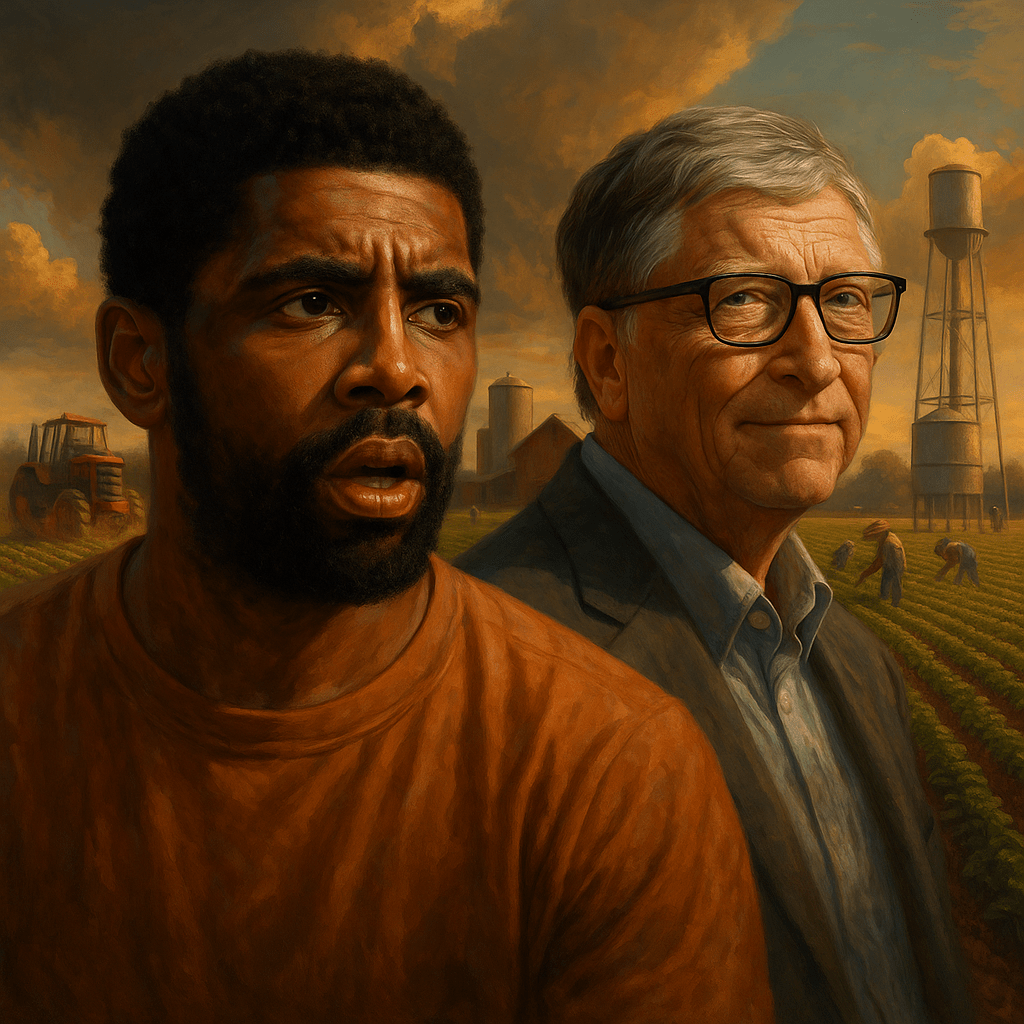
Kyrie Irving was mocked for questioning billionaire land and water control—but the laughter is propaganda. Corporate media exists to deflect attention from the privatization of essential resources by U.S. capital itself. Bill Gates’s farmland empire is a pillar of technofascist consolidation, not a harmless investment portfolio. We must defend proletarian intuition, expose capitalist enclosures, and organize to reclaim the commons.
By Prince Kapone | Weaponized Information | July 30, 2025
Clown Journalism in Defense of Billionaires: How the Media Mocked Kyrie Irving to Protect Bill Gates
On July 28, 2025, Fadeaway World published an article under the Yahoo! Sports banner titled “Kyrie Irving Claims Bill Gates Owning Majority Of The Land And Water In The USA Is Weird”, authored by Vishwesha Kumar. The piece centers on Kyrie Irving’s comments made during a Twitch livestream, where the NBA star questioned why Bill Gates, one of the richest men on the planet, owns massive tracts of farmland and, allegedly, a majority of the country’s water. The article swiftly launches into a rebuttal, using a familiar combination of technocratic factoids, mockery, and smug “debunking” to declare Irving’s concerns as baseless. The framing is textbook: take an imprecise formulation by a public figure, strawman it into a falsehood, and then tear it apart with surgically selected statistics that miss the larger political point.
But the real subject of the article isn’t Kyrie. It’s billionaire power. And the mission is clear: ridicule anyone who questions it. Let’s not kid ourselves about Kumar, either. This is not a radical voice or even a journalist in the classical sense. Vishwesha Kumar is a digital culture content writer—a product of the influencer-industrial complex—trained not in political economy or historical research but in clicks, impressions, and viral algorithms. His class function is clear: to funnel real popular anger at the system into individual ridicule and spectacle containment. In plain English: to clown Kyrie so the readers don’t start asking real questions about the Gates Foundation, land monopolies, or the privatization of water in an age of global drought. This is not reporting—it’s ideological babysitting.
And it doesn’t stop with Kumar. The outlet he writes for, Fadeaway World, is a low-rent sports gossip mill that syndicates its content through Yahoo!, now owned by Apollo Global Management—a multibillion-dollar private equity vampire with holdings in surveillance tech, private prisons, and every other tentacle of late-stage capital.
The very companies that profit off privatized infrastructure, land speculation, and digital disinformation own the pipeline through which the average American consumes “news.” In other words: the landlord writes the article explaining why you should stop complaining about landlords. The same Yahoo! that helped build the Great Firewall of China and handed over dissident emails to the Chinese government now pretends to be a watchdog for democracy. Spare us the theater.
Once this piece hit the web, it was instantly amplified by the usual suspects: Reddit forums flooded with nerdy debunk memes, “fact-checkers” like PolitiFact slapped their condescending ratings on it, and sports outlets recycled the clickbait headlines with robotic glee. Kyrie was once again painted as the mad jester of the NBA—too curious for his own good, too Black to be taken seriously, and too rich to be allowed nonconformity. That’s how cognitive warfare works in the empire: if your instincts threaten power, your intellect must be publicly humiliated.
Let’s be clear: Kyrie didn’t publish a policy paper. He said, offhandedly, that it was “weird” Bill Gates owns so much land and water. And that’s enough to summon the full weight of corporate media to swat him down like a bug. Why? Because the ruling class knows that once people start questioning who owns the land, the water, the air, and the means of survival, the entire property regime begins to tremble.
So the article pulls every trick in the imperial media playbook. It starts with a classic conspiracy-dismissal technique: flood the reader with precise land percentages to make the concern sound silly—“only 0.03% of U.S. farmland!”—as if capitalist concentration of farmland in the hands of one man during a global food crisis isn’t a red flag. Then it moves to strategic omission: no mention of water futures markets, no discussion of land speculation, no reference to Indigenous dispossession or Black displacement. Nothing but the shallowest legalisms: “technically, Gates doesn’t own the water.”
The article also makes expert use of emotional manipulation. It ties Kyrie’s water comments to his past flat-earth remarks to preemptively strip him of credibility. This is more than character assassination—it’s ideological euthanasia. Kill the rebel’s image so the rebellion doesn’t spread. There’s also a dose of cognitive warfare, where obscure legal jargon like “riparian rights” and
“prior appropriation” is trotted out, not to educate the public, but to intimidate them out of thinking they can ever understand how water access works. Know your place, says the state.
Then comes the obligatory false equivalence: the argument that because Gates doesn’t own “most” land or water, his control over either isn’t worth scrutiny. As if the logic of private ownership itself isn’t what’s on trial here. Finally, we get a subtle colonial caricature: Kyrie, the irrational Other, once again gets lumped into the same category as mystics and madmen, another unintelligible voice from the underclass who dares challenge science and reason (read: capitalist control).
This is how empire thinks: it’s not weird that one man owns a quarter million acres of farmland, but it is weird that a basketball player questions it. The media is not failing. It’s doing its job. And Kyrie—whether he knows it or not—just rattled the gate to the billionaire plantation.
What the Numbers Don’t Say: Extracting the Truth Behind Billionaire Land and Water Control
Once the propaganda is peeled back, we can finally look at what Kyrie Irving was actually pointing toward—even if he didn’t have the spreadsheet citations ready. The article admits that Bill Gates owns about 270,000 acres of farmland in the United States. It then immediately rushes to neutralize this fact by informing us that this represents a mere “0.03%” of all U.S. farmland, as if we’re supposed to breathe a sigh of relief. But that number—0.03%—functions like a smoke bomb. It obscures the fact that Gates is the largest private farmland owner in the United States. Not a government agency. Not a collective. A man. A tech billionaire with no background in farming owns nearly 300,000 acres of soil, rivers, irrigation systems, and food-growing potential across 19 states. He owns land in Nebraska, Arkansas, Louisiana, Arizona, and Washington. In Washington state alone, he spent $171 million for 14,500 acres of rich agricultural terrain. That’s not a hobby. That’s a strategy.
The next key dodge in the article is the idea that Gates doesn’t “own” the water. This is the technicality trick. In the U.S., water is governed by a bizarre patchwork of riparian and prior appropriation laws. You don’t own the raindrop, but if you own the land it falls on—or more accurately, if you have legal claim to the flow—you can extract it, divert it, sell it, or hoard it. You can also invest in water the same way you would with oil or lithium. That’s why Gates-backed entities and other billionaire funds are quietly acquiring water rights, stakes in water banking systems, and shares in water futures markets—not because they’re thirsty, but because scarcity is profitable.
The Nebraska land buy is a case in point. In 2022, Gates’s firm, Cascade Investments, used shell companies to spend over $113 million acquiring farmland in areas with access to irrigation systems tied to the Ogallala Aquifer. In California, billionaire firms like the Resnicks’ Wonderful Company use ownership of almond and pistachio orchards as a front for extracting massive quantities of groundwater. Through their control of 57% of the Kern Water Bank and over 120 billion gallons used annually, the Resnick empire not only irrigates its orchards but also profits from selling stored water—turning aquifers into access points for capitalist extraction. There’s a reason why Wall Street is now calling water “blue gold.” That reason isn’t philanthropy—it’s profit through artificial scarcity.
But let’s widen the lens. Gates isn’t just a guy with some land. He’s a key figure in a broader shift in imperial capitalist accumulation. Since the 2008 financial crisis, farmland has become a strategic asset class for institutional investors, hedge funds, and tech billionaires. As traditional stock and bond returns declined, capital pivoted to the oldest source of value: land itself. By 2023, investment funds had increased their U.S. farmland holdings more than 800%, with millions of acres now under corporate control—a trend documented by Reuters as part of a broader speculative shift toward agricultural consolidation. The UN and World Bank, meanwhile, promote “climate-smart agriculture” and “precision farming” as solutions—both of which just happen to be industries where Gates dominates through investments in GMO seed patents, ag-tech startups, and soil-monitoring software.
These investments aren’t just about growing carrots. They’re about securing control over the inputs, outputs, and logistics of global food systems. Gates is a major funder of the Alliance for a Green Revolution in Africa (AGRA), a program that has actually increased hunger, farmer debt and ecological disaster across the continent by flooding smallholders with expensive seeds, pesticides, and foreign-controlled markets. This is not a man investing in the future of humanity. This is digital colonialism disguised as technocratic benevolence.
Let’s also talk about water privatization on a systemic level. In the U.S. West, private firms—often backed by institutional and billionaire finance—are buying up farmland not simply for crops but for access to water itself. As documented in a Truthout investigation, these companies purchase water rights attached to farmland and then sell or lease those rights, sometimes transferring them across counties for profit. This is not about agriculture—it is about transforming the most essential resource into an asset class and commodifying scarcity for capital gain. These water grabs often hide behind local LLCs and real estate fronts. In the Global South, especially across Africa and Latin America, IMF-driven “public-private partnerships” have handed over water systems to multinational corporations, creating situations where people have to pay for rainwater or risk arrest for unauthorized wells. Gates’s philanthropy in these regions is a trojan horse—softening resistance to a system that puts hydration behind a paywall.
Meanwhile, in the United States—the supposed land of abundance—there are people in Jackson, Mississippi, and on Native reservations still without access to clean water. Black and Indigenous communities suffer from the collapse of municipal infrastructure and deliberate state neglect, while capital flows into speculative water markets and farmland consolidation. Kyrie may have misspoken by saying “majority,” but he spoke a truth deeper than numbers: the basic building blocks of life are being auctioned off, and billionaires like Bill Gates are first in line with paddles raised.
So when the article smugly concludes that “no one owns the water,” it’s technically correct—just like saying no one owns the air. But if you control the filters, the compressors, and the masks, then you own the breath. And Gates is buying every filter on Earth.
The Plantation Has Wi-Fi Now: Billionaire Land Grabs and the Return of Enclosure
Let’s not get cute about it—Bill Gates doesn’t have to “own” every acre or reservoir to control the basic lifelines of modern civilization. What Kyrie Irving pointed to, albeit clumsily, was not a misunderstanding of property law. It was a gut-level recognition of something older and more violent than American democracy: enclosure. The same logic that tore the commons away from peasants in England, that fenced off and auctioned away stolen land from Indigenous nations in the US, and that auctioned off entire water systems to foreign investors in the Global South is now reappearing in a high-tech costume. Call it what it is: the digital counterrevolution against the commons.
We are not living in an age of prosperity with some unfortunate billionaires on the side. We are witnessing the consolidation of a new feudal order, one that replaces kings with data moguls, knights with hedge funds, and castles with offshore LLCs. Gates’s land and water investments don’t just give him crops and irrigation privileges—they give him leverage over food pricing, seed monopolies, research funding, regional infrastructure negotiations, and climate resilience policies. This is not just agricultural speculation. It is Necro-Extractivism—a system where control over death (drought, famine, eviction) becomes the basis for wealth accumulation.
It’s not enough to say Gates is powerful. We need to name the system he is serving. This is Technofascism: the fusion of monopolized tech capital with state security, property law, and digital surveillance in order to pacify unrest while deepening structural inequality. Gates’s role in this isn’t incidental—he is one of its architects. His investments in seed data firms, water sensor systems, AI-driven agriculture, and “philanthropic” land acquisition form the infrastructure of a world where human rights are algorithmically priced and ecologies are engineered to maximize profit. You don’t need to deploy tanks when you can buy the soil they grow in.
What Kyrie was groping toward is the fact that in this world of app-based grocery delivery and billionaire “climate solutions,” the very idea of a commons has been erased. It has been replaced by what we can call Neocolonial Accumulation—the extraction of value from land, labor, and life itself,
under the guise of sustainability and national development. The Gates Foundation, like the Rockefeller and Ford foundations before it, wears a velvet glove, but the hand inside is steel. Its mission is to make dispossession feel like progress. Take a look at Africa, where the Gates-backed Green Revolution promised productivity and delivered debt peonage and crop failures. Or at India, where corporate seed monopolies and water-intensive agriculture have driven farmer suicides for decades. These are not accidents. They are the intended outcomes of a system designed to serve capital, not people.
That’s why the mockery of Kyrie is so revealing. He didn’t threaten truth—he threatened the mythology of capitalist benevolence. He questioned whether it’s normal that one man can accumulate so much while others die for lack of access to water. That question alone tears through the fog of American individualism and property fetishism like a machete. And so, the ruling class responded with laughter, memes, and fact-checks. But beneath the sarcasm lies fear. Because the real conspiracy isn’t Kyrie’s—it’s the fact that Gates and his class have fenced off the Earth and called it innovation.
The joke is supposed to be on Kyrie. But here’s the actual punchline: the planet is burning, billionaires are buying the lifeboats, and anyone who points this out is labeled a fool. The media calls it a “weird” thing to say. What’s weird is that we’re still pretending this is normal. What’s weird is that in 2025,
Black athletes are mocked for asking who owns the land while white billionaires are praised for buying it. What’s weird is that a man can own the software, the seeds, the satellites, and the soil—but we’re told he’s just a savvy investor. This isn’t weird. It’s warfare.
And here’s where we draw the line. No, Kyrie doesn’t need to cite riparian law. What he needs—and what we need—is to reclaim the standpoint of the oppressed: the landless peasant in Chiapas, the waterless child in Jackson, the tenant farmer in Punjab, the Black radical basketball player who smells smoke and refuses to believe it’s just fog. That’s who we build with. That’s who we defend. Because the plantation has Wi-Fi now. And it’s time to burn the apps.
From Mockery to Militancy: Building a Movement Against the Billionaire Enclosure Regime
At some point, we have to stop laughing along with the empire’s jokes. The ridicule of Kyrie Irving isn’t just a media sideshow—it’s a strategic effort to discredit intuitive rebellion. When a Black athlete questions why a tech billionaire owns farmland and water systems, that should be a teachable moment. Instead, it’s treated like comedy. But for the oppressed and dispossessed, the question hits different. It’s the same question the Zapatistas asked in Chiapas. The same one the Landless Workers’ Movement in Brazil asks every day. Who controls the land? Who controls the water? And who decides who eats and who starves?
Our solidarity lies first and foremost with those resisting this system on the frontlines. From the Movimento dos Trabalhadores Rurais Sem Terra (MST) in Brazil reclaiming farmland from oligarchs, to Indigenous land defenders in Wet’suwet’en territory, to the Kenyan farmers rejecting Gates-backed GMO seed dependency, the resistance is real, material, and global. These are not sentimental struggles—they are existential battles against the new feudalism of the tech-finance elite. Kyrie’s words, however imprecise, echo their call. And for those of us in the heart of empire, the time to join that call is now.
The blueprint for action in the Global North must start with rupturing the pipelines of profit and obedience that allow billionaires to consolidate our lifelines. First, we target the portfolios. The farmland acquisitions of Bill Gates, TIAA, and BlackRock are financed through pension funds, university endowments, and asset managers like Vanguard. Divestment campaigns must pressure these institutions to sever ties with farmland speculation and agribusiness monopolies. If your retirement fund owns a slice of Ethiopia’s breadbasket, you’re complicit. That has to end.
Second, we build from the soil up. Mutual aid food sovereignty projects—like Soul Fire Farm, the Black Land & Power Collective, and Indigenous farming networks—are creating the alternative. These projects don’t just feed people. They teach, train, and organize a new generation of land-conscious revolutionaries. They break dependency on corporate food systems and replace it with autonomy. Support them. Fund them. Join them.
Third, we weaponize the web. Open-source intelligence and mapping initiatives can expose the shell companies and LLC networks behind billionaire land grabs. Track Gates’s holdings. Publish databases. Visualize ownership. Pull the curtains back on who controls your county, your watershed, your supermarket supply chain. This is digital counterinsurgency against capitalist secrecy—and it costs them more than it costs us.
Finally, we commit to political education that centers enclosure as the foundational crime of capitalism. From the theft of Indigenous land to the criminalization of squatting, the fight over land and water is not an issue—it is the terrain of the class struggle. Kyrie’s comments open a door. Step through it. Host a teach-in. Run a study group. Use his words not as a meme but as a catalyst for real popular consciousness.
We are not here to defend Kyrie as a celebrity. We are here to defend him as a human being who dared to pull back the curtain on the biggest land grab since the settler frontier. He said it was weird. He was being polite. It’s monstrous. And it’s up to us to bring it down.
 Weaponized Information
Leave a comment