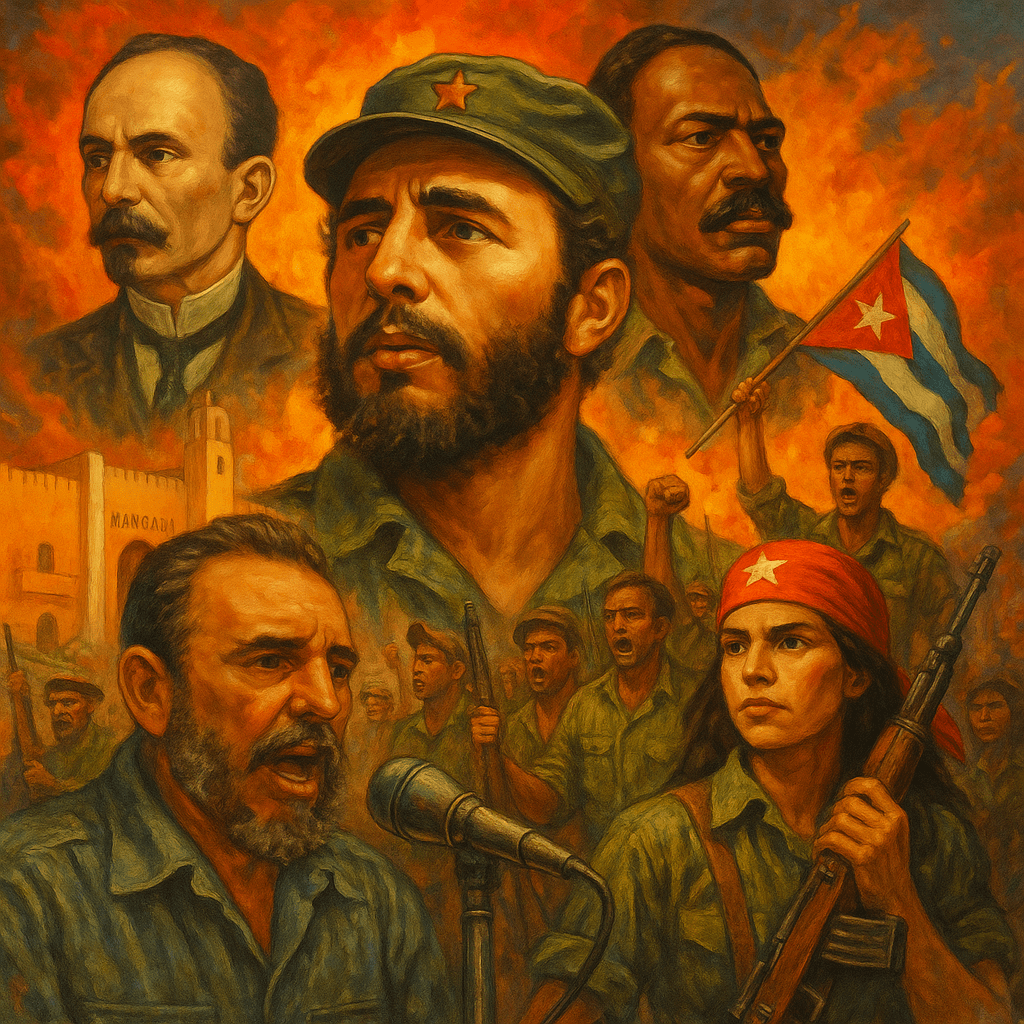
From the blood of Moncada to the barricades of today, Cuba’s revolution was never a moment—it is a method, a memory, and a mirror held up to empire. As the technofascist world order decays, the spirit of July 26th returns to demand a new generation of revolutionaries rise and finish what was begun.
By Prince Kapone | Weaponized Information | July 26, 2025
The Unbroken Thread of Cuban Rebellion
The story of Cuba’s July 26th Movement—the audacious assault on Moncada Barracks in 1953—is not some isolated spark that randomly lit up the darkness. It is one flaming point in a long-burning fire, part of a continuous revolutionary process that stretches back through centuries of rebellion, sacrifice, and defiant human dignity. To understand July 26th as anything less than a chapter in this ongoing narrative is to amputate it from the people who gave it life—and from the world-historical struggle it belongs to.
Long before Fidel and the compañeros marched toward Moncada with rifles and righteous fury, the blood of insurgents had already soaked Cuban soil. The island’s first revolutionaries were not communists with red banners, but cimarrones—enslaved Africans who tore off their chains and fled into the forests, building free communities in the mountains. They refused to live on their knees, and in doing so, gave birth to the spirit of Cuban rebellion. From the fires of the sugar plantations to the Taino resistance led by Hatuey, Cuba’s revolution began not with ideology, but with a primal rejection of being owned.
By the 19th century, this rejection had matured into organized revolt. In 1868, Carlos Manuel de Céspedes freed his slaves and launched the Ten Years’ War—an audacious declaration of war against Spanish colonialism and slavery itself. Though it was brutally repressed, it cracked the colonial edifice. In 1895, José Martí—poet, philosopher, anti-racist internationalist—picked up that mantle with the Cuban War of Independence. Martí didn’t want a Cuba with a new face on the same old system; he fought for a decolonized, egalitarian republic. His death in battle made him a martyr, but his dream lived on.
That dream, however, was carried forward on the shoulders of titans—and none stood taller than Antonio Maceo Grajales, known to the people as El Titán de Bronce, the Bronze Titan. The son of a Black Venezuelan mother and a Cuban mulatto father, Maceo rose through the ranks of the Liberation Army not through pedigree but through revolutionary prowess. Wounded in battle over two dozen times, he was as feared by the Spanish as he was beloved by the Cuban masses. But it was not only his courage that made him immortal—it was his clarity. When Spanish negotiators offered a peace treaty without abolition, Maceo refused, declaring that no true independence could exist while slavery endured. His Protesta de Baraguá was not a mere rejection of a bad deal—it was a revolutionary line drawn in blood: liberty without justice is a lie.
Maceo didn’t just fight for a free Cuba; he fought for a sovereign, multiracial republic where the colonial order would be shattered at the roots. His leadership shattered the myth that Black Cubans had no place in the struggle for nationhood. He was, in every sense, a precursor to Fidel—not only in method, but in moral courage. The July 26th Movement inherited Maceo’s spirit, not as an ancestor in a textbook, but as a living guide for action.
That dream, however, was immediately hijacked. The United States, with all the subtlety of a machete, swooped in under the pretense of “liberating” Cuba in 1898, only to impose the Platt Amendment and turn the island into a glorified brothel for Yankee capital. This was not independence—it was recolonization in a business suit. Sugar barons ruled. U.S. marines strolled Havana like it was Miami. A series of corrupt comprador regimes kept the Cuban people in chains while Washington reaped the profit. But still the fire burned.
In the 1930s, the people surged once more. Antonio Guiteras, a young radical nationalist, launched bold land reforms and nationalizations before being assassinated by the Cuban military under orders from Washington’s Cuban lapdogs. Workers struck. Students rioted. The streets of Havana became classrooms of struggle. From these revolts emerged a new generation that refused to forget Martí, refused to forget Maceo, refused to forget Hatuey, refused to forget the dignity of their ancestors. They knew that the island would never be free through ballots rigged by landlords or laws written in English.
So by the time 1953 arrived, Cuba was not a peaceful land shocked by a sudden uprising. It was a wounded volcano, rumbling with history. The Batista dictatorship had canceled elections, outlawed hope, and handed the country back to Wall Street and the Mafia. But Cuba’s memory was long—and its rebels were ready. The July 26th Movement, born in that assault on Moncada, was not the birth of revolution but its rebirth, a clarion call across the island that the long war for Cuban liberation was not over. The young men and women who took up arms that morning did not act out of despair—they acted with historical clarity.
They knew they were not alone. Behind them marched Martí, Maceo, Guiteras, Hatuey, and the nameless thousands who had died in cane fields and dungeons. And with them marched a vision—not just for Cuba, but for all peoples crushed under the weight of empire. That is the real meaning of July 26th. Not just a battle. Not just a movement. But a moment when the past rose up, clenched its fists, and said: We are not finished yet.
Moncada: When History Picked Up a Rifle
The morning of July 26, 1953, was not the start of something new. It was history pulling the trigger. At the crack of dawn in Santiago de Cuba, a group of young rebels led by Fidel Castro launched an armed assault on the Moncada Barracks—the second-largest military fortress on the island and a key pillar of Fulgencio Batista’s U.S.-backed dictatorship. The action was bold, bloody, and, in military terms, a failure. Dozens were captured. Many were tortured and murdered. Fidel was jailed. But this so-called failure set in motion a revolutionary chain reaction that would eventually topple a regime, exile an empire, and ignite a socialist transformation that still reverberates across the globe.
Fidel and his compañeros were not acting in desperation. They were acting in tradition. Moncada was their Baraguá, their Baire, their call to arms in the footsteps of Céspedes, Martí, and Maceo. They chose Santiago deliberately. It was no coincidence that this city—long a stronghold of Afro-Cuban resistance, maroon settlements, and anti-colonial uprisings—was the site of their stand. It was a city where rebellion ran deep in the soil, and where the masses were already poised to rise. The Moncada assault was a political lightning strike meant to electrify a numbed population and awaken the memory of revolution.
Batista’s regime, born of a 1952 coup backed quietly by Washington, had suspended the constitution, dissolved the legislature, and handed the country over to U.S. monopolies, casino bosses, and plantation oligarchs. The Cuban people were not living under a government—they were living under occupation with a native mask. The July 26th Movement named this reality for what it was and acted accordingly. They didn’t wait for permission from liberal reformers. They didn’t beg for reforms from their oppressors. They took up arms, because history had shown that liberation in Cuba had always come through struggle—not negotiation.
But the true weapon of Moncada was not bullets. It was consciousness. That’s why the most revolutionary moment came not during the gunfire, but after it—in the courtroom. At his trial, Fidel delivered a speech that became the backbone of the revolutionary movement: “La historia me absolverá”—History Will Absolve Me. In that speech, Fidel did not plead for mercy; he indicted the system. He laid bare the suffering of the people: the landless peasants, the hungry children, the unemployed workers, the Black Cubans barred from education and dignity. He named names. He cited statistics. And he offered a program: land reform, education, nationalization of monopolies, housing, health care, and real sovereignty. It was a manifesto of the future spoken from inside a prison cell.
The power of July 26th was never in the rifles—it was in the resurrection of political will. It shook a demoralized and depoliticized population and reminded them of their agency. It did not matter that Moncada failed tactically; it succeeded morally. It revealed the weakness of the regime and the strength of revolutionary vision. The movement named itself after that date not to mourn a defeat, but to celebrate a rebirth.
From the moment Moncada echoed across the island, the line of struggle sharpened. No more illusions about the “democratic” republic. No more fantasies of independence under U.S. tutelage. July 26th was a break. A refusal. A political explosion in a country where the soil was saturated with betrayal, blood, and the dreams of those who had died unfinished revolutions. And for the young rebels locked in Batista’s prisons, Moncada was not the end—it was the training ground. They emerged years later with deeper conviction, broader alliances, and a strategy that would take them from the cells of Boniato to the peaks of the Sierra Maestra.
Moncada was not merely a military event—it was a pedagogical one. It taught a generation of Cubans, and revolutionaries around the world, that sometimes history advances not through elections or reforms, but through rupture. That when institutions become tools of domination, the only dignified response is insurrection. And that when you act in the name of the people, with the clarity of justice and the courage of conviction, even in defeat, history will indeed absolve you.
From the Mountains, a Nation Reborn
When Fidel Castro emerged from prison in 1955, amnestied under pressure from a restless public, he did not return as a broken man. He returned as a strategist. The July 26th Movement had survived torture, massacre, and silence—and now it would regroup. But this time, the battlefield would shift. No longer Santiago, no longer Moncada—the revolution would move to the mountains. And from the peaks of the Sierra Maestra, it would descend upon the cities, the plantations, the barracks, and the soul of a nation yearning to breathe.
The Granma yacht sailed from Mexico with 82 rebels aboard—idealists, workers, peasants, students, a few soldiers, and many with nothing but courage and conviction. When they landed in December 1956, most were killed or scattered. But a core survived, including Fidel, Raúl, and Che Guevara. In the mountains, they began to build not just a guerrilla column but an embryo of a new Cuba. They recruited campesinos, trained messengers, punished rapists and thieves, and offered medical care where the state had never bothered to. Their rifles protected the people, but it was their conduct that earned their legitimacy.
While the revolutionaries fought in the Sierra, the cities also roared. Urban networks of students, workers, and women organized strikes, distributed propaganda, and carried out sabotage. The July 26th Movement wasn’t a cult of personality—it was a mass movement with roots in every corner of society. In Havana, Santiago, Las Villas, and Cienfuegos, a tidal wave of rebellion rose. The Cuban working class, long suffocated by U.S. sugar interests and comprador landlords, became the spine of the movement. Their struggle was not abstract; it was about land, bread, medicine, education, and dignity. And they saw in Fidel’s column—not a savior, but a mirror of their own will.
As the Batista regime unleashed terror—executions, disappearances, mass arrests—it only sharpened the people’s resolve. The revolutionary forces expanded. Rebel columns swept through the countryside. Peasant militias supported them. Workers struck en masse. By late 1958, the dictatorship was teetering. The final blow came with Che’s victory in Santa Clara, and the collapse of Batista’s army in the east. On January 1, 1959, the tyrant fled the country, the U.S. embassy went silent, and the Cuban people poured into the streets—not for reform, but for revolution.
That moment was not a change of government. It was a change of class power. The landlords, generals, and foreign investors were swept out—not politely, but permanently. The revolution dismantled the old order from the ground up. Illiteracy was attacked like an enemy army. Land was distributed to the poor. U.S.-owned utilities, banks, and plantations were nationalized. Doctors were sent into mountains and ghettos. Children got textbooks instead of sermons. And for the first time in Cuban history, the state did not serve capital—it served the people.
What began as a failed assault on a barracks became the most significant socialist revolution in the Western Hemisphere. July 26th was now not just a date but an institution, not just a memory but a mobilizing force. Its spirit was inscribed into schools, militias, newspapers, clinics, and consciousness. The revolution had been reborn in blood and resistance—but it would now be defended through education, organization, and solidarity.
And all of this—every step from Moncada to Havana—was accomplished not with IMF loans, not with corporate backing, not through political party games. It was achieved through mass participation, discipline, sacrifice, and vision. In the shadow of empire, with the world watching, the Cuban people built a new society on the ashes of the old. They did it in their own name. And they called it socialism.
Internationalism Under Siege: Cuba as Beacon and Barricade
The Cuban Revolution was never content to stop at the water’s edge. From the moment the people seized power in 1959, Cuba declared itself not just a free nation—but a trench of dignity in the global war against imperialism. It was not enough to redistribute land, abolish illiteracy, or expel U.S. corporations. Cuba saw its revolution as part of a planetary movement—the same one that burned in the fields of Vietnam, the favelas of Brazil, the mines of Congo, the camps of Palestine, and the townships of apartheid South Africa. From the start, Cuba’s sovereignty was not nationalist isolation—it was internationalist obligation.
Imperialism understood this immediately. The United States responded to Cuban independence the only way an empire knows how: with invasion, blockade, sabotage, and terror. The CIA armed exiles and mafiosos for the Bay of Pigs invasion in 1961. It failed. The Cuban people repelled the attack with rifles in hand and clarity in heart. In retaliation, Washington launched the most extensive economic siege ever imposed on a country not officially at war. The blockade—which continues to this day—is not just economic warfare. It is a colonial tantrum. A punishment for disobedience. A message to the Global South: this is what happens when you break the rules.
But Cuba didn’t just survive—it gave. It sent thousands of doctors across Latin America, Africa, and Asia. It trained teachers, engineers, guerrillas, and poets. It offered sanctuary to Black radicals fleeing U.S. repression. It deployed soldiers to Angola to repel the apartheid army backed by the CIA and Israel. And it did this not for profit, not for plunder, but for principle. Cuban internationalism was not charity—it was revolutionary reciprocity. A recognition that freedom in one nation means nothing if the world remains in chains.
In doing so, Cuba shattered the lie that socialism cannot be humane, cannot be creative, cannot be global. Despite being a small, underdeveloped island under siege, Cuba pioneered breakthroughs in medicine, education, and ecological sustainability. It developed its own biotechnology sector, created a universal healthcare system, and built a cultural model that elevated working-class and Afro-Cuban identities. All without a single dollar from the IMF or World Bank. In fact, it was precisely because Cuba rejected capitalist dependency that it could innovate so freely.
Of course, this made Cuba a target for not only military aggression but also ideological warfare. U.S. media painted the revolution as a dictatorship, a failure, a prison. The same corporate outlets that celebrate monarchs and genocidal presidents called Cuba a tyranny because it refused to kneel. They ignored the assassinations, the CIA bacteriological attacks, the hundreds of terror plots, and the daily deprivations inflicted by the blockade. They never forgave Cuba for choosing people over profit. And they never will.
But in the barrios of Caracas, in the refugee camps of Gaza, in the liberation archives of South Africa, and even in the tenements of Harlem, the truth is known. Cuba stood when others fell. Cuba gave when others hoarded. Cuba rebelled when others obeyed. And it did so not because it was perfect, but because it was principled. A lighthouse doesn’t need to be flawless—it only needs to show the way.
July 26th, then, was not just a Cuban act. It was a world-historical signal. A flare sent up from the Global South declaring that colonialism could be defeated, that socialism could be built, and that even the smallest nations could rise as giants when backed by the people’s will. Cuba’s revolution was a barricade against imperial domination—and a beacon for those still fighting to be free.
July 26th in the Present Tense
In the year 2025, July 26th is not a date to be commemorated with nostalgia. It is a living force. A memory that breathes, a revolution still in motion, a challenge hurled at every empire and every opportunist who believes the people can be crushed into submission. The men and women who stormed Moncada seventy-two years ago are no longer here—but their footsteps echo in every street where the poor demand bread, in every field where workers reclaim land, in every classroom where the veil of imperial propaganda is torn to shreds. July 26th is not past tense. It is present struggle.
The world we inherit today is one of decaying empires clinging to power through war, debt, surveillance, and lies. U.S. technofascism has digitized counterinsurgency, turned the internet into a weapon, and redrawn the map of domination through sanctions, drones, and AI-driven extraction. The same empire that tried to strangle Cuba in 1960 now suffocates Yemen, Venezuela, Iran, and every nation that dares defy the Washington Consensus. It plants its boots in Haiti under the banner of “peacekeeping.” It sends its proxies to destabilize Africa under the banner of “democracy.” And all the while, its own people drown in poverty, poisoned water, mass incarceration, and moral rot.
In this context, the Cuban example becomes even more dangerous to the empire—not because it threatens to invade, but because it threatens to inspire. A poor island, blockaded, slandered, invaded, and isolated, managed to survive and build a society where housing is a right, education is free, healthcare is universal, and solidarity is not a slogan but a system. That is why Cuba is punished. That is why July 26th is feared. Because it proves that the empire is not God, and that the people can win.
And yet, the revolution is not a museum. It is a process full of contradictions, tensions, and limits. Cuba faces enormous challenges—from bureaucratic inertia and economic hardship to generational change and global shifts in revolutionary strategy. But the essence remains intact. The island’s struggle is not just to defend socialism—it is to reinvent it, to adapt it, to sharpen it against new enemies with old faces. The embargo is still here. So are the dissidents trained by Langley, the fake NGOs, the digital psy-ops. But so too is the revolutionary vigilance of a people who know that freedom is not given—it is taken, defended, and rebuilt every single day.
For revolutionaries today—whether in the heart of empire or in its peripheries—July 26th must be understood as method. Not just as memory, but as map. The Moncada generation did not wait for permission, did not appeal to the moral conscience of their oppressors. They studied, they organized, they acted. They moved among the people. They adapted to setbacks. They built cells, networks, armies, and schools. They trained their bodies and their minds. They were neither messiahs nor martyrs—they were militants of history. And that is what we must become.
The lesson of July 26th is not romanticism. It is rigor. It tells us that revolution is not a spontaneous outburst—it is a science and an art. It is rooted in the conditions of the people, forged through discipline and strategy, and nourished by a love so fierce it will not tolerate slavery, in any form, on any land. If we are to honor the martyrs of Moncada, of Sierra Maestra, of Angola, of Matanzas, then we must not light candles—we must light fires.
In every struggle for land, water, food, dignity, sovereignty, and justice, July 26th lives. It lives in the eyes of children who refuse to inherit a world built on exploitation. It lives in the barricades of Haiti, in the communes of Venezuela, in the trenches of Gaza. It lives wherever the poor say: enough. Wherever the oppressed say: no more. Wherever the colonized say: we will be free.
History Will Absolve Us—If We Dare to Fight
July 26th is not a monument. It is a message. It tells us that history belongs to those who claim it with action, who carve it with struggle, who refuse to accept the world as it is and dare to imagine the world as it must be. The rebels who stormed Moncada knew they would not win that day. They knew many would fall. They knew the headlines would scream “terrorists” and “traitors.” But they also knew that silence was surrender. That complicity was death. And so they marched forward—not toward victory, but toward truth. And in doing so, they forced history to listen.
When Fidel stood in that courtroom and declared, “La historia me absolverá,” he was not pleading for forgiveness. He was challenging the very concept of legitimacy. He was saying: You may jail me, but you cannot jail this revolution. You may kill us, but you cannot kill this cause. You may bury us, but we are seeds, and the soil of Cuba is already fertile with rebellion. And he was right. Because that revolution did not end at Moncada. It did not end at Havana. It did not end with Fidel. It is still alive—beating in the chests of those who pick up its banner not as decoration, but as duty.
We live in a world where justice is outlawed, where truth is censored, where solidarity is criminalized. We are told to kneel before markets, to worship billionaires, to applaud wars waged in the name of freedom while the victims are buried in silence. In such a world, to remember July 26th is an act of rebellion. To invoke the Cuban Revolution is to spit in the face of empire. It is to declare that another world is not only possible—it has already been born, under blockade, under bombardment, under the boot—and it is still breathing.
The question is not whether history will absolve Cuba. It already has. The question is whether we will rise to the standard Cuba has set. Whether we will break with liberal paralysis and revolutionary cosplay, and instead organize with the seriousness that our ancestors deserved. Whether we will turn theory into praxis, slogans into systems, resistance into revolution. Because if July 26th teaches us anything, it is this: the future does not belong to those who wait. It belongs to those who fight.
So let us fight. Let us study, build, organize, and struggle with the clarity of Fidel, the resolve of Maceo, the courage of Haydée Santamaría, the foresight of Martí, and the uncompromising internationalism of Che. Let us make July 26th not a holiday—but a habit. A discipline. A strategy. A lifeline for the poor and a nightmare for the powerful. Let it live in our classrooms, our picket lines, our prisons, our poems, and our plans.
Long live the Cuban Revolution.
Long live the memory of Moncada.
Long live the struggle for a world without masters.
¡Hasta la victoria siempre!
 Weaponized Information
Leave a comment