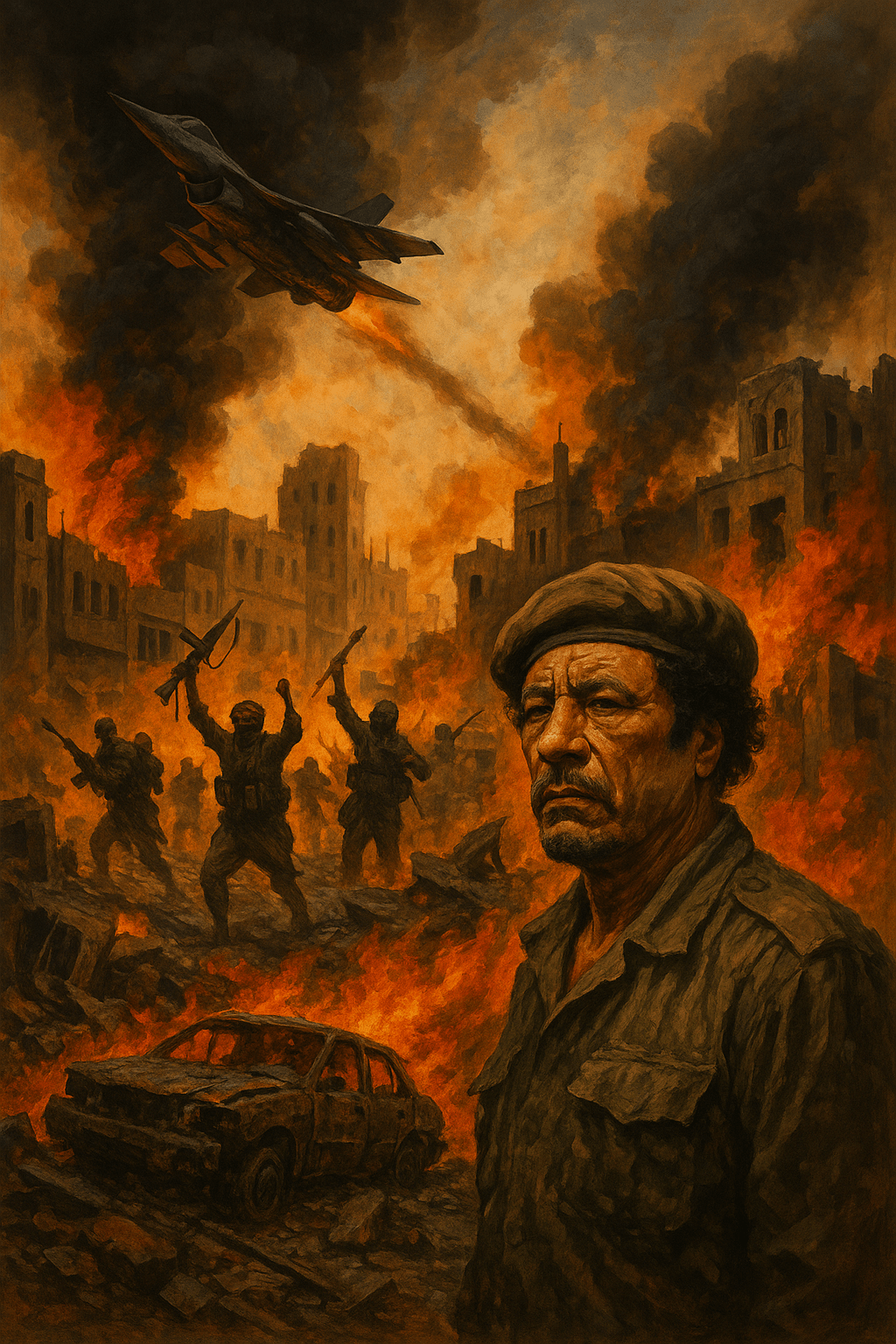
A revolutionary state was dismantled, a sovereign leader lynched, and a continent thrown into chaos—all under the banner of human rights. This is the true story of Libya: not a civil war, but a hyper-imperialist counterrevolution by empire.
By Prince Kapone | Weaponized Information
“You will regret it when it’s too late… when chaos spreads, and you have become involved in a war which will have no end.” — Muammar Gaddafi, 2011
The Greatest Crime of the 21st Century (So Far)
History, when told by the victors, becomes a smokescreen of euphemism. They called it a “civil war,” a “humanitarian intervention,” a “NATO-led air campaign.” But when the smoke cleared, Libya was in ruins, its leader mutilated, and its revolutionary state dissolved. What really happened in 2011 was not a revolution—it was an execution. A liquidation not just of a man, but of an idea: the idea that Africa could be sovereign, united, and defiant.
Muammar Gaddafi did not fall. He was targeted, hunted, and lynched by a global apparatus that feared not his tyranny, but his independence. The Jamahiriyah, the state he built, was no puppet regime. It redistributed oil wealth, erased foreign debt, and dared to speak of an African gold-backed currency. For that, it became enemy number one—not of democracy, but of empire.
What unfolded in 2011 was the first full-scale experiment in 21st-century hybrid warfare—a fusion of disinformation, proxy jihadism, humanitarian propaganda, and high-tech imperial force. It marked a shift in U.S. empire’s strategy: from occupation to destabilization, from boots on the ground to algorithmic regime change. Libya became the prototype, the test case, the blueprint for a new kind of war—less visible, more vicious.
And the results? Devastation by design. A unified African state shattered. A functioning society transformed into a zone of endless conflict. Open-air slave markets on the ruins of the most developed country in Africa. Migrant bodies floating in the Mediterranean, NATO jets flying overhead. And all the while, the Western media congratulated itself for “saving civilians.”
This exposé is not about relitigating the obvious lies. It is about reclaiming the truth. We tell this story not to mourn Gaddafi as an individual, but to restore Libya’s dignity as a revolutionary experiment in the colonized world. We examine the motives of the empire, the mechanisms of its war, and the meaning of Libya’s fall. This is the story they buried under rubble, drowned in soundbites, and sanitized for liberal consumption. This is the story from the other side of the gun.
For those who still believe imperialism ended with decolonization, Libya is a wake-up call. For those who ask whether sovereignty is possible under capitalism, Libya is a case study. For those who think hybrid war is a future threat—it has already happened. It began with the lynching of a sovereign African state.
They said they came to protect civilians. What they came for was oil, gold, and submission. What they left behind was chaos, terror, and recolonization. This was not a failure of Western policy. It was the plan. And it worked.
Why Libya Had to Be Destroyed
They told us it was about human rights. But the truth is simpler, older, and uglier: Libya had to be destroyed because it represented a threat—not to its own people, but to empire. The Jamahiriyah wasn’t perfect, but it was revolutionary. It built hospitals where colonizers built prisons. It delivered housing and education while the IMF delivered debt and austerity. It pumped oil not for Shell or Exxon, but for the Libyan people. In a world where African nations were stripped bare by foreign capital, Libya stood out as defiant. That could not be allowed to stand.
Under Gaddafi, Libya had the highest Human Development Index in Africa. Literacy rates soared. Women held government positions. Housing was considered a human right. Loans were interest-free. Farmers received land, machinery, and seeds. Water was pumped from the desert to the coast through the Great Man-Made River, one of the largest infrastructure projects in modern history. All of this funded not by Western banks, but by nationalized oil wealth. This was not a dictatorship of capital. It was a threat to it.
And that threat was growing. In the years before the NATO war, Libya spearheaded plans to create a gold-backed African currency—the dinar—that would dethrone the CFA franc and challenge the dollar in intra-African trade. Gaddafi envisioned an African Monetary Fund to rival the IMF, an African Central Bank to free the continent from European manipulation, and a pan-African army to defend it all. He wasn’t just talking. Libya held 144 tons of gold and was offering to fund the entire continental transition. The French knew it. The Americans knew it. The emails confirm it.
In a 2011 State Department email leaked by Wikileaks, Sidney Blumenthal laid it out to Hillary Clinton: French President Sarkozy’s top priorities in attacking Libya were to seize oil, prevent the dinar, increase French influence in North Africa, and crush Gaddafi’s pan-Africanist ambitions. The West wasn’t intervening in Libya—it was intervening in Africa. It wasn’t just regime change. It was a preemptive strike against the possibility of continental liberation.
And here lies the final, bitter irony: in the years before the war, Gaddafi had aligned himself with the West in the so-called “War on Terror.” He handed over intel on Al-Qaeda, shared blacklists with the CIA, and even allowed rendition flights through Libya. But when his sovereignty conflicted with imperial control, the same empire he had assisted turned him into a target. The jihadists he once helped suppress became the proxies to destroy him. His cooperation bought him nothing. His independence made him a marked man.
This is what the world must understand. Gaddafi was not attacked because he was cruel. He was attacked because he was useful once, and dangerous always. The Jamahiriyah was not toppled because it failed, but because it succeeded on terms the West could not control. And when Libya dared to lead Africa out of the IMF’s shadow, dared to build an oil-funded welfare state, dared to put the word sovereignty back into African politics—they brought the full machinery of hybrid war down on its head.
This is why Libya had to be destroyed. Not to save its people, but to punish them—for dreaming too far beyond their colonial cage.
Hybrid War Unleashed: Disinfo, Proxies, Bombs
Libya was not conquered in a day. It was broken apart in stages—by lies, by mercenaries, by satellites and soft power. The NATO operation of 2011 was not a war in the traditional sense. It was a coordinated imperial takedown orchestrated through the machinery of hybrid warfare: information warfare, proxy warfare, psychological warfare, and finally kinetic warfare. And like any good imperial deception, it began with a story—a trigger, a spectacle, a pretext for intervention.
That story was Benghazi. In February 2011, protests erupted in the eastern city—genuine grievances in a region long home to monarchist nostalgia and Islamist currents. But what followed was not spontaneous revolution. It was armed insurgency. Within days, caches of weapons were looted, police stations torched, and military bases overrun. The rebel ranks were quickly filled with known jihadists, exiled opportunists, and old monarchist elites. The narrative of peaceful protestors was over before it began.
Yet the media told a different story. Al Jazeera, BBC, CNN—each broadcast breathless headlines: Gaddafi is “bombing his own people,” “committing genocide,” “hiring African mercenaries.” Human Rights Watch and Amnesty International repeated the claims without verification. The most obscene lie—that Libyan troops were given Viagra to commit mass rape—was echoed from press briefings to prime time. All of it was fiction. None of it mattered. The point wasn’t evidence—it was escalation.
Behind the curtain, imperial logistics were already in motion. The U.S., Britain, and France greenlit arms shipments to the so-called rebels. The weapons flowed through Qatar and the UAE, who acted as the regional gophers of NATO’s dirty war. Special forces from the U.K. and France were on the ground early, directing rebel movements and designating targets. The jihadist group LIFG—Libyan Islamic Fighting Group, an affiliate of Al-Qaeda—re-emerged overnight as “freedom fighters.” Some had just returned from Iraq and Afghanistan. They were now the West’s foot soldiers in North Africa.
And then came the air cover. On March 17, the UN Security Council passed Resolution 1973 under the pretext of protecting civilians and enforcing a no-fly zone. Russia and China, burned by years of Western manipulation, chose not to veto but abstained—an abstention both would later call a strategic error. Within 48 hours, NATO began its bombing campaign. More than 26,000 sorties would follow. Hospitals, schools, water pipelines, and government buildings were reduced to rubble. Libyan defenses were decimated from the air while the rebels advanced with imperial blessing.
The “no-fly zone” became a full-fledged air war. The goal was never civilian protection—it was regime change, plain and simple. NATO acted as the rebels’ air force, enforcing a colonial division of labor: the West supplied the firepower, the proxies supplied the blood. By August, Tripoli had fallen. By October, Gaddafi was dead.
What happened in Libya was not a failure of humanitarian intervention. It was the success of imperial recalibration. This is hybrid war in its perfected form: weaponize the media, flood the zone with disinfo, unleash proxy militants, and then strike from above—clean, remote, and plausibly deniable. Libya was the beta test. Syria, Mali, and Ukraine would follow. The template had been forged in blood.
The Truth They Buried: Gaddafi’s Final Resistance
In the official narrative, Gaddafi was a madman clinging to power, blind to the people’s will, indifferent to bloodshed. But the archive tells another story—one of attempted negotiations, ceasefires offered, peace proposals signed, and every single one rejected by the rebels and NATO alike. Far from irrational, Gaddafi responded with clarity, caution, and a desperate desire to avoid the abyss. It was not he who refused peace. It was the West that refused Libya’s survival.
From the earliest days of the conflict, Gaddafi’s government offered national dialogue. Amnesty for rebels. A constitutional referendum. The opening of political space. He accepted the African Union’s ceasefire proposal, backed by Zuma of South Africa, Compaoré of Burkina Faso, and others. The plan included an immediate truce, humanitarian aid, and a roadmap to elections. Gaddafi signed it. The rebels spat on it. NATO bombed Tripoli that same week.
These were not stalling tactics. They were rational responses to a rapidly deteriorating situation. But the empire had already decided. Peace was not the objective—regime change was. Every proposal for dialogue was met with missiles. Every ceasefire became a trap. And as the violence escalated, Gaddafi’s warnings grew louder—and eerily prophetic.
In speech after speech, interview after interview, he predicted exactly what would happen: jihadists would take power. Arms would flood the Sahel. Africa would be destabilized. Terrorism would engulf Mali, Niger, and Nigeria. Migrants would drown in the Mediterranean. Europe would face a refugee crisis of its own making. “You will regret it,” he warned, “when chaos spreads, and you have become involved in a war which will have no end.” Every Western official laughed him off. Within a year, his words were reality.
And when his capital fell, he had chances to flee. Venezuela offered him asylum. Zimbabwe and Uganda made quiet overtures. Even Russia hinted at evacuation. But Gaddafi refused. He had ruled Libya for 42 years—not as a king, but as a revolutionary. He would not abandon his land to foreign looters. He retreated to Sirte, his hometown on the Gulf, and made his final stand. In his last messages, broadcast on scratchy radio frequencies, he spoke not of revenge—but of unity, of Arab dignity, of Africa’s future. “Even if you hear our voice no more,” he said, “fight on for your nation. Fight on for the Jamahiriyah.”
This is the Gaddafi they erased—the one who sought peace, warned the world, and chose to die with his people. Not the caricature conjured by Western media, but a leader trying to shield his country from collapse, trying to save a revolutionary project decades in the making. They didn’t just bomb his army. They buried his truth beneath rubble and ridicule. But it lives still, in the memory of the African struggle, in the resistance of the Sahel, in every attempt to reclaim sovereignty from empire’s grasp.
Ritual Execution and the Message of Terror
The end came not on a battlefield, but in a drainage pipe outside Sirte—filmed, uploaded, and cheered by the very forces that had once sworn to protect civilians. Gaddafi’s convoy, fleeing NATO’s carpet bombing, was tracked by a U.S. drone and struck by French jets. Survivors were dragged from the wreckage by Western-backed rebels. Gaddafi was captured alive, bleeding but breathing. What followed was not a capture—it was a lynching. He was beaten, tortured, sodomized with a bayonet, and executed on camera. His body, half-naked and broken, was put on display in a cold-storage meat locker for the world to gawk at like colonial trophy meat.
This was not simply violence. It was theatre. A meticulously staged ritual designed to send a message: this is what happens to those who defy empire. It was not enough to remove him. He had to be humiliated. Brutalized. Made into a warning for others. A psychological operation draped in digital gore. And for the architects of war, it was a punchline. Hillary Clinton, face beaming, boasted to CBS: “We came, we saw, he died.” They called it democracy. It was execution by empire.
This was not a one-off. It was policy. From Patrice Lumumba to Salvador Allende, from Saddam Hussein to Muammar Gaddafi, the colonial world has learned this lesson well: when a leader strays from the neoliberal script, no amount of compliance will save them. Gaddafi collaborated on counterterrorism. He gave up nuclear ambitions. He privatized parts of the economy. It made no difference. The sin was not what he did—it was what he represented: an African state outside the leash of the dollar, outside NATO, outside control.
That is why they filmed it. That is why they broadcast it. It was terror not just for Libyans, but for Africans, for Arabs, for the Global South. It was meant to break the spirit of resistance, to show what happens when a sovereign state declares itself free. And for a moment, it worked. Governments fell silent. Movements recoiled. Even the African Union, shamed by its impotence, could do little more than protest on paper.
But beneath the horror, something else stirred—an anger that has never fully died. Gaddafi’s killing did not end history. It intensified it. Across Mali, Burkina Faso, and Niger, the very jihadist networks unleashed in Libya are now being hunted by anti-imperialist governments. Across Africa, the memory of the Jamahiriyah is not forgotten. His image still hangs in refugee camps, in Tuareg hideouts, in Pan-African gatherings. They remember not the dictator of CNN’s imagination, but the man who gave them dignity, land, education, and pride.
His execution was meant to be the final word. Instead, it was the opening chapter in a longer resistance. A martyr was made. Not by choice—but by design.
The Aftermath: Necro-Colonialism and State Collapse
When the bombs stopped falling, Libya didn’t return to peace. It collapsed into a vacuum—planned, mapped, and monetized. The state, once centralized and sovereign, disintegrated into fiefdoms ruled by warlords, militias, and foreign-backed proxies. The “liberation” promised by NATO delivered chaos, rape, ethnic cleansing, and sectarian bloodshed. There was no plan to rebuild. Only a roadmap to ruin.
With Gaddafi gone, oil contracts were carved up like colonial spoils. European energy firms scrambled to stake their claims—Total, Eni, BP, and Shell—while U.S. consultants drew up privatization blueprints. Libya’s massive sovereign wealth fund, once used to bankroll African development, was frozen and looted. Billions vanished into Western banks. Meanwhile, pipelines rusted, hospitals shuttered, and schools closed their doors. The Jamahiriyah’s infrastructure—public, free, functional—was bulldozed by austerity and war.
In place of government came gangs. Militias, many of them Islamist, now operated checkpoints and “ministries.” Cities like Misrata became mafia states. Black Libyans and sub-Saharan migrants were especially targeted—rounded up, tortured, sold in open-air slave markets. CNN would later confirm what African activists had long cried out: slavery had returned to North Africa, live-streamed and auctioned off under the watch of NATO’s victorious banner.
The death of Libya echoed far beyond its borders. Weapons from looted armories flooded Mali, fueling the war that would engulf the Sahel. Trained fighters joined Boko Haram, al-Qaeda in the Islamic Maghreb, and ISIS affiliates. AFRICOM, the U.S. military command for Africa, used the crisis to expand its footprint—more drones, more bases, more surveillance. What had been a relatively stable zone became an endless battlefield, justifying more “counterterrorism,” more intervention, more imperial permanence.
And then came the migration crisis. As Libya splintered, smugglers turned chaos into commerce. Tens of thousands of Africans fleeing war, poverty, and climate collapse were funneled through Libya’s wreckage toward Europe. Many were detained in hellish detention centers funded by the EU. Others drowned at sea. Still others made it across, only to be met with racism, deportation, and death. The West blamed the migrants. It never blamed itself.
But imperialism didn’t fail in Libya. It succeeded. It didn’t set out to build a democracy—it set out to destroy a sovereign model. It didn’t miscalculate—it recalibrated. The goal was not stability but containment. Not peace but paralysis. Libya became a warning to all others: resist us, and we will not only break your state—we will salt the earth behind it.
This is what recolonization looks like in the 21st century. No flags. No governors. Just collapsed states, privatized loot, foreign troops, and mass graves. Libya was not a tragedy. It was a crime scene. And the fingerprints are still fresh.
From Regime to Revolution: Reframing the Jamahiriyah
History is never neutral. It is told by the victors, edited by empire, and archived by institutions whose job is to justify conquest. And so, Libya’s story has been reduced to a cautionary tale of dictatorship undone by democracy. Gaddafi, we are told, was a madman, a relic, a tyrant crushed by the inevitable march of freedom. But strip away the slogans, and what remains is not a regime—but a revolution. Not a pariah—but a sovereign experiment in postcolonial liberation.
The Jamahiriyah—“state of the masses”—was never perfect. But it was never meant to be a Western-style liberal democracy. It was a different proposition altogether: a state without parties, parliaments, or presidents. Its foundation was popular congresses and revolutionary committees, through which people organized local governance, distributed resources, and debated national priorities. It was a model of direct participation, not electoral charades. Its contradictions were real—but so was its commitment to an alternative to capitalist hegemony.
And it achieved results. Libya had no foreign debt. Oil profits were redistributed through housing programs, free education, health care, and subsidies. Women had rights unmatched in the region. Infrastructure boomed. African migrants worked, earned, and sent money home. Libya wasn’t a fantasy—it was a functioning, if flawed, revolutionary society. A beacon of what could be done when sovereignty is not surrendered to the IMF, and when resources serve people, not corporations.
This is what the empire erased. Not just Gaddafi, but the very idea that a postcolonial African nation could chart its own course outside the orbit of Western finance and militarism. That it could use its oil not for Exxon or Chevron, but to build homes, aquifers, and roads. That it could challenge French neocolonial currency. That it could speak of unity—real, material African unity—without apology.
Reframing Libya means understanding that its fall was not inevitable. It was orchestrated. The so-called uprising was manufactured, the rebels armed, the airstrikes coordinated. It was regime change by another name—backed by liberal humanitarians, Gulf monarchs, Silicon Valley platforms, and Pentagon planners. A symphony of technofascism. A masterclass in 21st-century counterrevolution.
And so we must reclaim Libya—not as a failure, but as a threat. A threat to the imperial order. A model, however imperfect, of what postcolonial sovereignty could look like in practice. When the West speaks of the “Libyan disaster,” they never mean the bombing, the slavery, or the collapse. They mean the Jamahiriyah itself. Its survival would have meant proof that another world was possible. That’s why it had to be liquidated.
We owe it to the memory of the Jamahiriyah to tell the truth. Not to romanticize, but to recognize. To lift Libya from the rubble of propaganda and remember it as what it truly was: a revolutionary rupture in the colonial world-system.
Exporting Chaos: How Libya’s Fall Fueled Jihad Across West Africa
They said they were fighting terrorism—but they manufactured it. The destruction of Libya did not just eliminate a sovereign state—it detonated a firestorm across the Sahel. NATO’s war unleashed a flood of weapons, fighters, and destabilization that stretched from Tripoli to Timbuktu, from Benghazi to Burkina Faso. It was the beginning of a long and bloody arc of chaos, cloaked in counterterrorism but engineered by imperial design.
In the wake of Gaddafi’s fall, his massive arms depots—once guarded by a unified state—were looted and scattered. Surface-to-air missiles, machine guns, anti-tank systems, and ammunition flooded out of Libya into black markets and warzones. Many of these weapons ended up in the hands of groups the U.S. and France once called “freedom fighters”—only now rebranded as threats.
The Tuareg fighters who had served in Libya’s security apparatus returned to Mali, abandoned and disillusioned, and sparked a rebellion in 2012. But their uprising was quickly overtaken by jihadist factions, armed with NATO’s leftovers and funded by Gulf monarchies. Al-Qaeda in the Islamic Maghreb (AQIM), Ansar Dine, and later ISIS affiliates spread through Mali, Niger, and Burkina Faso like wildfire. The very actors NATO claimed to contain in Libya were now destabilizing half the continent.
France, invoking its colonial “responsibility,” deployed Operation Serval—followed by Barkhane. AFRICOM expanded its drone operations. The UN sent peacekeepers. But nothing was solved. Why? Because the problem was never just terrorism. It was state collapse. And it was engineered. Without the Jamahiriyah acting as a northern bulwark, the entire western flank of Africa became a battlefield—one that justified permanent military occupation disguised as counterterrorism.
Is it a coincidence that the countries now rising in anti-imperialist revolt—Burkina Faso, Mali, Niger—are the same nations plunged into jihadist chaos after Libya’s fall? No. They have lived the consequences of recolonization. They saw how “humanitarian intervention” led to mass displacement, foreign military bases, and endless war. And they’ve begun to push back—not just against insurgents, but against the empire that armed and unleashed them.
If it feels suspicious, it’s because it is. The post-Gaddafi jihadist surge wasn’t a surprise—it was a feature. Libya’s destruction functioned as a geopolitical domino: destabilize the North, fracture the Sahel, and use the chaos to justify deeper imperial entrenchment. It’s a strategy of controlled implosion, with Africa as the blast zone.
The lesson is clear. The war on Libya was never meant to end in Libya. It was a continental assault on sovereignty—one that continues to this day. But so does the resistance.
Mobilizing Memory: Why Libya Still Matters
The war on Libya is not over. Its bombs may have fallen a decade ago, but its logic continues—replicated, refined, and redeployed. It lives on in every drone strike justified by a “no-fly zone,” every disinformation campaign waged in the name of “human rights,” every proxy force unleashed under the banner of democracy. Libya was not an aberration. It was a blueprint. A prototype of recolonization in the digital age.
To forget Libya is to surrender the future. Because Libya was the frontline of something deeper—a declaration by the empire that no African sovereignty would be tolerated, no independent model would be allowed to live, and no revolutionary memory would be left unmolested. The West did not merely remove a regime. It attempted to erase a history, a possibility, a proof that the Global South could chart its own course without Washington, Paris, or London at the helm.
But history doesn’t end in a meat locker. Libya’s destruction birthed new clarity. It showed that the empire will fund jihadists to fight anti-imperialists. That technofascist media will fabricate atrocities faster than they can be disproven. That “responsibility to protect” is just code for “permission to kill.” And most importantly—it showed the Global South exactly what awaits those who dare to be free.
Russia and China took notes. So did Venezuela, Iran, and Zimbabwe. But so too did Burkina Faso, Mali, and Niger. Today, the new revolutions rising across Africa carry within them the memory of Libya—not as a dead relic, but as a warning and a promise. A warning of what happens when we let our guard down. A promise that the struggle Gaddafi stood for—the struggle for African dignity, independence, and unification—is not over. It has simply changed terrain.
We must remember Libya not just to honor its dead, but to arm the living. Memory is a weapon—and in the hands of the colonized, it becomes resistance. That’s why they try to bury it. That’s why they call it “history.” But we call it unfinished business.
If Libya had survived, Africa might have followed. That’s why it had to be stopped. And that’s why we must never forget it.
What We Must Do:
- Restore Libya’s revolutionary legacy in the global consciousness
- Expose and dismantle the technofascist doctrine of hybrid war
- Build internationalist networks of resistance and defense
- Stand with all nations fighting recolonization—by bombs, by banks, or by bandwidth
- Never forgive the empire. Never forget the crime.
Gaddafi is gone. The Jamahiriyah lies in rubble. But the struggle lives—and the story is not over.
 Weaponized Information
Leave a comment