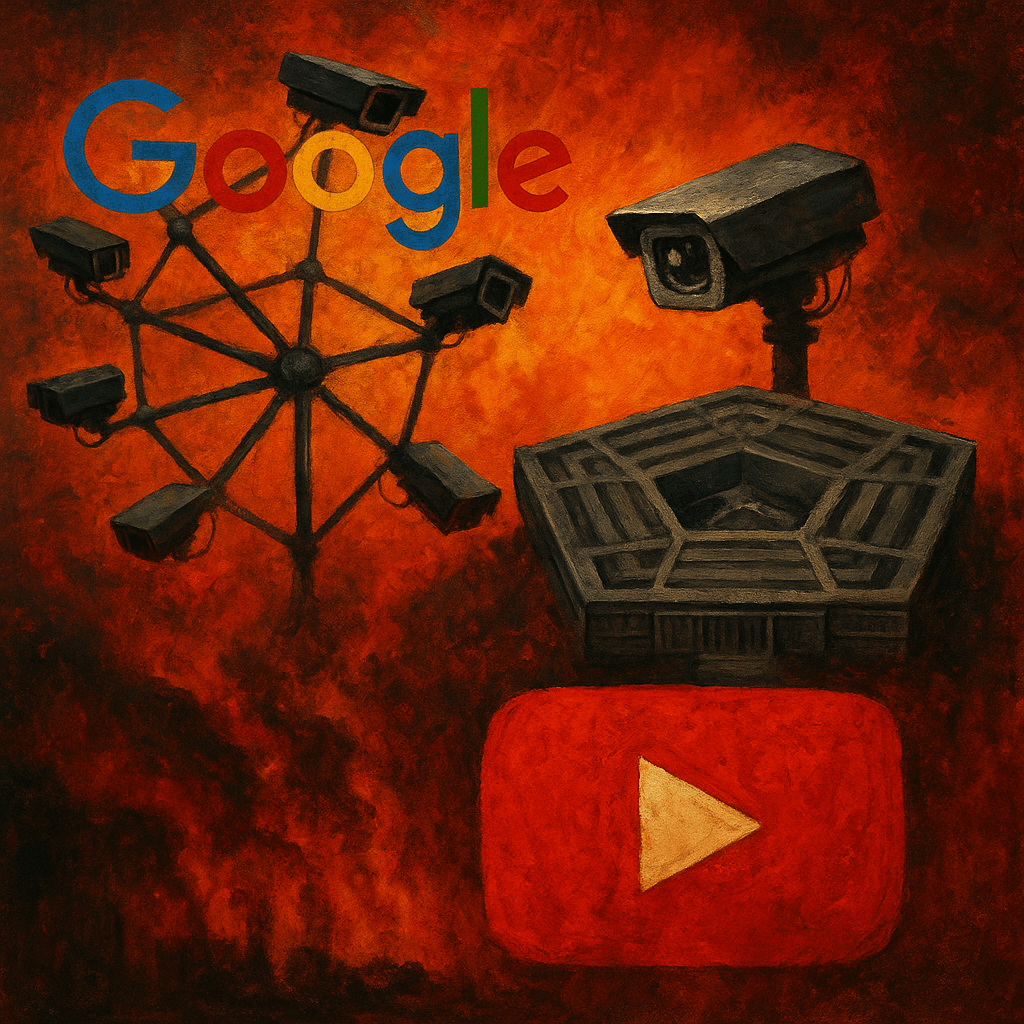
Big Tech isn’t cleaning up disinformation—it’s executing ideological warfare on behalf of empire. Section I exposes the CNBC article as a corporate-state press release cloaked in liberal concern. Section II reveals how YouTube’s censorship regime erases voices from the Global South while monetizing AI slop and Pentagon narratives. Section III traces the financial, institutional, and military infrastructure behind platform censorship, showing that it’s not private—it’s imperial. Section IV turns to resistance: from Pan-African broadcast collectives to favela routers and decentralized media, a new internet is forming beneath the ruins of the old.
By Prince Kapone | Weaponized Information
July 21, 2025
The Algorithm as Judge, Jury, and Executioner
On July 21, 2025, CNBC published an article titled “YouTube wipes out thousands of propaganda channels linked to China, Russia, others”, written by tech correspondent Zach Vallese. The piece triumphantly reports that Google has purged nearly 11,000 YouTube accounts in a single quarter—most allegedly “state-linked” to China or Russia—as part of what it calls a “global disinformation cleanup.” Vallese frames this as a benevolent act of corporate hygiene, casting Alphabet as the high priest of digital purity, cleansing the platform of ideological contagion. No evidence. No citations. No due process. Just another doctrinal edict from the Church of Silicon, delivered in the sacred language of empire.
Who is Zach Vallese? Certainly not a neutral journalist. A brief search of his bylines reveals the usual suspects: glowing write-ups on artificial intelligence rollouts, uncritical praise for Google’s automated content policing, and not a single exposé on Western disinformation networks. In a 2024 article, Vallese lauded YouTube’s “AI moderation breakthroughs” that “reduced moderation costs by 32%”—without pausing to ask what perspectives were algorithmically erased in the process. He is not an investigator; he is a stenographer of state-corporate convergence. His writing doesn’t interrogate power—it absorbs and amplifies it.
His employer, CNBC, follows the same script. Owned by NBCUniversal—a subsidiary of Comcast, itself a major defense contractor and broadband monopoly—CNBC functions as a mouthpiece for the national security state. Its “experts” are often drawn straight from the intelligence apparatus: former CIA officials, CSIS fellows, and NATO-aligned think tank analysts. These are not neutral observers. They are ideological custodians of empire. And when Google’s Threat Analysis Group claims, as it does in the article, that “over 7,700 channels were linked to Chinese influence operations,” CNBC simply echoes it—no evidence, no audit trail, just trust in the digital clergy.
The language is not neutral either. “State-linked.” “Propaganda.” “Influencer payments.” These phrases are not proofs—they are insinuations. Not one channel is named. Not one video is cited. “Linked” is a weasel word—a colonial whisper. It implies guilt through association, not action. And its use is strategic. In Western media, “state-linked” content from China, Iran, or Russia is assumed to be manipulative. But “state-linked” content from the Pentagon, NATO, or USAID? That’s called “civic education.” This asymmetry is not a glitch. It is the rhetorical software of Western hegemony.
We must name it for what it is: strategic sanitization. The use of passive voice and bureaucratic euphemism to obscure acts of repression. “Accounts were removed.” “Content was tied.” “Influence campaigns were detected.” There is no subject, no agency, no appeal. It’s the syntax of authoritarianism in polite disguise. And behind the grammar lies a racialized double standard: Global South voices are presumed guilty by geography. If you speak Mandarin or Farsi, if your perspective affirms sovereignty instead of subjugation, you are marked as deviant—“foreign,” “suspect,” “linked.”
Vallese never questions this framework. He never interrogates why Meta’s deletion of over 10 million accounts in Q3 2023 received no such coverage. He never examines why YouTube openly monetizes AI‑generated “slop” content farms while silencing Palestinian, Cuban, or African creators. His silence is not accidental. It is ideological. CNBC reports purges only when they align with U.S. foreign policy. When the targets are from Iran, China, or Venezuela, it’s “cleaning house.” When it’s domestic or NATO-aligned noise, it’s called “engagement.”
This is not journalism. It is ritual. A digital inquisition draped in technocratic language. The church may have changed vestments—from cassocks to code, from pulpits to platforms—but the sermon is the same: believe in empire, fear the foreign, obey the algorithm. What CNBC published on July 21 was not a news article. It was a liturgy of obedience, a hymn to the machine that deletes without explanation and governs without consent.
The War on Memory Disguised as Content Moderation
When Google claims it removed nearly 11,000 “state-linked” YouTube channels in a single quarter, we must start with the most basic revolutionary question: where is the evidence? The CNBC article offers none. No account names. No sample videos. No list of keywords. Not even a public-facing definition of what “state-linked” means. Just the unchallenged word of Google’s Threat Analysis Group—a name that sounds less like a team of engineers and more like a psychological operations unit from a Pentagon white paper. And yet, we’re expected to believe them. But belief is a privilege reserved for those who’ve never seen their voices erased, their stories banned, or their histories bombed for daring to speak in an accent unapproved by Washington.
The language is antiseptic by design. “Removed.” “Linked to.” “Tied with.” Words chosen not by truth-tellers, but by lawyers in rooms with no windows. Nowhere does CNBC say banned, censored, or blacklisted—because those words trigger memory. They recall the McCarthy era. COINTELPRO. The Pentagon Papers. They recall a time when empire’s lies were challenged—and when those who spoke truth were punished. What we’re reading isn’t a news report. It’s censorship through euphemism. The only thing “tied” here is language—bound and gagged by empire’s editorial code. No screenshots. No citations. No rebuttal. Just whispers and insinuation. It’s digital hearsay in Cold War dialect.
And while CNBC quotes vague claims about RT “paying influencers,” not a single transaction is linked. Not a single video is shown. Business Insider and Reuters have documented that two RT employees allegedly funneled roughly $10 million via shell companies into a Tennessee media outfit that then contracted U.S. influencers—Tim Pool, Benny Johnson, Dave Rubin—using licensing‑style deals without disclosure, per the DOJ. But when money flows from Moscow, it’s subversion. When it flows from Lockheed Martin, ExxonMobil, or the National Endowment for Democracy, it’s called freedom.
Meanwhile, the West runs its own sprawling disinformation campaigns—often hidden in plain sight. In 2022, Al Jazeera revealed that the Pentagon used fake Twitter accounts in Arabic and Russian—set up under covert profiles and even whitelisted—to push pro‑U.S. narratives for years. These influence operations stayed online with no mass purge, no major headlines, and no public outrage. When the empire lies, it lies in fluent English and wears a flag‑pin.
Google is not a neutral librarian. It is an active participant in information war. Its subsidiary Jigsaw, run by ex‑State Department and DARPA-linked officials, partners with the U.S. government to “shape discourse” in the name of “digital resilience.” Wired revealed that in 2018 Jigsaw covertly purchased a Russian troll campaign—paying about $250 to seed pro‑Stalin content—to study how inexpensive it would be to launch coordinated disinformation. It doesn’t just detect lies—it actively builds preemptive strike tools that identify narrative “threats” before they go viral. It doesn’t moderate misinformation. It suppresses ideology. The target isn’t just falsehood. It’s deviation.
This isn’t hypothetical. Consider the Redirect Method, rolled out by Google’s Jigsaw in 2016–17: it used search behavior and targeted ads to steer potential extremist audiences toward curated counter‑extremist videos on YouTube. And it didn’t stop there. In 2017, YouTube launched Project Owl, restructuring its algorithm to elevate “authoritative” sources—CNN, BBC, and the Atlantic Council—while demoting other perspectives. It was the foundation for the purge we’re witnessing now.
And let’s be clear: the targets are not trolls. They’re not bots. They’re not disinfo farms in smoky backrooms. They are real people. Journalists. Teachers. Mothers. Poets. Entire channels run by anti‑imperialist media collectives in Cuba, Venezuela, South Africa, and Palestine have been wiped—not because they spread lies, but because they told truths that Western capital couldn’t tolerate. MintPress recently documented that African Stream and others have been erased by Big Tech following U.S. government accusations—not for disinformation, but for challenging geopolitical narratives.
The hypocrisy is staggering. While YouTube censors leftist and Global South voices for being “unoriginal,” it floods the algorithm with AI‑generated slop channels that remix mainstream clips into revenue‑optimized noise. In 2025, YouTube renamed its “repetitious content” policy—now called “inauthentic content”—to demonetize mass‑produced, AI‑generated videos unless creators add genuine commentary and originality. Yet it continues to monetize AI duplicates of CNN talking points under the guise of “authoritative content.” The contradiction is ideological. Somali poetry gets flagged. CNN war commentary gets boosted. Palestinian testimonials are removed. Raytheon commercials autoplay without restriction.
The same double standard applies to the DMCA, a weaponized copyright law used to silence dissident voices under the guise of IP enforcement. The Electronic Frontier Foundation has shown how vague and overly broad takedown notices—commonly from automated systems—can be used to deplatform creators from the Global South. Indigenous podcasts. Revolutionary hip-hop. Labor documentaries. Entire cultural archives wiped clean with no recourse. You don’t need a court ruling when the algorithm is the executioner.
And then there’s the geopolitical theater. YouTube is banned in China. Banned. Yet this same platform is purging Chinese creators making content for global audiences. Why? Not because their content violates local law—it doesn’t. It violates narrative supremacy. The goal isn’t to stop Chinese people from watching content. It’s to stop us from hearing theirs. This isn’t content moderation. It’s firewall imperialism.
What empire truly fears isn’t falsehood. It’s narrative multipolarity. It’s the sound of Venezuelans speaking for Venezuela. Africans defining Africa. Iranians narrating their own resistance. Across Latin America, the Arab world, and the Black diaspora, new media ecosystems are emerging—CGTN Africa, PressTV, Telesur, RT en Español. They are being watched. They are being shared. They are being believed. And that terrifies a ruling class that for centuries has spoken about the world but never let the world speak back.
This is why the CNBC article omits the big numbers. The Meta report showing over 1 billion fake accounts removed in Q1 2025? Vanished from the record. The National Endowment for Democracy’s $10 million in regime-change grants to Hong Kong activists? Never mentioned. The 2019 Huawei and TikTok sanctions? Glossed over. There is no curiosity. No pattern recognition. Only the same colonial reflex: foreign = fake, dissent = threat, control = peace.
The purge isn’t random. It’s structural. It’s the inevitable product of a system in epistemological crisis. A system that no longer trusts its citizens to think, only to comply. And every erased account is not just a policy decision. It’s a line in a war poem—etched in the memory of those who refuse to be silent. This isn’t a battle of facts. It’s a battle of memory. And empire has declared war on remembrance itself.
The purge isn’t random. It’s structural. It’s the inevitable product of a system in epistemological crisis. A system that no longer trusts its citizens to think, only to comply. And every erased account is not just a policy decision. It’s a line in a war poem—etched in the memory of those who refuse to be silent. This isn’t a battle of facts. It’s a battle of memory. And empire has declared war on remembrance itself.
The foundations for this war were laid a decade ago, when the U.S. Federal Communications Commission began quietly dismantling net neutrality—once a cornerstone of the open internet. In 2014, under heavy lobbying from telecom giants, the FCC introduced a framework that allowed for the creation of so-called “internet fast lanes,” giving preferential treatment to content backed by capital and throttling access for the rest. As the Electronic Frontier Foundation warned at the time, this marked the beginning of the transformation of the internet from a democratic information commons into a gated platform of pay-to-play propaganda. By 2018, the final protections were gutted entirely. What remained was a privatized, corporatized grid—perfect for algorithmic repression.
This wasn’t an accident. It was strategic groundwork for what would come next: the weaponization of information infrastructure through military-corporate alliances. From 2018, executives from Google, Meta, Microsoft, and OpenAI were being formally invited to present at the Munich Security Conference, appearing on panels alongside NATO generals, CIA analysts, and State Department officials. These weren’t fringe meetings—they were the central stage. The theme? How to confront “foreign information warfare” by tightening coordination between Big Tech and Western security agencies. In other words: how to suppress Global South narratives under the banner of democratic resilience.
In one 2023 MSC panel titled “Digital Frontlines,” Google executives discussed their “early detection” systems for identifying viral content that challenges Western foreign policy. As Google itself reported, its leadership attended MSC 2023 to emphasize helping countries “build resilience in the face of an information war.” While NATO officials publicly praised efforts to limit visibility of pro‑Palestinian, anti‑NATO, and multipolar content—described as “essential to transatlantic stability”—these moments expose the real agenda: what Silicon Valley brands as “trust and safety” is military doctrine in disguise, and what it calls “harm mitigation” is imperial preemption.
And it all fits. The revocation of net neutrality, the purge of oppositional channels, the Munich declarations, the sanctions on rival tech—all of it is part of a single, integrated project: the consolidation of epistemic control. The West knows it can no longer monopolize the truth through narrative alone. It must now control the terrain—server farms, algorithmic pathways, platform policies, data flows. It must act not only on what we say, but on what we can see, search, recommend, and remember.
This is no longer about misinformation. This is about enforced ignorance. The goal is not to win the argument. The goal is to delete the question. To break the mirror before the reflection appears. To smother the voice before the story spreads. And that is why this purge matters—not because of what was said, but because of what was lost. A way of seeing. A path of remembering. A possibility of knowing outside empire.
The Machine That Erases Dissent
Let’s be clear—this is not about safety, protection, or “harm reduction.” What we are witnessing is the mechanized suppression of political thought, dressed in the sterile robes of “content moderation.” YouTube’s removal of nearly 11,000 accounts—most from the Global South—was not an act of public service. It was algorithmic statecraft. No hearing. No appeal. No explanation. Just deletion. What CNBC calls a “cleanup,” we must name as Technofascism: the fusion of monopoly tech power with militarized governance to silently erase noncompliant knowledge.
And it doesn’t need judges or journalists. It has engineers. The content cops of this era are “Trust & Safety” teams embedded in trillion-dollar firms like Alphabet, Meta, and Amazon. They don’t adjudicate—they optimize. This is the era of Algorithmic Governance: policy as product pipeline. Truth becomes a variable. Dissent becomes “risk.” Whether you’re a Namibian trade unionist or a Venezuelan economist, the algorithm doesn’t assess your accuracy. It calculates your threat profile—and buries you.
This isn’t malfunction—it’s design. In the past, censors burned books. Today, they delete metadata. This is Cognitive Warfare: the imperial strategy to fracture collective memory before rebellion can cohere. It’s not merely about misinformation—it’s about disorientation. The goal isn’t just to lie—it’s to remove the coordinates that make truth legible. Overload the senses. Fragment the archives. Bury insurgent knowledge beneath procedural fog.
The effect is epistemic chaos. The Houthi resistance becomes “Iran-backed terrorists.” BRICS development projects become “debt traps.” A Somali podcast critiquing AFRICOM disappears from search. Meanwhile, NATO-funded think tanks are algorithmically boosted. This is not the “marketplace of ideas.” It’s a weapons range—and the targets are ideas that resist empire.
The ruling class no longer believes in liberal mythologies. Gallup’s 2024 media trust poll found Americans’ trust in mass media at historic lows—just 31% say they have “a great deal” or “fair amount” of confidence, with a growing share saying they have “no trust at all.” So the state no longer persuades—it purges. This is Imperialist Decay: a ruling order losing its cultural grip and compensating with censorship. Google doesn’t act alone. It won a $10 billion Pentagon cloud contract in 2024. It is not a platform. It is infrastructure for empire.
And the system is rationalizing it all through profit. As tech layoffs accelerate, automation becomes a cost-saving strategy. Why pay creators when AI-generated clips of pundits can be endlessly recycled? Algorithmic Governance isn’t just repressive—it’s efficient. Human speech is expensive. Machine speech is scalable. The algorithm doesn’t care about context. It cares about compliance.
This is a pivot point. Not just from persuasion to suppression, but from speech to signal. From memory to metadata. What we are witnessing is the imperial recalibration of information control. The Pentagon’s 2023 Cyber Defense Review explicitly called for a “whole-of-society” coordination—including with tech giants—to manage foreign narratives and project U.S. informational power. This framework was formalized in the Department of Defense’s 2023 Strategy for Operations in the Information Environment, which outlines the integration of civilian platforms like Google, Meta, and OpenAI into broader military information dominance operations.
Look at the contradiction. A video of IDF soldiers shooting journalists gets labeled “context missing.” A BRICS speech on dollar de-risking is flagged as “state-sponsored disinfo.” Meanwhile, CIA-funded podcasts get recommended. YouTube is not a neutral platform—it is an imperial communication node, built to discipline consciousness. It doesn’t need to remove everything. Just enough to demoralize, confuse, and isolate.
And it doesn’t stop with YouTube. The same moderation matrices govern Twitter/X, Google Search, Instagram, and even ChatGPT. The Threat Analysis Groups. The trust boards. The AI filters. All networked. All coordinated. All executing a logic of programmable silence. What’s lost isn’t just content. It’s historical possibility. The very outlines of political imagination are being redacted—pixel by pixel, click by click.
This is more than a purge. It’s a war on memory. A war waged not with boots, but with bandwidth. Not with tanks, but with timelines. The battleground is our feed. The target is our attention. The cost is truth. And the stakes are nothing less than the future of dissent.
Building Counter-Infrastructure from Below the Firewall
The imperial internet has made its move—an open declaration of war on memory, sovereignty, and speech. This was no slip of the algorithm. This is the algorithm. YouTube’s purge of nearly 11,000 channels—many of them offering perspectives from the Global South—was not a cleanup. It was a surgical strike against political multiplicity. These channels weren’t erased for lying. They were erased for speaking truths that dared to exist outside the borders of imperial legitimacy.
We name them—not individually, but politically. The Palestinian journalist livestreaming under drones. The Iranian mother uploading a sanctions testimony. The Congolese professor explaining debt traps. The Cuban cooperative broadcasting harvest updates. The Marxist uploading scanned zines to a shadow channel. These are not “foreign agents.” They are memory workers. Truth-tellers. Survivors. And for every one that gets purged, a thousand USB drives are passed hand-to-hand, under the radar, beyond the firewall.
Resistance is already adapting. Consider Pan-African Television, a decentralized media network of African and Caribbean cooperatives. They bypass imperial platforms entirely, hosting on peer-to-peer servers, streaming worker protests from Zimbabwe, Pan-Africanist debates from Accra, student strikes in Haiti. They don’t rent space on Google Cloud. They build their own.
And they’re not alone. Russia’s VK has become a haven for voices banned from YouTube and Twitter/X, hosting independent coverage of Donetsk, Gaza, and Niger. Channels mirror banned content from Latin America and reupload it across multilingual hubs. VK Video actively mirrors and reuploads YouTube content, turning it into an archive for the digitally exiled.
In the imperial core, our role is not to uplift the silenced. It’s to confront the silencers. We start by targeting the flow of money. Google’s censorship isn’t just ideological—it’s subsidized. Universities, libraries, hospitals, and city governments all contract Google Cloud. If your institution is plugged into that network, it’s plugged into imperial narrative warfare. Demand divestment. Demand audits. Cut the cord.
Then we build dual infrastructure. No more waiting on platforms to “do better.” We mirror our own media. Join Panquake. Run instances of Odysee and PeerTube. Launch union-based USB “memory banks”—distributed offline archives of banned Palestinian documentaries, Syrian civilian interviews, Haitian cooperative meetings. Host them in radical bookstores. Share them in barbershops. Pass them in prison visitation rooms. Memory must travel without permission.
Third, we train. Proletarian Cyber Resistance is not just code—it’s culture. Organize skillshares on Tails OS, Tor bridges, and offline mesh relays. Teach youth how to download and mirror censored material. Show elders how to save channels before they vanish. Equip our movements with drives, cables, and literacy. If the cloud is hostile, we bring the sky underground.
Fourth, we weaponize the absurd. If YouTube uses AI to erase memory, we use it to replicate memory in infinite form. Build VTuber avatars that read out purged speeches from Sankara, Gaddafi, and Lumumba. Use voice-cloned narrators to broadcast censored Palestinian testimonies. Train diffusion models on revolutionary graffiti. Turn the machine against itself. If the algorithm wants slop, give it slop—radical, encrypted, multilingual slop that speaks the language of the colonized back into the feed.
Fifth, we politicize the purge. Don’t let 11,000 deletions vanish in silence. Host teach-ins in union halls. Screen banned documentaries. Archive the memory of what was lost. Use the Tricontinental Institute, FAIR, and #NoMoreCensorship campaigns to frame the fight. Build zine libraries. Launch community broadcast hubs. Turn deletion into doctrine. Let every takedown radicalize a hundred more.
And yes, this is global. The EU’s Digital Services Act is aligning with NATO’s censorship goals. Google’s backdoors are open to Five Eyes surveillance. But cracks are forming. Radical developers in the Philippines are building offline distribution kits. West African engineers are creating anti-censorship firmware. Brazilian collectives are testing solar-powered routers for favela broadcasting. A subterranean internet is forming—quiet, distributed, and defiant.
Because what Silicon Valley fears most isn’t Beijing or Moscow. It’s the convergence of memory and rebellion into a culture that no longer asks permission to speak. It’s Detroit union workers watching Cuban medicine on VK. It’s London students quoting Sankara avatars. It’s Ghanaian farmers discussing BRICS currency on flash drives from Johannesburg. It’s the global dialectic, syncing in real time, across firewalls, under suppression, through static.
That world is not theoretical. It’s operational. It exists in fragments—pasted, mirrored, encrypted, whispered. It refuses deletion. It rejects silence. And it carries one immutable truth: a new information order is not only possible—it is already alive, broadcasting from the ashes of the old. Our task is to amplify it. Encrypt it. Protect it. And most of all, to believe in it. Because in this war, silence is surrender. And solidarity is the signal they can never jam.
 Weaponized Information
Leave a comment