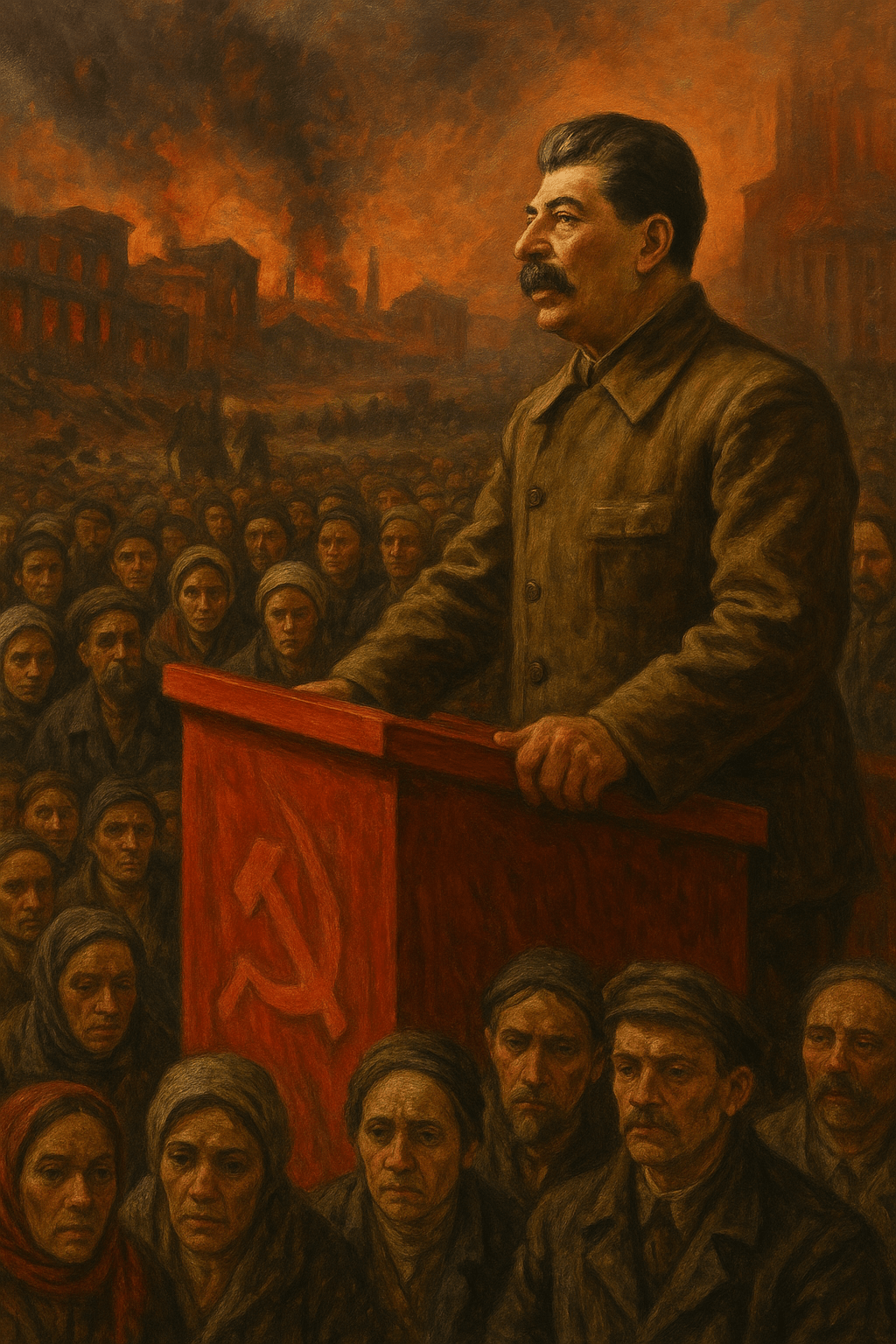
🟥 Discipline in the Ashes: Stalin, Famine, and the First Breath of Socialist Construction
In the aftermath of imperialist invasion and civil war, Stalin’s address to the Eleventh Congress in 1922 was not a celebration of victory, but a warning against illusion. Standing amid starvation, disillusionment, and creeping bureaucratism, he issued a challenge to the Party: build socialism through discipline, self-criticism, and deep roots in the working class—or risk collapse from within. This was not the mythic Stalin of later years. This was the Party’s internal physician, diagnosing rot and demanding revolutionary steel.
By Weaponized Information
July 17, 2025
🟥 The Famine, the Ruins, and the First Breath of Socialist Construction
“Comrades, you have gathered in congress after a whole year, in the course of which we have, for the first time, been free from the intervention and invasion of capitalist countries… This is the first year that we have had the opportunity of devoting our efforts to the real, main and fundamental tasks of socialist construction.” With these opening words, Stalin did not enter the stage as a triumphant war leader basking in victory, but as a man emerging from the smoking rubble of a collapsed world, asking a battered Party to learn how to build. This was not a moment of calm—it was a moment of exhaustion. The imperialist hyenas had momentarily retreated, but the wreckage they left behind remained: famine, disease, economic desolation, and the gnawing internal rot that had begun to spread through the ranks of the revolution itself.
Stalin’s tone is plain, almost painfully so. “The disasters that befell us in the past year were, if anything, even more severe than those of the preceding years.” No embellishment. No romance. Just the brutal reality that, although the guns of the foreign intervention had gone silent, the revolution was still bleeding out internally. The contradiction was glaring: the proletariat had seized power, but it had not yet conquered hunger. The imperialist states had been pushed back, but the peasantry was still starving. The Party had won militarily, but it was on the verge of losing politically if it could not deliver materially.
Here lies the dialectical core of this speech—this was the first congress of peace, and yet it was a congress of grave warning. Stalin was not rallying for war. He was rallying for construction. But construction under siege, construction with no blueprint, construction under the most severe economic blockade in history, construction with tools stolen, hands blistered, and food supplies broken. He did not pretend otherwise. “It seemed as if all the consequences of the imperialist war and of the war which the capitalists forced upon us had combined and hurled themselves upon us in the shape of famine and the most desperate ruin.”
This was not just a material observation—it was a political one. Stalin was naming the structural consequence of imperialist encirclement. The famine was not accidental. It was not simply the result of nature or misfortune. It was the deliberate fruit of blockade, sabotage, and the systematic underdevelopment imposed on Russia by global capital. That is what Stalin meant when he said they had now taken the “first steps” toward construction. Not that they were entering a blank slate, but that they were crawling through scorched earth to lay the foundations.
For the revolutionary today, there is a lesson in the very structure of this speech. It is not a declaration of confidence. It is not even primarily an exhortation. It is a mirror held up to the movement itself, forcing it to look—clear-eyed, unblinking—at its own vulnerability. In this sense, Stalin was modeling not arrogance but revolutionary sobriety. He was setting the tone not of triumph but of discipline. “If we soberly appraise what we have achieved and are not afraid to look facts—which are not always pleasant, and sometimes very unpleasant—straight in the face, we shall certainly overcome all the difficulties…”
That conditional—if—is the keyword. That “if” is not rhetorical. It is a test. Not just for Stalin’s audience, but for every revolutionary movement that imagines the seizure of power is the endgame. What Stalin makes painfully clear is that the seizure of power only opens the most difficult chapter of all: building something that can survive, that can feed, that can endure. And not just endure materially, but endure ideologically. “We have, for the first time,” he says, “been free.” But freedom was not the destination. Freedom was the opening of a responsibility. To build. To feed. To govern. To lead.
That is what this speech marks. The birth of responsibility. The end of romanticism. The beginning of the real work. And if today’s revolutionaries are serious, they would do well to study this moment—not as an object of hagiography, but as a living lesson in what it means to carry the weight of proletarian power on your back, while still bleeding from the last battle, and already hearing the next one gathering outside the gates.
🟥 The Party is Not a Choir: Discipline, Deviation, and the Struggle for Line
What Stalin confronted at the Eleventh Congress was not just the external catastrophe of famine or the infrastructural obliteration left by civil war—it was the internal drift of the Party itself. “If we want to overcome our difficulties,” he warned, “we must first of all examine the condition of our Party… and determine whether we are capable of overcoming them.” This was not abstract theorizing. It was a frontal assault on the political degeneration creeping into the Party’s own body.
The core of his concern was factionalism—not in the narrow sense of policy disagreement, but as a crisis of class alignment. The Party, forged in the heat of insurrection, was now being invaded by elements who mistook the privileges of state power for revolutionary maturity. Stalin saw it clearly: opportunism was seeping in through the cracks opened by hardship, and behind every deviation was a class content. He noted with alarm “the weakening of the ties between the Party and the working class,” warning that bureaucracy was not just a technical problem—it was a symptom of alienation from the masses.
Here, Stalin was not simply issuing a procedural critique. He was drawing a line of demarcation. “The Party must be purged,” he declared, “not only of the clearly hostile and anti-Soviet elements, but also of elements who are indifferent to the interests of the working class.” That was the real scandal—the quiet indifference that had infected sections of the Party now that the gunfire had faded. Stalin wasn’t hunting enemies under the bed. He was naming the enemy within: complacency, careerism, and the bureaucratic detachment that emerges when revolutionaries lose sight of their class base.
In targeting these contradictions, Stalin did not plead. He drew the knife. “We must smash factionalism,” he said flatly, “we must bury it as we would a corpse.” He knew what some still pretended not to—that factionalism wasn’t just a distraction. It was the early stage of liquidation. The Party, if reduced to a debating society or a mosaic of private agendas, would not survive the next offensive from capital. It would rot from within before a single imperialist shell was fired.
This is not to say Stalin was advocating blind conformity. On the contrary, he placed contradiction at the center of Party life—but disciplined contradiction, proletarian contradiction, contradiction aimed at synthesis and clarity, not chaos. In this, his method echoed what Mao would later call “unity, criticism, unity.” The point of internal struggle was not to indulge individual vanity or air grievances in public, but to forge steel from iron. And that required a guiding line. Not everyone had to agree with the line. But everyone had to respect its authority once adopted—until the class struggle proved otherwise.
The ideological stakes were enormous. This was not about winning arguments—it was about preparing the Party to lead in the darkest economic and political conditions imaginable. Without unity, there would be drift. Without clarity, sabotage. Without discipline, collapse. Stalin was not theorizing from the comfort of peacetime. He was staring down a Party bleeding members, facing mass hunger, and increasingly populated by those drawn not by sacrifice but by proximity to power. That is what made the fight over line existential.
Today, we hear cries for pluralism and horizontalism, as if revolutionary organization is a music festival and not a war. But Stalin’s warning rings louder than ever: the Party is not a choir of soloists. It is a weapon. And if that weapon is blunted by liberalism, or bent by opportunism, it cannot defend the class it claims to serve. Factionalism is not a sign of democratic health—it is a symptom of ideological rot when not held within the discipline of proletarian leadership.
To the untrained ear, Stalin’s speech may sound harsh. But to the revolutionary who has ever tried to build organization under siege—who has faced isolation, hunger, slander, repression—it is not harshness, but clarity. In the words of Walter Rodney: “You cannot fight against oppression with sugar-coated bullets.” Stalin wasn’t offering sugar. He was offering steel.
🟥 Leadership is a Burden: Responsibility, Self-Criticism, and the Weight of Power
By the time Stalin addressed the issue of leadership itself, the tone had already been set—this was not a moment for celebration, but for reckoning. “Let us not deceive ourselves,” he said, “we are only at the beginning of the road.” This was a statement drenched in revolutionary humility, the kind that only emerges when a movement steps out of the romance of rebellion and into the daily grind of governance. And in that moment, Stalin was not posturing as an infallible general or iron-willed savior. He was confronting the loneliness of leadership—of being responsible for a process that cannot be paused, even when the cost is unbearable.
He did not name names to score points. He did not cast blame to cover his own tracks. Instead, he placed the burden squarely on the Party’s shoulders. “The task is not only to organise production,” he reminded, “but to organise it in such a way that will make the working class feel the results.” This was the litmus test of revolutionary leadership: not how many slogans you shout, but whether the class you claim to lead can eat, work, learn, live. Can they feel the revolution in their bones—or just hear about it in speeches?
This emphasis on measurable impact was not technocratic. It was Marxist to its core. For what is leadership in a socialist state if not the continuous struggle to align intention with material outcome? It is easy to write policies. It is hard to deliver bread. Stalin knew the difference. He was not interested in the fantasy of administration from above. He was obsessed with its failure from below. And so he called on the Party not to decorate itself with proclamations, but to deepen its mass work. “We must reforge our apparatus,” he insisted, “rebuild it in such a way that it is inseparably bound up with the working class.”
There is a quiet but profound self-criticism running through this speech. Not the kind that grovels, but the kind that diagnoses. Stalin did not indulge in personal flagellation, but neither did he present the Party as blameless. He spoke of the “degeneration of local Party organisations,” the “arbitrary rule of irresponsible bureaucrats,” and the “dissatisfaction” brewing among the workers. These were not problems imported from outside. They were signs of internal decay. And to name them publicly, in front of the highest organ of the Party, was to risk being seen as vulnerable. Stalin took that risk.
It is easy, in hindsight, to flatten this moment into myth or into caricature. But to do so is to lose the strategic insight it offers. Leadership, Stalin showed, is not the art of command—it is the science of responsibility. It is not performance, but commitment. It is not avoiding contradiction, but entering it fully, with eyes open. The measure of a revolutionary is not how well they speak at a congress, but how fiercely they fight to keep the revolution alive when the masses begin to lose faith.
This is where Stalin’s method echoes across generations. He did not ask the Party to celebrate its past. He demanded that it interrogate its present. “We must teach the masses to govern,” he said, “and at the same time learn from them how to govern.” That sentence contains the essence of mass line. It is not a technique. It is not a gimmick. It is a dialectical process: from the people, to the people. The Party is not above the working class. It is born from it, and must be reborn through it again and again, or it will die.
To the revolutionary cadre reading this today—exhausted by disorganization, burned by betrayal, suffocated by liberal NGOs masquerading as movements—Stalin’s challenge remains: Can you lead without privilege? Can you take responsibility for failure without seeking applause for your intentions? Can you practice self-criticism as a weapon of rectification, not a theater of guilt? If not, you are not ready.
Leadership is not a costume to be worn. It is a burden to be carried. And those who do not feel its weight will never wield its power with integrity.
🟥 Between Ruin and Renewal: What the Eleventh Congress Demands of Us Today
Stalin stood before the Eleventh Congress not as a man intoxicated by power, but as a revolutionary surrounded by ruins—speaking plainly, without ornament, to a Party straining under the weight of famine, exhaustion, and creeping ideological rot. He made no promises. He offered no shortcuts. “We shall certainly overcome all the difficulties,” he said, “if we soberly appraise what we have achieved and are not afraid to look facts… straight in the face.” That “if” still hangs in the air. A century later, it is a question that stares directly at us.
This is not a historical speech frozen in time. It is a living intervention. In an age of collapse dressed up as normalcy, where liberal states teeter on the edge of irrelevance and fascist movements surge behind the banner of nationalist grievance, Stalin’s words offer something utterly unfashionable: revolutionary responsibility. The world is starving again—not just for bread, but for meaning. And in the absence of revolutionary organization, the ruling class supplies only surveillance, scapegoats, and war.
Stalin’s discipline—however maligned or misunderstood—was not a product of authoritarian instinct. It was born of necessity. You cannot feed a nation through vibes. You cannot defend socialism with sentiment. You cannot withstand imperialist sabotage with slogans. You need steel. You need clarity. And above all, you need a Party that lives among the people, not above them. A Party that bleeds with them, organizes with them, struggles with them. A Party that tells the truth, even when it is “very unpleasant.”
In our current moment—of technofascist consolidation, of collapsing liberal democracies, of proletarian confusion and lumpen abandonment—this speech delivers a ruthless and necessary clarity: socialist construction is not a phase. It is a war of position, waged block by block, grain by grain, contradiction by contradiction. It is a war against external siege and internal decay. And it is a war that requires, more than anything else, revolutionary honesty.
Stalin did not claim to have all the answers. But he insisted on asking the right questions. Is our line clear? Are we still connected to the class that birthed us? Are we reproducing revolution—or just managing its corpse? These are the questions that must guide us now. Not academic debates about the past. Not personalized myths or demonologies. But strategic clarity grounded in revolutionary praxis.
“Comrades,” Stalin began, “you have gathered in congress after a whole year…” That year was 1922. But in a deeper sense, it could be 2025. It could be now. We too gather after a year of disasters. We too stand amid ruins. We too face the question of whether we are serious enough, disciplined enough, and rooted enough to build again.
If we are, then this speech is not a relic. It is a manual. A challenge. A dare. And a demand.
Let the final words ring: “We must not be afraid of the truth.” Let them ring in the ears of every revolutionary who wants to lead but fears being held accountable. Let them ring in the halls of every party that claims the name of the working class but has lost the trust of the worker. Let them ring in the skull of every coward who imagines that revolution is a posture, not a discipline.
We must not be afraid of the truth. Because the enemy never is.
 Weaponized Information
Leave a comment