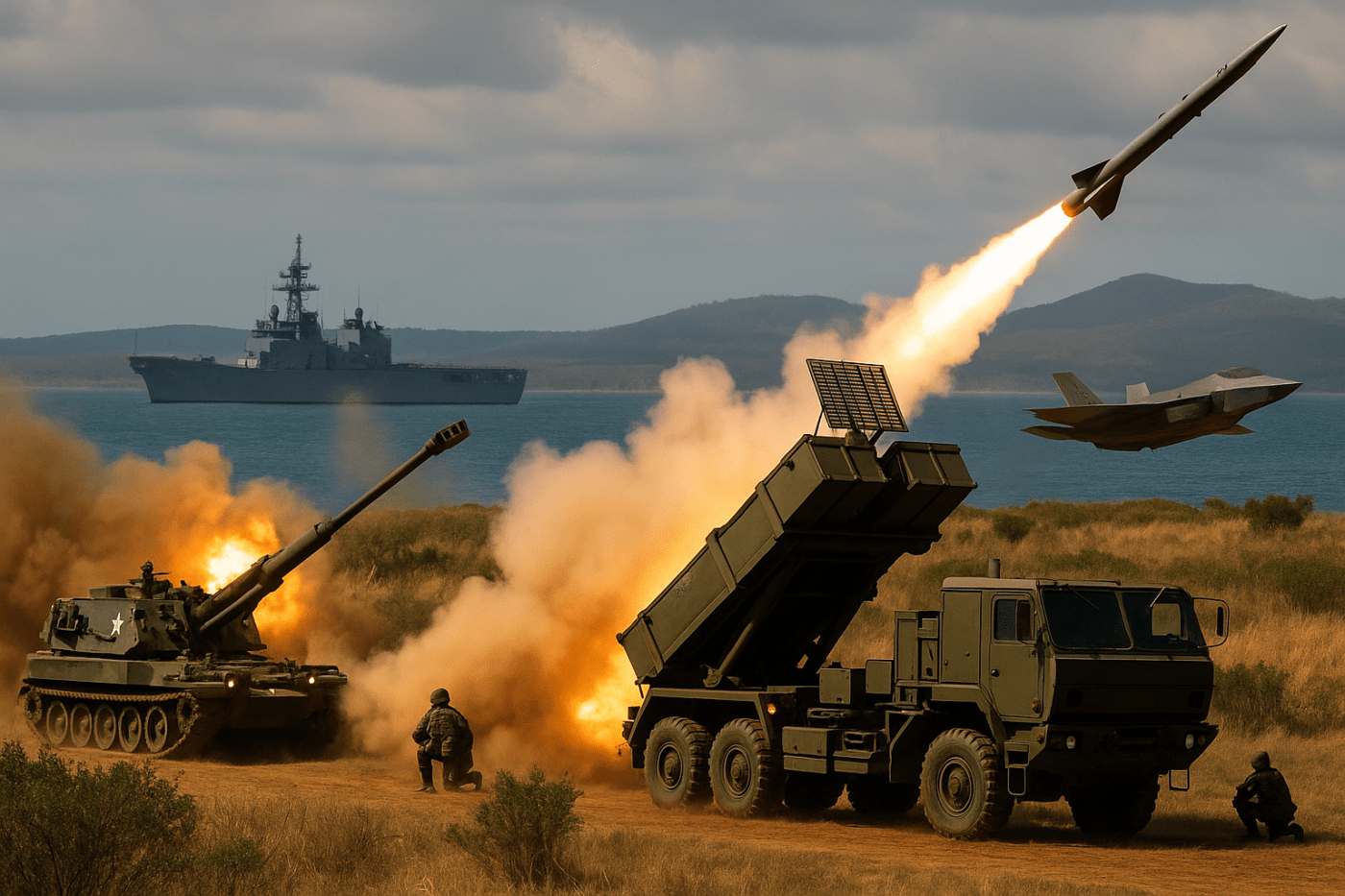
Australia’s largest-ever military drills are not a show of defense, but a coordinated rehearsal for Pacific war—waged from unceded land, sold as multilateral peace, and enforced through empire’s digital and logistical apparatus.
By Prince Kapone | Weaponized Information
July 18, 2025
🟥 Imperial Optics and the Art of Frictionless War
On July 14, 2025, Al Jazeera published a photo essay on Talisman Sabre 2025, depicting the U.S.-led military drills in Australia as a moment of multinational cooperation, logistical excellence, and mutual professionalism. The article is presented as a neutral photo gallery with minimal accompanying text, offering a visual narrative of firepower without context, consent, or contradiction. No author is credited.
Al Jazeera’s decision to publish this uncritical visual documentation—without naming command structures, contesting strategic motives, or offering even token geopolitical framing—must be read through the lens of its class position. Owned and operated by the Qatari monarchy, which hosts the largest U.S. airbase in the region (Al Udeid), the outlet routinely postures as an alternative to Western propaganda while reproducing NATO-aligned narratives across the Indo-Pacific. Its function is not journalistic neutrality but imperial soft power management: manufacturing legitimacy for military escalation through visual abstraction.
The first and most obvious technique deployed is the use of framing through minimization. Talisman Sabre is referred to as a “joint exercise” or “drill,” strategically softening the reality of a live-fire multinational war simulation involving 35,000 troops. By choosing terminology that implies practice rather than projection, Al Jazeera anesthetizes the viewer to the scale of military coordination unfolding.
Second, the article relies on rhetorical omission. There is no mention of who owns the land on which these exercises take place, nor any allusion to the long-standing resistance movements within the Pacific or Australia. The site is treated as empty terrain—open for occupation, cleared of political or ecological history.
Third, emotional deflection via spectacle drives the photo selection. Viewers are not shown the consequences of militarization but its cinematic aesthetics: missile trails, explosions, hardware in motion. The violence becomes choreography. The exercise becomes entertainment. Militarism is stripped of consequence and repackaged as visual awe.
Fourth, normalization of surveillance and counter-surveillance is executed through a casual aside that Chinese “spy ships” are expected to monitor the drills. There is no analysis of why China might be concerned, nor any indication of how surveillance justifies increased U.S. presence. The line acts as a cognitive primer, guiding the audience to see China as the outlier, the watcher, the trespasser.
Fifth, false consensus via symbolic participation is mobilized. The article highlights the involvement of countries like Malaysia and Vietnam as observers, insinuating alignment without explaining the nature of their participation or the structural pressures behind it. This sleight-of-hand creates an illusion of unified support where only asymmetric compliance exists.
Sixth, legitimacy laundering through geographic dispersion is deployed. The inclusion of drills in Papua New Guinea for the first time is mentioned without analysis. This extension of the exercise’s footprint is framed as logistical expansion, not geopolitical annexation. There is no mention of recent U.S.-PNG defense deals, student protests, or domestic backlash.
By withholding all contradiction, Al Jazeera’s gallery becomes a curated theater of empire. No motive is questioned. No voices are heard. No system is named. This is not passive reporting—it is aestheticized counterinsurgency. Through strategic framing, curated silence, and emotional manipulation, the outlet helps midwife consent for a war already in motion. The battlefield has no borders anymore—only lenses.
Beneath the Pacific Surface: The Material Architecture of U.S. War Planning
Talisman Sabre 2025 is officially described as a biennial training exercise, but the material evidence reveals a structure of integrated war rehearsal. This year’s iteration involves over 35,000 troops from 19 nations, including the United States, Australia, Japan, South Korea, the Philippines, India, Indonesia, and a rotating cast of NATO-aligned and Pacific client states. For the first time in its two-decade history, the drills are being staged not only across northern Australia, but also in Papua New Guinea, whose civil society sectors expressed alarm over the encroachment of foreign military forces.
This expansion follows the May 2023 signing of a bilateral defence cooperation agreement between Papua New Guinea and the U.S. that laid out access to key installations including Momote Airport and Lombrum Naval Base. It bypassed parliamentary transparency and sparked protests among students from universities such as the University of Papua New Guinea. According to Human Rights Watch’s World Report 2024, the pact empowers the U.S. to deploy troops in emergencies and conduct patrols in PNG waters—marking a significant expansion of U.S. militarized cooperation. These developments effectively transform PNG into a forward-operating logistics node within the broader U.S. Indo-Pacific posture.
Meanwhile, the main theater of operations remains Shoalwater Bay in Queensland, one of Australia’s largest and most heavily militarized training zones. This region is the ancestral homeland of the Darumbal people and has never been ceded to the Australian state. Live-fire drills have repeatedly drawn local opposition due to environmental, cultural, and strategic concerns. In a submission during the 2021 exercise cycle, Friends of the Earth and First Nations communities cited the destruction of nesting habitats, fuel contamination, and restricted access to ceremonial sites—particularly impacting the Darumbal and Woppaburra peoples.
The exercise is coordinated by U.S. Indo-Pacific Command (INDOPACOM), which holds centralized control over cyber infrastructure, logistics, and live targeting operations. Recent years have seen INDOPACOM modernize its operational capacity by integrating artificial intelligence systems, autonomous command nodes, and high-bandwidth intelligence platforms designed to sustain combat operations across maritime and archipelagic environments. In May 2025, U.S. Indo-Pacific Command began deploying AI-powered decision-support tools—including the Pentagon’s “Thunderforge” initiative—during its Pacific Sentry tabletop exercise to assess courses of action in complex scenarios, as reported by Defense One. According to Technology Magazine, the command is also investing in AI capabilities, human-machine teaming, cybersecurity architecture, and secure high-bandwidth networks to enable real-time, all-domain command and control.
Australia’s role in this network is infrastructural. Under the AUKUS trilateral pact signed in 2021, it has agreed to procure Virginia-class nuclear-powered submarines from the United States and United Kingdom. The first wave of U.S. vessels will rotate through HMAS Stirling in Western Australia, while construction on new base infrastructure is already underway. According to a March 2025 report from Reuters, this effort marks the most significant expansion of permanent U.S. naval presence in the Southern Hemisphere since World War II.
The Asia-Pacific arms market has boomed in tandem with these developments. Defense spending in the region has grown over 37 percent since 2015, fueled in part by synchronized drills like Talisman Sabre. In July 2025, Taiwan deployed U.S.-made HIMARS rocket systems in its own Han Kuang military exercises, a move that coincided with regional arms demonstrations by South Korea, Japan, and Australia. According to AINvest’s assessment of SIPRI data, the Indo-Pacific is now the fastest-growing defense procurement zone on Earth.
In the Philippines, the Enhanced Defense Cooperation Agreement (EDCA) continues to anchor U.S. troop access to strategic sites near Taiwan and the South China Sea. In February 2023, four new EDCA sites were announced, giving U.S. forces increased capacity to stage amphibious and intelligence operations within striking distance of contested waters. These EDCA expansions occur in coordination with multilateral exercises like Balikatan and now Talisman Sabre, constituting a multi-vector pressure architecture around Chinese commercial and military interests.
The broader framework for these exercises is housed under the Pacific Deterrence Initiative, a $27 billion U.S. military strategy for encirclement and escalation containment. The PDI provides funding for missile installations, radar upgrades, and expanded war games across the Pacific archipelago, from Guam to Palau to the Philippines. It reflects the strategic logic of containment updated for a multipolar century—linking forward operating presence, strategic partnerships, and regional compliance under U.S. hegemony.
What is absent in the media portrayal of these exercises is precisely what the facts reveal: an evolving military infrastructure designed not to preserve peace, but to prepare for war. Talisman Sabre is not simply a test of allied interoperability—it is a planetary signal, calibrated across terrain, treaties, and weapons platforms. Its meaning does not reside in spectacle. It resides in structure.
🟩 Simulated Consensus, Real Command: Reframing Talisman Sabre as Hyper-Imperial Architecture
Talisman Sabre 2025 is not a “joint exercise.” It is the practical codification of an imperial order under digital command—a structure in which logistics, surveillance, and coercion are integrated into a seamless system of rule. The troop deployments, infrastructure upgrades, and regional access agreements outlined earlier are not mere acts of defense coordination. They constitute the operating blueprint of hyper-imperialism: a phase in which multiple capitalist core states converge under centralized military command—not to share power, but to protect its existing distribution.
Under this structure, participation by states like the Philippines, Papua New Guinea, and Australia does not reflect mutual sovereignty. It reflects conditional incorporation. The decisions are not theirs. The geography is theirs. The command is not. What appears as coalition is, in reality, a hierarchy. The drills simulate consensus, but enforce dependency. National terrain becomes imperial substrate. Sovereignty is algorithmically subordinated.
This system is not only imperial—it is increasingly automated. The U.S. Indo-Pacific Command’s evolving warfighting model is now anchored in Joint All-Domain Command and Control (JADC2), a fully integrated digital combat architecture that synchronizes land, sea, air, cyber, and space operations through artificial intelligence, satellite-linked command nodes, and predictive targeting platforms. With this system, kinetic and cyber operations can be coordinated in real time across multiple territories and militaries—without requiring traditional negotiation or oversight. This is the operational face of technofascism: a military doctrine in which high-tech repression replaces colonial garrisons, and obedience is measured by algorithmic integration.
Technofascism doesn’t need mass mobilization. It needs networks. It thrives not through ideology but through logistics—cabling alliances into one operating system, where data and weaponry flow across borders faster than consent can be withdrawn. The public sees drills. The machine sees combat rehearsal. The press describes interoperability. The system executes a loyalty test. The simulation becomes strategy.
Through this lens, recent access agreements, facility upgrades, and logistics corridors across the Pacific are best understood not as “alliances” but as platforms for neocolonial extraction. What is extracted is not only territory—but control. Not only labor—but obedience. A nation’s consent becomes operational rent. Resistance is recoded as instability. Indigenous land is digitized as training space. Participation becomes obligation, and refusal is priced as risk.
This is where the contradiction intensifies. The more the empire standardizes its command structures, the more it exposes the inequality embedded within them. Australia houses bases but does not direct strategy. The Philippines hosts missiles it cannot unilaterally fire. PNG offers ports under a foreign flag. The veneer of parity collapses under the weight of dependency. These are not defensive partnerships. They are programmed occupations. The drills perform alliance, but train subordination.
In this configuration, war rehearsal becomes ideological normalization. Each exercise trains not only soldiers, but publics. Media outlets like Al Jazeera function not as observers, but as actants—scripting firepower as cooperation, deleting Indigenous memory, muting regional dissent. Their silence is not passive. It is structural. It is the operating silence of empire: where nothing needs to be said because the system speaks through its repetition. Every new drill becomes both a warning and a weapon. Every absence becomes a statement of control.
As the Tricontinental Institute’s Dossier 76 makes clear, U.S. militarization in the Indo-Pacific is not a defensive posture—it is a strategy of permanent pressure designed to contain sovereignty and enforce alignment. What we are witnessing is not just the mobilization of troops, but the calibration of narrative. Hyper-imperialism now operates as a closed circuit: war rehearsals, media framing, and digital logistics reinforcing one another to simulate consent, erase contradiction, and preempt rebellion. Empire no longer sells war—it scripts its inevitability. The task ahead is not to wait for its collapse, but to break the circuit before the loop completes.
From Spectacle to Struggle: Breaking the Pacific Theater
Talisman Sabre is not a far-off abstraction. It is the forward projection of imperial firepower—landed, rehearsed, and normalized through the quiet consent of the settler core. But that consent is manufactured, and it can be broken. Resistance is not theoretical; it’s already underway across the Pacific. The Darumbal people have resisted the desecration of their unceded land. Filipino coalitions like BAYAN are organizing against U.S. occupation. Students in Papua New Guinea have mobilized against military base agreements rammed through without public debate. These are not “regional protests”—they are frontline struggles in the global anti-imperialist war.
It is not enough to stand in solidarity. Organizers and movements within the imperial core must actively disrupt the logistics of war. That means targeting the financial arteries, narrative infrastructures, and institutional enablers that render militarism profitable and palatable.
First, target the profiteers. Lockheed Martin alone stands to make billions from the war rehearsals staged in Australia, the Philippines, and Taiwan. Their HIMARS rocket launchers—live-fired in Shoalwater Bay—are not instruments of “defense,” but market-tested tools of aggression. Global North organizers must launch divestment campaigns against weapons manufacturers like Lockheed Martin, Raytheon, and Northrop Grumman. Public pension funds—including the California Public Employees’ Retirement System (CalPERS) and Australia’s CBUS Super Fund—invest heavily in these firms. Name them. Disrupt their meetings. Demand immediate divestment and accountability.
Second, fund the frontlines. Resistance in the Global South is not symbolic—it is strategic. The Indigenous-led blockade of Shoalwater Bay has cost the Australian military time, money, and legitimacy. BAYAN’s organizing against EDCA sites in the Philippines represents a mass anti-imperialist current with decades of movement history. Organizers in the core must reroute resources to these efforts by building permanent transnational support systems—legal defense funds, material aid channels, and rapid response communications networks.
Third, seize the narrative terrain. The drills may be staged in Shoalwater Bay, but the ideological theater extends into classrooms, search engines, and think tank white papers across the Global North. Organizers must expose the militarized propaganda pipeline—from university departments funded by AUKUS contracts, to media outlets like Al Jazeera that sanitize occupation. Host political education forums featuring Darumbal and BAYAN speakers. Project counter-narratives during weapons expos like DSEI London 2025. Use open-source tools to map base infrastructure and visualize complicity. Narrative warfare is not metaphorical. It is strategic terrain.
Finally, rupture the manufactured consensus. These drills rely on the myth of inevitability—that militarism is normal, popular, and permanent. It is not. Organize flash teach-ins in front of recruiting centers. Disrupt defense expos with guerrilla projections. Leak internal university documents exposing AUKUS-aligned programs. Occupy campuses complicit in weapons research. Reclaim public space with militant clarity. This is not moral protest—it is counter-logistics.
Resistance is not charity. It is a military necessity. Talisman Sabre is not only a test of alliance interoperability—it is a loyalty audit. The Pacific is not passive terrain. It is an insurgent geography. The task is not to observe—it is to act. Every blockade, every narrative disruption, every divestment campaign builds contending power against the imperial logistics grid. The drills are not inevitable. The system is not invincible. What it fears most is fracture—from below, from within, from those it counted on to obey.
 Weaponized Information
Leave a comment