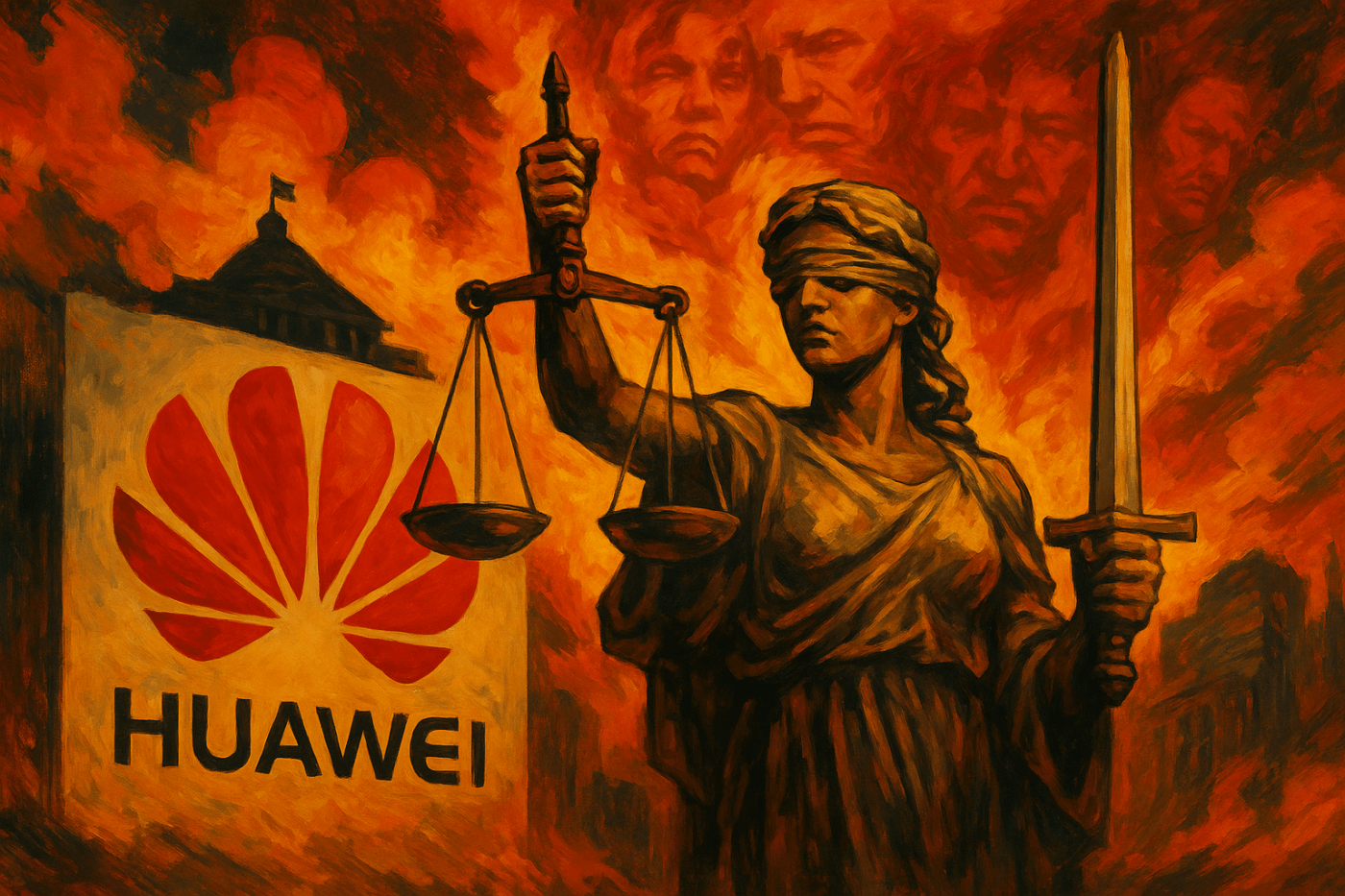
What looks like a fraud indictment is actually a battle over the future of global infrastructure—and the U.S. is using every weapon it has to stop the Global South from building its own.
By Prince Kapone | Weaponized Information | July 2, 2025
Racket or Recalibration? How the U.S. Uses the Courtroom to Police the Global Tech Order
The Associated Press would have you believe that a grand crime saga is unfolding—one in which a Chinese tech giant, cloaked in shadows and state secrets, has been caught red-handed. The article, written by AP Asia editor Elaine Kurtenbach and published on July 2, 2025, announces that Huawei Technologies “must face” criminal charges in a sweeping federal case. A U.S. judge, we’re told, has denied the company’s request to dismiss a 16-count indictment alleging everything from racketeering to bank fraud, sanctions evasion to surveillance assistance. The message is unmistakable: Huawei is not just a telecom company—it’s a threat, a syndicate, an arm of totalitadian power.
But look a little closer, and this tidy courtroom drama starts to fall apart. The author, Kurtenbach, has built a long career reporting on Asia’s economies for Western financial media, and her class position is inseparable from her prose. She writes not as an observer of empire but as its stenographer—repeating the U.S. Department of Justice’s claims with reverent precision, yet offering no interrogation of the power relations that make such accusations possible in the first place. In this piece, she doesn’t ask why U.S. law is being applied to a Chinese company for doing business outside the U.S., nor why sanctions—tools of economic war—are treated as neutral legal standards. She doesn’t question whether the surveillance charge holds any water, or whether American tech firms might have bloodier fingerprints on the global digital apparatus. She doesn’t ask because the answer is already decided: America is the law, and Huawei is the outlaw.
This is par for the course at the Associated Press, an old and dusty pillar of Western information warfare dressed up as neutral reporting. AP is a cooperative, yes—but not of journalists, of media corporations. Its revenue comes from licensing stories to the same legacy outlets that sit on editorial boards with Lockheed Martin lobbyists and State Department envoys. It markets itself as independent but functions as a public relations wing of the U.S. foreign policy elite. It will never run a story asking how many nations the U.S. has sanctioned into starvation. But it will run every story accusing China of playing dirty, especially if it helps pave the way for a new round of chip sanctions or diplomatic strong-arming in the Global South.
The propaganda in this article isn’t just in what’s said—it’s in how it’s said. The headline sets the tone with a presumption of guilt: Huawei “must face” charges. That’s not legal reporting; that’s narrative management. The body of the article hammers in the point with language like “racketeering,” “fraud,” and “spy on protesters,” sprinkled with just enough Cold War nostalgia—North Korea, Iran—to summon the appropriate demons for the reader to hiss at. But while the article names these allegations, it never explains them. The phrase “enabling Iran to spy on protesters” is dropped like a bomb, with no evidence, no technical description, no contextual timeline. It’s not a fact; it’s a moral trigger. It invites the reader to react, not reflect.
And what goes unsaid is perhaps more dangerous than what’s printed. There is no mention of the U.S. surveillance state, no allusion to the NSA’s global dragnet, no acknowledgment that American firms like Palantir, Amazon Web Services, and Cisco have long supplied repressive governments with the tools of digital control. There is no mention of Edward Snowden, no room for Assange. The only spying that exists in this moral universe is done by foreigners with yellow skin and funny names. It’s the oldest trick in the imperial book: accuse others of your own crimes.
Even the narrative arc leans into orientalist tropes. Meng Wanzhou, Huawei’s CFO, is identified not only by her corporate role but by her bloodline—“the daughter of Huawei’s founder.” It’s a line straight out of an opium-era pulp novel: the dragon-dynasty tech empire run by a patriarch and his cunning heiress. Meanwhile, U.S. prosecutors and judges are portrayed as steady, impartial arbiters of justice—no mention of the geopolitical theater they’re participating in, no recognition that this is a state-sponsored prosecution against a strategic rival.
What we’re watching is not a legal case but a front in the information war—a trial not of Huawei’s crimes, but of China’s refusal to kneel. This is the court as cockpit, where imperial turbulence gets translated into legalese. It’s lawfare, not law. And the AP, through carefully curated framing, selective omissions, emotional cues, and recycled Cold War caricatures, has once again proven its loyalty—not to truth, but to the narrative imperatives of empire.
The Facts Buried Beneath the Verdict: What the AP Didn’t Tell You About Huawei, Sanctions, and the Global Tech War
Let’s clear away the rhetorical fog. Once we strip the Associated Press article of its moral framing, Cold War ghosts, and judicial window dressing, what remains is a series of factual claims. These are worth listing plainly—not because they are trustworthy in themselves, but because they form the skeleton on which the entire propaganda body is hung. According to the article:
- U.S. District Judge Ann Donnelly ruled against Huawei’s motion to dismiss a 16-count federal indictment.
- The indictment alleges that Huawei stole U.S. trade secrets, committed wire and bank fraud, violated U.S. sanctions on Iran and North Korea, and enabled Iranian state surveillance during the 2009 protests.
- Huawei is accused of using a Hong Kong shell company, Skycom, to do business with Iran, violating U.S. law.
- Huawei CFO Meng Wanzhou was arrested in Canada at the request of the U.S. in 2018 and later released in a prisoner swap in 2021.
- Huawei claims the allegations are vague, extraterritorial, and do not involve domestic wire or bank fraud.
- Chinese officials describe the case as “economic bullying.”
Now, let’s talk about what this article leaves out—what it cannot say without shattering the whole narrative scaffolding of Western techno-imperial legitimacy.
First, there is no mention of the U.S. surveillance-industrial complex that dominates the digital world. Companies like Palantir, Raytheon, and Booz Allen Hamilton (home of Snowden) supply advanced surveillance and analytics to both the Pentagon and U.S.-aligned regimes. The same government accusing Huawei of “helping Iran spy on protesters” runs the NSA’s PRISM program, which tapped directly into the servers of Google, Facebook, Microsoft, and others to collect global communications without consent. That spying wasn’t just technical—it was total.
Second, the U.S. legal campaign against Huawei cannot be understood outside the context of escalating tech warfare. The article glances at sanctions, but fails to explain that in 2019, the U.S. placed Huawei on its “Entity List,” cutting it off from U.S.-made chips, software, and semiconductor manufacturing equipment. The goal was not justice—it was domination. Huawei’s rise threatened U.S. monopolies like Qualcomm, Cisco, and Intel, and more importantly, it undermined Washington’s control over the global 5G rollout.
Third, while the article names “Iran” and “North Korea” with reverent scorn, it omits the very nature of U.S. sanctions: extraterritorial weapons used to enforce political compliance. These are not globally accepted laws. They are unilateral declarations of financial war. According to research by the Transnational Institute, U.S. sanctions regimes have devastated healthcare systems, disrupted food imports, and killed hundreds of thousands in targeted countries. To criminalize Huawei for defying this regime is to criminalize defiance itself.
Fourth, there’s no mention of the 2013–2014 period, when documents revealed that the NSA had hacked Huawei’s servers in Shenzhen. The U.S. didn’t just fear Huawei—they surveilled it. They justified the breach by claiming national security risk, but never produced evidence. The real fear was that Huawei was building infrastructure Washington couldn’t control.
Fifth, the article fails to note that the U.S. spent years lobbying its NATO allies and Pacific vassals—Canada, the UK, Australia, Germany—to block Huawei from their 5G networks. The courtroom is not an isolated space. It’s one flank in a multi-theater conflict over who builds the global communications future.
Finally, Huawei’s response to sanctions is made to sound defensive—“the company shifted focus to hospitals, factories”—but this overlooks a key point: Huawei did not collapse. It innovated. Under siege, it ramped up its domestic chip design and fabrication capabilities, and became a leading symbol of Chinese technological sovereignty. This is the real threat: a Global South nation refusing dependency.
In this light, the contradictions are sharp. The United States, which accuses Huawei of theft, itself pioneered the global theft of data. The United States, which claims Huawei evades the law, wrote the rules in a rigged casino. The United States, which shouts “national security,” is not defending freedom—it is defending supremacy. And the AP, through strategic omission, turns geopolitical war into courtroom drama.
What’s unfolding isn’t about Huawei’s alleged crimes. It’s about punishing technological self-determination. The empire is not threatened by racketeering—it’s threatened by a future it doesn’t control. That’s the real verdict, and it never made it to print.
Technological Sovereignty on Trial: Lawfare, Sanctions, and the Crisis of U.S. Imperial Control
Let’s be clear: this isn’t about Huawei. It’s about hegemony. What the Associated Press dressed up as a courtroom drama is actually a chapter in a much larger story—the story of an empire in decline, fighting tooth and nail to retain control over the infrastructure of the future. Huawei stands accused not because it broke any universal law, but because it defied the imperial order that writes the rules. This case—wrapped in judicial robes, flanked by terms like “fraud” and “racketeering”—is lawfare as empire-building. And like all imperial projects, it relies on the projection of legality to obscure its fundamentally coercive nature.
The facts excavated earlier now assemble into a coherent pattern. U.S. sanctions block Huawei from accessing semiconductors, software, and financial services. The legal campaign criminalizes its workaround strategies—Skycom, third-party sales, dual-use tech exports. Meanwhile, the media cultivates public opinion by invoking the ghosts of Iran and North Korea, framing the narrative in familiar Cold War moralism. When Huawei pushes back and adapts—by investing in domestic chip production, expanding into non-Western markets, and consolidating national infrastructure—Washington calls it subversion. In this world, sovereignty is the crime.
The case illustrates what we at Weaponized Information call the Sanctions Architecture—a global blockade regime enforced through financial, logistical, and reputational coercion. It’s not just about denying chips. It’s about denying permission to exist outside the U.S.-controlled economic matrix. In Huawei’s case, the Sanctions Architecture operates hand in hand with the judicial apparatus. The company is locked out of chips, then sued for attempting to source them. It is accused of surveillance, while U.S. firms like Palantir and Amazon Web Services build predictive policing platforms for ICE, the NYPD, and apartheid regimes around the world. The architecture doesn’t only punish behavior—it polices allegiance.
Beneath that architecture lies a deeper logic: Financial Piracy. Huawei’s CFO, Meng Wanzhou, was arrested not for violence, but for the alleged act of misrepresenting transactions to a bank. The U.S. claims it was misled—about Iranian dealings, about internal structures, about corporate shells. But what really angers the empire is not the lie—it’s the evasion of tribute. The U.S. financial system functions as a toll booth on the global economy. Banks like HSBC and Citibank act as informal enforcers. When firms circumvent that tribute system—by operating outside of U.S. jurisdiction, using third-party processors, or trading with sanctioned states—the punishment is not just legal. It is exemplary.
This is why the U.S. goes after Huawei so aggressively. Because it’s not just a company. It’s a symbol. A state-linked corporation from a non-Western, formerly colonized nation, rising to the top of a high-tech sector dominated by Euro-American monopolies. Its success undermines the fantasy of Western exceptionalism. Its survival despite sanctions undermines the threat of punishment. Its alliances with Iran, Russia, and African states undermine the monopoly on infrastructure-building. In the eyes of the empire, Huawei is guilty of something far worse than fraud. It’s guilty of Technological Sovereignty.
This is where we must introduce another concept: Technofascism. The U.S. is not simply engaging in liberal competition. It is fusing its surveillance infrastructure with state, military, and financial power to suppress alternatives. This isn’t an open market—it’s a digital enclosure movement. The same empire that once fenced off Indigenous land now fences off frequency bands and chip supplies. Technofascism is the domestic face of this project: predictive policing, AI-powered surveillance, and algorithmic censorship. Huawei is accused of being the surveillance state, but in reality, it is being punished by the most expansive surveillance regime the world has ever known.
And there is one more dimension to this: Dual-Use Colonization. The U.S. and its allies promote so-called “civilian” tech companies—like Microsoft, Cisco, and Intel—as apolitical entities. But these firms are structurally tied to the U.S. military-industrial complex. Their chips go into drones. Their clouds serve the Pentagon. Their standards shape the technical architecture of global policing. What’s marketed as “innovation” is in fact the privatization of warfare. And when Huawei enters this arena, it threatens not just commercial interests, but colonial control over how knowledge is produced, stored, and transmitted.
The contradiction at the heart of this case is that the U.S. demands total obedience to a system it calls “rules-based,” yet those rules change whenever the empire’s dominance is threatened. It labels Chinese firms corrupt for doing business in sanctioned states, while it arms Saudi Arabia, trains Israeli cyber units, and funds intelligence operations in dozens of repressive regimes. It accuses Huawei of violating privacy while operating a global wiretap system that listens to the world. It calls Meng Wanzhou a criminal for telling the wrong story to a bank, while hiding behind corporations that launder blood money through Cayman shell accounts.
This is not hypocrisy. It is imperial logic. The system isn’t broken—it’s working as designed. And the Huawei case is not an anomaly. It’s a blueprint. A warning shot to every Global South nation dreaming of independence, every public-sector telecom project hoping to build sovereign networks, every coder who wants to escape the backend of Google’s algorithmic jail. The message is clear: in a world where code is capital and bandwidth is battlefield, the empire will not tolerate disobedience.
But we must also see the cracks. Because if it takes this much firepower to slow one company, what happens when a whole world resists? What happens when sanctions produce innovation, when arrests build solidarity, when the courtroom becomes a battleground of narratives? What happens is this: the old empire begins to show its age. It can no longer dominate by consent, so it governs by coercion. It no longer inspires—it indicts. And that, comrades, is not a sign of strength. It’s a symptom of crisis.
From the Courtroom to the Commune: What the Global North Must Do
If Huawei is on trial, so are we. Every person living inside the imperial core, drawing breath in a society that claims to speak for democracy while jailing the future, has a choice to make. We can be spectators to empire, applauding its prosecutions and parroting its talking points. Or we can become traitors to its logic—active deserters from the digital Cold War being waged in our name. This isn’t just about chips or court cases. It’s about sovereignty. It’s about whether the Global South has the right to build, communicate, innovate, and govern without begging permission from Washington, Brussels, or Silicon Valley.
Let’s be precise: the Huawei case is not an isolated injustice. It’s part of a coordinated system of repression, enforced through sanctions, trade blacklists, export controls, and legal assaults designed to punish any nation or company that refuses to comply with U.S. technological domination. This is the logic of empire in the digital age: if you don’t play by our rules, we will freeze your assets, seize your executives, and smear you in the press. And if you survive that, we’ll indict you anyway.
But resistance is already underway. In May 2025, Brazil’s National Telecommunications Research Center announced a partnership with South Africa and India to build a fully sovereign, BRICS-backed semiconductor production consortium. The project, nicknamed “Chipasa,” is not just about manufacturing—it’s about liberation. It aims to break dependency on the U.S.-controlled tech stack by pooling research, funding, and infrastructure across the Global South. This is not some abstract future. It’s already in motion, with joint labs under construction and export frameworks being drafted outside of SWIFT and U.S. dollar controls.
So what can we do in the imperial core—here in the belly of the beast—to support this insurgent push for tech sovereignty?
First, we must target the empire’s choke points. That means confronting the banks, brokers, and investment funds underwriting techno-sanctions. Organizers should demand that cities, pension funds, and universities divest from firms complicit in tech warfare—from Raytheon and Lockheed Martin to JPMorgan and HSBC. These entities don’t just fund bombs. They fund the financial infrastructure of domination. They launder empire through quarterly reports.
Second, we must build alternative media and communications systems. Support grassroots outlets like Dongsheng News, Tricontinental, and independent tech cooperatives working to decentralize information and infrastructure. Instead of letting Google and Meta mediate every global narrative, let’s lift up the voices being silenced—journalists, engineers, workers, students—fighting on the frontlines of informational liberation.
Third, we need to train and deploy Proletarian Cyber Resistance teams. This means mutual aid groups composed of coders, designers, sysadmins, and digital organizers who can help Global South movements protect their infrastructure, evade censorship, and develop sovereign tools. It’s not enough to march or chant. In the war of circuits, we need comrades fluent in Python, not just protest signs.
Finally, political education must be weaponized. The Huawei case offers a perfect wedge to expose the myth of digital neutrality. Host teach-ins, write zines, organize reading groups, create memes that cut through the noise. Break the illusion that the internet is free, that markets are fair, that laws are impartial. Show that the real crime isn’t trading with Iran. It’s living in a world where the U.S. gets to decide who eats, who connects, and who gets dragged into court for disobedience.
The courtroom was never the end of the story. It’s just the beginning of a reckoning. And we in the imperial core have a duty—not to the state that imprisons dissidents and engineers coups, but to the world struggling to breathe outside its firewall. As long as sovereignty is treated as a crime, solidarity must become the counter-law. Let’s make sure the next verdict is ours.
 Weaponized Information
Leave a comment