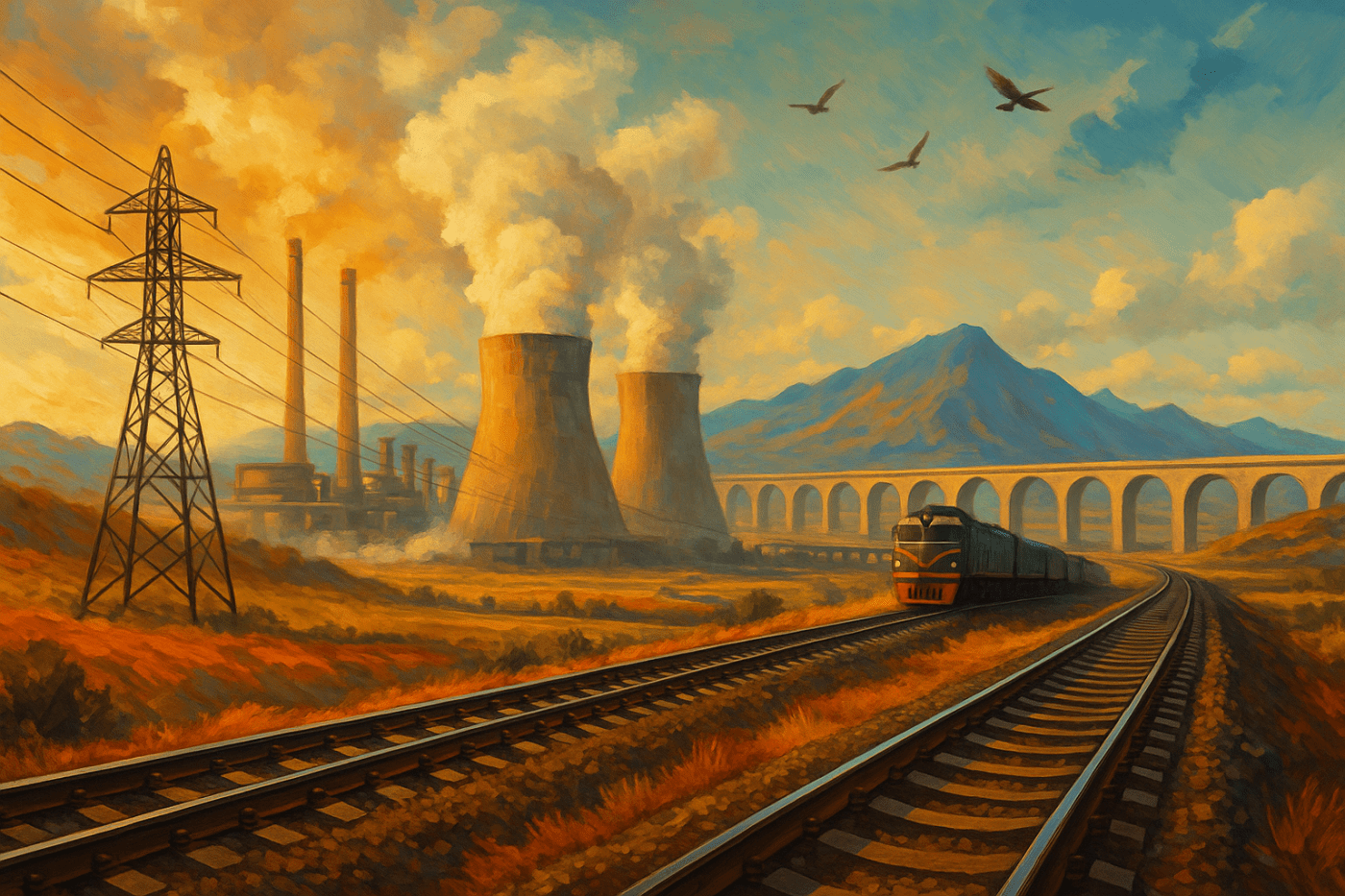
How 24 bilateral agreements expose the imperialist decay of the West and point toward a new infrastructure of liberation
By Prince Kapone | Weaponized Information | June 18, 2025
Soft-Power Dispatches from the Steppes of Sovereignty
When The Astana Times heralded the 24 new China–Kazakhstan agreements, it read less like a breathless Western press release and more like a proud telegram from the post-Soviet steppe: measured, diplomatic, and pointedly free of the usual Sinophobic shrill. The piece, penned by staff reporter Dana Omirgazy, rolls out phrases—“unwavering friendship,” “peace-loving initiatives,” “no political conditions”—that would give Washington’s editors indigestion. Yet beneath the courteous prose lies a deeper signal: Central Asia is repositioning itself in a world no longer chained to NATO’s imagination.
Omirgazy writes for The Astana Times, Kazakhstan’s English-language outlet founded in 2010 and published by the Guild of Independent Journalists—a non-profit registered with the Ministry of Communications in Nur-Sultan. Far from the corporate newsrooms of New York or London, this paper functions as a soft-power amplifier for a post-colonial state clawing back its narrative after decades of foreign tutelage. It is state-aligned, yes—yet crucially, it is not a cog in the Western imperialist media apparatus; its editorial compass orients toward sovereignty, not sanctions.
The article’s tone is telling. There is no breathless fear of “debt traps,” no hand-wringing over “authoritarian influence.” Instead, Omirgazy foregrounds history: China “has never harmed the Kazakh people,” President Tokayev says, drawing a quiet but lethal contrast with centuries of Russian czarist expansion and, more recently, IMF-scripted austerity. The prose is friendly, almost ceremonial—yet every cordial sentence doubles as an indictment of the coercive habits of the unipolar world. The subtext is Marx’s old quip in diplomatic garb: The West offers lectures; Beijing shows up with rail steel.
Make no mistake: this is fraternal narrative construction, not enemy propaganda. The story celebrates a socialist-led development model—build infrastructure, respect sovereignty, export no coups—that stands in material opposition to the Pentagon-Wall Street playbook. Our task, then, is not to smash the narrative but to sharpen it: to excavate the class and ecological questions Omirgazy leaves unspoken, while amplifying the anti-hegemonic thrust that already pulses beneath her paragraphs. In doing so, we weaponize the very text Western censors would prefer remain a polite footnote.
Railways, Reactors & the Silk Road of Sovereignty
On June 16, 2025, Presidents Xi Jinping and Kassym-Jomart Tokayev sat shoulder-to-shoulder in Astana and inked 24 agreements that stitch Kazakhstan even tighter into the fabric of Eurasia’s rising multipolar order. The deals sweep across energy grids, aerospace research, digital customs regimes, green-tech financing, agriculture, and tourism—tangible bricks in a world Beijing builds with rail steel, not aircraft carriers. Bilateral trade already hit a record $44 billion in 2024, and both sides signaled that figure is merely a mile-marker on a much longer track.
The most charged item on the table is power: Kazakhstan confirmed plans for two to three nuclear reactors in partnership with the China National Nuclear Corporation (CNNC). The Central Asian republic—already one of the world’s top uranium suppliers—will now climb the value ladder from raw-ore exporter to sovereign generator of baseload electricity. Where the U.S. wields sanctions and the EU peddles austerity, China transfers technology that can light every home from Shymkent to the steppes.
These projects crystallize the “long road to multipolarity” we dissected in April, when we traced BRICS+ realignments as material ruptures in the imperial order—not utopian abstractions but concrete responses to five centuries of colonial extraction.
They also echo the high-speed precedent set along the China–Laos Railway, where a once-land-locked nation punched a tunnel straight through the logistics chokehold of the Mekong and rewired its future without a single IMF signature.
Zoom out, and the geography tells its own story. From the Horgos dry port on the Xinjiang border to the Caspian railheads, Kazakhstan is the keystone of the Belt & Road’s Middle Corridor—a trans-Eurasian artery that dodges NATO sea lanes and Russian bottlenecks alike. New fiber-optic cables, grain terminals, and passenger routes announced this week widen that corridor into a people’s highway, binding Turkic steppes and Han heartlands against the choke-points of the petrodollar.
In fact, Astana’s rails are already reaching past the Caspian: our May 6 investigation, “The Silk Road Returns,” showed how Vietnamese ports and Kazakh freight depots are knitting a Hanoi-Almaty-Xinjiang triangle invisible to Reuters but lethal to the dollar’s monopoly on Asian trade flows.
Nor is Kazakhstan alone. From Jakarta—whose BRICS bid we chronicled in “Indonesia at the Crossroads”—to the Straits of Malacca, Global South states are leveraging Chinese capital to break the maritime vice that once let Washington throttle 40 percent of world shipping at will.
Yet the Astana Times piece leaves the class ledger blank. It says little about how these mega-projects will touch the calloused hands of miners in Karaganda or the herders displaced by ribbon-straight rail lines across ancestral pasture. Nor does it remind readers of the IMF-dictated shock therapy that gutted Kazakh industry in the 1990s, selling copper pits and oil wells for kopeks to transnational vultures. Today’s agreements are born from that historical scar: they are a material counter-proposal to the privatization gospel that once promised plenty and delivered precarity.
Thus, the context is dialectical: China’s socialist market engine meets Kazakhstan’s post-colonial quest for sovereignty, both maneuvering within a capitalist-imperialist world still policed by Washington. The contracts signed this week are not mere memoranda; they are waypoints in a continental strategy to tunnel under sanctions architecture, reroute value chains, and pry open breathing space for South–South development. Whether the benefits reach the mine shaft, the village clinic, and the union hall will depend on how fiercely Kazakh workers and peasants press their claims in the new corridors of power now being laid in concrete and uranium fuel rods.
Multipolarity in Motion: Steel, Sovereignty, and the End of Western Grammar
If you listen closely to the official toasts in Astana, you can hear something far deeper than diplomatic pleasantries. Beneath the smiles and mutual admiration lies a tectonic shift in the world order. What China and Kazakhstan sealed this week wasn’t just a set of commercial agreements—it was a chapter in the burial of Western unipolarity. And it wasn’t written in the ink of press releases. It was written in steel tracks, nuclear cores, and high-voltage cables. It was written in the grammar of multipolarity—a language the West still refuses to learn because it cannot control the punctuation.
This isn’t just diplomacy. It’s development with a different center of gravity. Where the World Bank arrives with contracts and conditions, China comes with cranes and conductors. Where U.S. envoys preach “human rights” and stage-manage coups, Beijing sends fiber-optics and mutual recognition. That’s not to say the Belt and Road is free of contradictions—it isn’t. But its class character is qualitatively distinct from the imperialist blueprint that plundered the Global South for 500 years. This is not about “spreading democracy” at gunpoint. It’s about building sovereignty with rebar and cooperation—sometimes clumsy, sometimes bureaucratic, but undeniably real.
Our April dossier “The Long Road to Multipolarity” argued precisely this: multipolarity is no charity project. It is the dialectical recoil of colonized peoples against a collapsing imperial core—and every container of Kazakh wheat that now moves east instead of west is empirical proof that the recoil has teeth.
The Western line, of course, will be that China is colonizing Central Asia. That’s rich, coming from the same capitals that tore through the region with IMF reforms, asset-stripping, and Pentagon partnerships. Let’s be clear: China hasn’t bombed a single Kazakh village, hasn’t demanded regime change, hasn’t imposed sanctions, and hasn’t carved up land for military bases. Instead, it’s co-constructing infrastructure, sharing technology, and supporting energy independence. That’s not imperialism. That’s multipolar reciprocity—one awkward step at a time.
Yes, class contradictions remain. Chinese capital is still capital. Kazakh oligarchs will still try to siphon contracts. Environmental risks must be confronted. But these are internal struggles within a larger battlefield—the struggle to break from Western dominance. And in that war, this partnership is not a threat to the people—it’s a weapon in their arsenal. It is not the socialist horizon, but it is the terrain on which socialism might walk forward.
Witness Myanmar: when Naypyidaw flirted with Chinese logistics corridors, The Economist staged a panic attack we unmasked on June 5 as narrative counterinsurgency. The same script will now run against Astana.
We are not naïve romantics. We are dialectical realists. And reality tells us this: A freight train connecting Almaty to Xi’an carries more revolutionary potential than a hundred White House briefings on democracy. These deals don’t just signal regional cooperation—they signal a global transition. One where the future is negotiated between states, not dictated by empire. Where infrastructure becomes a tool of sovereignty, not subjugation. Where the Global South learns to breathe again—not under the shadow of NATO, but under the rising sun of strategic autonomy.
From Steppe to Struggle: Building the Infrastructure of Liberation
What China and Kazakhstan are doing is more than paperwork—it’s praxis. And for those of us committed to revolutionary transformation, this is not the time to sit on the sidelines with red pens and purity tests. This is the time to insert ourselves into the fault lines of multipolar realignment and push the process toward the people. Because while elites cut ribbons and shake hands, the real question remains: Will the steel tracks of Eurasia carry grain and uranium for hedge funds, or for humanity?
Revolutionaries must begin by defending this multipolar corridor against the disinformation and sabotage already brewing in the West. We’ve seen this script before: NGOs funded by State Department cut-outs stirring up “anti-corruption” protests at Chinese project sites, U.S.-trained journalists crying “neocolonialism” while their own government strangles the world with sanctions, think tanks warning of “authoritarian expansionism” from the very states that invented regime change. It’s not critique—it’s counterinsurgency in a three-piece suit.
We reject that script. We stand with Kazakhstan’s right to develop without IMF handcuffs. We defend China’s right to export turbines, not tanks. And we recognize that this kind of South–South cooperation is not utopia—it’s strategy. Flawed, partial, contradictory—but moving in the direction of sovereignty, not servitude. That’s a terrain worth fighting for.
Our task now is to mobilize—not just ideologically, but materially. We need to build transnational bridges between Kazakh workers laying rail and African unions fighting privatization. Between Chinese engineers wiring smart grids and Latin American peasants demanding energy justice. Between students in Almaty and comrades in Palestine, Sudan, and Haiti resisting the same empire by different names.
As we showed in the Vietnam–Kazakhstan and Myanmar case studies, narrative warfare is designed to isolate each struggle. Our answer is to splice them together—rail by rail, port by port, union by union—until empire’s map of chokepoints becomes a spider-web of insurgent logistics.
Let’s launch counter-narratives on every front: expose the Western sabotage, amplify the development victories, and analyze the contradictions without becoming a mouthpiece for the empire’s lies. Let’s translate this diplomatic moment into revolutionary potential—through education, agitation, and transnational organizing.
Because multipolarity isn’t the revolution. But it opens the door. And when the door opens, we don’t critique the hinges—we storm through with the masses.
Endnotes
- “Kazakhstan, China Deepen Strategic Partnership, Sign 24 Agreements,”
, June 16, 2025.
- Dana Omirgazy’s profile at
- “About Us,”
- “Here Are Key Facts About Construction of Kazakhstan’s First Nuclear Power Plant,”
, April 2025.
- “To Understand China’s Belt and Road Initiative, Understand Horgos,”
, November 27, 2023.
- John Nellis, “Time to Rethink Privatization in Transition Economies?”,
, June 1999.
- “The Long Road to Multipolarity: BRICS and the Contradictions of the Imperial Order,”
, April 14, 2025.
- “The Belt Rolls On: China–Laos Railway and the Strategic Displacement of Empire,”
, April 11, 2025.
- “The Silk Road Returns: Vietnam, Kazakhstan, and the Multipolar Future Western Media Won’t Cover,”
, May 6, 2025.
- “Indonesia at the Crossroads: Between BRICS, Beijing, and the Bayonets of Empire,”
, April 14, 2025.
- “Myanmar and the Multipolar Moment: Excavating the West’s Manufactured Panic,”
, June 5, 2025.
 Weaponized Information
Leave a comment