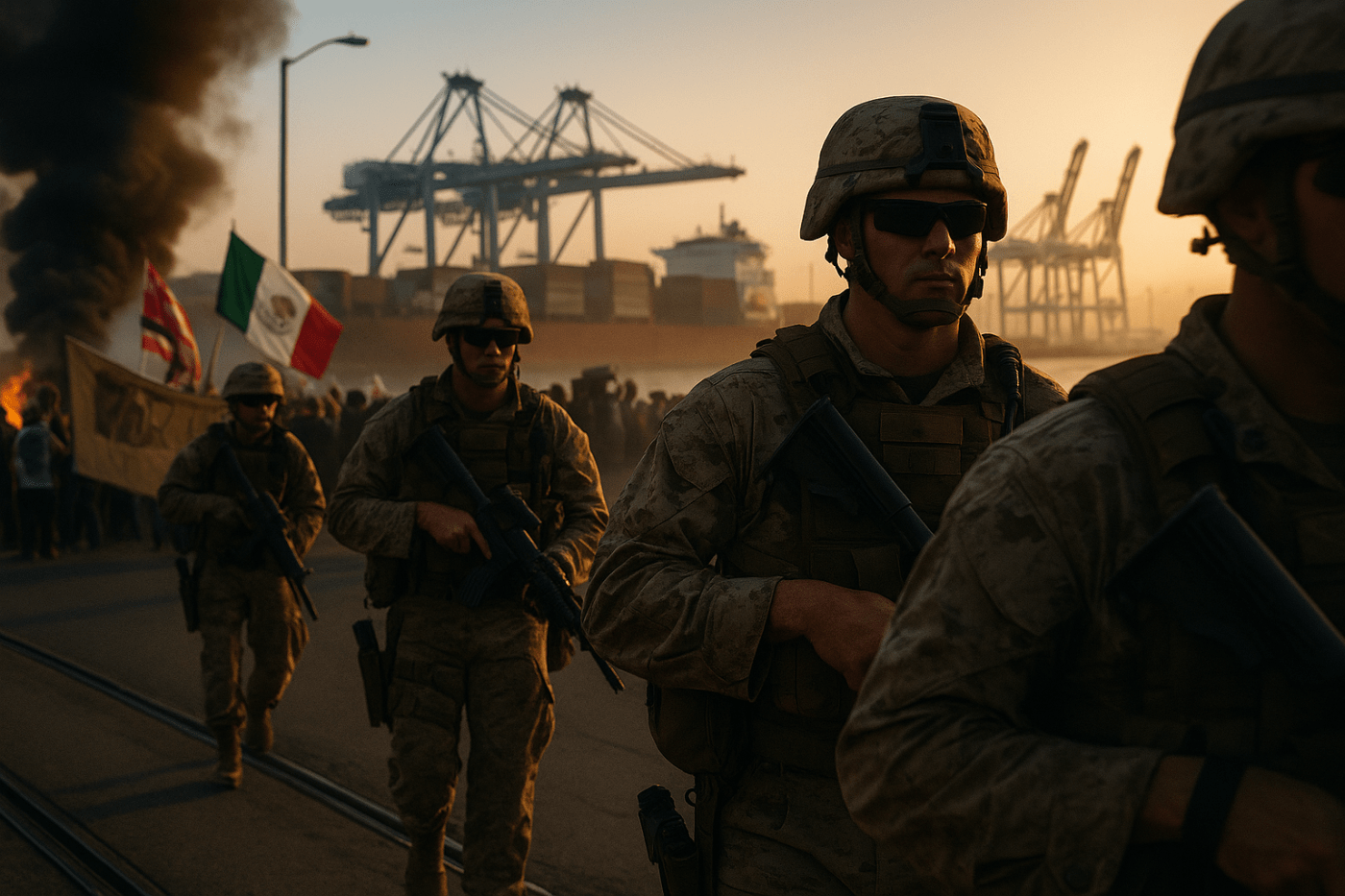
From the Treaty of Guadalupe Hidalgo to biometric border walls, the settler-colonial project continues—now digitized, militarized, and deployed against the very workers it displaced.
By Prince Kapone | Weaponized Information | June 17, 2025
On June 15, 2025, the New York Times published a feature by immigration correspondent Jazmine Ulloa, presenting the deployment of 700 active‑duty Marines across Los Angeles as a curious historical throwback: the same military force that stormed Chapultepec now “protects” the border at home. The piece masks the fact that when colonized descendants protest, colonizer heirs call it an “invasion.” That’s not irony—it’s ideological camouflage.
Ulloa’s career—from the Boston Globe to the L.A. Times to the NYT’s Washington bureau—demonstrates her immersion in liberal institutions that reproduce capitalist state narratives. And the Times itself—under the Ochs‑Sulzberger dynasty, backed by billionaire Carlos Slim, and governed by a board stacked with Wall Street and Big Tech executives—is a prime example of Weaponized Information’s imperialist media apparatus. Its ownership doesn’t simply fund news—it shapes it. The article’s omission of NAFTA’s agricultural devastation isn’t oversight; it protects agribusiness advertisers and upholds trade‑policy orthodoxy.
The narrative was embraced wholesale by Fox News, DHS officials, and Defense Secretary Pete Hegseth—all with skin in the game. GEO Group profits from detention; Palantir supplies surveillance systems; Amazon and Maersk rely on the cheap labor this kind of policing secures. And the Democrats? They can posture humane, even as they vote for more surveillance funding.
Euphemism performs its ideological labor. The Times reports Marines “moving in to protect federal property.” But while the Posse Comitatus Act (1878) prohibits federal troops from engaging in domestic law enforcement, 10 U.S.C. § 252 authorizes the president to deploy armed forces when “unlawful obstructions” block legal enforcement or to “suppress rebellion” or protect federal property. This legal sleight-of-hand transforms military occupation into routine public‑order maintenance.
The article parrots Trump’s claim of “foreign flags” signaling an “invasion”—no challenge, no context. The real invasion occurred in 1848, when the Treaty of Guadalupe Hidalgo forced Mexico to cede 55 % of its territory to the United States. By invoking history merely as anecdote, the Times cloaks the continuity of empire under the illusion of democracy.
The omission is most telling. There’s no mention of how NAFTA’s subsidized U.S. corn exports—up 400 %—obliterated two million rural livelihoods in Mexico by 2005, dislocating campesinos and triggering migration. Unmentioned is E‑Verify, mass deportation, or the contractors who profit from them. Naming these forces would challenge the bipartisan border‑security consensus; that’s why they disappear.
Instead the article sets up a made‑for‑TV debate: Trump versus Newsom, conservatives versus liberals—optics over outcomes, spin over struggle. But this is not a partisan quarrel: it’s empire enforcement. And the Times, once again, has done its duty: narrating occupation as policy, not power.
This isn’t journalistic sloppiness—it’s ideological scaffolding. Because to expose militarized border enforcement’s roots, you’d have to trace a single continuum—from bayonets at Chapultepec to boots on Boyle Heights. That invasion never ended. It just got rebranded.
From Cornfields to Cargo Hubs: Tracing the Infrastructure of Repression
Beneath the Times’ ironic tone lies a grid of material facts that, when reassembled, reveal a much darker architecture—one rooted in settler colonialism, racialized labor control, and the convergence of military, economic, and algorithmic enforcement. What appears as a partisan border skirmish is, in fact, an imperial counterinsurgency operation adapted to domestic terrain. The Marines aren’t just deployed—they’re positioned at chokepoints of circulation, communication, and protest: Union Station, the Alameda Corridor, and the ports of L.A. and Long Beach. These are the same strategic nodes identified in Weaponized Information’s exposé on deportation logistics, where transit infrastructure becomes the staging ground for raids, detentions, and labor discipline.
Trump’s justification for this military presence—that it halts a so-called “invasion”—relies on the complete erasure of historical and economic memory. There is no mention that it was U.S. policy that dismantled Mexican agriculture in the first place. As shown in “Corn, Capital & Colonization”, NAFTA-enabled agribusiness giants dumped subsidized U.S. corn into Mexican markets, collapsing local farming economies and triggering a mass exodus of displaced campesinos northward. Migration, in this context, is not criminal—it is coerced. The border crisis is not a failure of policy but a successful program of recolonization.
The Times briefly references DHS claims that cartels are “using migrant flows to disguise subversive activity.” But this is more than bureaucratic paranoia—it’s strategy. As dissected in “The Empire’s Terrorism Card”, designating cartels as terrorist organizations allows the Pentagon to expand its jurisdiction, authorizes surveillance and kinetic operations across borders, and reframes any cross-border economic or political disruption as an issue of national security. It’s a doctrine that stretches the “war on terror” to include not just distant nations, but domestic neighborhoods.
The article notes, in passing, that the Marine surge is tied to trade negotiations—specifically, tariff relief talks with Mexico. Here the material function becomes clear: the military is not deployed to enforce the law, but to back up the dollar. The state flexes muscle at the border while demanding “concessions” behind closed doors. As exposed in “Negotiating in Chains”, this is how imperialist recalibration operates today—not through invasion alone, but through hybridized pressure: economic, legal, and military, all deployed simultaneously to discipline supply chains and subordinate regional sovereignty.
Even the protest slogan—“We didn’t cross the border, the border crossed us”—is stripped of its full political weight. The Times presents it as cultural symbolism. But in “Deportation as Economic Warfare”, we analyzed this phrase for what it is: a proletarian indictment of border militarization as a form of wage suppression. Deportation is not just state cruelty—it is economic coercion. By threatening undocumented workers with removal, the U.S. state artificially lowers labor costs and terrifies entire sectors of the working class into submission.
What emerges from these connections is not a “border crisis” but a recalibrated system of imperial labor control. It stretches from subsidized cornfields in Iowa to sweatshop corridors in Ciudad Juárez to the ports of Los Angeles where Marines now guard the flow of goods and people. The logic is unified: extract, displace, suppress, repeat. And the media’s job is to narrate that system as chaos—not design.
These deployments are not anomalies. They are prototypes—a preview of empire turned inward. The same infrastructure used to destabilize sovereign states abroad is now being directed at internal colonies. L.A. is the new Fallujah, minus the mortars—for now.
1848 Never Ended: Empire as Permanent Counter-Insurgency
The U.S. Marines now patrolling Los Angeles are not reacting to an “invasion.” They are enforcing one that never stopped. In 1848 the Treaty of Guadalupe Hidalgo legalized the annexation of 55 percent of Mexico’s territory, birthing a settler state whose logic of elimination—what historian Patrick Wolfe calls a structure, not an event—demands permanent displacement of the colonized. Marx labeled this land-seizure model “colonialism properly so-called,” the raw primitive accumulation that jump-starts capitalist expansion. Today’s Marines, biometric border walls, and ICE dragnets are that same structure with new hardware.
Weaponized Information names this updated architecture technofascism: the merger of algorithmic surveillance, capitalist labor discipline, and militarized repression, intensifying as imperial profits falter. Biometric databases, predictive policing, and armed troops at transit chokepoints are not anomalies; they are the operating system of a state safeguarding extraction and suppressing rebellion.
Follow the money trail. After NAFTA, U.S. corn exports to Mexico skyrocketed 413 percent and prices for Mexican producers collapsed 66 percent, displacing more than two million campesinos.(Wilson Center,Tufts University). Forced northward, these workers enter a precarious labor market policed by ICE raids and E-Verify screens—the modern plantation overseers. This is capitalist “free trade”: export grain, import desperation, criminalize the surplus humanity it creates.
Deportation is the wage whip. By menacing 11 million undocumented workers with removal, employers depress pay for the entire low-wage sector—costing non-college workers roughly $2,000 annually, according to the Economic Policy Institute. Racialized precarity props up profit margins as growth stalls.
The security apparatus is wildly profitable. Palantir, whose co-founder bankrolls the Trump-Vance ticket, just landed a $30 million sole-source contract to build ICE’s next-gen “ImmigrationOS” surveillance spine; its share price has soared more than 70 percent this year (Reuters,Biometric Update). It joins agribusiness titans (Cargill, ADM), defense contractors (Northrop Grumman, Raytheon), and logistics giants (Amazon, Maersk) in a cross-class bloc that profits from border militarization.
Democrats manage the same machinery. Biden extended Trump’s Title 42 expulsions and boosted ICE funding, proving that in imperial decline both parties converge on technofascist consensus: racialized labor must remain deportable, Indigenous land claims must remain extinguishable, and dissent must remain surveilled.
Yet, as Indigenous scholar Glen Coulthard reminds us, settler states confront a “refusal to reconcile.” Land-Back uprisings, campesino blockades, and migrant mutual-aid networks all reject integration into the colonial economy. They expose the empire’s fear: that the colonized might unite across borders and dismantle the very system the Marines are sent to defend.
Imperial power abroad is fraying; the violence comes home. Militarized ports and drone-watched neighborhoods mark a dying empire’s turn inward. The question, as always, is whether the oppressed can convert repression into revolutionary counter-power—transforming border walls into barricades against capital itself.
From Defense to Defiance: Building Power in the Belly of the Empire
The deployment of U.S. Marines onto the streets of Los Angeles is not a temporary crisis—it is a warning shot. It signals the internalization of imperial warfare, the collapse of the foreign/domestic distinction, and the readiness of the state to use full-spectrum force to protect capital and suppress the colonized. But repression always reveals a deeper fear: the fear that the oppressed might organize, fight back, and win. What we need now is not just opposition—but organization. Not just resistance—but strategy. Not just slogans—but power.
That begins with political education. Every movement starts with clarity. Let’s produce bilingual zines, posters, and street visuals mapping the continuity from the 1847 invasion of Mexico to the 2025 Marine deployment in L.A. Use the findings of Weaponized Information—on NAFTA’s agricultural sabotage, on border militarization, on labor discipline—as visual ammunition. Put them in barbershops, bodegas, transit stops, community clinics. This is counter-hegemony at street level. Teach people the material roots of the crisis, and they’ll stop mistaking it for chaos.
Second, build community defense infrastructure. Form rapid-response observer brigades at key chokepoints—ports, rail hubs, transit stations—where Marines and ICE concentrate. Document troop presence. Record misconduct. Distribute footage through WI’s Proletarian Cyber Resistance platforms. Every raid must be seen. Every occupation must be contested. Counterinsurgency cannot operate in the dark.
Third, strengthen cross-border solidarity. Connect with campesino organizations, land defense collectives, and Mexican worker unions fighting against food dependency and agro-extractivism. Defend Claudia Sheinbaum’s limited resistance to U.S. tariff blackmail, while pressuring her administration to reject the North American supply chain model outright. Solidarity means syncing timelines, sharing tactics, and targeting the same corporate enemies on both sides of the border. Our liberation will not be bilateral—it must be insurgent and internationalist.
Fourth, engage in economic disruption. Coordinate with dockworkers, teamsters, and farmworker unions to refuse handling of cargo tied to deportation contractors, military suppliers, or ICE logistics firms. If Marines are protecting trade corridors, then those corridors are the frontlines. Hit them. Shut down the flow of profit. Use work stoppages, boycott actions, and direct interference with the infrastructure of racialized capital. The goal is not symbolic protest—it’s material interruption.
Finally, we must build dual and contending power. That means mutual aid networks that don’t just feed people—but disconnect them from imperial supply chains. It means sanctuary workplaces that refuse to implement E-Verify, that protect undocumented workers from raids, and that serve as training grounds for labor militancy and popular defense. Every meal delivered without ICE collaboration, every job offered without biometric vetting, every rent strike coordinated in solidarity with the undocumented—these aren’t just acts of survival. They are insurgent institutions in embryo. They make the existing order ungovernable.
And our demands must be as clear as our vision: Disband ICE. Abolish E-Verify. Repeal NAFTA’s Chapter 11 investor protections. End all military deployments on U.S. soil. Build a new continental union based on food sovereignty, labor dignity, and people’s control of production.
Marines may hold the ports today. But they do not hold the future. That belongs to those willing to organize—not just to resist the occupation, but to bury it.
 Weaponized Information
Leave a comment