Book Review Series | Part I: The Making of a Guerilla Intellectual
By Prince Kapone | Weaponized Information | June 14, 2025
I. Tailor’s Son in a Tailored World: The Fabric of a Colonial Upbringing
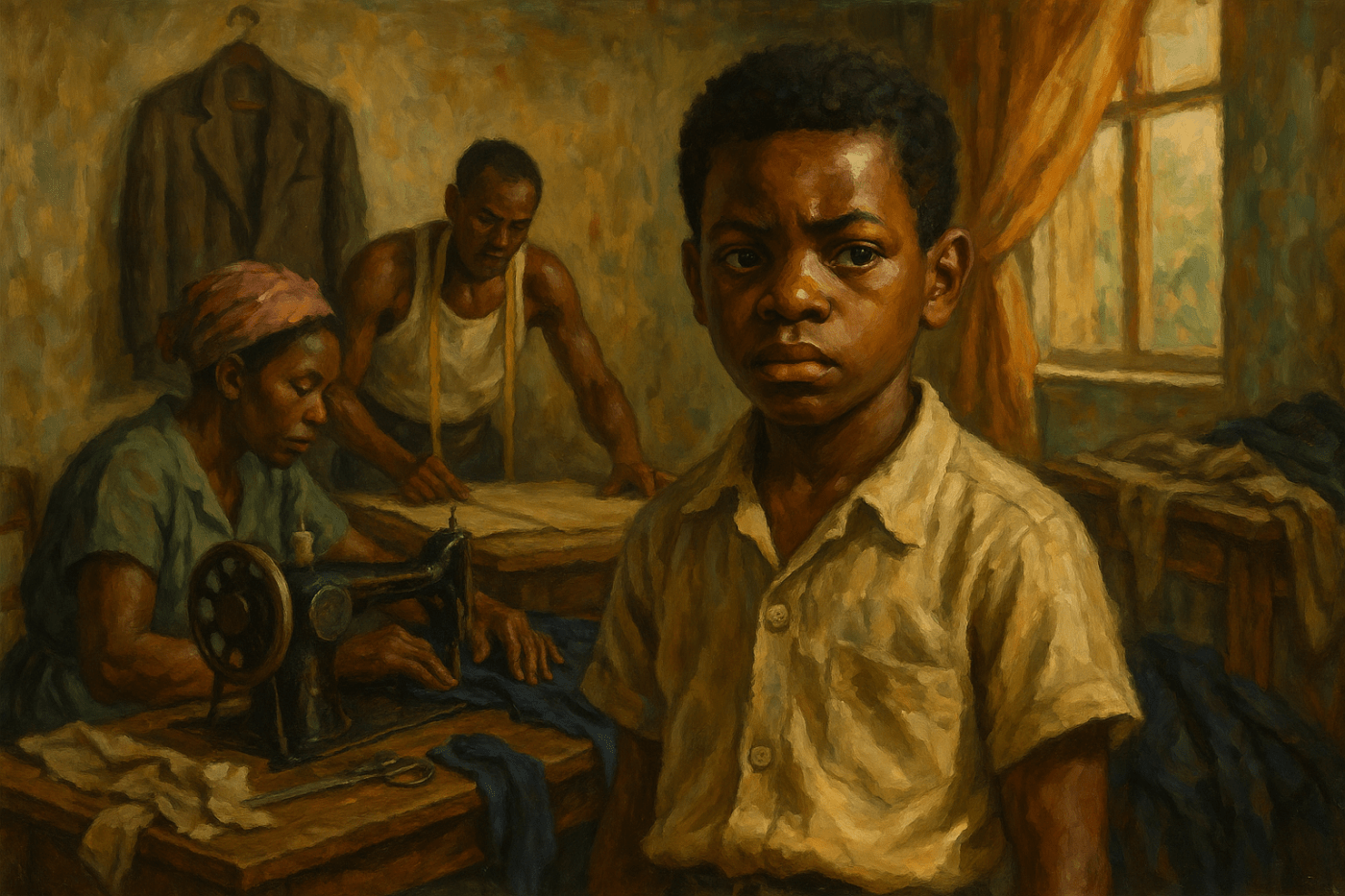
Walter Rodney didn’t come from Harvard. He came from Bent Street—Guyana. From the home of a self-employed tailor and a seamstress. And in that small, overworked, underpaid household, something dangerous was already taking shape. Not the child of privilege, but a boy learning early that the world was stitched against him.
In the first chapter of Walter Rodney Speaks, we don’t meet a celebrity scholar—we meet a young Black boy in a colonial prison dressed up as a nation. A colony so proud of its Queen’s College that it forgot its children were still being groomed to serve Empire, not free themselves from it. Rodney saw that early. He understood that even as his parents ran their own small business, they didn’t own anything. They worked all day, and what they had—like most working people—was the illusion of independence. The landlord still came. The state still ruled. The market still punished.
Marxists in Europe call this the petty bourgeoisie. But Rodney is already warning us: don’t get trapped in Euro-terminology. You want to understand the Caribbean working class? You need to understand that “class” in a colony doesn’t look like Manchester in 1848. It looks like a tailor who runs his own shop but still can’t eat without selling his hands. It looks like a seamstress who works three jobs just to keep the lights on.
The schools Rodney attended were hailed as stepping-stones to greatness. But whose greatness? Certainly not Guyana’s. Education, he says, wasn’t liberation—it was an escape route. Your parents worked themselves ragged so you could get your degree and leave. Become a doctor in Toronto. A lawyer in London. A servant of empire with better pay and a British accent. You want to know what neocolonialism looks like? It’s a graduation cap.
But Rodney also saw something deeper—a tension that shaped him. On the one side, Africans in Guyana were taught to see Indo-Guyanese as competitors, even enemies. But at the same time, they were told to be more like them. Study harder. Save more. Work longer. The colonizer didn’t just divide—they policed ambition. They weaponized poverty. And still, people held on to this idea that if you just studied hard enough, if you just behaved, you’d make it. Make it where, though? Into whiteness?
Rodney compares the Caribbean, African, and Black American student. Caribbean and African students often pushed harder—but not out of revolutionary fire. They still believed in the system. Black Americans, on the other hand, were already suspicious of the whole setup. They saw it was a rigged game—but too often lacked the structure and support to build something better. One group believed too much. The other didn’t believe enough. Neither had what Rodney was starting to build: a scientific understanding of their condition and a revolutionary plan to change it.
By the time he’s eleven, Rodney is handing out pamphlets for the People’s Progressive Party and learning more about class than most Ph.D.s. He’s chased from the houses of the rich. He’s told he doesn’t belong. He starts to see who the police protect and who the churches curse. And even though he hasn’t read Marx yet, he’s already lived him.
What this chapter reminds us is that Rodney’s politics didn’t start in a classroom—they started in the streets. They weren’t imported from Europe—they were born in Guyana’s colonial ghettos. He wasn’t trained to become a revolutionary. He chose to defect from the class he could have joined. And that’s what makes him dangerous.
The first lesson of Walter Rodney’s life is this: if you come from the colonized world and make it into the university, you have two choices. Use your knowledge to escape your people—or use it to arm them. Rodney chose the second. That’s why they killed him. But that’s also why we still listen.
II. From Caribbean Classrooms to the Barricades of Thought: Nationalism Meets the Dialectic
Rodney’s next stop was the University of the West Indies in Jamaica. But don’t confuse it with decolonization. UWI may have been located in the Caribbean, but its foundation was British, its structure imperial, and its ideological function clear: produce a polite Black elite to administer the plantation after the Union Jack was lowered. And yet—cracks were forming.
Rodney arrives in the early 1960s, just as the first wave of “West Indian nationalism” is peaking. Professors are starting to teach Caribbean history. Students are rediscovering Toussaint Louverture and the Morant Bay Rebellion. The nationalist pilgrimage has begun, but no one yet knows where it leads. Rodney is a top student. But he’s not satisfied with top marks. He wants something deeper: he wants to understand his people’s condition—and how to end it.
He encounters two names that blow open the colonial syllabus: Eric Williams and C.L.R. James. Williams’s Capitalism and Slavery reveals how the transatlantic slave trade wasn’t a moral failing—it was a business plan. And James’s Black Jacobins does something even more subversive: it puts African people at the center of revolutionary history, not as victims, but as strategists, thinkers, and actors. This wasn’t Black pride. This was Black power rooted in historical materialism.
Rodney drinks deeply from these wells, but he doesn’t stop there. He asks questions his professors can’t answer. Why did the slave system collapse then? Why didn’t Haiti’s revolution spread? What happened to Africa after colonization? And why do our leaders today still act like colonial governors? These aren’t the questions of a student looking for a job. These are the questions of a revolutionary looking for a theory.
He’s starting to see what the university tries to hide: that nationalism without socialism is just neocolonialism with flags. That Blackness alone isn’t power unless it’s tied to the people. That you can teach history in a classroom or you can use it to make revolution—but not both. Rodney begins leaning toward the second.
His experiences beyond the campus sharpen this trajectory. He travels to the Soviet Union and sees working-class people flying on jets, reading books in the street, and going to the ballet—not as elite consumers, but as citizens. Then he visits Cuba in the early years of its revolution and sees what happens when the people stop asking for justice and start taking it. Cuba doesn’t just impress Rodney—it ignites him. He sees that socialism is not a European abstraction. It’s a living, breathing project unfolding just 90 miles from the Caribbean elites pretending it doesn’t exist.
But back at UWI, Rodney runs into the wall: the liberal professoriate. He recounts an exchange with one academic who scoffs at his use of the term “revolutionary intellectual” to describe Lenin. The professor says: You can be a thinker or a doer—but not both. Rodney is stunned. And sharpened. That one smug dismissal reveals the whole rotten truth of the colonial university: it doesn’t want intellectuals who fight. It wants intellectuals who explain—preferably in Queen’s English, with footnotes, behind a desk.
Rodney doesn’t swallow the insult. He stores it like a weapon. Because this is where he begins to realize that a people’s history requires a people’s scholar. Not an expert who studies the poor, but a comrade who struggles with them. And not from above, but from among. What Rodney begins here—and will later perfect—is a fusion that terrifies the ruling class: a scholar who refuses to stay in the classroom, a revolutionary who knows how to read archives, and a teacher who listens before he speaks.
This is not the story of a student learning about the world. It’s the story of a defector discovering where he stands. Rodney isn’t becoming radical for career points. He’s crossing a line, and he knows it. From here on out, there’s no going back.
III. London Was the Furnace: Class Struggle in the Belly of the Beast
When Walter Rodney lands in London in the mid-1960s to begin his doctoral research at the School of Oriental and African Studies (SOAS), he’s not entering a temple of higher learning. He’s entering the control tower of Empire—where the colonial administrators were trained, where African studies was born not to liberate the continent but to manage its exploitation. But Rodney doesn’t arrive starry-eyed. He arrives armed with questions, and leaves with a political weapon.
Let’s not romanticize it. SOAS was no radical incubator. It was the intellectual wing of British colonialism. It taught about “tribes” and “traditions” and “transitions to modernity”—never about class, extraction, or resistance. Rodney enters this world as an outsider twice over: Black and colonized. His degree from the University of the West Indies isn’t respected. His accent marks him as foreign. He’s told—implicitly and explicitly—that he should be grateful to be there. But gratitude isn’t what Rodney brings. He brings analysis. He brings defiance. And most dangerously, he brings purpose.
Rodney plays the game—strategically. He excels in the library, he dominates the seminars, he meets their academic standards not to seek approval, but to destroy the foundations from within. He’s not there to be validated. He’s there to excavate the real history of Africa—one rooted in production, labor, empire, and resistance. The result will become his first major work, A History of the Upper Guinea Coast, a direct challenge to the sanitized narratives of European scholarship. But that’s just the theoretical side.
Rodney’s real education isn’t happening in SOAS. It’s happening in Brixton. In Lewisham. In the boarding houses of migrant workers, in the living rooms of nannies, tailors, cooks, and railway men from the Caribbean. These aren’t just neighbors—they are comrades in formation. Rodney doesn’t live in a university bubble. He rents with working-class people. He eats with them. He listens. He learns. He organizes.
At Hyde Park, he becomes a public educator in the most literal sense—speaking from makeshift platforms to anyone willing to listen. And plenty do. He doesn’t deliver academic lectures. He connects history to housing, slavery to racism, underdevelopment to unemployment. He’s not out to impress the British left. He’s out to help his people understand the system that’s killing them.
This is also the period where Rodney begins reading Marxism seriously—not as a set of sacred texts, but as a living method. He sees the relevance of class struggle, not just in theory, but in the everyday lives of the West Indian migrants hustling to survive in a hostile metropolis. He’s especially drawn to China—not as a model to imitate wholesale, but as a nonwhite nation organizing its peasants and workers into revolution. He sees Maoism not as a fashion trend, but as a pathway toward people’s power from below.
The contradictions pile up. He’s doing doctoral research in an elite institution while living like the very people he’s studying. He’s navigating the cold, racist social structures of Britain while searching for warmth in the solidarity of the working class. He’s developing revolutionary clarity while the state watches, worried, as another brilliant young Black mind refuses to become a loyal servant of Queen and scholarship.
And let’s be clear: Rodney could have played it safe. He could have climbed the academic ladder, published quietly, gotten tenure somewhere far from struggle. But that’s not what he was built for. His experience in England deepens his commitment. He sees the empire from the inside and becomes even more determined to dismantle it.
London wasn’t his exile. It was his furnace. It didn’t break him. It sharpened him. By the time he leaves, Rodney isn’t just a historian. He’s a revolutionary intellectual, forged in theory and tempered in class struggle.
IV. Africa Is a Battlefield, Not a Backdrop: Rodney’s Return and Reckoning
When Walter Rodney returns to Africa, it isn’t as a wide-eyed Pan-Africanist looking to “rediscover his roots.” It’s as a trained Marxist and seasoned organizer coming to wage ideological war. He lands in Tanzania—ground zero for African socialism under Julius Nyerere. But Rodney doesn’t arrive to applaud. He arrives to analyze.
This chapter of Walter Rodney Speaks is full of sharp contrasts. Rodney is deeply inspired by Nyerere’s attempt to chart a non-capitalist path. But he’s also fiercely critical of the class contradictions still operating within Tanzanian society. The universities are still dominated by Eurocentric frameworks. The bureaucracy is thick with elites. And most dangerously, the term “African socialism” is often used to dodge hard questions about class struggle.
Rodney doesn’t romanticize Africa. He doesn’t imagine that being back on the continent will automatically solve the colonial wound. Instead, he shows how the neocolonial virus has mutated: foreign aid as dependency, nationalist leaders as technocrats, the World Bank as the new governor. In other words, flag independence without economic power is just recolonization in Swahili.
It’s in Tanzania that Rodney writes How Europe Underdeveloped Africa—a book that doesn’t just shift debates; it detonates them. He flips the script entirely. Africa is not “underdeveloped” because it failed to modernize. It was actively underdeveloped—robbed, drained, and stunted—by European colonialism. Capital didn’t bring civilization to Africa. It brought extraction, slavery, and structural impoverishment. This isn’t just a historical point. It’s a call to arms.
Rodney didn’t write this for accolades. He wrote it because the liberation movements were getting confused. Too many nationalists believed that once they took state power, the struggle was over. Rodney insists that’s when it begins. He sees clearly that the African petty bourgeoisie—new ministers, professors, diplomats—is positioning itself to replace white rulers, not dismantle the system. The comprador class isn’t a theory to Rodney. He’s watching it rise all around him.
And he doesn’t stand on the sidelines. He teaches at the University of Dar es Salaam but throws himself into study groups with workers, peasants, and students. He’s trying to bridge the massive chasm between theory and practice, between intellectuals and the masses. He doesn’t want to explain the world. He wants to change it—and he knows he can’t do that from the faculty lounge.
Rodney becomes one of the few who can read Marx and apply him to Kilimanjaro. He doesn’t mimic Europe’s revolutions—he reconstructs the method, rooted in Africa’s real conditions. He asks: What are the class forces at work here? Who are the agents of change? What does socialism mean in a country where the majority are peasants and the urban elite serve imperial capital in African dress?
The Tanzanian state grows uneasy. Rodney is becoming too popular. Too sharp. Too dangerous. Not because he opposes Nyerere—but because he takes Nyerere’s socialist project more seriously than many in government do. Rodney sees that you can’t have socialism without the masses, and you can’t serve the masses if your loyalty is to donors and developmentalist fantasies.
By the end of this chapter, it’s clear that Rodney’s Pan-Africanism isn’t about emotional reunions or symbolic unity. It’s about class struggle across borders. It’s about decolonizing not just the flag, but the economy, the university, and the imagination. Rodney wasn’t searching for roots. He was preparing for revolution.
V. The Groundings Were a Weapon: Revolution in the Rasta Yards
In 1968, Walter Rodney returned to Jamaica not as a tourist or tenured professor, but as a revolutionary intellectual with a mission. He came back not to reform the system, but to root out its foundations. This chapter of Walter Rodney Speaks recounts one of the most dangerous and inspiring periods of his life—when theory met struggle in the burning heart of Kingston’s urban ghettos.
Rodney had been offered a teaching post at the University of the West Indies, Mona Campus. But he didn’t confine his knowledge to elite lecture halls. Instead, he grounded. That meant going into the Rastafari communities, the garrisons, the poor people’s neighborhoods that most professors feared—and listening first. Learning. Teaching. Connecting. Challenging. Not as a savior, but as a comrade.
The “Groundings” weren’t casual dialogues. They were weapons of liberation. They were classrooms without walls, where the oppressed could decolonize their consciousness, confront their history, and reclaim their agency. Rodney didn’t “bring” Marxism to the people. He revealed what they already knew through their lived experience. He gave them the language to sharpen their struggle.
What made Rodney so dangerous wasn’t just what he taught—it was who he taught. He elevated the political consciousness of the Rastafari movement, which had long been criminalized, ridiculed, and repressed. He didn’t dismiss their worldview. He engaged it critically, respectfully, dialectically. He found the revolutionary kernel inside their resistance to Babylon, and helped clarify the enemy: not white people as individuals, but the imperialist system that exploits and controls through class and race.
Rodney taught Caribbean history not as nostalgia, but as fuel. He linked slavery to wage labor. He exposed how the neocolonial elites were Black in skin but white in practice—servants of foreign capital, IMF dictates, and comprador business interests. He drew clear lines: if you serve the system, you are an enemy of the people, regardless of your color. If you betray the poor, your suit and degree don’t protect you from revolutionary critique.
Unsurprisingly, the state moved fast. Prime Minister Hugh Shearer, a loyal functionary of the Jamaican bourgeoisie and its imperial backers, banned Rodney from re-entering the country after a trip to a Black Writers’ Conference in Canada. The excuse? Rodney was a threat to national security. The truth? Rodney was waking up the people.
The response was immediate and historic. Thousands of students and workers erupted in protest, sparking what would become known as the Rodney Riots. The uprising shook the neocolonial order to its core. For the first time in Jamaica’s post-independence history, the state saw a glimmer of what a politically conscious mass movement could look like.
Rodney’s deportation exposed the lie of Jamaican democracy. It proved what he’d been saying all along: that the so-called “independent” Caribbean nations were still under the boot of capital, policed by a comprador elite that feared its own people. The universities trained future technocrats, not revolutionaries. The press served the state. And when someone dared to educate the masses in the science of liberation, they were exiled.
What the chapter makes clear is this: Rodney didn’t lose Jamaica. Jamaica lost Rodney. Or rather, the ruling class did. But the poor remembered. His name became legend, his teachings spread underground, and his exile only magnified his impact.
Rodney’s groundings weren’t just educational encounters. They were acts of rebellion. He broke the social contract that demanded intellectuals serve power. Instead, he armed the people with analysis. He exposed the system’s contradictions and called it by its true name: neocolonialism.
This was Rodney at his most dangerous—because he was no longer just critiquing. He was organizing. And when an organizer with theory connects with the oppressed, the ruling class starts to panic. That’s exactly what happened in Jamaica. And it wouldn’t be the last time.
VI. He Wasn’t Killed for Talking—He Was Killed for Teaching
Rodney’s final years, as recounted in the last chapter of Walter Rodney Speaks, are not a slow descent into martyrdom—they are a fierce sprint toward revolutionary fulfillment. After being banned from Jamaica for grounding with the poor, he returns to his homeland of Guyana with sharper clarity, deeper commitment, and the hard-earned knowledge that revolution is not an academic concept—it’s a confrontation with death.
Rodney doesn’t come home looking for peace. He comes home to organize. He sees that post-independence Guyana is a tragic mirror of the rest of the Caribbean: Black and Brown faces in high places serving white capital and foreign banks. The promise of independence has curdled into dictatorship. Forbes Burnham’s regime, cloaked in socialist rhetoric, has become an instrument of repression. Rodney sees through the façade and begins building the most dangerous thing a neocolonial state can imagine: a multiracial, working-class political party rooted in mass struggle.
The Working People’s Alliance is not another petty electoral outfit. It’s a revolutionary formation aimed at fusing African and Indian workers, urban poor and rural farmers, women and youth, across the racial lines that colonialism carved and the postcolonial state maintained. Rodney isn’t just fighting Burnham—he’s fighting the legacy of divide and rule. And he’s doing it with clarity, humility, and unshakable faith in the people.
He grounds with sugar workers, speaks at factories, holds street meetings, and refuses to let intellectualism become elitism. His method remains unchanged: teach, listen, struggle. But the stakes have changed. The state is watching. The CIA is watching. The imperialist network that props up compliant regimes across the Global South is watching. And they all know what Rodney represents: a rupture.
On June 13, 1980, Rodney is assassinated by a car bomb—lured into a trap by an army sergeant acting as an informant. The state claimed ignorance. The press looked away. The Western powers stayed silent. But the people knew. Rodney wasn’t killed in a crime of passion. He was executed in a crime of class warfare. Because he refused to betray the people. Because he organized. Because he taught.
This chapter makes clear that Rodney’s murder wasn’t the end of his work—it was its confirmation. He had become too dangerous to the system not because of what he published, but because of who he empowered. His Marxism wasn’t a library indulgence—it was a machete. He cut through the lies of nationalism, the myths of middle-class progress, and the illusions of academic neutrality. He proved that the role of the intellectual is not to explain the world for the ruling class, but to help the oppressed transform it.
And that’s why they killed him.
But here’s the deeper truth: they didn’t kill an individual—they tried to kill a method. Rodney’s legacy is not just in what he said. It’s in how he lived. He showed that the guerrilla intellectual is not a luxury, but a necessity. He proved that revolutionary education is the foundation of liberation. And he reminded us that revolutions are made by people who study, struggle, and dare.
This chapter doesn’t end with closure. It ends with charge. If Rodney’s work remains unfinished, it’s because we haven’t finished it. If the system that killed him is still standing, it means we still have work to do.
Walter Rodney Speaks is not just a historical record. It’s a political weapon. It belongs in the hands of every poor person fighting to breathe under capitalism, every student searching for truth behind the syllabus, and every organizer building bridges across the boundaries colonialism drew in blood.
He wasn’t just killed for talking. He was killed for teaching. So now it’s our turn to teach. And struggle. And avenge him—not with vengeance, but with victory.
Continue the Struggle:
Read the second and final installment of our review series:
“Walter Rodney Speaks”: A Revolutionary Autopsy of the Guerilla Intellectual (Part 2 of 2)
 Weaponized Information
Leave a comment